


Three different events on the same Saturday. Your head chef preps for a 300-person corporate gala while someone else handles the intimate anniversary dinner, and somehow the rental truck needs to be at both venues. Sound familiar?
Last weekend I watched a catering company completely melt down during peak season. The owner was running between three events, fielding panicked calls about missing linens at the wedding while trying to explain to new staff why the corporate buffet needed different service timing. Their veteran event manager had called in sick, and suddenly nobody knew who was supposed to handle wine service at the formal dinner.
Most catering operations live in the owner's head. Veterans know their stuff through repetition. New people learn by watching until they maybe figure it out. This works fine until you book multiple events simultaneously—then everything falls apart fast.
The real challenge isn't running individual events. It's creating a system that handles weddings, corporate launches, and backyard parties using the same core team. Each event demands different approaches, but they share about 60% of the same operational foundation.
Why traditional catering SOPs collapse under pressure
Standard procedures usually exist as random documents scattered everywhere. Prep checklist in the kitchen, setup notes in someone's email, maybe a few templates saved somewhere. They're written for perfect conditions and one event type, never accounting for the chaos of overlapping bookings.
The breakdown happens around 15-20 events monthly. Below that, experienced people hold everything together through effort and memory. Above it, small mistakes snowball into disasters. The salad station runs empty because nobody checked what yesterday's event used up. Rental delivery goes to the wrong venue because two people sent conflicting instructions.
Individual tasks aren't the problem—it's how they connect. Pre-event planning affects execution which determines cleanup requirements. But most companies treat these as separate workflows instead of one system.
Management structure makes it worse. Owner handles sales and VIP clients. Head chef owns kitchen operations. Events manager coordinates logistics. Everyone creates their own processes, rarely documenting handoffs. When someone's out or handling another event, their knowledge vanishes.
Modular SOPs: building blocks instead of custom everything
Think furniture assembly from standardized parts instead of building from scratch each time. Weddings need modules A, B, D, and F. Corporate lunch uses B, C, and E. Private dinner requires A, C, and F. Same components, different combinations.
End chaos with centralized catering management.
Caterngly helps you plan, confirm, and manage every catering event seamlessly.
- Unified event and order management
- Real-time client updates
- Staff and resource scheduling
No credit card required
Break every event into component processes. Core modules for all events include client intake and contract, menu planning and costing, inventory ordering and receiving, equipment and rental coordination, staff scheduling and briefing, food preparation workflow, transportation and load-in, service execution, breakdown and load-out, plus post-event reconciliation.
Create variations based on event characteristics. Plated dinner modules differ from buffet service. Outdoor venues need different equipment checklists than hotel ballrooms. Corporate clients require different communication than wedding couples.
Each module contains trigger conditions, required inputs, step-by-step process, decision points and variations, output requirements, and handoff procedures.
Your "Equipment and Rental Coordination" module might have three versions: Full-service (you provide everything), Venue-provided (coordinate with their inventory), and Hybrid (mix of yours, venue's, and rentals).
A 500-person corporate gala uses Full-service Equipment + Plated Dinner Service + Formal Staff Briefing. Casual backyard wedding combines Hybrid Equipment + Buffet Service + Relaxed Staff Briefing.
RACI matrices that work in real catering operations
RACI sounds like corporate jargon until you're figuring out who ordered wrong linens for Saturday's wedding. In catering, where roles blur constantly, clear ownership prevents expensive mistakes.
Most RACI attempts fail because they're too rigid. Your sous chef might handle food prep Monday through Thursday, but Friday they're running a different event while your prep cook takes charge. Fixed assignments break under operational pressure.
Build RACI around functions, not job titles:
Menu Development & Costing
-
Responsible
Kitchen Lead (whoever's planning that specific event)
-
Accountable
Operations Manager
-
Consulted
Sales (client preferences), Purchasing (pricing)
-
Informed
Service Staff Lead
Day-of Kitchen Operations
-
Responsible
Designated Chef for that event
-
Accountable
Kitchen Lead
-
Consulted
Service Manager (timing)
-
Informed
Operations Manager, Transport Team
"Kitchen Lead" might be your head chef, sous chef, or experienced line cook depending on the day. The function stays constant while people rotate through roles.
Test: can someone who's never worked that event type look at your RACI and understand exactly what they own? If your answer involves explaining context, the matrix needs work.
Pre-event phase: where margins get made or destroyed
Pre-event operations determine most of your profitability. This phase sets food costs, labor allocation, and client expectations. Mess up here and perfect execution won't save margins.
Standard workflow looks linear: sales call → proposal → contract → planning → prep. Real operations bounce between stages constantly. Clients change guest counts after contracts. Venues alter layouts during walkthroughs. Menu items disappear days before events.
Modular pre-event systems handle changes without complete replanning. Initial consultation module captures event vision, budget range, and deal-breakers. This isn't sales—it's operational assessment. Can you profitably deliver what they want? Do you have capacity? Are expectations realistic?
Document red flags immediately. Budget unrealistic for vision, venue limitations not acknowledged, timeline too compressed, requirements beyond capabilities.
Proposal development works better with standardized modeling. If typical weddings run around $73 per person in direct costs, start there and adjust. Include baseline costs for common configurations instead of guessing then adding markup.
Contract and deposit phases lock operational parameters beyond legal protection. Specify not just what you'll provide but how changes work. Include final counts deadline, menu lock date, change fees, cancellation impacts.
Planning coordination connects stakeholders before cooking starts. Your checklist should track tasks and identify dependencies and conflicts. Venue requires 6am access but prep team needs 4 hours starting at 7am? That dependency breaks the timeline. The playbook should flag conflicts automatically.
Event-day execution: planning meets chaos
Event day tests whether modular systems actually function. Something unexpected always happens. Wedding party arrives late. Corporate client adds guests that morning. Venue loading dock is blocked.
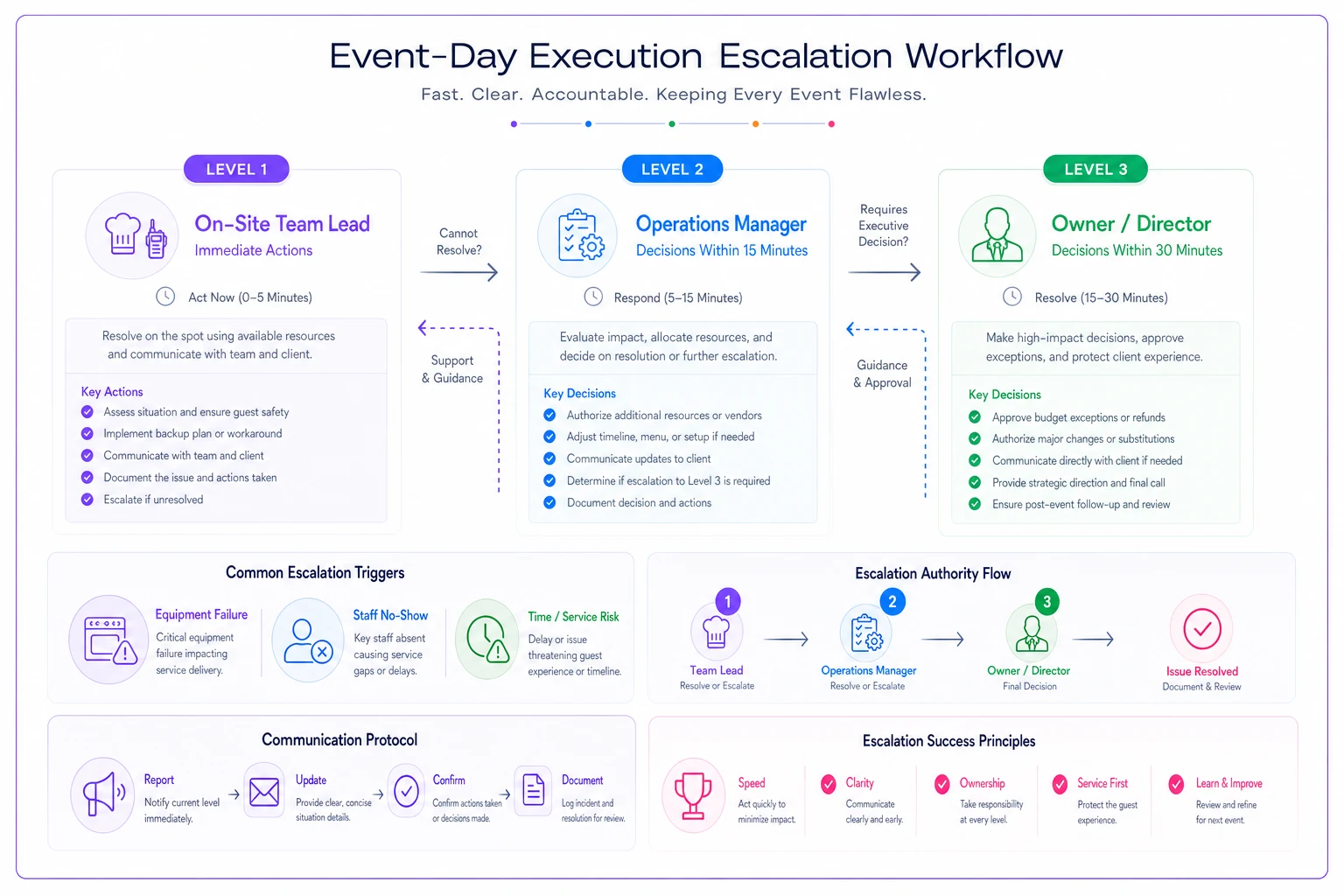
This diagram shows the escalation workflow for event-day decisions.
Your playbook needs escalation paths that don't require finding the owner.
Level 1 authority for on-site team lead covers menu substitutions within cost tier, staff reassignment within event, timeline adjustments up to 30 minutes, and equipment workarounds using available inventory.
Level 2 for operations manager handles menu upgrades affecting margin, pulling staff from other events, major timeline changes, and emergency vendor authorization up to $500.
Level 3 owner decisions include accepting significant cost overruns, canceling or combining events, major client disputes, and emergency authorizations over $500.
Each level needs response times. Level 1 immediate. Level 2 within 15 minutes. Level 3 within 30. No response within window passes authority to next available person.
Include common scenarios with pre-approved responses. Key equipment fails? Service Manager finds alternatives immediately, Operations Manager approves emergency rental in 5 minutes, no rental available means authorizing competitor equipment loan within 15.
Staff no-show gets handled with Team Lead redistributing responsibilities immediately, Operations Manager approving overtime or backup calls within 10 minutes, still short means authorizing agency temp or modifying service style within 20.
Post-event phase: capture knowledge before it vanishes
Most caterers treat post-event as cleanup and invoicing. The operational goldmine—what actually happened versus planned—disappears once everyone leaves.
Immediate debrief happens same day before anyone forgets. Actual versus planned timeline, menu items that ran out or had excess, equipment issues or innovations, staff performance notes, client behavior patterns, venue challenges. Standardized form taking five minutes. Event lead completes during breakdown.
Financial reconciliation within 48 hours compares actual costs to projections. Food cost variance and reasons, labor hours versus plan, equipment reconciliation, additional charges, tips distribution. Patterns emerge fast. Seafood stations consistently over-run 20%. Saturday weddings always need extra breakdown hour.
Client follow-up within 72 hours thanks them, gets feedback, plants future business seeds. Operationally confirm no disputes, damage claims, satisfaction with changes, future interest.
Knowledge integration happens weekly by reviewing all post-event reports and updating playbooks. Three events reported same venue challenge? Add to venue profile. New menu item consistently impressed? Incorporate into standards.
Wedding blueprint: emotion meets logistics
Weddings carry emotional weight corporate events don't. Couple, families, wedding party all have opinions and anxieties. Handle human elements while maintaining operational discipline.
Pre-event modifications include family dynamics assessment in consultation, tasting requirement in proposal, multiple planning meetings versus one for corporate, and day-of coordinator designation.
Common wedding configuration flows through cocktail hour in separate space, transition management moving people efficiently, plated or buffet dinner, cake service often from outside vendors, late-night snack options, and more complex bar service than corporate events.
Critical wedding decisions cover vendor meals for photographer and band, family dietary restrictions often discovered day-of, timeline flexibility for late ceremonies and long speeches, alcohol monitoring since emotional celebrations create overservice risk.
Wedding escalation triggers include family disputes affecting service, weather forcing venue changes, wedding party menu changes, bar consumption exceeding projections by 30%, and timeline delays over 45 minutes.
Typical wedding RACI for ceremony-to-reception transition:
| RACI Role | Assigned |
|---|---|
| Responsible | Service Manager |
| Accountable | Event Captain |
| Consulted | Venue Coordinator, DJ/Band |
| Informed | Kitchen Lead, Bar Manager |
This transition determines the evening's flow. Miss it and everything runs late.
Corporate blueprint: precision over personality
Corporate events optimize for efficiency, professionalism, precise timing over personalization. Decision-makers often aren't attendees, complicating communication.
Pre-event modifications include detailed AV and presentation requirements, multiple stakeholder approvals, strict invoice and documentation needs, plus brand guidelines affecting presentation.
Common corporate configuration includes continental breakfast or buffet, morning break service, lunch buffet or boxed, afternoon break service, possible reception or dinner, and cleanup during sessions.
Corporate operational needs require quiet service during presentations, flexible timing for agenda changes, dietary labels and allergen management, professional appearance standards, and quick room flips between sessions.
Corporate escalation triggers involve sessions running over 20+ minutes, unexpected attendee increases, executive dietary requirements, AV conflicts with food service, and invoice disputes or PO issues.
Corporate RACI for lunch during conference:
-
Responsible
Banquet Captain
-
Accountable
Account Manager
-
Consulted
Corporate Contact, AV Team
-
Informed
Kitchen, Operations Manager
Account Manager owns client relationship, Banquet Captain executes. Sessions run long? Captain can delay 15 minutes, Account Manager decides longer holds.
Private party blueprint: flexible structure
Private parties blend wedding personality with corporate simplicity. Hosts want special touches without wedding complexity or corporate formality.
Pre-event modifications involve single decision-maker usually, shorter planning cycles, menu flexibility, and casual service options.
Common private configuration flows through cocktail and appetizer service, buffet or family-style dinner, dessert service, simple bar setup, and minimal décor or rentals.
Private party considerations include home venue challenges like kitchen limits and parking issues, guest list uncertainty with unreliable RSVPs, service style flexibility, host involvement in service, and equipment transport to residential locations.
Private escalation triggers cover home utilities insufficient for equipment, significant guest count variance, neighbor complaints for outdoor events, casual service change requests, and parking or access problems.
Private RACI for backyard setup and service:
-
Responsible
Team Lead
-
Accountable
Operations Manager
-
Consulted
Host
-
Informed
Kitchen
Simpler structure but Team Lead needs more decision authority working alone or with minimal staff.
Technology integration: from paper chaos to connected systems
Spreadsheets and printed checklists work until about 40 events monthly. Beyond that, human coordination breaks. Information gets scattered everywhere, updates don't reach everyone, people work from outdated versions.
AI-powered operational software transforms static playbooks into dynamic systems. Book a 200-person wedding at country club? Platform automatically assembles relevant modules, adjusts staffing calculations, creates role-specific task lists.
Assign role-specific task lists in the platform so new staff can follow steps without asking.
Real improvement comes from connection visibility. Sales changes guest count, kitchen prep lists update automatically. Purchasing notes price increase, proposals reflect new costs immediately. Equipment issue logged at venue, future events include workarounds.
AI automation handles routine coordination eating hours daily by matching staff availability to event needs, calculating quantities from guest counts and consumption history, flagging conflicts between overlapping events, suggesting menu items based on inventory and prep capacity, and creating role-customized briefing documents.
This isn't replacing judgment—it's freeing experienced staff from administrative tasks for quality and client relationships. Your sous chef shouldn't spend mornings creating prep lists. Operations manager shouldn't manually check venue requirements for each booking.
Platform becomes institutional memory. Every event feeds data back. Actual costs refine estimates. Service notes improve modules. Client preferences get remembered. New staff execute unfamiliar events because the system guides each step.
Measuring playbook effectiveness
Playbooks only work if people use them and they improve operations. Track adoption and impact through adoption metrics like module usage rate by event type, escalation path activation frequency, RACI reference during events, and post-event documentation completion.
Modules not being used? Too complex or don't match reality. Low escalation usage might mean unclear triggers or authority hesitation.
Operational impact shows up in timeline variance between planned versus actual, cost variance by module, rework frequency fixing mistakes, staff overtime reduction, and client complaint patterns. Look for trends. Kitchen modules consistently over time? Need adjustment. Certain venues always trigger escalations? Base process has gaps.
Financial results include per-event margin improvement, labor efficiency measured as revenue per labor hour, waste reduction, equipment utilization, and rebooking rates.
Best indicator: can you vacation without constant phone calls? Functioning playbook means your team executes without micromanaging every decision.
Common implementation failures
Building playbooks is maybe 20% of the work. Getting people to actually use them consistently is where most attempts die. Companies spend months creating detailed procedures that gather dust because they didn't address adoption barriers.
First failure involves overcomplicating modules. You write procedures assuming perfect conditions and include every possible scenario. Result? Nobody wants to follow 47 steps for basic setup. Start simple, add complexity gradually.
Second failure means not involving the people who'll use them. Your head chef might create amazing kitchen modules, but if servers can't understand handoff requirements, coordination breaks. Include frontline staff in development.
Third involves treating implementation like a one-time event instead of ongoing process. Roll out gradually. Start with one event type, get feedback, adjust, then expand. Don't try changing everything simultaneously.
Fourth failure has no enforcement mechanism. If using the playbook is optional, it becomes ignored when pressure builds. Make module completion required for event approval. Include adherence in performance reviews.
Fifth ignores technology adoption barriers. Your staff might be comfortable with basic software but struggle with complex platforms. Choose tools matching their current skill levels, not your ideal future state.
The companies that succeed start small, involve users in design, and enforce usage consistently. They also accept that initial versions will be imperfect and plan for continuous improvement rather than launching comprehensive systems immediately.
Ready to elevate your catering business?
Join 500+ caterers trusting Caterngly to save time, reduce errors, and deliver flawless events.