

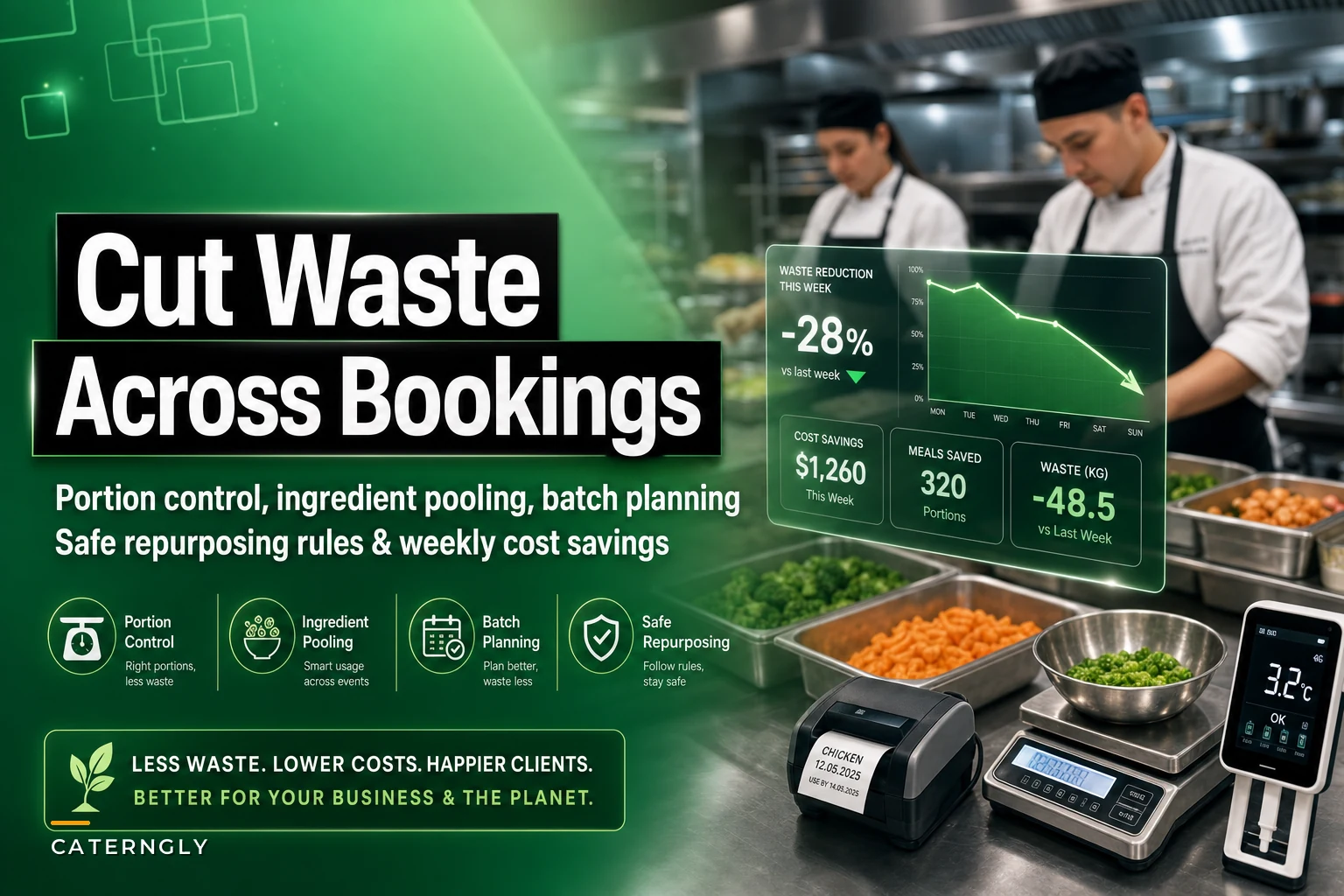

That sinking feeling when you're dumping perfectly good prime rib into the trash at 11 PM after a wedding, knowing you have another event at noon tomorrow? Most caterers lose $800-1,200 per week just throwing away food that could safely feed the next event.
The problem isn't making too much food. It's not having a system to move ingredients between events without risking food safety violations or disappointing clients who expect fresh preparations.
Why traditional batch cooking fails for consecutive events
Standard catering wisdom says cook each event separately. Keep everything isolated. Never mix preparations between clients. This approach protects you legally but destroys your margins when you're running events on consecutive days.
The average catering operation running back-to-back weekend events throws away 35-40% of prepped ingredients between events. Not just cooked food—prepped vegetables, portioned proteins, mixed sauces, and garnishes that took hours of labor to prepare.
Here's what happens: You prep 50 pounds of vegetables for Saturday's 200-person wedding. The event uses 32 pounds. You can't legally serve those remaining 18 pounds at Sunday's corporate brunch because you don't have documentation showing safe storage temps, handling procedures, or allergen tracking between events. So you toss them.
The labor alone on that wasted prep runs about $120. The ingredient cost adds another $180. Multiply that across proteins, starches, and sauces for a typical weekend, and you're burning $1,100 in direct costs. Add the opportunity cost of what you could have sold those ingredients for, and the real number climbs toward $1,800 per weekend.
Breaking down portion control beyond basic counting
Portion control in back-to-back catering isn't about smaller servings. It's about engineering your prep quantities to create intentional surplus that flows safely into the next event.
End chaos with centralized catering management.
Caterngly helps you plan, confirm, and manage every catering event seamlessly.
- Unified event and order management
- Real-time client updates
- Staff and resource scheduling
No credit card required
Start with proteins. Instead of prepping exact quantities plus 10% buffer for each event, you prep in standardized batch sizes that align across multiple events. If Saturday needs 47 portions of chicken and Sunday needs 38, you don't prep 52 and 42 separately. You prep 90 portions in one batch with documented HACCP controls, then allocate them across both events with a 5-portion buffer.
Actual consumption rate vs. guaranteed headcount. Corporate events consume about 0.78 portions per guaranteed guest. Weddings hit 0.91 portions. Family reunions push 1.1 portions. These aren't random—they're predictable patterns based on event type, time of day, and season.
Component overlap between menus. Your Saturday wedding wants herb-roasted chicken. Sunday's brunch needs chicken for their breakfast burritos. Same base protein, different final preparation. The chicken can move between events if you structure your prep correctly.
Degradation timelines by ingredient type. Blanched vegetables hold for 72 hours. Seared proteins last 48 hours. Raw prepped vegetables give you 36 hours. These windows determine which ingredients can actually flow between back-to-back events.
Most catering software tracks none of this. You're either guessing based on experience or maintaining elaborate spreadsheets that nobody updates during the Friday night prep rush.
Cross-event ingredient pooling that actually works
The key to successful ingredient pooling is treating your prep kitchen like a central commissary that serves multiple "restaurants" (your events) rather than isolated prep sessions for individual bookings.
Phase 1: Menu engineering for overlap
Before taking any booking, they analyze menu compatibility with adjacent events. They won't book a Saturday night Indian wedding next to a Sunday morning corporate continental breakfast—zero ingredient overlap means zero pooling opportunity.
Phase 2: Unified prep scheduling
Rather than prepping each event separately, they run unified prep sessions that produce base ingredients for the entire weekend. Wednesday afternoon: all vegetable prep for Friday through Sunday. Thursday morning: all proteins for the weekend. Thursday afternoon: base sauces and marinades.
Phase 3: Dynamic allocation tracking
This is where most attempts at pooling fail. You need real-time visibility into what's allocated where. A shared spreadsheet doesn't cut it when your prep team is pulling ingredients at 5 AM for a breakfast event while another team is loading trucks for a lunch service.
They implemented a simple bin system with color-coded labels showing primary allocation (green for Saturday dinner) and secondary allocation (yellow for potential Sunday lunch use). Every item gets logged in and out with timestamps and temperatures.
Use durable labels with both color and written allocation details so pulls at 5 AM are unambiguous.
Each prep session generates standardized, labeled, dated components that multiple events pull from. Think restaurant prep but across multiple service periods at different locations.
Safe repurposing rules that protect your business
Food safety kills most attempts at cross-event pooling. One temperature violation, one allergic reaction from cross-contamination, and you're facing lawsuits that destroy your business.
The 4-hour/2-hour rule becomes your bible. Food held between 41°F and 135°F for under 2 hours can be re-chilled and used later. Between 2-4 hours, it must be used immediately or discarded. Over 4 hours means automatic disposal. No exceptions.
Create ingredient passports. Every batch of prepped ingredients gets a passport—a simple card that travels with the food showing:
-
Initial prep time and temp
-
Every temperature reading (minimum every 2 hours)
-
Every person who handled it
-
Current allocation status
-
Expiration timestamp
When Saturday's unused chicken breasts move to Sunday's event, the passport comes with them. You have complete documentation if anyone questions safety.
Establish no-cross zones. Some ingredients never move between events:
-
Anything containing common allergens (nuts, shellfish, etc.)
-
Items that touched serving utensils
-
Partially consumed platters
-
Anything that left your temperature control
Build in testing checkpoints. Before any repurposed ingredient goes into Sunday's prep, it gets a quality check: visual inspection, smell test, and temperature verification. Takes 30 seconds per item but prevents embarrassing service failures.
Batch planning strategies for consecutive events
Successful batch planning starts two weeks before your events, not the day before. You're analyzing bookings as a portfolio, not individual events.
Map out your events on a grid showing:
-
Event type and headcount
-
Menu items and quantities
-
Prep requirements and timing
-
Potential pooling opportunities
-
Risk factors (allergens, dietary restrictions)
Then identify your pooling candidates. A typical weekend might show:
-
Saturday wedding (200 guests)
-
- 50 lbs roasted vegetables
-
- 80 portions grilled chicken
-
- 30 lbs garden salad
-
- 15 qts marinara sauce
-
Sunday corporate lunch (75 guests)
-
- 20 lbs roasted vegetables
-
- 30 portions chicken (for Caesar salads)
-
- 15 lbs garden salad
-
- 8 qts marinara (for pasta station)
The overlap is obvious. Instead of prepping 70 lbs of vegetables total, you prep 65 lbs in one batch with 40 allocated to Saturday (expecting 35 lbs consumption) and 25 to Sunday (expecting 18 lbs consumption). The 5-lb buffer covers variance while reducing total prep by 7%.
What most caterers miss: You also need to batch your labor allocation. The same prep cook who portions Saturday's chicken should portion Sunday's. They already have the workflow rhythm, the portioning consistency, and the mise en place established. Switching cooks between batches adds 15-20 minutes of setup/breakdown time.
Real cost analysis: the $67,000 difference
Numbers from a mid-sized catering operation in Phoenix running 350 events annually, with about 60% scheduled as back-to-back bookings.
Before implementing pooling and portion control: vs After 6 months with new systems:
| Metric | Before | After (6 months) |
|---|---|---|
| Weekly food cost | $8,200 | $7,400 |
| Weekly waste | $1,850 (22.5%) | $740 (10%) |
| Weekly labor on redundant prep | $960 | $340 |
| Annual waste-related costs | $146,120 | $79,040 |
The $67,000 annual savings came from:
-
$41,600 in reduced food waste
-
$16,900 in eliminated prep labor
-
$8,500 in reduced disposal/composting fees
The real gain? They could take on 20% more events with the same kitchen staff because they eliminated redundant prep work.
Building your weekend pooling workflow
The exact workflow that makes this system function during the chaos of back-to-back events:
Monday: Portfolio Planning Review all upcoming weekend events. Identify pooling opportunities. Adjust menus with clients if needed to increase overlap. Sometimes telling a client "we can discount 5% if you switch from beef to chicken" makes everyone happy when you already have chicken prepped for another event.
Tuesday: Unified Orders Place combined orders for all weekend events. You're ordering for total needs, not individual events. The savings on bulk ordering alone often hit 8-10%.
Wednesday-Thursday: Batch Prep Run your unified prep sessions. Every item gets logged into the allocation system. Ingredients receive their passports. The temptation here is to prep everything at once, but maintain separation between early-weekend and late-weekend items to maximize freshness.
Friday: Final Allocation Lock in your primary allocations. Move ingredients to event-specific storage areas. Update passports with final destinations. Brief your event teams on what's available for repurposing.
Saturday: Active Monitoring Track actual consumption versus planned. Update secondary allocations based on reality. If the wedding crushed more appetizers than expected, you need to know before Sunday's team counts on those ingredients.
Sunday: Controlled Repurposing Execute your secondary allocations. Verify all safety checkpoints. Document everything. What doesn't get used goes to staff meals or controlled disposal—never to Monday's events unless you have explicit 72-hour protocols.
Visual workflow of weekend pooling:
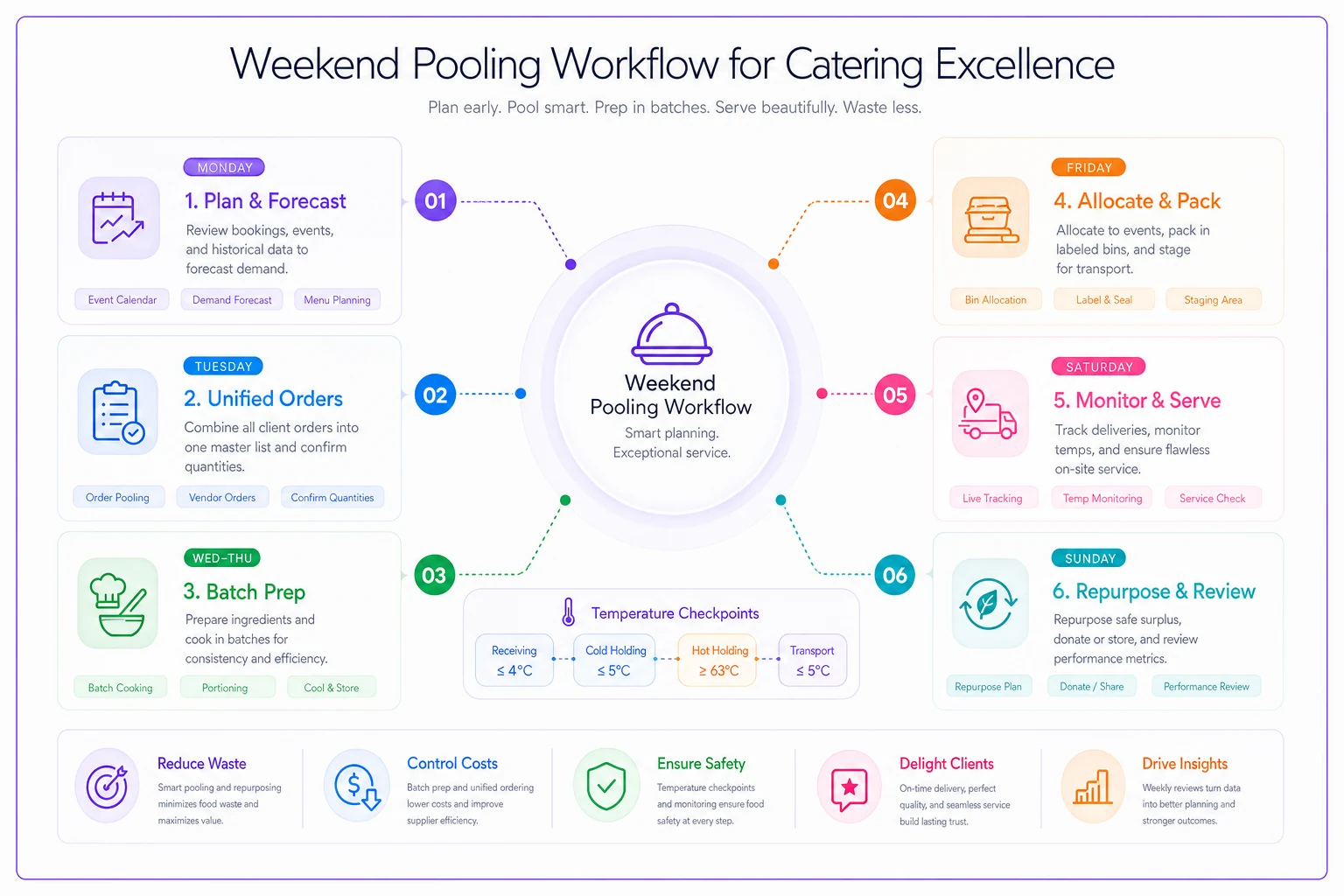
Use this as a training reference during team briefings.
Common failures and how to prevent them
The biggest failure? Communication breakdown between prep and service teams. Your prep team carefully allocates ingredients for pooling, then your service team grabs everything for their event without checking the system. Sunday's team shows up to empty bins.
Fix this with physical controls. Use separate storage areas for primary and pooling inventory. Require sign-offs for any pulls from the pooling area. It feels like bureaucracy until it saves you from buying 30 pounds of chicken at 6 AM Sunday because someone didn't follow the system.
Temperature control failures kill more pooling programs than anything else. One busy Saturday night where nobody logs temperatures, and you're tossing everything for safety. Invest in continuous monitoring systems—$200 in Bluetooth thermometers beats $2,000 in wasted food.
Menu creep destroys your overlap planning. Sales teams love saying yes to custom menu requests, but every unique dish reduces your pooling potential. Create approved menu modules with built-in overlap, and charge premiums for anything outside those modules.
Technology integration for multi-event tracking
Tracking all of this manually works for maybe 2-3 events per weekend. Beyond that, you need systems that automatically monitor your pooling opportunities and safety compliance.
Modern AI-powered operational platforms track ingredient flow across multiple events, automatically calculate pooling opportunities based on your menus, and maintain digital passports for every batch of ingredients. The good ones integrate with your temperature monitoring systems to create unbroken chain-of-custody documentation.
The automation handles the complexity of tracking which ingredients are allocated where, when they expire, and whether they meet safety requirements for repurposing. Instead of checking spreadsheets and paper logs, your team gets clear dashboards showing available inventory for upcoming events.
These systems prevent the costly mistakes that happen when you're running on three hours of sleep trying to remember if those vegetables were prepped Wednesday afternoon or Thursday morning. The system knows, tracks, and alerts before you accidentally serve questionable ingredients.
Making this work in your operation
Start small. Pick one weekend with two similar events and test the pooling workflow. Document everything—what worked, what failed, where the friction points emerged. Most operations need 3-4 test runs before the system feels natural.
Train your entire team, not just management. Your prep cooks need to understand why they're batching differently. Your service teams need to know why they can't grab ingredients without checking allocations. When everyone understands the why, compliance improves dramatically.
Build in buffers everywhere. Never pool 100% of your theoretical surplus. Keep 20-30% as buffer stock for when Saturday's event runs over on portions or Sunday's attendance exceeds guarantees. Better to have slight waste than to run short during service.
Monitor and adjust constantly. Your consumption rates will vary by season, event type, and even weather. That corporate picnic consumes way more beverages on a 95-degree day than your model predicted. Update your standards based on actual data, not theoretical calculations.
The strategic advantage nobody talks about
Beyond cost savings: pricing flexibility that your competitors can't match.
When you're wasting 20% of your food, you have to build that into your pricing. When waste drops to 8%, you can price 10% below competitors and still maintain better margins. In competitive catering markets, that 10% difference wins bids.
You also get schedule flexibility. With pooled prep, you can take last-minute bookings that would normally be impossible. A client calls Thursday needing Saturday lunch for 50? You already have most ingredients prepped for other weekend events. You just need to adjust allocations and add a few specific items.
The efficiency gains compound over time. Staff get faster at batch prep. Your ordering becomes more predictable. Your recipes standardize around poolable ingredients. What starts as waste reduction transforms your entire operation.
The caterers still tossing food between every event? They're working harder, spending more, and wondering how you're winning bids at prices they can't match. Meanwhile, you're turning Saturday's surplus into Sunday's profit, one properly documented ingredient passport at a time.
Running back-to-back events doesn't have to mean doubling your prep work and waste. With proper portion control, strategic pooling, and safety protocols, you can reduce food waste by 50-60% while actually improving your service quality. The $67,000 annual savings is nice, but the operational efficiency gains change how you compete in the market.
The caterers still tossing food between every event? They're working harder, spending more, and wondering how you're winning bids at prices they can't match. Meanwhile, you're turning Saturday's surplus into Sunday's profit, one properly documented ingredient passport at a time.
Ready to elevate your catering business?
Join 500+ caterers trusting Caterngly to save time, reduce errors, and deliver flawless events.