


You watch it happen every wedding season. A catering company finally breaks through, lands their biggest weekend ever — three weddings, two corporate events — and then completely melts down. The Caesar salad arrives without dressing at the country club. The bartender shows up at the wrong venue. The head chef discovers nobody ordered the salmon.
These aren't new caterers. They've been running events for years. They just never built the operational backbone to handle multiple teams working parallel events.
The invisible complexity jump nobody talks about
Running two events simultaneously isn't twice as hard as running one — it's about four times harder. You're not just doubling your staff and supplies. You're creating an entirely new operational layer that didn't exist before.
When you go from sequential to parallel events, everything changes. Your head chef can't personally check every plate anymore. Your operations manager can't float between prep and service. Your owner can't be the emergency backstop for both venues. Every single quality control point that relied on a specific person being present just disappeared.
Most catering businesses try to solve this by hiring more experienced staff. They bring in a seasoned event captain, maybe promote their best server to team lead. Then they wonder why their new captain makes different portion decisions than they would, why the promoted server doesn't catch the missing dessert forks, why quality still varies wildly between simultaneous events.
The problem isn't the people. The problem is trying to scale a system that was never designed to scale.
Stage 1: Building real capacity planning (not just counting bodies)
Capacity planning in catering means something completely different than just counting how many servers you have available. You need to understand your actual operational capacity across multiple dimensions.
End chaos with centralized catering management.
Caterngly helps you plan, confirm, and manage every catering event seamlessly.
- Unified event and order management
- Real-time client updates
- Staff and resource scheduling
No credit card required
Start with your kitchen production limits. A kitchen that can prep 200 plates for a 6pm Saturday event might completely fail trying to prep 400 plates for two 6pm events. It's not just about doubling ingredients — it's about oven space, prep surface area, refrigeration capacity, even how many sheet pans you own.
One catering company discovered their walk-in cooler could hold ingredients for 300 guests max. They'd been booking 400-guest weekends, forcing their team to make multiple supply runs mid-prep. Their food costs were 3% higher just from buying ingredients at retail when their main supplier couldn't fulfill a second order.
Map out your true constraints:
-
Maximum plates your kitchen can prep in a 4-hour window
-
How many events can share your refrigerated truck
-
Which equipment can't be split between venues (warming boxes, coffee urns)
-
How many experienced leads you have (not just total staff)
Sample Capacity Matrix
| Scenario | Kitchen Load | Transport Need | Lead Staff Required | Viable? |
|---|---|---|---|---|
| 1 wedding (150 guests) | 60% | 1 truck | 1 captain, 1 kitchen lead | Yes |
| 2 small corporate (50 each) | 40% | 1 truck, 2 trips | 2 team leads | Yes |
| 2 weddings (150 each) | 120% | 2 trucks | 2 captains, 2 kitchen leads | No - kitchen overflow |
| 1 wedding + 1 corporate | 75% | 2 trucks | 1 captain, 1 experienced lead | Yes |
The matrix reveals combinations you never considered. Maybe you can handle two afternoon corporate events but not two evening weddings. Maybe Sunday brunch events can run parallel because they need less kitchen prep. Sometimes your bottleneck isn't staff at all — it's that you only own 200 champagne flutes.
Stage 2: Site leads who actually lead (not just senior servers with clipboards)
Most catering companies promote their best server to site lead and create an expensive server with a clipboard. They still pour water, still clear plates, still do server tasks — they just also have a walkie-talkie now.
A real site lead runs the event like a conductor runs an orchestra. They're not playing an instrument; they're ensuring everyone else plays in sync. This requires completely different training than most catering companies provide. You're not teaching them to be better servers — you're teaching them to be operations managers.
Pre-event ownership:
-
Reviewing the event order and spotting what's missing
-
Confirming equipment matches the venue layout
-
Running a pre-service briefing that actually prevents problems
-
Checking that backup supplies are loaded (not assuming they are)
Active coordination:
-
Reading the room energy and adjusting service pace
-
Spotting when the kitchen is falling behind before it's critical
-
Making portion adjustments when you're running low
-
Deciding when to skip the champagne toast because dinner's running late
Problem resolution authority:
-
Authorizing a grocery run for missing ingredients
-
Calling in backup staff when someone no-shows
-
Adjusting the menu when equipment fails
-
Dealing with client complaints without calling the owner
Site leads need clear authority boundaries. Can they comp a bottle of wine for a complaint? Authorize overtime? Send someone home who shows up intoxicated? Without clear authority, they'll either make no decisions (calling you for everything) or make decisions you hate (giving away too much).
Give site leads a short, laminated authority card listing their decision limits.
Your site leads become mini-operations managers, not glorified servers. That shift makes the difference between chaos and coordination.
Stage 3: Cross-team protocols that prevent venue chaos
When you're running multiple events, information gaps become quality disasters. The morning prep team makes 150 portions. The evening service team expects 175. Nobody catches the discrepancy until guests are literally standing in the buffet line.
Cross-team protocols aren't about creating more paperwork. They're about ensuring critical information flows between teams that never actually see each other.
The Three-Point Handoff System
-
Sales to Prep
What was actually sold vs. standard menu
-
Prep to Transport
What was actually prepared vs. plan
-
Transport to Service
What actually arrived vs. needed
Most catering companies do none of these formally. The salesperson verbally mentions the vegan option to the chef. The prep team assumes service knows they made extra sauce. The delivery driver doesn't mention that one warming box wouldn't fit in the truck.
Build simple handoff sheets that travel with the event:
Prep Team Handoff (filled at kitchen):
-
Portions prepared
150 chicken, 30 vegan, 20 kids
-
Items modified
Caesar made without anchovies
-
Items missing
Out of fresh dill, used dried
-
Special notes
Extra sauce in blue container
-
Prep lead signature
_
Transport Handoff (filled at loading):
-
Equipment loaded vs. list (check off)
-
Food items temperature checked
-
Items that wouldn't fit
___
-
Estimated arrival time
___
-
Driver signature
_
Here's a visual of the handoff workflow.
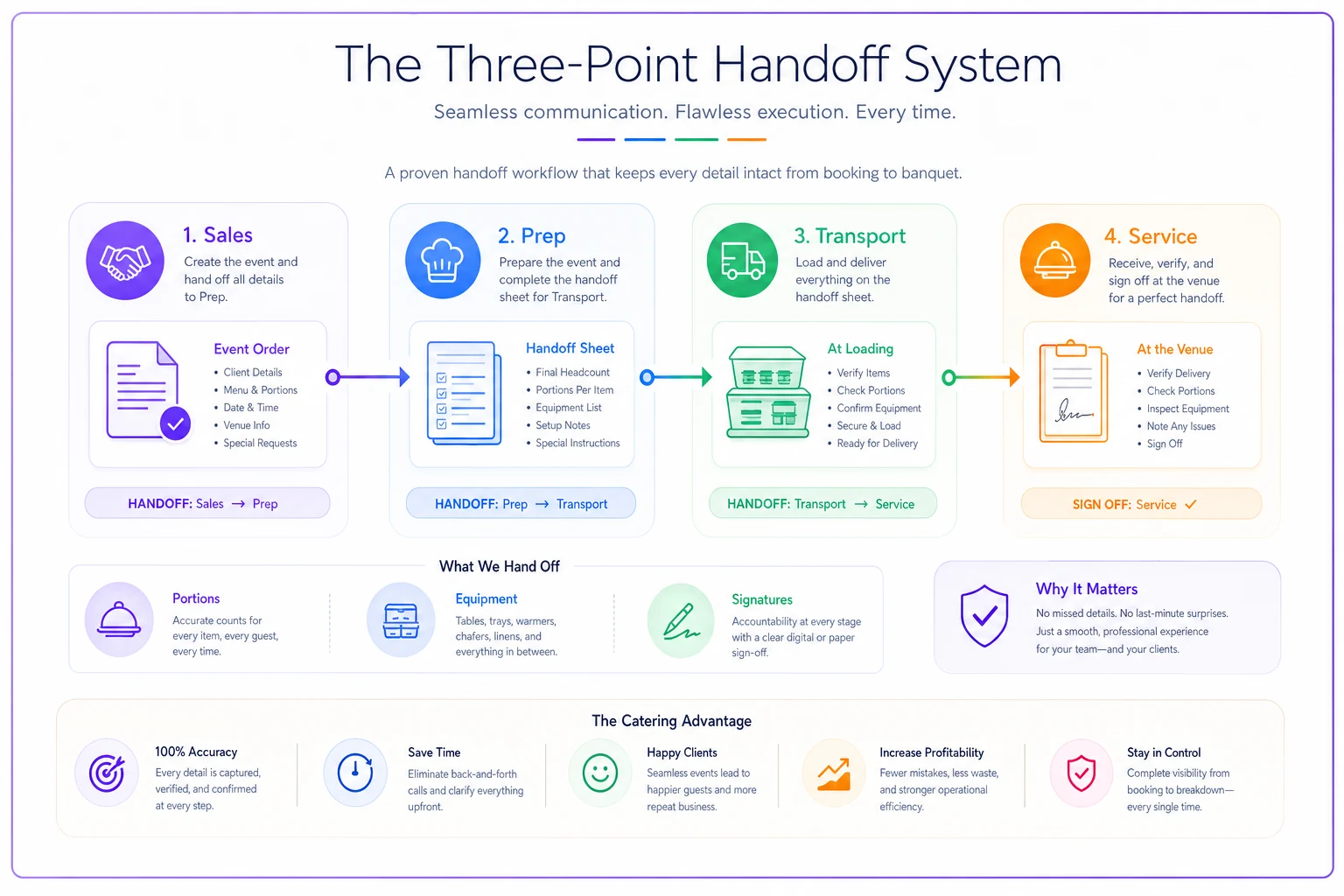
This shows the flow between sales, prep, transport, and service and where handoff sheets are signed.
This prevents the 7pm phone call asking "where's the wedding cake?" because everyone assumed someone else handled it. Information gaps disappear when you force documentation at every transition point.
Stage 4: Conflict resolution before conflicts explode
When you're running multiple events, conflicts don't wait for Monday's team meeting. The prep cook and event captain disagree about portion sizes. Two site leads both claim they were promised the experienced bartender. The client at venue A wants their dessert early, which means the pastry chef can't finish venue B's desserts on time.
Most catering companies handle conflicts through ownership firefighting — the owner's phone rings, they make a quick decision, everyone moves on. This works until the owner is at their daughter's recital.
The Escalation Flow That Actually Works
Level 1: Peer resolution (3-minute rule) Two team members have 3 minutes to find a solution themselves. If they can't agree, it escalates. This forces quick compromise on minor issues.
Level 2: Site lead decision (10-minute rule) The most senior person on-site makes the call within 10 minutes. They document what they decided and why. Even if it's wrong, a decision gets made.
Level 3: Operations manager remote decision (30-minute rule) For bigger issues, the ops manager gets one phone call to understand the situation, then makes the decision. No back-and-forth, no committee discussion.
Level 4: Owner override (next day) Only true emergencies reach the owner during events. Everything else waits for the next business day.
Everyone knows the escalation path before conflicts arise. The prep cook knows that arguing about portions for more than 3 minutes means the site lead decides. The site lead knows they have authority to make that call.
Conflict Resolution Log Example:
-
Date/Event
3/15, Smith Wedding
-
Issue
Guest count increased from 150 to 170 at 4pm
-
Decision
Reduced portion sizes by 15% rather than running out
-
Decided by
Sarah (site lead)
-
Result
No complaints, all guests served
Review these logs weekly. You'll spot patterns — maybe portion conflicts always involve the same prep cook, maybe last-minute guest increases happen with certain salespeople. Fix the pattern, not just the individual conflict.
The staffing matrix that prevents "body shopping"
Most catering companies staff events by counting bodies. "We need 12 servers for the Henderson wedding." Then they grab whoever's available, throw them in black pants, and hope for the best.
This breaks catastrophically when running parallel events. You end up with all your experienced staff at one venue while the other gets the B-team. Or worse, you split your good people and have no experienced core at either event.
Staff Capability Levels:
-
Level A (Autonomous)
Can run their station without supervision, train others, handle complaints
-
Level B (Building)
Solid execution with minimal supervision, learning advanced skills
-
Level C (Coached)
Needs regular check-ins, follows standard procedures, still learning
Minimum Staffing Requirements by Event Type:
-
Small corporate (under 50)
1A, 2B, 1C
-
Standard wedding (100-150)
2A, 4B, 2C
-
Premium wedding (150+)
3A, 5B, 2C
-
Parallel events
Never more than 50% C-level at any single event
This matrix prevents the classic mistake of sending four new servers to an event with one experienced captain. It also reveals when you actually can't staff parallel events — if you only have 3 A-level staff total, you can't run two premium weddings simultaneously, period.
Your capability matrix becomes your booking filter. Can't staff it properly? Don't book it.
Sample escalation flows that keep events moving
Real escalation flows need to be specific enough to be useful but simple enough to remember during chaos:
Missing Item Escalation:
-
Minute 0-5
Server notices missing items, checks with team
-
Minute 5-10
Site lead checks truck, calls kitchen
-
Minute 10-15
Improvise with available items or purchase locally
-
Minute 15+
Inform client and offer compensation
Staff No-Show Escalation:
-
30 minutes before
Call staff, call backup list
-
20 minutes before
Redistribute responsibilities
-
10 minutes before
Site lead fills the role
-
Event start
Adjust service style if needed
Equipment Failure Escalation:
-
Assess
Can event proceed with workaround?
-
If yes
Document workaround, continue event
-
If no
Call operations manager for alternatives
-
Last resort
Rent/buy replacement, document cost
Everyone knows these flows before they need them. Laminate them. Put them in every event binder. Decision paralysis kills events faster than bad decisions.
The parallel events checklist that catches what you miss
Running parallel events requires a different checklist than single events. It's not about checking more boxes — it's about checking different ones.
48 Hours Before Parallel Events:
-
[ ] Equipment assignments documented (no sharing assumptions)
-
[ ] Staff schedules show specific venue assignments
-
[ ] Prep schedule shows staggered production times
-
[ ] Transport routes avoid overlap
-
[ ] Communication leads designated for each venue
-
[ ] Backup supplies allocated to each event
Day of Events - Central Operations:
-
[ ] Morning huddle includes both teams
-
[ ] Prep areas clearly labeled by event
-
[ ] Loading zones assigned by venue
-
[ ] Communication check at 2-hour intervals
-
[ ] Float person designated (not assigned to either event)
-
[ ] Owner/ops manager availability confirmed
Post-Event Consolidation:
-
[ ] Equipment return from both venues tracked
-
[ ] Staff hours recorded by event
-
[ ] Client feedback collected separately
-
[ ] Conflicts/decisions documented
-
[ ] Inventory variances noted
-
[ ] Team debrief scheduled within 48 hours
These checklists prevent the "oh shit" moments at 5:30pm when you realize the champagne glasses all went to venue A.
When operational software becomes essential (not just helpful)
Once you're running parallel events regularly, certain problems become unsolvable with spreadsheets and group texts. You can't track which warming boxes went to which venue. You can't see real-time prep progress for multiple events. You can't coordinate staff assignments when people are at different locations.
Real-time visibility: Every team member sees the same information. When prep finishes the appetizers for the Smith event, service team gets an automatic update. No phone calls, no wondering.
Smart staff scheduling: The system tracks who worked which events, preventing you from accidentally sending the same server to back-to-back 12-hour shifts. It knows Sarah can't work the west-side venue Saturday because she's already at the downtown event.
Equipment tracking: Every warming box, coffee urn, and champagne bucket gets assigned to an event. The system alerts you if someone tries to load equipment needed at venue B onto venue A's truck.
Automatic handoffs: Digital handoff sheets that prep teams fill on tablets, drivers confirm on phones, and service teams receive automatically. No lost paperwork, no missing signatures.
Conflict documentation: When site leads make decisions, they log them in real-time. Patterns become visible — maybe venue B always has equipment issues, maybe Saturday events always run behind schedule.
The difference isn't that software makes you look professional. It prevents the 6pm disasters that destroy your reputation. When your prep team can see that service expects 180 portions but they only have ingredients for 150, they can fix it at 2pm instead of discovering it during plating.
Building your staged roadmap
Most catering companies try to jump straight from single events to full parallel operations. They book three events for one Saturday, throw everyone into the deep end, and wonder why quality crashes.
Stage 1 (Months 1-2): Capacity reality check Run your normal single events but track everything. How long does prep actually take? When does your kitchen hit capacity? Which staff members can really lead? Build your matrices based on actual data, not assumptions.
Stage 2 (Months 3-4): Overlapping events Book events with 2-hour overlaps, not full parallel timing. Maybe a lunch corporate event and an evening wedding. This lets you share some resources while testing your handoff protocols.
Stage 3 (Months 5-6): Same-time, different complexity Run two events simultaneously but make one significantly simpler. A basic corporate lunch plus a full wedding. This tests your parallel operations without overwhelming every system at once.
Stage 4 (Month 7+): Full parallel operations Only now do you run multiple complex events simultaneously. Your teams know the protocols. Your systems are tested. Your escalation paths are proven.
Don't skip stages. Each one reveals problems you didn't anticipate.
The growth trajectory nobody mentions
When catering companies successfully scale to parallel events, their per-event profit margins initially drop by about 15-20%. More coordination overhead, more backup supplies, more experienced staff needed.
Around month four of consistent parallel operations, something interesting happens. The margins come back, then exceed original levels. Why? Because you're utilizing expensive assets better. Your refrigerated truck makes two deliveries per trip. Your prep team stays productive for full shifts instead of having downtime between events. Your experienced staff can mentor newer team members during live events.
The companies that push through the initial margin compression end up with stronger businesses. They're not dependent on the owner being present. They can take last-minute bookings because they have real capacity planning. They can promise consistent quality because they have systems, not just good intentions.
More importantly, they can finally take a weekend off.
The bottom line on scaling catering operations
Most catering businesses never successfully run parallel events because they treat it as a staffing problem instead of a systems problem. They hire more people, buy more equipment, and hope everything works out.
The ones that successfully scale understand it's about building operational infrastructure. Clear capacity planning that shows what's actually possible. Site leads with real authority and training. Cross-team protocols that prevent information gaps. Escalation flows that keep events moving when problems
The ones that successfully scale understand it's about building operational infrastructure. Clear capacity planning that shows what's actually possible. Site leads with real authority and training. Cross-team protocols that prevent information gaps. Escalation flows that keep events moving when problems
Ready to elevate your catering business?
Join 500+ caterers trusting Caterngly to save time, reduce errors, and deliver flawless events.