


Last month, a catering director texted me at 11 PM about a corporate gala that went sideways. Not because of food quality or service issues — those were flawless. The event collapsed because their florist, rental company, and lighting crew all arrived at 2 PM expecting immediate access to the venue's single freight elevator. By the time they sorted out the chaos, setup ran two hours behind, the client was furious, and the caterer ate a $4,800 penalty for delayed service.
Vendor coordination disasters are completely preventable with basic operational planning. Yet most caterers treat vendor management like an afterthought, assuming everyone will magically coordinate themselves on event day.
After analyzing vendor-related failures across hundreds of events, the pattern is obvious. Caterers who run smooth multi-vendor events don't rely on hope or last-minute phone calls. They build actual coordination systems — contact matrices, handoff protocols, and clear accountability chains that eliminate the guesswork.
The hidden complexity of vendor interdependencies
Most caterers underestimate how many moving parts require active coordination. Take a standard 200-person wedding reception. You're managing relationships with:
The venue coordinator who controls access times and loading procedures. The rental company delivering tables, chairs, linens at specific intervals. The florist who needs those tables set before arranging centerpieces. The DJ or band requiring power access before your cocktail hour starts. The photographer who needs specific lighting conditions during dinner service. Sometimes a separate bar service handling beverage logistics.
Each vendor operates on their own timeline, with their own priorities, their own understanding of the event flow. Without central coordination, you get situations where the florist shows up while tables are still being unloaded. Or the band starts sound check during your plated service briefing. Or worse — the rental company tears down chairs while guests are still mingling because "pickup was scheduled for 10 PM."
This fragmentation creates a reliability problem. When vendor A runs late, it cascades through your entire timeline. But vendors rarely communicate delays to each other — they call you, usually when it's too late to adjust. Now you're playing telephone between six different companies while trying to execute service.
Why vendor coordination catering failures happen repeatedly
The core issue isn't vendor incompetence. It's structural. Traditional event planning treats vendor coordination as a series of independent contracts rather than an integrated operation.
End chaos with centralized catering management.
Caterngly helps you plan, confirm, and manage every catering event seamlessly.
- Unified event and order management
- Real-time client updates
- Staff and resource scheduling
No credit card required
Caterers typically book vendors separately, send them individual timelines, maybe share a basic schedule. Then on event day, everyone shows up with slightly different expectations about who does what when. The venue thinks setup starts at noon. Your rental delivery assumes 11:30 AM access. The florist was told "early afternoon." These minor discrepancies spiral into major conflicts when everyone converges on site.
Communication gaps multiply because information flows through multiple channels. The venue emails you about a loading dock closure. You text the rental company. They call their delivery driver. By the time the message reaches the person who actually needs it, critical details are lost or distorted. "Loading dock closed from 2-3 PM for maintenance" becomes "some issue with the dock around 2-ish."
Most caterers try to manage this complexity through group texts or email chains, but these tools aren't built for operational coordination. Important updates get buried in conversation threads. Nobody has a clear view of the current status. When something goes wrong, you're scrolling through 47 messages trying to figure out who confirmed what.
The accountability problem makes everything worse. When the cocktail hour runs late because the bar setup was delayed, who's responsible? The bar service claims they couldn't set up because rentals were late with the tables. Rentals says they were on time but couldn't unload because the florist's van was blocking access. The florist insists they were told to park there by the venue. The venue has no record of that conversation. Meanwhile, your client is asking why guests are standing around with no drinks.
Building your vendor contact sheet (the right way)
Forget those basic vendor lists with just company names and phone numbers. A functional vendor contact sheet needs operational depth that actually helps during crisis moments.
Start with the obvious — company name, primary contact, cell phone, and email. But that's just foundation level. You need the actual day-of contact who'll be on site, not the sales rep who sold you the service. Include their direct cell, their supervisor's number, and the dispatch or emergency line.
Always list the on-site crew's direct cell phone, not the sales rep's number.
Document arrival windows and dependencies. Don't just write "Florist - 2 PM arrival." Specify "Florist - 2:00-2:15 PM arrival, requires tables fully set, needs 90 minutes for centerpiece installation, must complete before 4 PM guest arrival." This clarity eliminates assumptions.
Add operational notes that matter during execution. Does this vendor require special parking permits? Do they need elevator access or can they use stairs? What's their typical unload time? How many crew members usually show up? These details prevent surprises.
Include contractual checkpoints — deposit paid, balance due, cancellation deadlines, overtime triggers. When the rental company claims they're leaving because you've exceeded the contracted time, you need this information immediately accessible.
Track historical performance in your sheet. Has this vendor been late before? Do they typically run over their time estimates? Do they require more hand-holding than others? This institutional knowledge helps you pad schedules appropriately.
Create a communication hierarchy section. Who gets called first when issues arise? If the primary contact doesn't answer, who's next? What's the escalation path for serious problems? Having this pre-documented prevents panic-driven decision making.
Make your contact sheet accessible to everyone who needs it. Your event captain, setup crew, venue coordinator — they all need this information. A contact sheet sitting in your office while you're managing three simultaneous events is worthless.
The decision matrix that prevents loading dock chaos
That loading dock bottleneck I mentioned earlier? Completely preventable with a basic decision matrix that clarifies priorities and sequences.
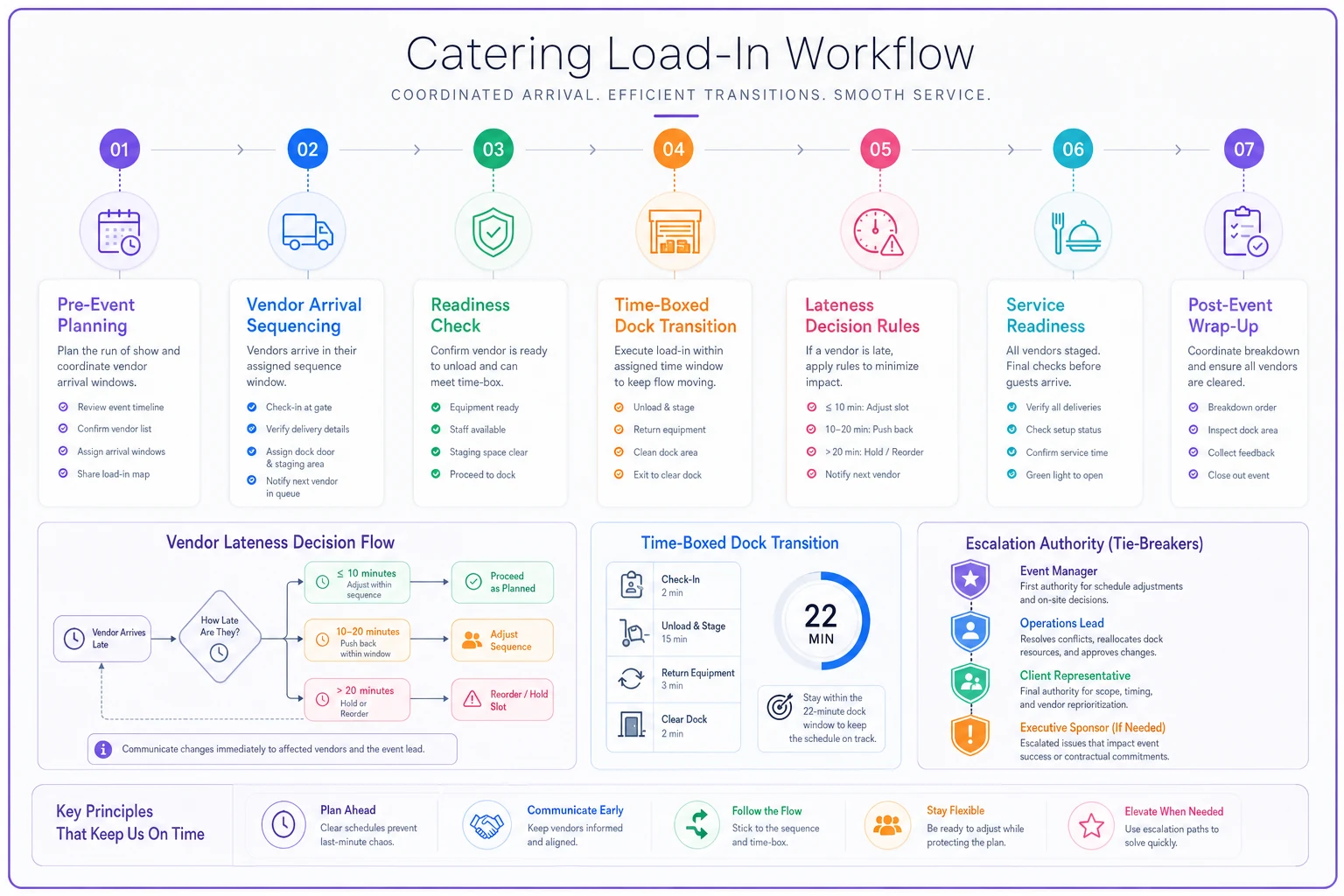
Your matrix starts with arrival sequencing based on setup dependencies. Map out which vendor installations must happen in what order. Tables before linens. Linens before centerpieces. Electrical before lighting. This logical flow becomes your default sequence.
If Vendor A is late:
-
Can Vendor B proceed without them?
-
What specific tasks can advance?
-
What must wait?
-
Who makes the call to adjust?
If multiple vendors arrive simultaneously:
-
Who gets priority access?
-
What's the tiebreaker criteria?
-
Who has authority to decide?
Build contingency columns for space conflicts. When two vendors need the same area, who yields? Usually it's whoever has more flexibility in their setup location, but document these decisions before they're needed.
| Decision Matrix Element | Guidance |
|---|---|
| Arrival sequencing | Map out which vendor installations must happen in what order. Tables before linens. Linens before centerpieces. Electrical before lighting. This logical flow becomes your default sequence. |
| Time-boxing | Time-boxing prevents single vendors from monopolizing resources. If the rental company gets dock access at 2 PM, they have until 2:45 PM regardless of completion status. At 2:45 PM, they move aside for the next vendor. This forces efficiency and maintains flow. |
| Trigger points | Your matrix should include trigger points for timeline adjustments. If any vendor is more than 30 minutes late, what changes? If setup is running 60 minutes behind, what gets cut or compressed? |
Time-boxing prevents single vendors from monopolizing resources. If the rental company gets dock access at 2 PM, they have until 2:45 PM regardless of completion status. At 2:45 PM, they move aside for the next vendor. This forces efficiency and maintains flow.
Your matrix should include trigger points for timeline adjustments. If any vendor is more than 30 minutes late, what changes? If setup is running 60 minutes behind, what gets cut or compressed? These predetermined decisions remove emotional reactions from operational choices.
The decision matrix lives as a simple table, printed and laminated, that your day-of coordinator can reference quickly. No scrolling through documents or calling you for every decision. The answers are pre-determined, visible, and actionable.
A simple visual shows the vendor sequencing and decision triggers.
No scrolling through documents or calling you for every decision. The answers are pre-determined, visible, and actionable.
Day-of liaison role (not just another body on site)
The biggest mistake is treating the vendor liaison role as a passive position — someone who just checks vendors in and points them toward the venue. That's not coordination, that's expensive greeting.
An effective liaison actively manages the vendor ecosystem throughout the event. They own the timeline, make real-time adjustments, and prevent small issues from cascading into disasters.
The role starts two days before the event with final confirmations. Your liaison calls every vendor, verifies arrival times, confirms crew counts, and identifies any last-minute concerns. They're not just checking boxes — they're listening for hesitation, confusion, or conflicting information that suggests problems ahead.
On event day, the liaison arrives before any vendor to establish command position. They verify venue access, check that elevators are operational, confirm loading zones are clear. When vendors arrive, the liaison doesn't just greet them — they manage them.
This means enforcing your arrival sequence even when vendors push back. When the rental company shows up early wanting immediate access, your liaison holds the line: "I understand you're here, but florist has the dock until 2:45. You can stage in the auxiliary lot until then." This requires someone with backbone and clear authority.
The liaison tracks actual versus planned timing throughout setup. If the tent installation runs 20 minutes over, they're already adjusting downstream vendors before delays compound. They're proactively communicating: "Lighting, heads up — tent crew running behind, adjust your arrival to 3:15 instead of 3:00."
During service, the liaison manages vendor movements around your operation. When the photographer wants to reposition lighting during salad course, the liaison makes the call whether that disrupts service flow. When the DJ needs to run cables through your service path, the liaison finds alternatives.
The liaison shields you from vendor noise. Instead of six vendors calling you with questions while you're managing kitchen operations, everything flows through one point of contact who has authority to make decisions. You only hear about true emergencies that require your input.
This isn't an entry-level position. Your liaison needs operational experience, vendor relationships, and enough confidence to manage confrontation. They're running air traffic control for your entire vendor ecosystem — treat the role with appropriate seriousness.
Vendor SLA checklist that actually prevents failures
Service Level Agreements sound corporate, but they're really just documented expectations that prevent the "I thought you were handling that" disasters.
Start with arrival and departure windows that include buffers. Don't just say "arrive at 2 PM." Specify "arrive between 1:45-2:15 PM, setup must complete by 3:30 PM, breakdown begins at 10:00 PM, premises vacated by 11:30 PM." This precision eliminates interpretation.
Document handoff protocols between vendors. When the rental company delivers linens, who checks them? How are damages noted? Who signs off on receipt? When items transfer between vendors (rentals to florist for table draping), who owns liability? These mundane details prevent finger-pointing when something goes wrong.
Your SLA needs specific performance standards. "Professional appearance" means nothing. "Crew in black pants, black shirts, closed-toe shoes" is enforceable. "Timely setup" is vague. "All centerpieces placed within 90 minutes of arrival" is measurable.
Include communication requirements that matter operationally. Vendors must confirm arrival 24 hours prior. Any delays greater than 15 minutes require immediate notification. Setup completion requires check-in with liaison. These checkpoints give you early warning of problems.
Equipment and staffing minimums prevent undersourcing. Specify minimum crew sizes for different event scales. Document required equipment — hand trucks, protective floor covering, cleaning supplies. When a vendor shows up understaffed or underequipped, you have contractual grounds to demand fixes.
Build in financial accountability. Late arrival penalties. Damage deposits. Cleanup bonds. When vendors know money is at stake, their attention to detail improves dramatically. Even if you rarely enforce penalties, their existence changes behavior.
The checklist format matters for usability. Group items by event phase — pre-event, arrival, setup, service, breakdown. Use simple yes/no checkboxes, not lengthy paragraphs. Your liaison should be able to verify compliance quickly without interpretation.
Get vendors to acknowledge your SLA before booking. Not buried in contract fine print — as a separate document they initial. This explicit agreement prevents the "nobody told me" excuse when standards aren't met.
Real consequences of vendor coordination failures
That corporate client whose gala started late? They work in a building with twelve other companies who use catering regularly. One bad vendor coordination experience becomes corridor conversation that costs you untold future bookings.
Your team bears hidden costs from coordination failures. When setup runs behind, your service staff stands around on the clock waiting to begin. Overtime kicks in because breakdown extends past scheduled hours. Your chef holds hot food longer than optimal, affecting quality. These labor and food costs compound quickly.
Vendor relationships deteriorate through repeated coordination failures. The reliable rental company starts declining your bookings because your events are always chaotic. The talented florist finds caterers who respect their time. You're left working with second-tier vendors who perpetuate the dysfunction.
Stress cascades through your entire operation. Your team loses confidence when events consistently feel chaotic. Your best people leave for caterers who run tighter operations. You spend more time recruiting and training replacements than improving your business.
The opportunity cost might be worst of all. Every hour you spend mediating vendor conflicts or apologizing to clients is an hour not spent on sales, menu development, or team building. Vendor coordination failures don't just cost money — they steal your capacity to grow.
Technology that finally makes coordination manageable
Here's where operational software changes the game entirely. Instead of juggling spreadsheets, group texts, and printed checklists, modern platforms centralize your entire vendor coordination workflow.
The best systems integrate vendor management directly into your event timeline. When you adjust service time, every affected vendor gets automatically notified. No more playing telephone or wondering who received which update.
Real-time coordination becomes possible when everyone operates from the same platform. Your liaison sees vendor status updates on their tablet. The venue coordinator knows exactly when each vendor arrives. Your kitchen gets alerts when setup milestones complete. This shared visibility eliminates information gaps.
Automated confirmations reduce your pre-event workload. The system sends confirmation requests two days before events, tracks responses, and alerts you to any vendors who haven't confirmed. No more manual calling unless someone fails to respond.
Digital SLA tracking replaces paper checklists that get lost or ignored. Vendors acknowledge requirements digitally, creating timestamps and audit trails. When someone claims they weren't told about the 2 PM deadline, you have receipts.
Some platforms now incorporate basic AI automation that identifies coordination conflicts before they happen. When you schedule two vendors for overlapping dock access, the system flags the conflict immediately. When historical data shows a vendor typically runs 30 minutes late, it suggests buffer adjustments.
The reporting side reveals patterns you'd never catch manually. Which vendors consistently cause delays? Which venue locations create the most coordination challenges? Which types of events have the highest vendor-related issues? This intelligence helps you make better booking and scheduling decisions.
These platforms scale with your business. Managing vendor coordination for three events per week feels impossible with spreadsheets. With proper operational software, coordinating ten simultaneous events becomes systematic rather than chaotic.
Building your coordination system step by step
Don't try implementing everything at once. Start with the contact sheet — spend one afternoon building a comprehensive version for your next event. Test it, refine it, then replicate for future bookings.
Add the decision matrix next. Pick your most complex recurring event type and map out the vendor sequences and decision points. Laminate it, use it for a month, adjust based on real-world feedback.
Introduce the liaison role gradually. Maybe start with just your high-stakes events where coordination failures would hurt most. Find the right person, train them properly, give them real authority. Once you see the impact, expand the role to more events.
The SLA checklist can roll out vendor by vendor. Start with your most problematic vendor relationship. Document expectations, get agreement, enforce consistently. Other vendors will notice the improved dynamic and become more receptive to similar agreements.
Technology adoption should come after you've proven the manual processes work. Once you know your coordination system functions, then digitize it. Trying to implement software before establishing solid processes just digitizes chaos.
That catering director who texted me about the loading dock disaster? Three months later, their events run like clockwork. Not because they found better vendors or easier venues. They built actual coordination systems that prevent confusion before it starts.
Vendor coordination catering success isn't about hoping everyone plays nice together. It's about creating structures, establishing clear ownership, and refusing to leave critical handoffs to chance. Every caterer dealing with multi-vendor events needs these tools. The only question is whether you build them before or after your next coordination disaster.
The tools I've outlined — contact sheets with operational depth, decision matrices for real-time calls, dedicated liaison roles, and enforceable SLAs — aren't theoretical concepts. They're practical systems proven across hundreds of events. They transform vendor coordination from a stress point into a competitive advantage.
Your clients hire you to deliver flawless events. That includes managing the entire vendor ecosystem, not just the food and service. When you nail vendor coordination, events feel effortless to clients even when complexity runs high behind the scenes. That perception drives referrals, repeat bookings, and premium pricing power.
Stop treating vendor coordination as someone else's problem. Own it, systematize it, and watch your events run smoother than ever before.
Ready to elevate your catering business?
Join 500+ caterers trusting Caterngly to save time, reduce errors, and deliver flawless events.