

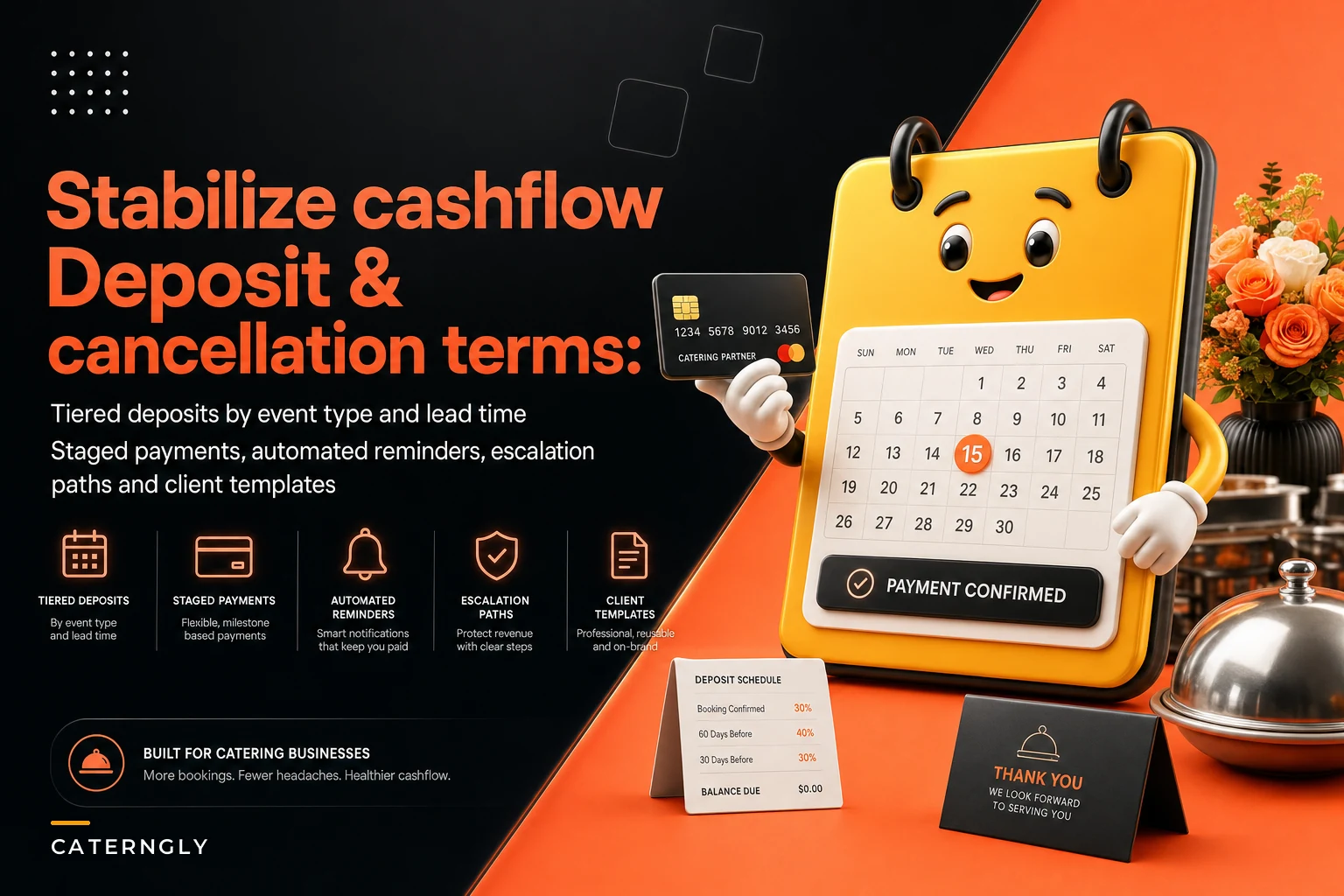

Most catering businesses operate on razor-thin margins. You book an event three months out, buy ingredients two days before, pay staff the day of, and then wait 30-60 days to collect final payment. Meanwhile, you're floating operational costs for every event on your calendar.
The math gets ugly fast. A $15,000 wedding reception requires roughly $6,000 in upfront costs between food, staff deposits, and rental guarantees. Book eight similar events in a quarter and you're floating close to $48,000 in operational expenses while waiting for payments to clear. Miss one collection and your entire quarter's cashflow collapses.
What makes this worse is that catering has inherently volatile demand. Corporate events cluster around fiscal quarters. Wedding season creates massive peaks and valleys. Holiday parties all hit within a six-week window. Without a structured catering deposit policy, you're essentially becoming an interest-free lender to your clients while shouldering all the operational risk yourself.
The Three-Tier Deposit Framework That Actually Works
There's a clear pattern across catering operations that survive cashflow volatility: they use tiered deposit structures based on event complexity and lead time, not arbitrary percentages.
Tier 1: Simple Events (Under 50 guests, standard menu)
-
Initial deposit
30% at booking
-
Second payment
40% at 14 days before event
-
Final payment
30% day of event
-
Cancellation protection
Full refund minus $250 processing fee if cancelled 30+ days out
Tier 2: Standard Events (50-150 guests, custom elements)
-
Initial deposit
35% at booking
-
Second payment
35% at 30 days before event
-
Third payment
20% at 7 days before event
-
Final payment
10% within 48 hours after event
-
Cancellation protection
Sliding scale starting at 50% refund if cancelled 45+ days out
Tier 3: Complex Events (150+ guests, multiple vendors, custom everything)
-
Initial deposit
40% at booking (non-refundable after 14 days)
-
Second payment
30% at 60 days before event
-
Third payment
20% at 21 days before event
-
Final payment
10% within 5 business days after event
-
Cancellation protection
Initial deposit non-refundable, additional payments refunded on sliding scale
Each tier aligns payment milestones with actual operational commitments. You're not asking for money arbitrarily — you're collecting funds when you're genuinely incurring costs.
Building Payment Schedules That Match Your Operational Reality
Payment schedules fail when they ignore how catering actually works. You can't run a sustainable business collecting 50% upfront and 50% after the event when your cost structure looks nothing like that split.
End chaos with centralized catering management.
Caterngly helps you plan, confirm, and manage every catering event seamlessly.
- Unified event and order management
- Real-time client updates
- Staff and resource scheduling
No credit card required
-
Booking to 60 days out
5% of costs (admin, planning)
-
60 to 30 days out
15% of costs (vendor deposits, special orders)
-
30 to 7 days out
25% of costs (food orders, staff scheduling)
-
7 days to event
40% of costs (perishables, final prep)
-
Day of event
15% of costs (overtime, last-minute needs)
Your payment schedule should slightly lead these cost curves, not lag behind them. That gives you working capital buffer without asking clients for unreasonable upfront amounts.
For corporate clients with procurement processes, a modified structure usually works better:
-
25% at contract signing
-
50% at 30 days before event (aligns with most net-30 cycles)
-
25% within 15 days after event
For weddings and social events:
-
35% at booking (commitment device)
-
35% at 60 days (before the major planning push)
-
20% at 14 days (covers perishables)
-
10% day of service (small enough not to create friction)
Corporate clients handle large scheduled payments easily but often struggle with multiple small transactions. Social clients prefer spreading costs out but need that initial commitment to prevent casual cancellations. Match payment friction to client behavior and you'll chase a lot less money.
Automated Reminder Sequences That Prevent Payment Drama
Payment collection in catering isn't about chasing money — it's about preventing the chase from being necessary at all. Most late payments happen because clients forget, not because they're avoiding paying.
For each scheduled payment:
-
14 days before due
Friendly reminder email with payment link
-
7 days before due
Text message reminder with amount due
-
3 days before due
Email with updated invoice and payment options
-
Day of due date
Morning text reminder
-
1 day overdue
Phone call (not automated)
-
3 days overdue
Formal notice via email and certified mail
-
7 days overdue
Event modification warning
-
10 days overdue
Cancellation notice
The piece most operations miss: escalation should change based on how close you are to the event. A late deposit six weeks out triggers a different response than a late payment three days before service.
Escalation Matrix by Timeline:
| Days Until Event | Payment Overdue | Action | Authority Level |
|---|---|---|---|
| 45+ days | 1-3 days | Automated reminders only | System |
| 45+ days | 4-7 days | Personal call from coordinator | Operations |
| 45+ days | 8+ days | Pause all planning activities | Management |
| 15-44 days | 1-2 days | Immediate phone call | Operations |
| 15-44 days | 3-5 days | Require credit card on file | Management |
| 15-44 days | 6+ days | Event cancellation warning | Owner |
| Under 15 days | 1 day | Multiple contact attempts | Operations |
| Under 15 days | 2 days | Credit card charge attempt | Management |
| Under 15 days | 3+ days | Event modification/cancellation | Owner |
Here's a simple workflow visualization.
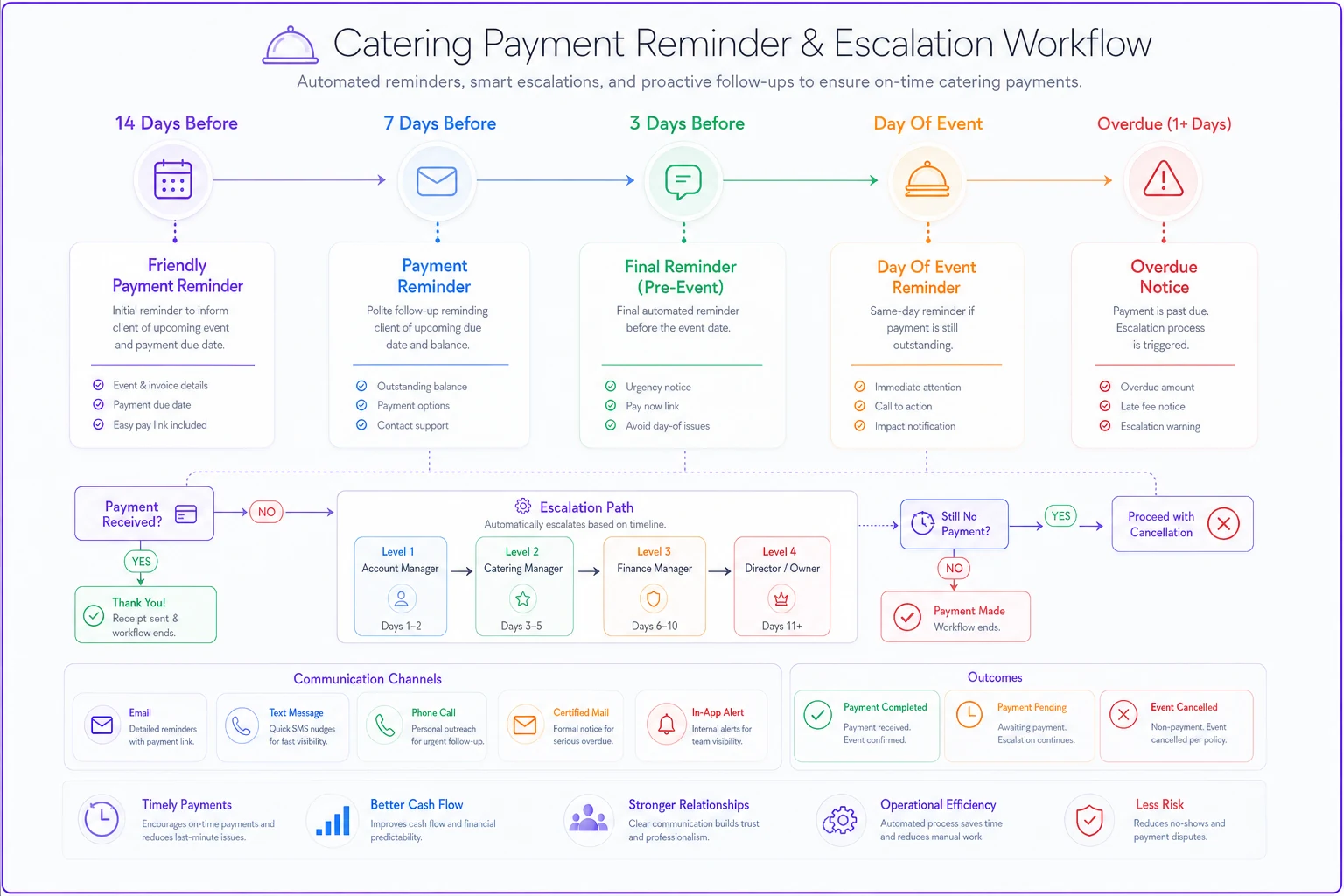
Use this to align reminders and escalation steps so the right action happens at the right time.
Sample Communication Templates That Preserve Relationships
The language you use for payment communications determines whether clients feel managed or hassled. Small wording changes make a real difference in response rates.
Initial Deposit Request (Sent with Contract):
"To secure your date and begin planning your event, we require an initial deposit of $[AMOUNT]. This immediately locks in your date and triggers our planning process, including:"
-
Vendor coordination for your specific requests
-
Menu development session scheduling
-
Dedicated event coordinator assignment
"Payment can be completed via [PAYMENT METHODS]. Your date is temporarily held for 72 hours while you complete payment."
Friendly Reminder (14 Days Before Due):
"Hi [NAME], Quick reminder that your next payment of $[AMOUNT] for your [DATE] event is scheduled for [DUE DATE]. Everything is moving along well with your planning — [SPECIFIC DETAIL ABOUT THEIR EVENT]. This payment keeps us on schedule for [NEXT MILESTONE]. Pay online: [LINK] Questions? Reply directly to this email. [COORDINATOR NAME]"
Urgent Reminder (3 Days Overdue):
"[NAME], We haven't received your payment of $[AMOUNT] that was due [DATE]. This covers critical preparations including food orders and staff scheduling for your [DATE] event. To avoid any disruption:"
-
Pay immediately
[LINK]
-
Call us to handle by phone
[PHONE]
-
Reply with questions about your invoice
"Without payment by [DATE + 4 DAYS], we'll need to pause preparations and risk losing vendor commitments. [COORDINATOR NAME] [DIRECT PHONE]"
Cancellation Warning (7 Days Overdue, Event 20+ Days Out):
"FORMAL NOTICE: Payment Required to Maintain Event Booking Event: [DETAILS] Amount Overdue: $[AMOUNT] Days Overdue: 7 Action Required By: [DATE + 3 DAYS] Per our service agreement, payments more than 10 days overdue trigger automatic cancellation. Your event will be cancelled and your date released unless payment is received by [DEADLINE]. Immediate Payment Options: [PAYMENT DETAILS] To discuss payment arrangements, contact [MANAGER NAME] directly at [PHONE] before [DEADLINE]."
Calendar Milestones That Keep Operations and Payments Synchronized
The biggest operational failure in catering payment collection happens when your operational calendar and payment calendar run separately. When these drift apart, you're either floating costs unnecessarily or creating payment friction at the wrong moments.
Booking to 60 Days Before Event:
-
Day 1
Contract sent with deposit request
-
Day 3
Follow up if contract unsigned
-
Day 7
Release date hold if no response
-
Day 14
Initial planning call (only if deposit received)
-
Day 30
Menu tasting scheduled
60 to 30 Days Before Event:
-
Day -60
Second payment triggered, vendor deposits placed
-
Day -55
Special order items confirmed
-
Day -45
Staffing assignments made
-
Day -35
Final menu modifications locked
30 to 7 Days Before Event:
-
Day -30
Third payment triggered
-
Day -28
Final guest count requested
-
Day -21
Rental orders confirmed
-
Day -14
Perishable orders placed
-
Day -10
-
Day -7
Final payment for additions collected
Week of Event:
-
Day -7
All payments must be current
-
Day -3
Final confirmations sent
-
Day -1
Setup begins
-
Day 0
Service delivery
-
Day +1
Final invoice sent if balance exists
-
Day +7
Thank you note with payment reminder if needed
Keeping payments and operations in sync protects you from one of the most common catering traps: being so focused on execution that payment collection falls through the cracks until it's too late.
Cancellation Terms That Protect Operations Without Destroying Reputation
Cancellation policies aren't about punishing clients. They're about covering real costs you've already incurred. Structure them around operational reality, not arbitrary penalties.
Operational Cost Timeline for a $12,000 Event:
-
At booking
$200-300 (sales time, initial planning)
-
60 days out
$800-1,200 (vendor deposits, special orders)
-
30 days out
$2,400-3,600 (staff scheduling, committed purchases)
-
14 days out
$4,800-6,000 (perishable orders, rental confirmations)
-
7 days out
$8,000-9,000 (everything committed except day-of variables)
Your cancellation terms should reflect those realities:
-
60+ days before event
Full refund minus initial deposit (or $500 minimum)
-
45-59 days before
70% refund of payments made
-
30-44 days before
50% refund of payments made
-
15-29 days before
25% refund of payments made
-
14 days or less
No refund
Force Majeure Modifications:
-
Weather
Full credit toward rescheduled date within 12 months
-
Venue issues
50% refund or full credit for rescheduling
-
Medical emergency
Case-by-case with documentation
-
Government restrictions
Full refund minus actual costs incurred
Require written cancellation and document actual costs incurred. Keep a running cost log for each event starting from booking. If a client cancels, you can show exactly what you've already committed — that documentation protects you legally and removes the emotional component from the conversation.
Technology Stack for Payment Operations
Manual payment tracking kills catering businesses slowly. You miss a reminder, forget a follow-up, lose track of who owes what — and suddenly you're chasing payments instead of planning events.
Modern operations need payment workflows that run regardless of how busy things get. Automated reminders, clear payment status dashboards, and escalation triggers that don't require daily management attention.
-
Contract generation with embedded payment terms
-
Automated payment scheduling based on event type
-
Multi-channel reminder sequences (email, text, phone)
-
Payment status dashboard showing aging and risk
-
Integration with accounting for automatic reconciliation
What matters more than any individual feature is workflow integration. Your payment system needs to connect with event planning, vendor management, and financial reporting. When a payment comes in late, your purchasing team needs to know. When an event gets modified, payment schedules should adjust automatically.
AI-powered operational platforms have changed what's possible here. Smart payment systems can flag clients who are trending toward late payment based on communication patterns, automatically adjust reminder intensity, and surface situations that need a human call rather than another automated message. That's the kind of operational leverage that used to require a dedicated office manager.
Connect your payment status dashboard to vendor purchase triggers so late payments automatically halt non-essential orders.
The shift happens when payment collection moves from a manual chase to a system that just runs. Instead of wondering who owes what, you have clear visibility. Instead of personally calling about every overdue payment, automated sequences handle routine collection while you focus on the exceptions that actually need your attention.
Making This Work in Your Catering Operation
Implementing a structured catering deposit policy requires changing both systems and culture. Your team needs to understand that payment collection is part of event success, not an awkward addition to it.
Start with your highest-risk events — large corporate gatherings and elaborate weddings. These have the biggest cashflow impact and clients generally expect formal payment structures. Use the three-tier framework as a starting point, but adjust percentages based on your actual cost curves.
Document everything. Every payment conversation, every modification to terms, every exception you grant. That documentation protects you legally, but more practically, it reveals patterns. You'll quickly see which client types need different structures and which situations keep creating friction.
Train your sales team to present payment terms as operational necessities, not negotiable policies. "This payment schedule aligns with when we commit resources to your event" lands better than "this is our policy." When clients understand that payments trigger specific preparations, they're more likely to treat due dates seriously.
Track these numbers monthly:
-
Average days sales outstanding
-
Percentage of payments made on time
-
Collection costs as a percentage of revenue
-
Cancellation losses by tier
-
Payment-related event disruptions
Most operations see meaningful improvement within 90 days of implementing structured payment workflows. Late payments drop significantly, cancellation losses decrease, and the constant cashflow stress largely disappears.
The real test is peak season. When you're managing multiple events simultaneously, solid payment operations mean you're not also juggling collection calls. Your systems handle routine follow-up while you focus on actually delivering good events.
Financial stability creates operational stability. When payments flow predictably, you can make better purchasing decisions, lock in better vendors, and maintain the staffing levels you need. Your catering deposit policy isn't just about getting paid — it's about building a business that can handle seasonality, support growth, and deliver consistent quality without constantly operating on the edge.
Ready to elevate your catering business?
Join 500+ caterers trusting Caterngly to save time, reduce errors, and deliver flawless events.