

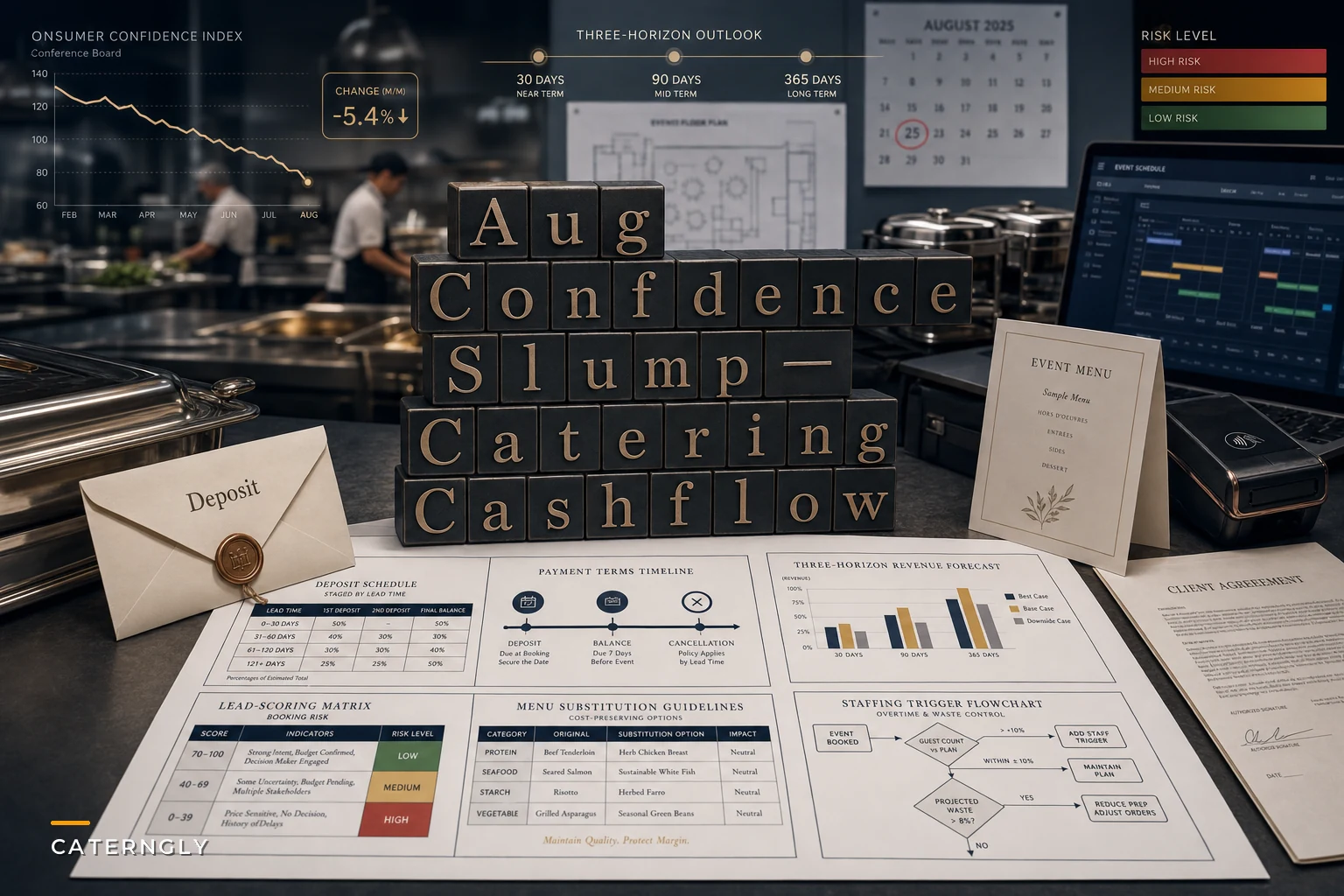

The Conference Board's latest read landed at 89.4 in August, down from 90.2, with the Expectations Index dropping harder to 68.2. On paper it's a small move. For catering owners heading into fall, it's the kind of soft signal that tends to show up in your deposit inbox about six to eight weeks later.
Caterers usually feel these shifts before the data confirms them. You notice it in the tone of inquiry emails. The "we're still finalizing our budget" replies. The corporate holiday party that quietly downsizes from 200 to 140 covers. By the time the Conference Board publishes the dip, you've often already lost a couple of soft bookings without fully registering why.
This post isn't about the index. It's about what a weakening Expectations number specifically does to your cashflow triggers — and why the deposit rules that worked in a confident market quietly become dangerous in a hesitant one.
Why the Expectations Index matters more to you than the headline number
Most coverage focuses on the top-line confidence figure. For catering, the Expectations Index is the one to watch — it measures how people feel about the near future: income, jobs, business conditions. That's precisely the mindset that drives discretionary event spending.
Weddings, milestone parties, corporate galas, fundraisers — these are planned in the future and paid for out of anticipated comfort. When people expect leaner months ahead, they don't cancel the event. They shrink it, delay the deposit, or negotiate the terms. Reuters noted in its August coverage that the decline reflected more pessimism about future incomes and business conditions — and that pessimism translates almost directly into slower booking velocity and softer commitment at the deposit stage.
The pattern that shows up again and again: bookings don't vanish. They get mushier. Guest counts float. Contracts get signed later. Final payments arrive right up against the wire. And that mush is what wrecks a catering business's cash position, because your costs — deposits to rental vendors, protein orders, staffing commitments — don't soften at all. They stay firm.
The real problem: your deposit structure assumes commitment you no longer have
Most catering deposit schedules were designed during a period of buyer confidence, even if nobody thought of them that way at the time. A typical structure looks like:
End chaos with centralized catering management.
Caterngly helps you plan, confirm, and manage every catering event seamlessly.
- Unified event and order management
- Real-time client updates
- Staff and resource scheduling
No credit card required
-
25% deposit to hold the date
-
50% due 30 days out
-
Remaining balance due 7 days before the event
That works fine when clients are eager and confident. The problem is the 25% hold. In a hesitant market, it's small enough that a client will happily forfeit it if their situation changes — or use the threat of forfeiture as leverage to renegotiate down.
Think about it from the client's side. Someone books a $22,000 event with a $5,500 hold deposit. Their bonus doesn't come through in October. Walking away from $5,500 to avoid a $22,000 commitment is an easy decision. You're left with a hole in your calendar that's too late to refill at full price, and a deposit that doesn't come close to covering your lost margin plus the vendor commitments you've already made.
A deposit designed to hold a date isn't the same as one designed to protect your capacity. In a confident market you can get away with conflating the two. In a hesitant one, you can't.
What actually needs to change in your triggers
The instinct when confidence dips is to raise deposits across the board. That's usually a mistake — it makes you less competitive on exactly the bookings you want to win, while doing little to stop the ones that were going to flake anyway.
| Booking Signal | Confident Market Approach | Hesitant Market Adjustment |
|---|---|---|
| High-probability, short lead (under 45 days) | Standard 25% hold | Move to 40% hold — commitment is real, capture cash early |
| High-value, long lead (90+ days) | 25% hold, balance 30 days out | Add a non-refundable 15% "planning fee" separate from the deposit |
| Corporate repeat client | Flexible terms | Keep flexible, but add a written guest-count floor with a cutoff date |
| First-time client, vague budget | Standard terms | Require full menu selection + 40% before locking the date |
| Fundraiser / nonprofit event | Discounted deposit | Tighten final-payment window to 14 days out |
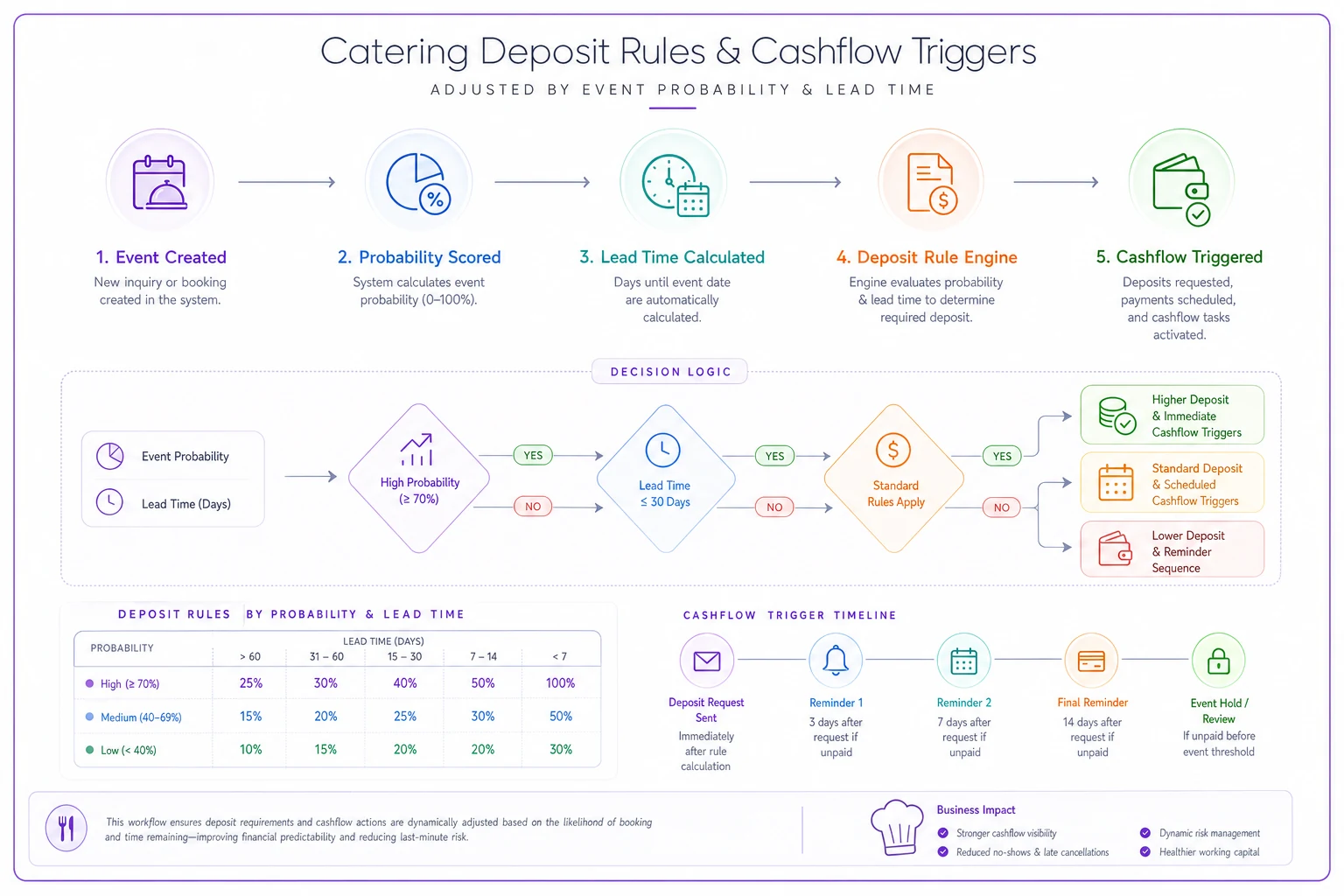
This diagram shows the decision flow for deposit and trigger adjustments.
The exact percentages will depend on your market. The broader point is that a soft-confidence environment rewards differentiated terms over blanket ones — protect margin where risk is highest, stay flexible where the relationship is strongest.
Rebuilding the guest-count floor (the lever most caterers ignore)
The most damaging thing in a downturn usually isn't cancellation — it's the quiet downsize. A 200-cover event that becomes 150 covers destroys your per-event P&L because fixed costs don't drop proportionally. Staffing minimums, delivery, setup labor, equipment — most of that stays put regardless of how many plates you're serving.
Most contracts have a guaranteed minimum somewhere in the fine print, but it's usually set too low and enforced too late. When confidence softens, this clause becomes your most important cashflow protection.
-
A hard minimum billed regardless of final count (set at roughly 80–85% of the booked number)
-
A count-lock date far enough out that you can adjust orders — usually 10–14 days
-
Language that final count can go up but never below the floor
-
A per-cover downsize fee if they drop between contract signing and lock date
Set your billed minimum at about 80–85% to protect margin while keeping the client relationship intact.
What this looks like in practice: a caterer books a corporate holiday event at 180 covers, $95 per cover — roughly $17,100. With an 85% floor, the minimum billed is 153 covers, or about $14,500. If the client downsizes to 130 attendees, you still bill 153. That difference — around $2,200 — is often the gap between a profitable event and one that barely breaks even after you've already committed to rentals and staff.
Without the floor, you eat the downsize entirely.
Tightening the three-horizon forecast under uncertainty
A confidence dip is exactly the moment your cashflow forecasting needs to get sharper, not looser. The problem is that most caterers forecast off booked events as if they're all equally certain — which overstates near-term cash and hides real risk.
The fix is to weight your pipeline by booking stage and lead time, then map that against your fixed obligations across three horizons. If you haven't built that out, the breakdown in our three-horizon event-driven cashflow model for caterers walks through mapping deposits, lead times, and event density into a forecast you can actually plan against.
For a soft-confidence period specifically, the adjustment is: discount your unconfirmed pipeline more aggressively. Here's the process:
-
Segment your pipeline into confirmed (deposit paid), verbal (agreed, no deposit), and inquiry stages.
-
Apply a confidence-adjusted conversion rate — in a hesitant market, drop verbal conversions from your usual assumption (say 70%) down to 50–55%.
-
Overlay your fixed cash-out obligations by week — vendor deposits, payroll, standing costs.
-
Identify the pinch weeks where committed outflows exceed confidence-adjusted inflows.
-
Set a contingency buffer targeting those specific pinch weeks, rather than holding a flat cash reserve that doesn't account for timing.
This gives you an early warning about which weeks are actually exposed, rather than discovering the shortfall when payroll is due.
When tightening terms is the wrong move
Tighter deposit rules aren't universally correct, and applying them reflexively will cost you good business.
Don't tighten terms on:
-
Repeat corporate accounts with a clean payment history — you're protecting against a risk they've never posed
-
Long-standing referral sources whose events fill your slow weeks
-
Off-peak dates you'd struggle to book anyway — flexibility there is a competitive advantage, not a liability
Do tighten on:
-
First-time clients with undefined budgets and long lead times
-
Events during your peak weeks, where a flake costs you a slot you could've sold twice
-
Any booking where the client is already negotiating hard before signing — that's your preview of how the whole engagement will go
The distinction that matters: tighten terms to protect capacity you could otherwise sell, stay flexible on capacity that would sit empty regardless.
A quick real scenario
A mid-sized caterer running mostly corporate and wedding work — roughly 90 to 110 events a year — noticed inquiries slowing through late summer and a couple of fall corporate parties downsizing. Their standard terms: 25% hold, balance 30 days out, no meaningful guest floor.
They made three changes going into fall. Raised the hold deposit to 40% on all new bookings under 60 days out. Added an 85% guest-count floor with a 12-day lock. Re-scored their open pipeline and stopped holding peak-Saturday dates for vague inquiries with no money down.
The result over the following quarter wasn't dramatic on the surface — booking volume was roughly flat. But two downsize events that would have gutted margin got backstopped by the floor, protecting somewhere around $4k–$5k they'd otherwise have absorbed. More importantly, they freed up two peak dates from dead-weight holds and rebooked one of them. Going into the slower winter stretch, their cash position was noticeably steadier — more money had arrived earlier, and fewer events surprised them at the count-lock date.
What to actually do this week
You don't need to overhaul everything. A soft-confidence period rewards a few precise adjustments:
-
Re-score your open pipeline and identify which "verbal" bookings have no money behind them
-
Set a real guest-count floor on every new contract at 80–85%
-
Differentiate deposit percentages by lead time and client history instead of one flat rate
-
Move your count-lock date far enough out to protect your ordering
-
Rework your forecast to discount unconfirmed events more heavily and surface your actual pinch weeks
-
Stop holding peak dates for anyone who hasn't committed cash
A drop from 90.2 to 89.4 doesn't sound like much, and by itself it isn't. But the direction of the Expectations number tells you something about how the next few months of buyer behavior will feel — later commitments, softer counts, more negotiation. The caterers who come through it in good shape aren't the ones who guessed the economy right. They're the ones whose deposit rules and cashflow triggers were built to hold up when clients get cautious — so the caution shows up as a manageable adjustment on the calendar, not a hole in the bank account.
A drop from 90.2 to 89.4 doesn't sound like much, and by itself it isn't. But the direction of the Expectations number tells you something about how the next few months of buyer behavior will feel — later commitments, softer counts, more negotiation. The caterers who come through it in good shape aren't the ones who guessed the economy right. They're the ones whose deposit rules and cashflow triggers were built to hold up when clients get cautious — so the caution shows up as a manageable adjustment on the calendar, not a hole in the bank account.
Ready to elevate your catering business?
Join 500+ caterers trusting Caterngly to save time, reduce errors, and deliver flawless events.