

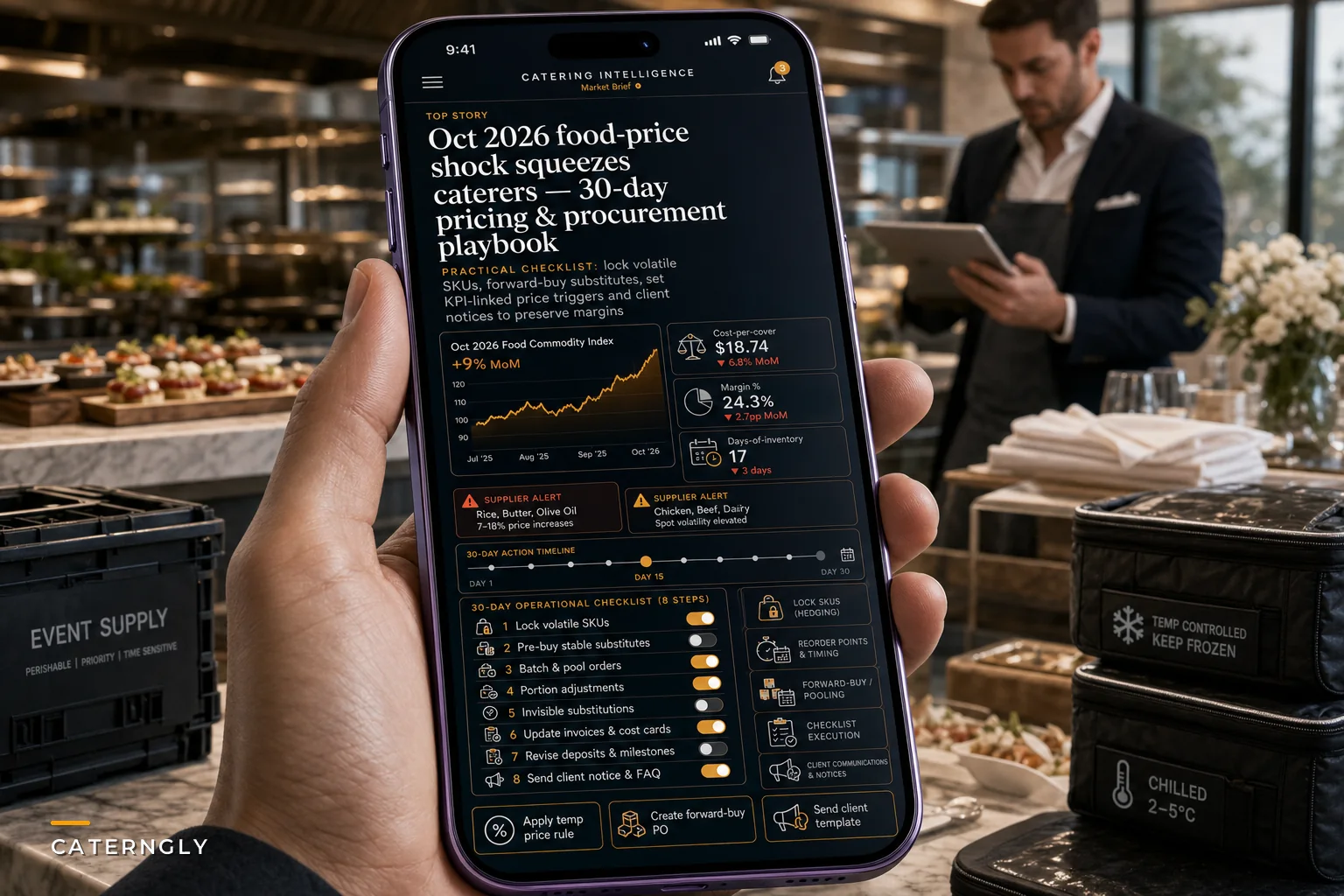

The warnings got louder in the last week of October. Reuters reported that major food and household brands are bracing for another round of price hikes as commodity and transportation costs climb, and a few days later the same outlet noted U.S. inflation accelerated in September with food‑away‑from‑home costs pushing higher. None of that is abstract when you're a caterer staring down a December calendar already stacked with holiday parties, corporate year‑end events, and private bookings you quoted back in August.
The painful part isn't the price increase itself — caterers survive inflation every year. It's the timing. You locked prices on events months ago, you're buying perishables at peak demand, and suppliers are raising quotes right when you have the least flexibility to shop around. A protein line that penciled in at one cost during quoting can land 15–25% higher at the loading dock in mid‑December, and you've already signed the contract.
So this isn't a "watch the market" piece. It's a 30‑day operational plan broken into weekly moves — because the caterers who come out of this season with margins intact aren't the ones who reacted fastest to the news. They're the ones who had a sequence ready.
Week 1: Freeze the bleeding before you touch pricing
The instinct when costs spike is to immediately raise prices. That's a mistake this early. You can't price correctly until you know which line items are actually moving, and by how much. Most caterers discover, when they finally look, that the pain is concentrated in three or four categories — not spread evenly across the menu.
Your first week is diagnostic. Pull your last 60 days of invoices and flag every item where unit cost moved more than roughly 5%. You're looking for the real offenders, because those are the only ingredients worth reengineering around. A typical pattern looks like this:
| Category | Oct cost vs. 60 days ago | Volume this season | Priority |
|---|---|---|---|
| Beef / premium proteins | +18–24% | High | Reengineer first |
| Dairy / butter / cream | +9–14% | High | Substitute where invisible |
| Cooking oils | +11% | Medium | Renegotiate volume |
| Specialty produce | +6–20% (volatile) | Medium | Lock contracts now |
| Dry goods / staples | +2–4% | High | Hold, monitor |
A common mistake is treating a 3% dry‑goods increase with the same urgency as a 20% protein spike. You dilute your attention and end up raising prices on things that didn't need it — which annoys clients without actually recovering margin.
Week 1 action list:
-
Identify your top 5 cost‑moving ingredients by dollar impact, not percentage
-
Flag every signed‑but‑not‑executed event where those ingredients appear
-
Calculate your real exposure
how many booked covers in Nov–Dec rely on the volatile items
-
Pull your supplier contracts and check which ones allow mid‑term price changes
-
Don't change a single menu or price yet — just map the damage
Don't change a single menu or price yet — just map the damage
Week 2: Procurement moves while you still have leverage
Supplier leverage shifts dramatically between early November and mid‑December. Right now, your distributor still wants your holiday volume committed. By the second week of December, they know you're locked in, and the conversation gets very one‑sided.
End chaos with centralized catering management.
Caterngly helps you plan, confirm, and manage every catering event seamlessly.
- Unified event and order management
- Real-time client updates
- Staff and resource scheduling
No credit card required
Week 2 is about converting your diagnostic into contracts. A few tactics that actually hold up during a price shock:
Lock the volatile items, float the stable ones. Negotiate fixed pricing specifically on the handful of ingredients from your Week 1 list, even if it means accepting a slightly higher base number. A guaranteed price on butter at a 10% premium beats a spot price that swings 20% the week you need 400 portions.
Pool your holiday orders. If you're running multiple events across a two‑week stretch, batch perishable purchasing into fewer, larger orders tied to your event density. Caterers who already run proper reorder points and safety‑stock rules walk into supplier calls knowing their exact December demand — that's a real negotiating advantage.
Batch perishable purchasing into fewer, larger orders tied to your event density to improve negotiating leverage.
Line up one backup supplier per volatile category. Not necessarily to switch, but so your primary distributor knows you have options. The existence of a credible second quote changes how aggressively they hold the line.
Pre‑buy shelf‑stable substitutes. If your menu reengineering in Week 3 leans on dry or frozen components, buy those now while they're still in the +2–4% band rather than scrambling in December.
One quieter observation: caterers who get the best December pricing are usually the ones who were reliable, predictable accounts all year. If you've been paying on time and ordering consistently, use that relationship explicitly in the conversation. Suppliers protect their steady accounts first when supply tightens.
Week 3: Menu reengineering that clients never notice
This is where margin actually gets recovered, and it's the part most owners skip because they're afraid of client pushback. The reality is that the vast majority of substitution happens in places guests can't perceive.
Think about where the cost lives versus where the perceived value lives. A client remembers the centerpiece protein, the signature dish, the dessert they photograph. They don't remember whether the sauce base used cream or a cream‑and‑stock blend, whether the starch was the premium version or a well‑executed alternative, or whether garnish portions dropped by a few grams.
A realistic reengineering pass on a holiday buffet might look like:
-
Protect the hero item. Keep the premium protein guests expect, but tighten the portion spec to the actual plated standard instead of the generous over‑portioning most kitchens default to. Recovering 10–15g per cover across 300 covers adds up fast.
-
Rebalance the plate. Shift the ratio slightly toward lower‑cost, high‑perceived‑value components — seasonal roasted vegetables, grains, breads — that read as abundant and festive without the protein cost.
-
Substitute invisibly in bases and sauces. This is where dairy and oil spikes get absorbed without anyone noticing.
-
Swap one volatile specialty item for an equally appealing in‑season alternative. December produce has plenty of options that photograph just as well.
The economics here deserve more rigor than a gut call. When you know the exact cost delta of each substitution and its effect on your per‑cover margin, you can make these decisions in minutes rather than agonizing over them. This is exactly why a KPI‑linked pricing system built on real cost cards and price triggers matters during a shock like this — it turns "I think this swap saves money" into a number you can trust before you commit it to 20 events.
A simple workflow for the reengineering steps:
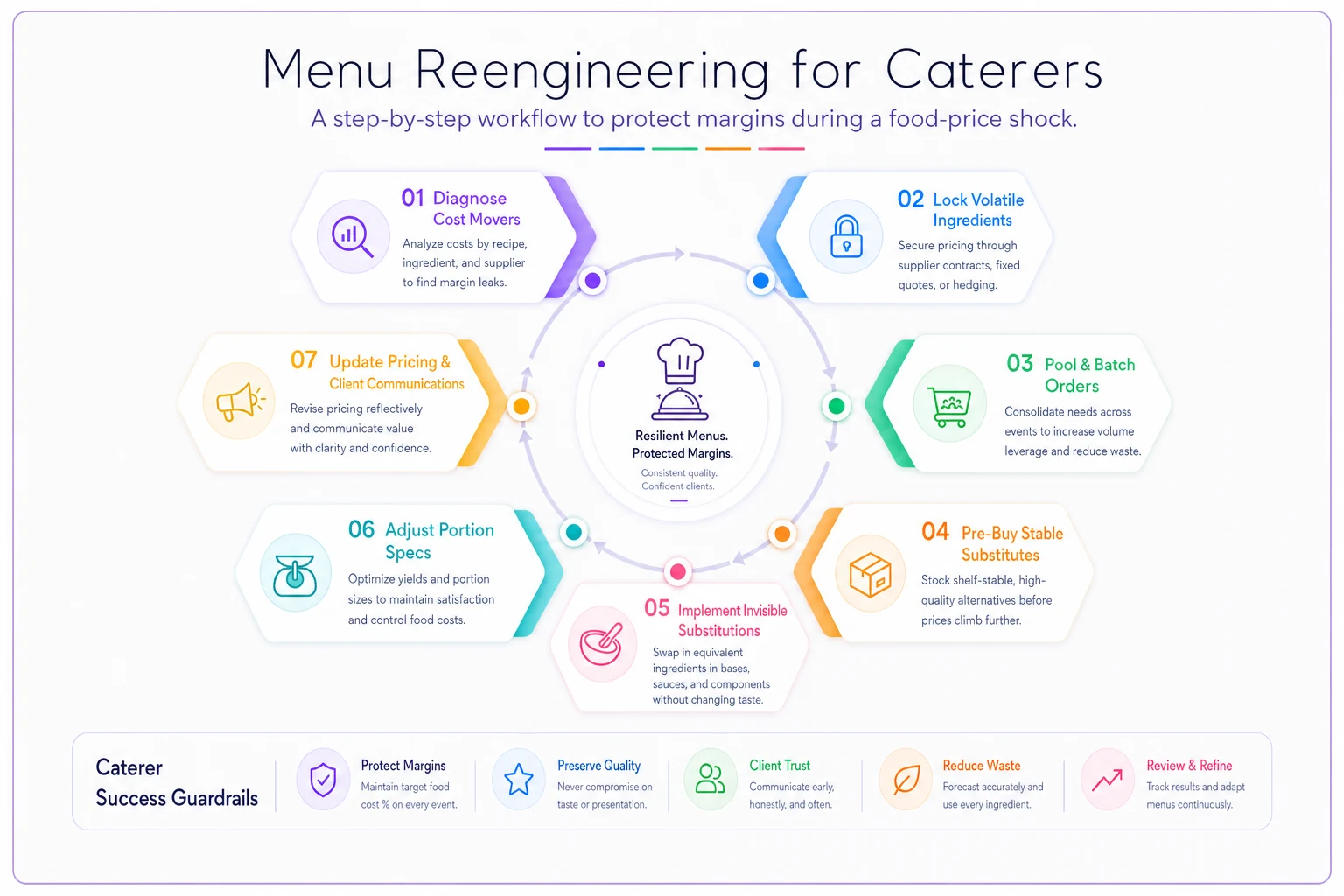
When invisible substitution is a bad idea: if a client specifically contracted a named ingredient, or if it's a tasting‑heavy affair where guests are actually paying attention to every component. Don't play games with a client who'll notice. Reengineer the menus where the margin math is clean and the perception risk is near zero.
Week 4: Pricing and the client conversation you've been dreading
By now you know your real cost exposure and you've recovered some margin through procurement and reengineering. Whatever gap remains gets addressed through pricing — and that falls into two very different buckets.
Events not yet quoted or signed: straightforward. Update your cost cards, reset your price triggers, and build the new cost reality into every proposal going out. No conversation needed because the client never saw the old number. Just make sure your quoting reflects current costs and not figures from three months ago — that's the single most common way caterers quietly bleed margin through a season.
Events already under contract: this is the hard one, and how you handle it depends entirely on your contract language. If your agreement has a market‑adjustment or ingredient‑escalation clause, this is the moment it earns its keep. If it doesn't, you're mostly absorbing the hit on those specific events — and taking notes to fix your contracts before next year.
When you do need to have the pricing conversation, a few things keep it from going sideways:
-
Lead with the fixed menu, not the increase. Reconfirm their event, the dishes, the headcount — then address pricing as a logistics detail, not an apology.
-
Be specific and external. "Protein and dairy costs have moved sharply this quarter" lands far better than a vague "costs are up." Clients read the same headlines you do; the pressure is credible right now.
-
Offer a path, not just a number. Give them a modified menu option that holds their original price alongside the as‑contracted option at the adjusted price. Most clients pick the menu adjustment, which is exactly the outcome you want.
-
Protect your cashflow. For any event where you're absorbing cost, tighten the deposit and final‑payment timing so you're not financing someone else's party on volatile ingredients.
A real scenario
A mid‑sized caterer running mostly corporate holiday events — roughly 40 bookings between Thanksgiving and New Year's, averaging around 180 covers — went into November with about a third of those events already signed at August pricing. Their beef and dairy exposure alone threatened to erase somewhere between $9k and $12k of margin across the season.
Rather than a blanket price hike, they ran the sequence above. Portion re‑specs and invisible base substitutions on the signed events recovered most of the dairy and oil pressure. For the heavy‑protein events, they offered clients a slightly rebalanced menu at the original price — about two‑thirds took it. New proposals went out with reset cost cards. They didn't claw back every dollar, but they turned a projected five‑figure margin loss into something closer to a minor dent, and a couple of the menu swaps performed well enough that they kept them permanently.
The outcome that mattered most wasn't the dollars. Not one client felt nickel‑and‑dimed, because the pricing conversation happened after the operational work — not instead of it.
What this shock actually exposes
A price spike is a stress test for a system you should already have running. Caterers who scramble every time commodity costs jump are usually carrying cost assumptions in their heads and quoting from memory. When the numbers move, they have no fast way to see which events are now underwater.
The ones who absorb these shocks calmly share a common trait: costs live in current, maintained cost cards, reorder and safety‑stock rules reflect real event density, and pricing responds to triggers instead of panic. When beef jumps 20%, they know within an hour which events are affected and exactly how much margin is at risk on each.
That's the real lesson under the October headlines. The news gave you a reason to act this month — but the goal is to never need the news as a wake‑up call again. Build the pricing and procurement discipline now, during a live shock when the stakes are obvious, and the next commodity jump becomes a Tuesday adjustment instead of a season‑threatening emergency.
Run the 30‑day sequence. Then make the parts that worked permanent, so December 2027 starts from strength instead of scramble.
Ready to elevate your catering business?
Join 500+ caterers trusting Caterngly to save time, reduce errors, and deliver flawless events.