

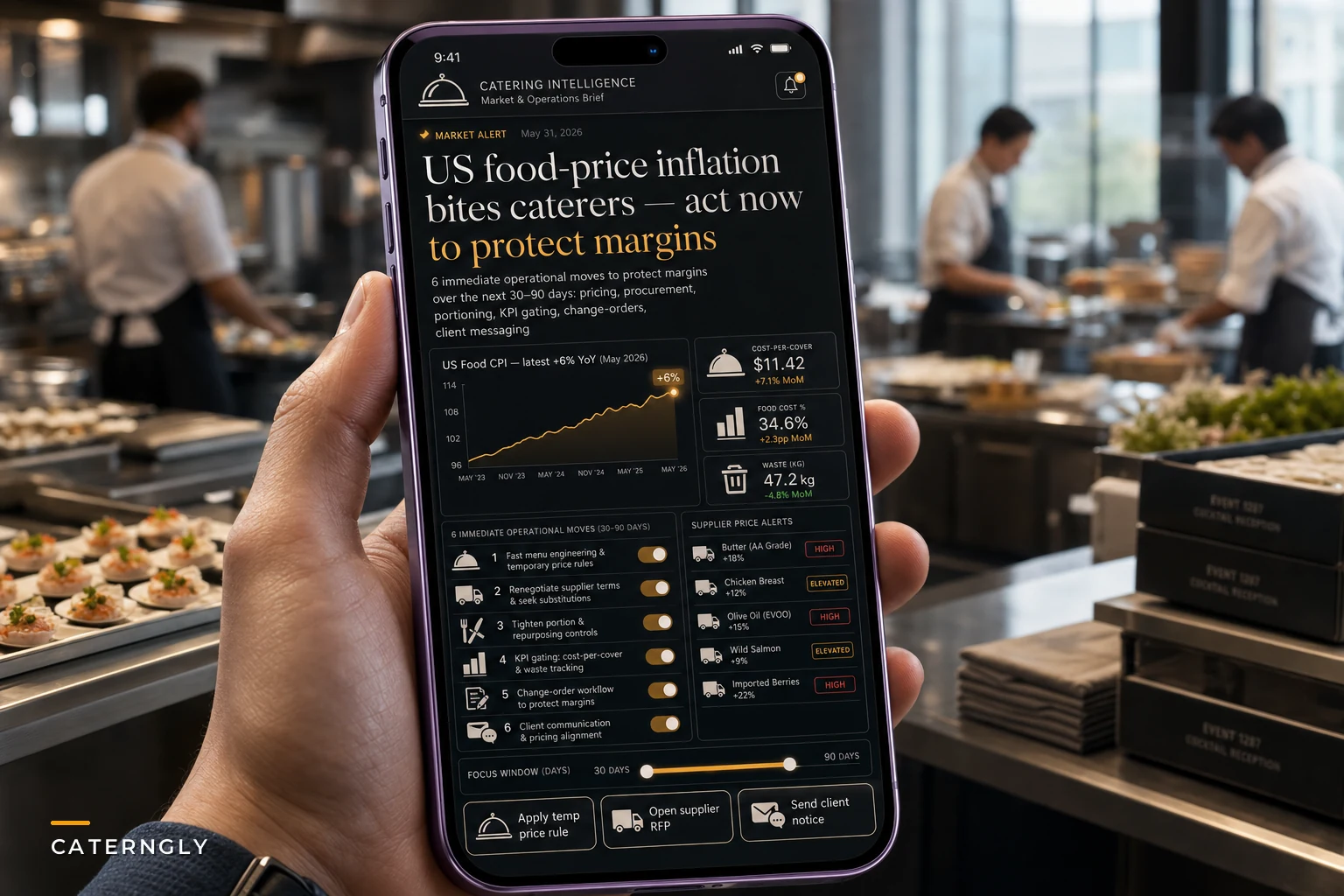

Last Thursday, a mid-sized caterer in Atlanta using our platform watched their primary seafood vendor send out a price adjustment email. Salmon up 35%. Shrimp up 22%. Even basic chicken breast climbed 18% in two weeks.
This isn't isolated. CNN reported that inflation hit a three-year high this week, with food costs leading the surge ahead of Memorial Day. For caterers already working on razor-thin margins (typically 8–12% net), these spikes aren't just inconvenient—they're business killers.
Most catering operations still quote events 60–90 days out using today's food costs. By the time that wedding or corporate gala happens, your carefully calculated margins have evaporated. Meanwhile, clients who booked months ago expect the same menu at the locked-in price, while new prospects balk at updated quotes that reflect actual costs.
The dangerous lag between quotes and actual event costs
You quote an event in March for a June wedding. Between quote and execution, produce costs spike, proteins surge, even basic pantry items climb. That $85-per-head pricing you confidently promised? It now costs you $94 to deliver.
Most caterers absorb these hits, thinking it's temporary. But inflationary cycles often last 6–18 months. Eating a 10% margin reduction across dozens of events means the difference between growth capital and scrambling to make payroll.
The standard response—raising prices across the board—only works if you're willing to lose 30–40% of your pipeline. Clients comparing quotes will naturally gravitate toward caterers still using outdated pricing. You're stuck: honor old prices and bleed money, or update prices and lose bookings.
What actually works is a multi-pronged operational adjustment that protects margins without shocking clients. Not through clever pricing tricks, but through systematic changes to how you source, plan, quote, and execute events.
1. Switch to ingredient-flexible menu frameworks
The biggest mistake during volatile pricing? Locking yourself into specific ingredients months before an event. That beef tenderloin centerpiece might double in cost by event day.
End chaos with centralized catering management.
Caterngly helps you plan, confirm, and manage every catering event seamlessly.
- Unified event and order management
- Real-time client updates
- Staff and resource scheduling
No credit card required
Instead, structure menus around cooking methods and flavor profiles rather than specific proteins. Instead of "Pan-Seared Salmon with Lemon Butter," offer "Market Fish with Citrus Beurre Blanc." Instead of "Beef Short Ribs," position it as "Braised Protein Selection."
This isn't about bait-and-switch. It's about building flexibility into your operational model. When you quote, specify that final protein selection happens 2–3 weeks before the event based on market conditions. Clients still get the quality and presentation they expect, but you maintain the agility to source what's actually affordable.
A Houston caterer shifted to this model last year and reduced their food cost variance from 18% to about 6%. They maintain a stable of 4–5 protein options for each menu category, selecting based on weekly pricing. Their clients actually appreciate the "seasonal market selection" positioning—it feels more premium, not cheaper.
Your kitchen team needs cross-training on multiple preparations. If they can only execute one version of a dish, flexibility becomes chaos. Build prep sheets for each variation. Document timing differences. Run practice rounds during slower periods.
2. Create weekly supplier scorecards (not just price sheets)
Most caterers check prices sporadically—usually when placing orders. During inflation, that's like driving while only looking up every few minutes. You need continuous market intelligence.
Build a simple weekly scorecard tracking:
-
Price per pound for your top 20 ingredients
-
Week-over-week percentage change
-
Which suppliers offer the best current pricing
-
Alternative products at better price points
-
Quality consistency scores
This isn't about jumping between suppliers constantly. It's about knowing when to pivot. When your primary vendor's chicken breast hits $4.80/lb but the secondary supplier maintains $3.90/lb with comparable quality, you have data to support the switch.
Track availability patterns too. That amazing deal on strawberries might mean they're about to flood the market—perfect for adjusting next week's dessert offerings. Or that beef price spike might signal a shortage that'll last months, meaning you need to start transitioning clients away from steak-heavy menus.
Share weekly scorecards with sales teams to make supplier conversations data-driven.
The scorecard also becomes leverage during supplier negotiations. When you can show exact price disparities, vendors suddenly become more flexible on pricing—especially if they know you're actually tracking alternatives.
Implementing portion control that doesn't feel cheap
During my early catering days, I watched a high-end caterer serve a corporate event where every plate looked absolutely abundant—but they'd actually reduced portions by about 15% through clever plating techniques. Wide, shallow bowls made smaller portions appear generous. Strategic garnishing filled visual space without adding cost.
-
Protein portioning Drop from 8oz to 6.5oz for most proteins, but slice thinner and fan the presentation. The visual coverage remains while actual product use decreases. Add height with vegetable accompaniments.
-
Starch management Instead of heaping sides, use ring molds for precise portions that look architectural. 4oz of risotto in a perfect cylinder looks more impressive than 6oz spread across a plate.
-
Sauce discipline Pre-portion sauces into 2oz ramekins for service rather than free-pouring. Not only does this control costs, it actually speeds plating during service.
One Baltimore caterer implemented strict portioning last fall and dropped food costs by 11% without a single client complaint. When your team understands they're protecting everyone's jobs, not just being stingy, compliance shoots up.
3. Build inflation triggers into contracts
Stop eating inflation risk yourself. Every contract needs clear language about price adjustments based on documented cost increases.
Structure it simply: "Menu pricing is guaranteed for events within 45 days of contract signing. For events beyond 45 days, pricing may be adjusted up to 10% based on documented wholesale food cost increases. Client will be notified of any adjustments at least 30 days before the event with the option to adjust menu selections to maintain original pricing."
Clients rarely object when you frame it properly. You're not surprising them—you're being transparent about market realities. Most appreciate knowing you're protecting the business's ability to deliver quality rather than cutting corners.
For existing contracts without this language, proactive communication beats surprise charges. Reach out to clients with events 60+ days out. Explain the situation, show them actual cost increases (those supplier scorecards become sales tools), and offer options: maintain the original menu at adjusted pricing, modify the menu to hit the original price point, or meet somewhere in the middle.
About 70% of clients accept modest increases when you approach them early with documentation. The other 30% work with you on menu adjustments. Almost nobody cancels if you handle it professionally.
The accelerated cash conversion cycle
Inflation destroys caterers through cash flow timing more than actual cost increases. You're paying today's inflated prices while collecting on last quarter's quotes. The gap compounds weekly.
Restructure your payment terms immediately:
-
Move from 50% deposits to 65–70%
-
Require final payment 7 days before events (not day-of)
-
Implement 2/10 net 30 terms for corporate accounts
-
Add credit card processing fees as line items rather than absorbing them
A Phoenix catering company restructured payment terms during 2022's inflation spike and improved cash flow by roughly $45,000 per month—enough to cover their entire food cost increases. Clients barely pushed back because everyone understands the current environment.
For hesitant clients, offer alternative structures that still accelerate cash: monthly payment plans starting at contract signing, or smaller deposits but earlier final payment. The goal is getting money in hand before you're buying ingredients at inflated prices.
4. Deploy strategic menu engineering (beyond the obvious)
Everyone knows to push high-margin items, but effective menu engineering during inflation requires deeper analysis. Track contribution margin per menu item—not just food cost percentage.
That pasta dish with a 28% food cost might generate $31 in contribution margin per serving. The chicken entrée at 35% food cost could yield only $24 in margin. During inflation, absolute dollar contribution matters more than percentages.
| Menu Item | Selling Price | Food Cost % | Food Cost $ | Contribution Margin |
|---|---|---|---|---|
| Pasta Primavera | $42 | 28% | $11.76 | $30.24 |
| Chicken Marsala | $48 | 35% | $16.80 | $31.20 |
| Beef Tenderloin | $67 | 45% | $30.15 | $36.85 |
| Market Fish | $52 | 32% | $16.64 | $35.36 |
Labor intensity affects real margins too. That beef tenderloin might show the highest contribution margin, but if it requires twice the prep time as the market fish, your actual profit per labor hour drops.
Build a new menu scoring system:
-
Contribution margin per serving
-
Prep time per serving
-
Ingredient stability (how much do costs fluctuate?)
-
Execution complexity during service
-
Client satisfaction scores
Weight each factor and score every menu item. Push the high scorers through suggestive selling, feature them in proposals, and train staff to guide clients toward these selections.
5. Ingredient cross-utilization mapping
Waste becomes deadly during inflation. Not just trim waste or spoilage—buying ingredients that only work for one menu item. When asparagus spikes to $6/lb and you only use it for one dish, you're trapped.
Map every ingredient across multiple menu applications. That expensive asparagus? It works in the vegetarian entrée, as a side for three proteins, in the seasonal salad, and pureed in the spring soup. When you buy it, you're covered even if one event cancels.
Create an ingredient utilization matrix:
-
Roasted butternut squash soup (starter)
-
Butternut squash risotto (vegetarian entrée)
-
Maple-roasted butternut (side dish)
-
Butternut squash ravioli (pasta course)
-
Butternut hummus (cocktail hour)
During planning, actively steer clients toward menus that share ingredients. If Saturday's wedding features butternut soup, Sunday's corporate brunch should include that butternut risotto. Your purchasing power increases, spoilage drops, and prep efficiency improves.
One Seattle operation mapped cross-utilization for their top 40 ingredients and reduced waste by about 30% within two months. They also negotiated better pricing by concentrating purchases—buying 100lbs of butternut weekly gets better pricing than sporadic 20lb orders.
When to actually raise prices versus absorb costs
Not every cost increase demands immediate price adjustments. The decision looks like this:
Raise prices when:
-
Food costs increase more than 15% over 60 days
-
Your net margins drop below 8%
-
Competitors have already adjusted pricing
-
You're booking 90+ days out
-
Your pipeline is strong (over 70% of capacity booked)
Absorb costs when:
-
Increases appear temporary (under 90 days)
-
You're below 50% booking capacity
-
Major competitors haven't moved pricing
-
It's your slow season
-
The increase affects only specialty items
The worst approach is incremental price creep—raising prices 2% monthly. Clients notice the pattern and lose trust. Better to make meaningful adjustments quarterly with clear communication about why.
Creating your inflation response playbook
A quick visual workflow to run this four-week playbook:
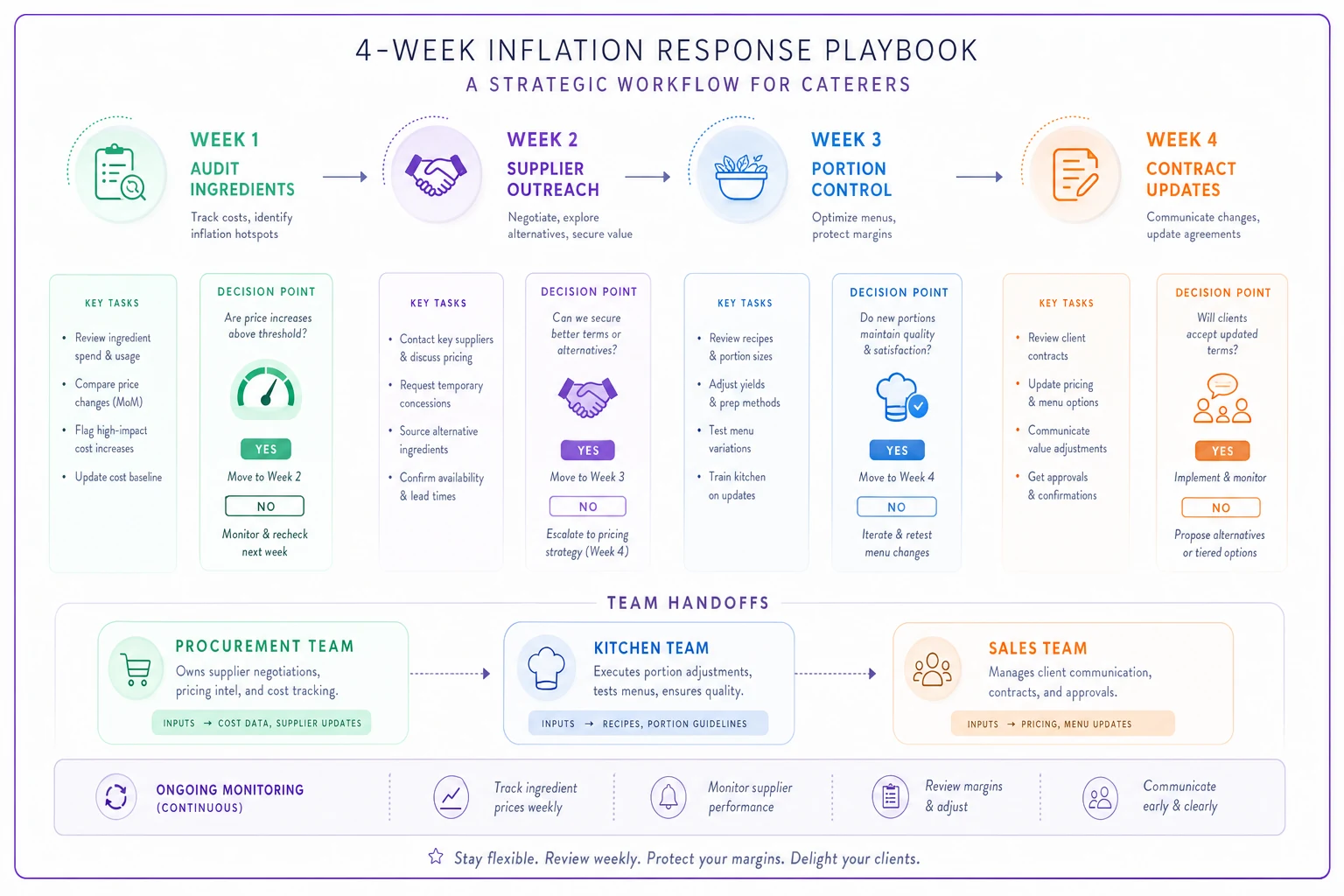
Use this flow to coordinate tasks across procurement, kitchen, and sales.
Week 1:
-
Audit your top 30 ingredients for price changes
-
Identify three suppliers for each key ingredient
-
Review all contracts for events 45+ days out
-
Calculate current actual margins (not projected)
Week 2:
-
Implement portion control standards
-
Create ingredient cross-utilization maps
-
Draft contract language for inflation adjustments
-
Restructure payment terms for new bookings
Week 3:
-
Build menu flexibility into upcoming proposals
-
Train kitchen on alternative preparations
-
Contact clients about potential adjustments
-
Start weekly supplier scorecards
Week 4:
-
Analyze contribution margins per menu item
-
Adjust featured items based on margins
-
Implement cash flow acceleration tactics
-
Review and adjust based on results
Review and adjust based on results
The technology leverage most caterers miss
Tracking all these moving pieces—supplier prices, portion costs, real-time margins, contract terms—typically requires scattered spreadsheets that nobody updates consistently. This is where a proper KPIs dashboard becomes essential for spotting margin erosion before it compounds.
Modern operational platforms can automatically flag when food costs exceed targets, track supplier pricing trends, and calculate real-time margins per event. Instead of discovering problems during monthly P&L reviews, you spot issues within days. AI automation handles the number-crunching while you focus on strategic adjustments and client relationships.
The caterers weathering inflation best aren't just raising prices or cutting portions—they're operationally nimble. They see cost changes early, adjust quickly, and communicate transparently. They treat inflation as an operational challenge requiring systematic solutions, not a crisis requiring panic moves.
This inflationary cycle will end eventually, but the operational improvements you make now—the systems, the flexibility, the monitoring—these become permanent competitive advantages. The caterers who emerge stronger aren't the ones who simply survived through price increases, but those who built better businesses through operational excellence.
Your clients need you to stay healthy and profitable. They'd rather work with a caterer who adjusts intelligently to market conditions than one who maintains old prices until bankruptcy. Make the operational moves now, while you still have room to maneuver.
Ready to elevate your catering business?
Join 500+ caterers trusting Caterngly to save time, reduce errors, and deliver flawless events.