

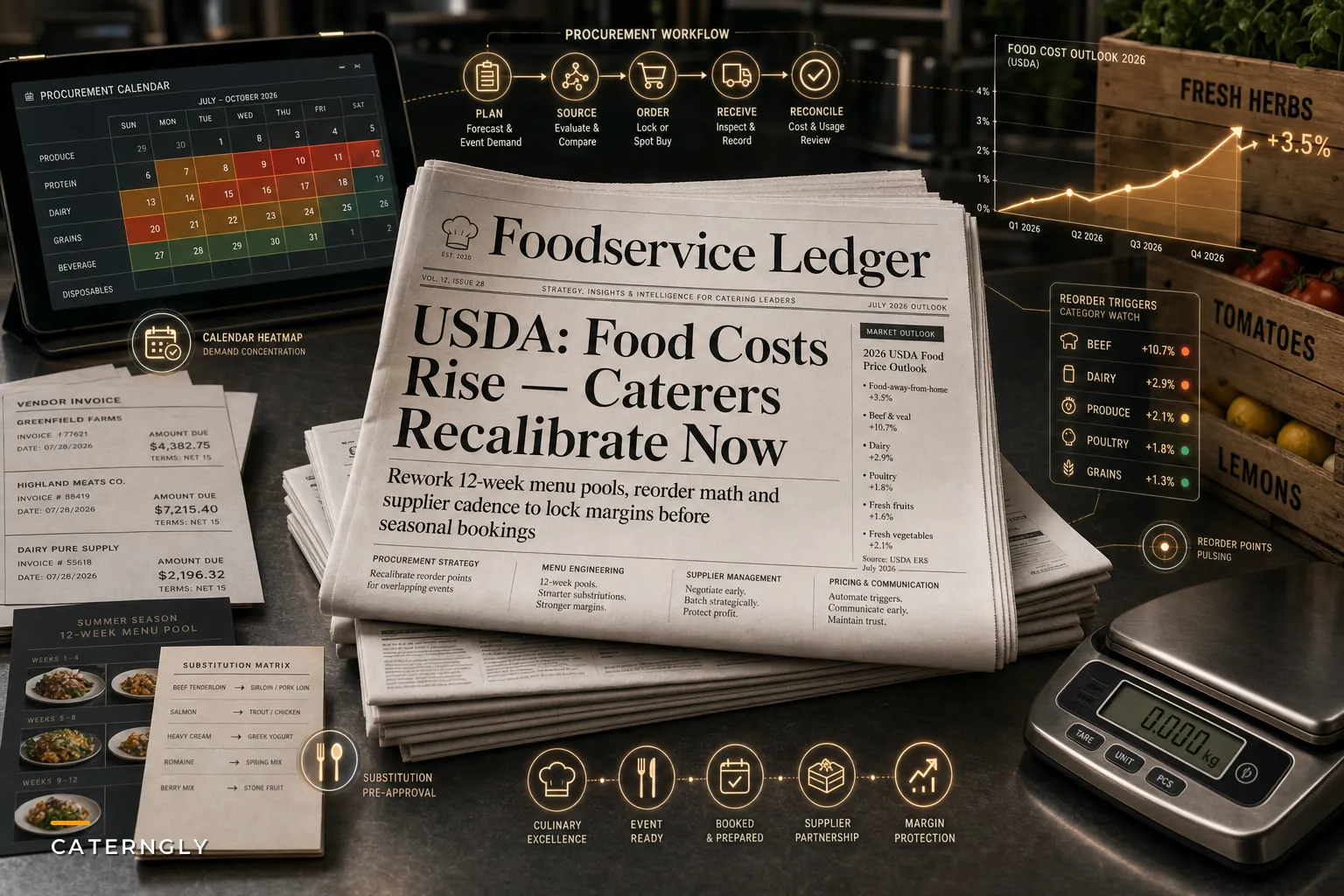

The USDA's July 24 Food Price Outlook dropped some brutal numbers for caterers: food-away-from-home prices climbing 3.5% overall, with beef shooting up 10.7%. If you're running a catering operation, you already felt this coming — protein costs have been creeping up for months, and now the government data confirms what your invoices have been saying.
What really stings is the timing. These projections land right as most caterers are locking in Q3 and Q4 contracts. Most operations quote events 60-90 days out at fixed pricing. That means the weddings you're booking today for October will hit your kitchen when beef costs peak. Your current menu pricing is already behind.
The situation gets uglier when you look at category volatility. Beef up 10.7%, poultry relatively stable, produce swinging based on regional weather. This isn't just inflation — it's category chaos that breaks traditional procurement thinking.
Why standard menu rotation fails when categories diverge this sharply
Most catering operations run some version of seasonal menu rotation — spring/summer menus, fall/winter menus, maybe a holiday cycle. Works fine when prices move predictably. Falls apart when beef jumps 10% while chicken stays flat.
A Dallas caterer learned this the hard way last fall. They'd built their entire fall menu around beef tenderloin stations and short rib entrees — stuff that had sold well at tastings. By the time those events rolled around, food cost on those items jumped from 28% to 34%. On a $15,000 wedding, that's $900 straight off the bottom line.
The problem runs deeper than just swapping proteins. When you build menus around specific ingredients, you create downstream dependencies — prep procedures, staff training, equipment allocation, even plating choices. A beef-heavy menu requires different cooking equipment than a seafood-focused one. Your prep cooks might know how to break down tenderloins in their sleep but struggle with whole fish.
Category divergence like we're seeing now exposes every assumption in your menu system. The 12-week rotation pools covered here help, but even those need recalibration when spreads get this wide.
Build procurement rules that actually respond to category swings
Blanket purchasing agreements don't work anymore. When beef and chicken prices diverge by 8-10%, locking in proteins quarterly becomes a profit killer. You need category-specific procurement triggers that move independently.
End chaos with centralized catering management.
Caterngly helps you plan, confirm, and manage every catering event seamlessly.
- Unified event and order management
- Real-time client updates
- Staff and resource scheduling
No credit card required
The framework keeping margins stable for operations dealing with these swings:
Category-specific reorder triggers:
-
Beef
Order only 2 weeks forward when prices exceed 7% YoY increase
-
Poultry
Lock 6 weeks when stable (under 3% variance)
-
Seafood
Spot purchase for events over 30 days out
-
Produce
Regional sourcing with 10-day maximum commitment
A Houston operation ran this split strategy starting in May. Their beef costs still went up — obviously — but they avoided locking in peak prices across their entire fall season. Meanwhile they secured solid poultry rates through November by extending commitments while that category was stable.
The overhead isn't trivial. You're running multiple procurement calendars at once. But the alternative — watching margins disappear because you locked the wrong protein at the wrong time — is worse.
Quick procurement adjustment checklist:
-
Review all standing orders immediately
-
Cancel or reduce beef commitments beyond 14 days
-
Identify stable categories for extended locks
-
Create substitution pre-approvals with key clients
-
Build buffer pricing into quotes beyond 45 days
Here's a quick visual to help operations decide which categories to lock and which to keep spot-priced.
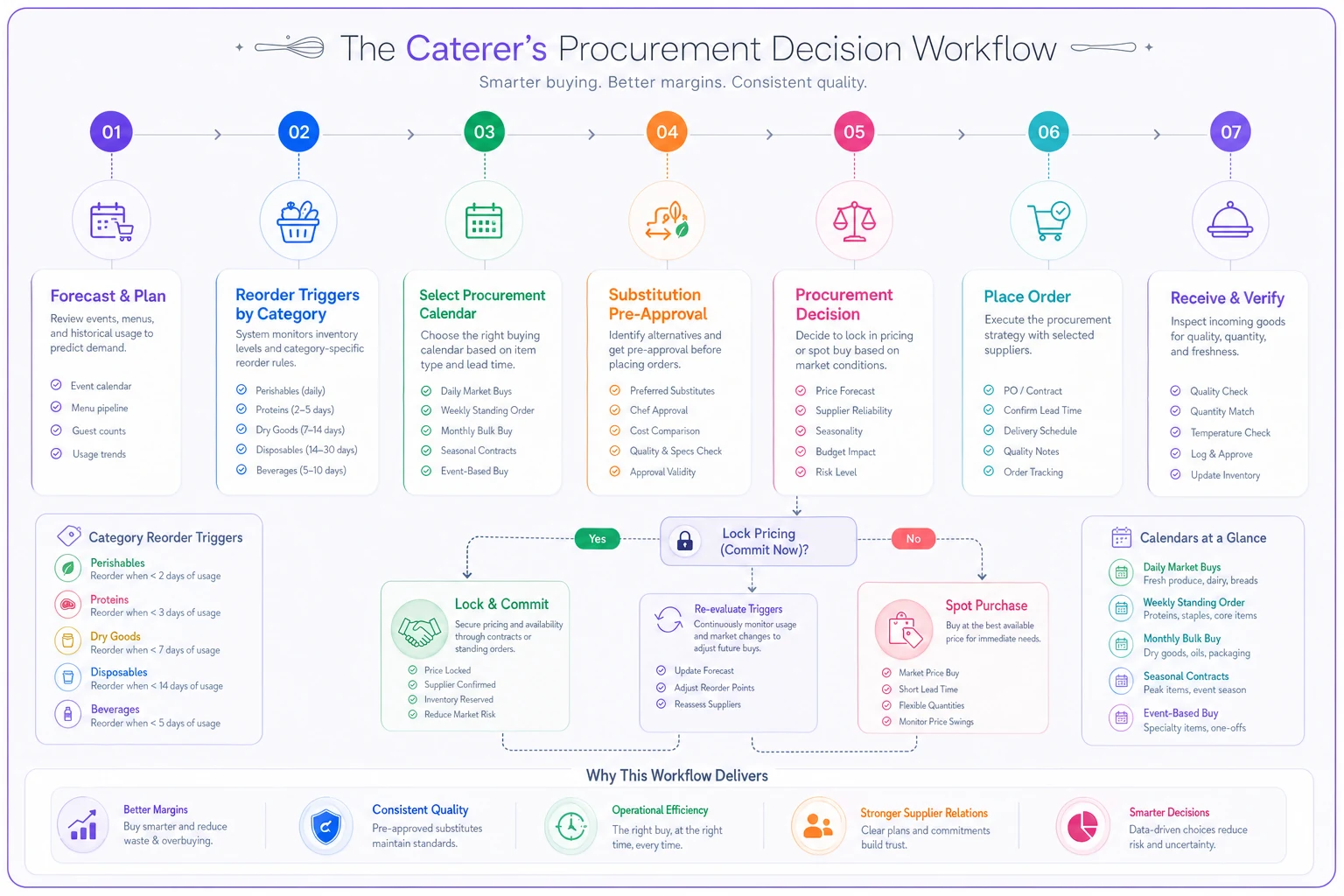
Run weekly procurement stand-ups during volatile periods to align kitchen, purchasing, and sales on which categories to lock.
Start with the categories that move the most and segment your procurement calendars there first; expand as your team gets comfortable.
The hidden killer: portion creep during price spikes
Something counterintuitive happens in kitchens when ingredient costs spike — portions often get bigger, not smaller. Chefs trying to maintain value perception start adding extra sides, garnishes, or bumping protein portions to justify higher menu prices.
One Baltimore caterer tracked this clearly. When beef prices jumped in June, their chef started cutting 8oz portions instead of the spec'd 6oz. "Clients are paying more, they should get more." Except food cost went from 30% to 37% overnight.
The math:
-
Original
6oz portion at $8/lb = $3 cost
-
Inflated price
$8.80/lb
-
Creep portion
8oz at $8.80/lb = $4.40 cost
47% increase in actual cost vs. a 10% price increase
Emergency menu engineering tactics for the next 90 days
Three distinct menu strategies need to run simultaneously through Q4:
1. Locked events (next 30-45 days):
-
Portion control becomes military-strict
-
Cross-utilize every protein trim
-
Push accompaniments that balance smaller proteins
-
Negotiate service upgrades instead of food additions
2. Quoted but unsigned (45-90 days):
-
"Seasonal menu updates" that pull back on beef-heavy items
-
Introduce "chef's market selections" with pricing TBD
-
Add 5-7% "market adjustment" language to contracts
-
Offer early-lock incentives for non-beef menus
3. Future inquiries (90+ days):
-
Design protein-flexible stations
-
Price everything with a 15% food cost buffer
-
Build modular menus that can swap proteins last-minute
-
Create "market price" tiers for volatile items
A Phoenix caterer running this three-track approach held a 31% food cost through a brutal summer price environment while competitors hit 38-40%.
Substitution matrices that preserve quality perception
The knee-jerk response to beef prices is "just swap in chicken." That's how you lose clients. Smart substitution maintains perceived value while cutting actual cost.
| Original Item | Naive Swap | Smart Substitution | Cost Save | Quality Perception |
|---|---|---|---|---|
| Beef Tenderloin | Chicken Breast | Pork Tenderloin + Demi | 45% | "Elevated comfort" |
| Short Ribs | Pulled Chicken | Lamb Shank (smaller) | 25% | "More exotic" |
| Beef Skewers | Veggie Skewers | Chicken + Beef Mix | 35% | "Variety station" |
| Prime Rib Station | Roasted Turkey | Carved Pork + Chimichurri | 40% | "Artisanal" |
The perception column isn't marketing fluff — it's operational strategy. Staff need talking points when clients ask questions. "We've upgraded to a chef-carved heritage pork with house-made chimichurri" is a very different conversation than "beef got too expensive."
Renegotiation scripts for locked contracts
Sometimes you're just stuck. Contract signed, beef-heavy menu locked, event in 30 days. You need a renegotiation approach that protects margins without burning the relationship.
"Hi [Client], I wanted to personally reach out about your upcoming event. Due to unprecedented increases in certain ingredients — beef prices alone are up nearly 11% since we planned your menu — I'd like to propose some alternatives that would actually enhance your guests' experience while keeping within your budget."
Key moves:
-
Never say "cheaper" — say "alternative" or "enhancement"
-
Offer something additional (appetizer upgrade, dessert station)
-
Present 2-3 options, not just one downgrade
-
Document everything in writing
Success rate on these conversations is somewhere around 60-70% when approached well. The remaining 30% who won't budge? You absorb the margin hit and adjust your quoting going forward.
Stop the bleeding with automated cost tracking
Manual cost tracking breaks down when prices swing this fast. By the time you update spreadsheets and run reports, you've already lost money on a few events.
Operational software platforms built for catering can pull pricing data directly from supplier invoices, match costs to menu items, and flag margin problems before quotes go out. Instead of discovering your beef wellington is underwater after you've already bought $3,000 in tenderloin, you get an alert when ingredient costs cross your thresholds.
AI automation handles the recalculation work that's otherwise a manual nightmare. When beef prices jump, the system recalculates every menu item using that ingredient, flags quotes that need adjustment, surfaces substitution options based on your preset matrices, and updates future pricing — without someone manually touching every line item.
This isn't about replacing your chef's judgment or your sales process. It's about having accurate numbers in real-time so you're not discovering problems at a monthly P&L review.
What happens if you don't adjust now
The USDA projections run through 2027, showing sustained pressure on food-away-from-home pricing. This isn't a blip you can wait out.
Caterers who don't restructure their menu and procurement approach now face a compound problem. Current bookings become loss leaders — your fall weddings with beef-forward menus quietly turn into events you're subsidizing. Meanwhile, you're training clients to expect those price points while your costs keep climbing.
That structural damage takes years to undo. Once clients anchor on your old pricing, raising rates feels like a betrayal. Competitors who adjusted earlier capture those price-conscious clients with properly margined menus.
A Virginia catering company ignored inflation signals in 2023, thinking they'd ride it out with competitive pricing. By mid-2024, they were doing roughly 20% more events but making around 30% less profit. Working harder to go broke slower, as the owner put it.
The three moves that matter most right now
Looking at catering operations navigating these conditions, three moves consistently separate those holding margins from those losing ground:
First, implement floating protein pricing immediately. Not for current contracts — everything quoted beyond 45 days. Add language that allows protein selection 30 days before the event based on market conditions. Clients get menu certainty, you get cost flexibility.
Second, redesign portions around accompaniments. A 5oz protein with exceptional sides often feels more generous than 8oz with basic vegetables. This isn't cheaping out — it's redirecting food cost to where it creates the most value. Grains, legumes, and seasonal vegetables carry better margins and give your kitchen more creative flexibility.
Third, build category-specific procurement rules. The difference between locking beef for 90 days versus 14 days could be the difference between a profitable Q4 and a painful one.
The USDA outlook isn't catastrophic — food service has survived worse cycles. But it demands operational changes now, not after Q4 damage shows up in your books. The caterers restructuring their menu rotation, procurement, and pricing today will have healthy margins when everyone else is scrambling to catch up.
Hope is not a procurement strategy when the USDA is literally publishing warnings about what's coming.
Ready to elevate your catering business?
Join 500+ caterers trusting Caterngly to save time, reduce errors, and deliver flawless events.