

Your spring menu has been killing it for three months straight. Herb-crusted salmon with seasonal asparagus at every corporate event. Clients love the strawberry spinach salad. Everything's dialed in.
Then July hits. Asparagus jumps from $3.20 to $7.80 per pound. Strawberries vanish from wholesale lists. Your salmon supplier starts shorting orders. Suddenly that profitable spring menu is bleeding money, and you've got seventeen events already booked with those exact items.
Most caterers scramble here. They eat the cost difference and destroy margins, frantically substitute items and confuse clients, or just keep the same menu year-round and watch food costs swing wildly with every season change.
The hidden complexity of catering menu management
Running a catering menu rotation isn't like managing a restaurant. Restaurants can change items daily. You're booking events three to six months out with specific menu commitments. When a client books your autumn harvest menu in June for their October wedding, you're essentially making a futures contract on butternut squash prices.
The operational challenge compounds when you factor in:
-
Events booked months in advance at locked-in prices
-
Seasonal ingredient availability that doesn't match booking seasons
-
Vendor minimums that force bulk purchasing
-
Multiple events per week requiring different menu items
-
Staff training on new preparations and presentations
Most caterers handle this reactively. Margins drop, pricing gets panic-updated, then they deal with clients who booked at old rates. Or menus stay static and cost volatility just gets absorbed. Neither works at scale.
Building a 12-week rotating pool system
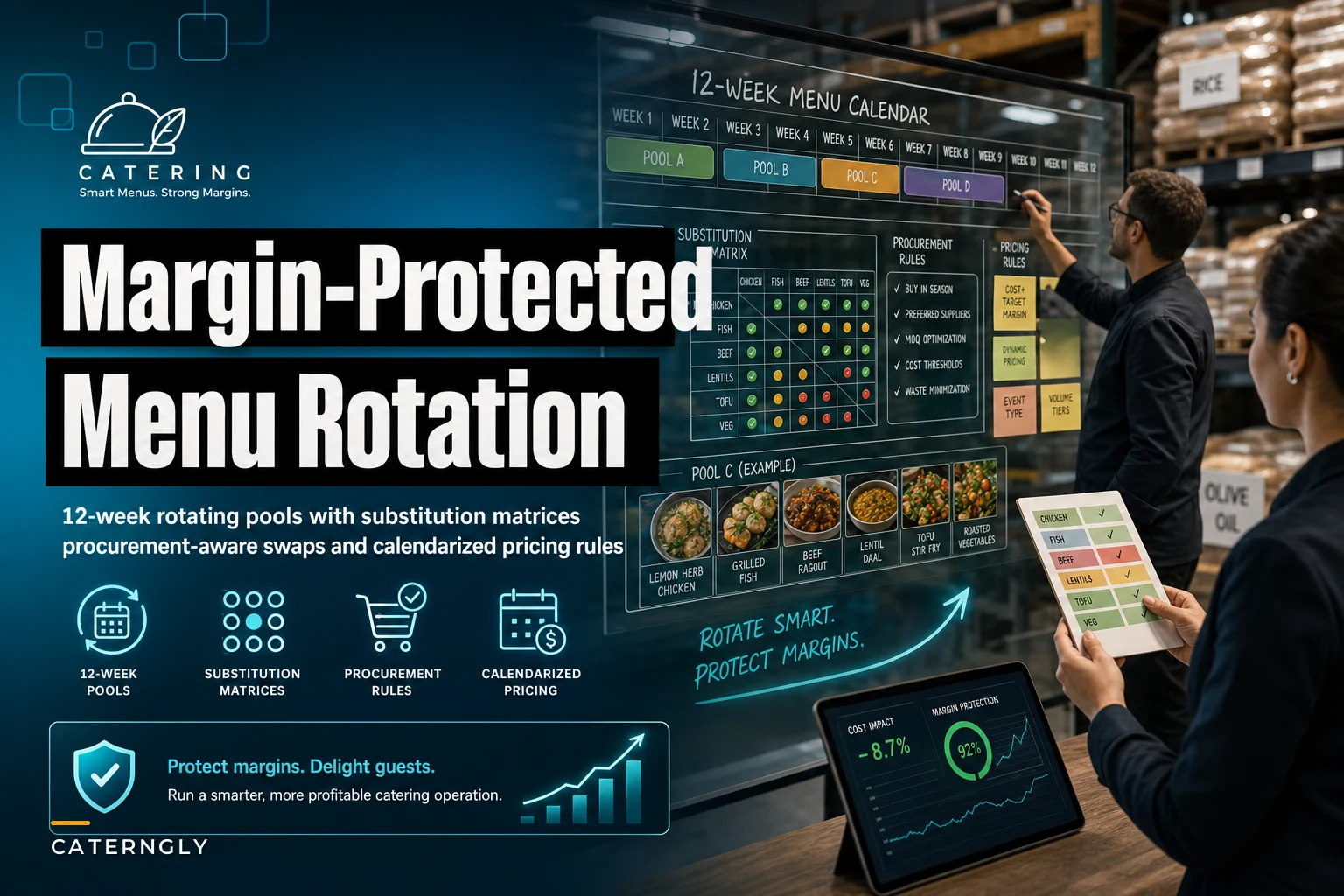
The most stable approach involves creating four seasonal menu pools, each with 12–15 core items rotating on a fixed schedule. The key difference from what most caterers try: you're not just rotating menus, you're rotating entire operational systems.
End chaos with centralized catering management.
Caterngly helps you plan, confirm, and manage every catering event seamlessly.
- Unified event and order management
- Real-time client updates
- Staff and resource scheduling
No credit card required
Each 12-week pool contains:
-
5 protein options with locked supplier agreements
-
4 vegetable sides with backup substitutions pre-defined
-
3 starch/grain options with portion flexibility
-
3 salad configurations with seasonal swaps built in
The value comes from how these pools overlap. While you're selling from Pool A (spring menu), you're simultaneously procuring for Pool B (summer menu) and planning Pool C (fall menu). That three-pool visibility window lets you lock in pricing before you commit to clients.
Here's what a typical rotation calendar looks like:
| Period | Active Sales Pool | Active Service Pool | Procurement Pool | Planning Pool |
|---|---|---|---|---|
| Jan-Mar | Spring | Winter | Spring | Summer |
| Apr-Jun | Summer | Spring | Summer | Fall |
| Jul-Sep | Fall | Summer | Fall | Winter |
| Oct-Dec | Winter | Fall | Winter | Spring |
Notice the intentional offset. You're always selling from next season's menu while serving this season's events. That gap gives you pricing protection and procurement leverage.
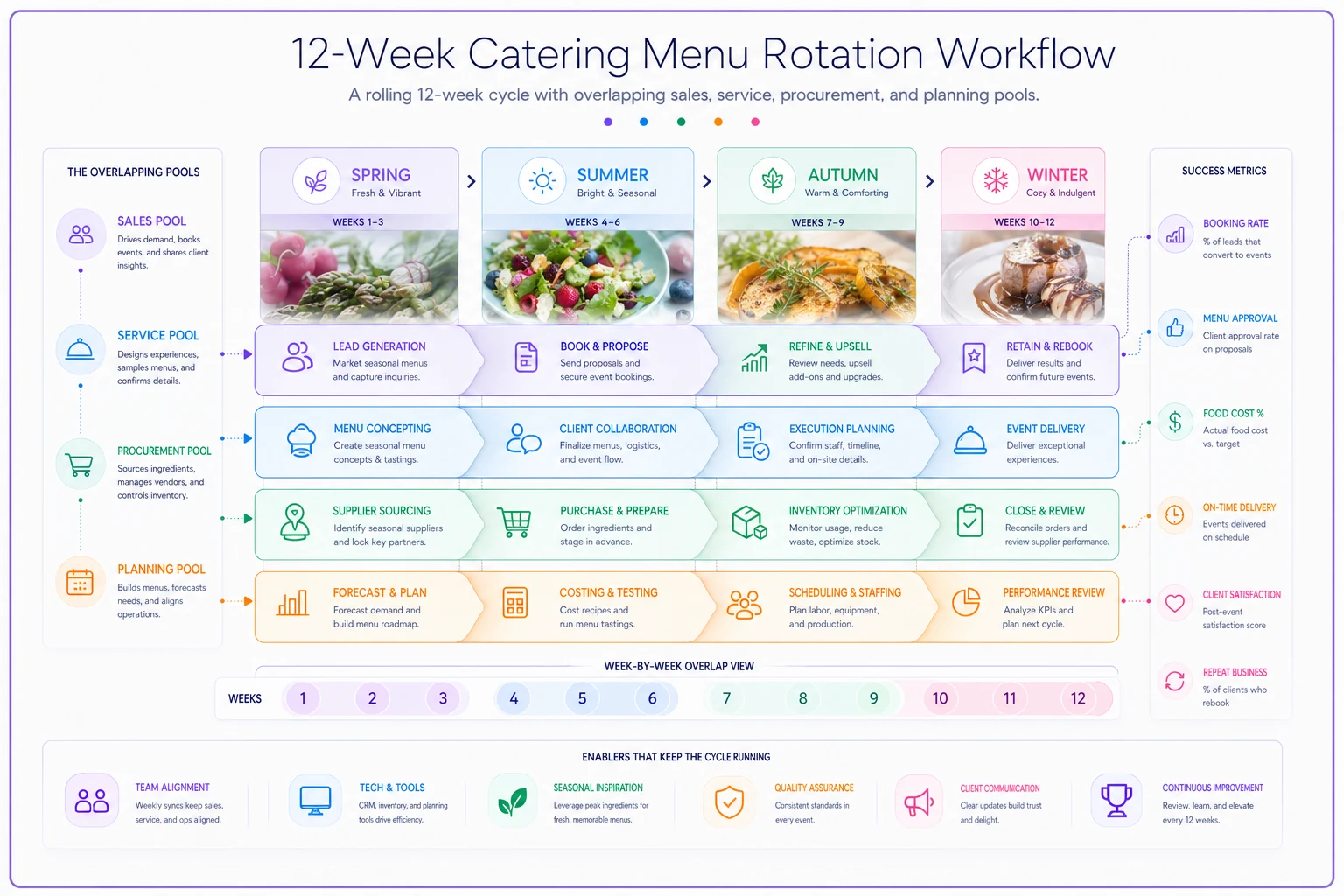
This visual shows how the pools overlap and flow across a quarter, clarifying when to sell, serve, procure and plan.
The substitution matrix that saves margins
The real operational breakthrough comes from building substitution matrices before you need them. Most caterers figure out substitutions in a panic when ingredients spike or disappear. Smart operators build the substitution logic directly into their rotation system from the start.
For every primary ingredient, you define:
-
Trigger price (when to switch)
-
Primary substitute
-
Secondary substitute
-
Preparation adjustments
-
Pricing impact
Take that herb-crusted salmon. Your substitution matrix might look like:
Primary: Atlantic Salmon
-
Trigger
>$14/lb wholesale
-
Sub 1
Arctic char ($11–13/lb)
-
Sub 2
Striped bass ($9–11/lb)
-
Prep change
Reduce herb crust thickness for char (flakes easier)
-
Price impact
None if switched before $14 trigger
The key is building these rules into your pricing system from the start. When you quote an event six months out, you're not pricing based on today's salmon cost—you're pricing based on your worst-case substitution scenario.
Procurement rules that protect profitability
Traditional catering procurement is reactive. Book an event, create a shopping list, order ingredients. That approach guarantees margin volatility because you're always buying at spot prices.
The 12-week pool system flips that sequence. You commit to ingredient volumes before booking specific events, using a rolling procurement calendar that locks in pricing for entire menu pools.
Here's how procurement timing works across a typical quarter:
Week 1–3 of each quarter:
-
Lock protein contracts for next pool
-
Negotiate produce standing orders
-
Confirm specialty item availability
Week 4–6:
-
Test new pool recipes with staff
-
Photograph dishes for sales materials
-
Calculate final portion costs
Week 7–9:
-
Begin selling next pool to clients
-
Monitor current pool performance
-
Adjust substitution triggers if needed
Week 10–12:
-
Evaluate pool profitability
-
Document successful substitutions
-
Plan modifications for next rotation
Pro-tip: Prioritize locking protein contracts in Week 1–3 to capture supplier discounts and stabilize margins.
Following this sequence means you're never surprised by cost changes mid-quarter. Margins are known before prices are quoted, which changes the entire dynamic of how you sell.
Connecting rotation to booking systems
The biggest operational failure happens when your rotation system doesn't talk to your booking system. Sales staff quote items from the wrong pool. Operations orders ingredients for discontinued items. Clients get confused about what's actually available.
This is where operational software matters. You need systems that enforce rotation rules automatically—blocking sales staff from booking winter items for summer events, triggering procurement based on forward bookings, alerting when substitution thresholds are hit.
When your event calendar drives your reorder points, you're not guessing at volume needs. The system knows you have fourteen events booked in October featuring butternut squash soup, so it triggers September procurement automatically. Most caterers still manage this through spreadsheets and memory, which works until it doesn't.
Managing client expectations through menu transitions
Clients hate surprises. The couple who tasted your summer menu in July expects those exact dishes at their September wedding. Abrupt changes damage client relationships in ways that are hard to recover from.
The 12-week pool system builds in natural overlap periods. During transition weeks, both pools stay available at different price points. Early-season items from the outgoing pool carry a small premium. Late-season items from the incoming pool offer a slight discount. This pricing gradient naturally moves clients toward seasonal options without forcing anything.
Your sales conversations shift too. Instead of apologizing that something isn't available, you're offering seasonal value. "We can absolutely do the heirloom tomato salad for your October event, though our autumn harvest salad with roasted beets and candied walnuts is really spectacular that time of year and runs about $3 less per guest."
Margin protection through systematic rules
Every catering operation leaks margin through inconsistent decision-making. One coordinator approves a substitution that kills profit. Another locks in pricing before checking procurement costs. These individual decisions compound into real losses over a quarter.
The 12-week rotation system replaces individual judgment calls with operational rules.
Pricing rules:
-
Never quote beyond current procurement pool
-
All quotes expire at pool transitions
-
Substitutions trigger automatic price reviews
Procurement rules:
-
Minimum 20% margin on all pool items
-
No single-event procurement (everything in pool quantities)
-
Substitution triggers set at 15% margin threshold
Operations rules:
-
New pools require full staff training before launch
-
Substitutions must be tested before triggering
-
Client notification required 30 days before transitions
These aren't suggestions—they're enforced constraints. When your coordinator tries to book a December event with spring ingredients, the system blocks it. When procurement costs spike above triggers, substitutions happen automatically rather than after a panicked phone call. Getting this discipline into daily operations is harder than it sounds, but once it's there, the margin swings mostly disappear.
Real scenario: How rotation saved a $400k/year operation
A corporate catering company in Chicago was bleeding margin on their "signature" menus. Same 10 entrees year-round, absorbing massive cost swings. Their mushroom risotto cost $4.80 per portion in October but $8.20 in April. They couldn't raise prices mid-season without losing corporate contracts.
After implementing a 12-week rotation system:
-
Food costs stabilized within 3% quarter-to-quarter
-
Overall margins improved from 31% to 43%
-
Client satisfaction increased (menus felt "fresh")
-
Procurement costs dropped around 15% through advance pool buying
-
Food waste decreased since they weren't panic-buying for individual events
The biggest surprise was that corporate clients actually preferred the seasonal variety. Instead of seeing the same menu every quarter, they got options that felt more considered—and nobody complained about the change.
Building your rotation system step-by-step
Start simple. Don't try to overhaul everything at once.
-
Phase 1 (Month 1) Map your current menu items to seasons. Which items are naturally spring-focused? What screams autumn? Build initial pools from what you already do well.
-
Phase 2 (Month 2) Create substitution matrices for your top 10 items. Focus on proteins first—they drive most of your cost volatility. Document trigger prices and approved substitutes.
-
Phase 3 (Month 3) Test your first rotation. Run spring and summer pools simultaneously. Track what breaks. Document client reactions. Adjust transition timing.
-
Phase 4 (Month 4–6) Lock in procurement contracts for your proven pools. This is where margins improve noticeably. Vendors give better pricing for committed quarterly volumes versus spot purchases.
-
Phase 5 (Ongoing) Refine substitution triggers based on actual margin data. Add seasonal pools gradually. Build the system into your operational platform so it runs without constant manual intervention.
Expect the first rotation to be messy. Something will break—usually the transition timing or a substitution that doesn't land with clients. That's fine. The point of phasing it in slowly is that you catch those problems at low cost before they're baked into every event you run.
When rotation systems fail
Not every catering operation benefits from rigid rotation. If you primarily do corporate drop-off with basic sandwiches and salads, the added complexity might hurt more than it helps. If clients specifically choose you for signature dishes that define your brand, forced rotation could damage your core value proposition.
Rotation works best when:
-
You handle diverse event types with varying menus
-
Your ingredients have significant seasonal price swings
-
You book events 2–6 months in advance
-
Your clients value variety and freshness
-
You have enough volume to negotiate procurement contracts
If you're doing fewer than 20 events monthly, skip it for now. The operational overhead isn't worth it until pool purchasing actually moves the needle on costs.
The technology that makes rotation manageable
Manual rotation management falls apart at scale. You need systems that automatically enforce pool rules, track substitution triggers, and coordinate procurement with bookings.
AI-powered catering platforms handle this complexity in the background—monitoring ingredient prices, flagging when triggers are hit, suggesting substitutions based on margin impact, and catching booking errors before they happen. The critical feature is connecting your menu pools to your booking calendar so everyone's working from the same rotation schedule, whether that's through specialized catering software or a well-structured database. Even basic operational software beats spreadsheets here.
Systemization is what makes rotation sustainable. The tool matters less than actually building the process.
Making rotation work tomorrow
The path from chaotic menu management to systematic rotation doesn't require perfection. Start with your most problematic ingredients—usually proteins with volatile pricing. Build substitution rules for those first. Test a single seasonal transition before committing to full 12-week pools.
Treat rotation as an operational system, not a marketing angle. The goal isn't to impress clients with seasonal menus, though that's a decent bonus. The goal is to protect margins through predictable procurement and systematic substitution rules.
When ingredient costs spike, you've already got substitutions defined. When seasons change, pricing is already locked. When clients book months out, you know what your margins will be. That's the difference between reactive menu management and a rotation system that actually works.
Ready to elevate your catering business?
Join 500+ caterers trusting Caterngly to save time, reduce errors, and deliver flawless events.