

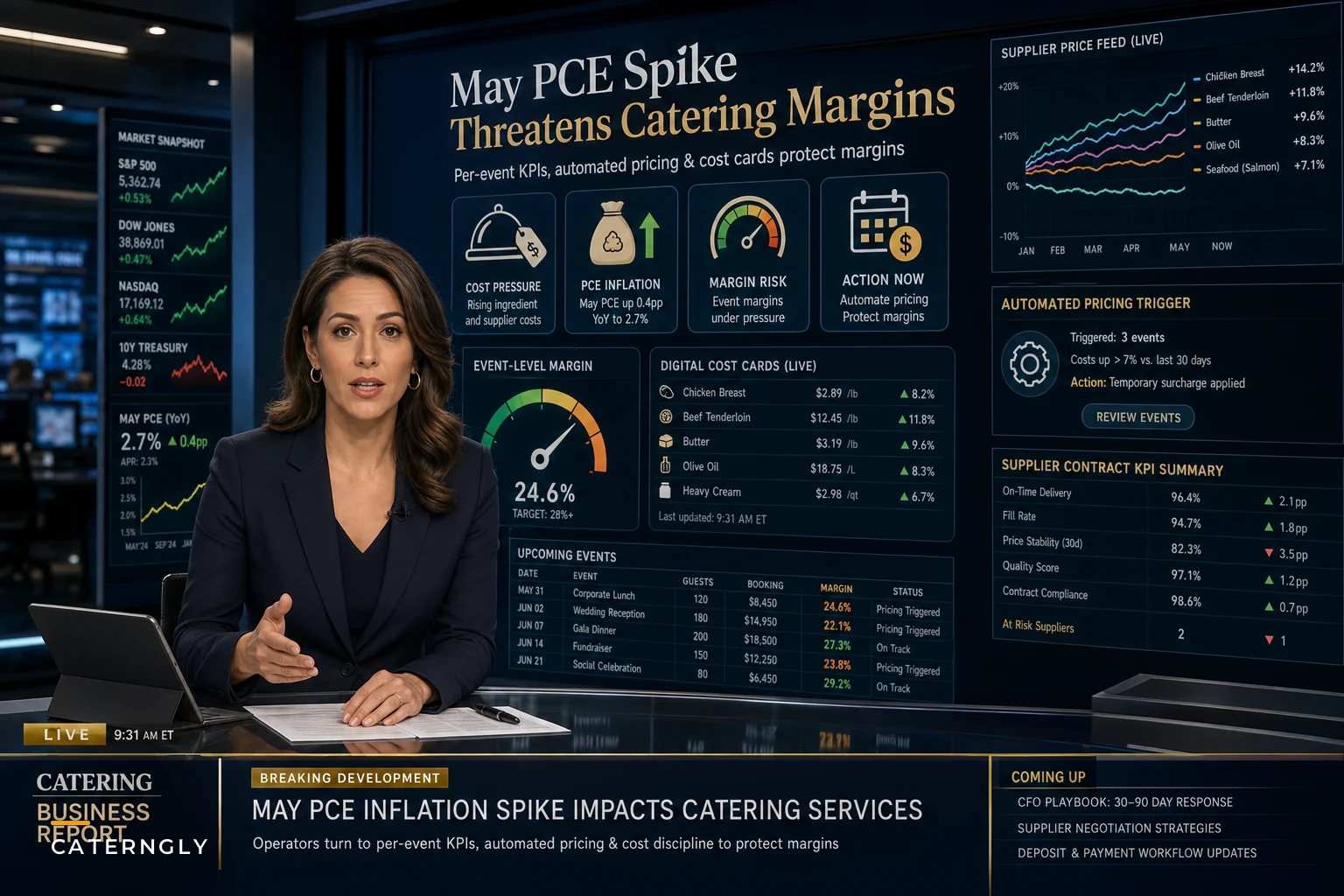

The May PCE inflation numbers dropped yesterday, and they're worse than expected. The Bureau of Economic Analysis reported a 4.1% year-over-year headline increase with core PCE hitting 3.4% — the highest since October 2023. For catering operations already working with thin margins on overlapping bookings, this isn't just another data point to scroll past. It's an operational problem sitting inside your June invoices right now.
Most caterers track margins quarterly or monthly. By the time you spot the damage from this inflation spike, you'll have already locked in pricing for dozens of summer events at rates that no longer cover actual costs. The gap between what you quoted in April and what you're paying suppliers in late June could easily wipe out your profit on those back-to-back Saturday bookings where you're already stretched thin.
The inflation squeeze hits caterers differently than restaurants
Restaurant owners can adjust menu prices weekly. They see costs go up and react. Caterers are stuck honoring quotes from 60-90 days ago while paying today's inflated prices for ingredients, fuel, and labor.
Take a typical 150-person wedding quoted in early April. Your cost card showed $42 per head for food and beverage, giving you a solid 35% margin at $65 per head. Between April and late June, here's what actually happened to costs:
-
Proteins up 6-8% (beef especially)
-
Dairy up 4-5%
-
Fresh produce up 7-9% (weather plus fuel costs)
-
Delivery fuel surcharges adding another 3%
-
Prep cook demanding $2 more per hour to match the new Chipotle starting wage
That $42 cost basis is now pushing $46-47. Your 35% margin just collapsed to under 28%, and that's before overtime on a weekend where three events are running simultaneously.
The real problem is that most catering operations don't catch this event-by-event. Monthly numbers blend profitable corporate lunches with money-losing wedding receptions into something that looks passable until it isn't. By the time the pattern becomes clear, you've already committed to more events at underwater pricing.
Why traditional KPI tracking fails during inflation spikes
Standard catering KPI dashboards track the wrong metrics at the wrong frequency. Most operations monitor:
End chaos with centralized catering management.
Caterngly helps you plan, confirm, and manage every catering event seamlessly.
- Unified event and order management
- Real-time client updates
- Staff and resource scheduling
No credit card required
-
Monthly food cost percentage
-
Quarterly labor ratios
-
Annual equipment ROI
-
Weekly sales totals
These are lagging indicators. They tell you what already happened, not what's happening to your margins right now. During rapid cost escalation, you need per-event margin tracking that flags problems before they compound — not after you've invoiced twelve more bookings.
Here's what per-event KPI tracking looks like in practice versus the traditional monthly view:
Traditional Monthly View:
-
June food costs
34% (looks acceptable)
-
June labor
28% (within range)
-
June profit
12% (seems healthy)
Per-Event Reality for the Same Period:
-
Corporate lunch June 3rd
41% profit
-
Wedding June 10th
-3% loss
-
Graduation party June 11th
8% profit
-
Wedding June 17th
-7% loss
-
Corporate dinner June 22nd
38% profit
The profitable corporate events mask the bleeding on social events. Without event-level visibility, you keep accepting wedding bookings at rates that guarantee losses while missing opportunities to raise corporate catering prices the market would easily bear.
Building inflation-responsive per-event KPIs
Forget monthly averages. During inflation surges, you need four specific KPIs calculated for every single event, updated in real-time as costs change.
1. Live Contribution Margin per Event
Event: Thompson Wedding (July 15) Original quoted margin: 35% Current cost basis margin: 27% Variance: -8% Decision required: Yes/No
When variance exceeds 5%, that's your trigger to either renegotiate, add a surcharge, or adjust the menu within contract terms. Most caterers have more contract flexibility than they realize — but only if they catch the compression early enough to act.
2. Booking-to-Service Cost Drift
Track the percentage change in your cost basis between when you book an event and when you actually serve it. During the May PCE spike, caterers with 60-day booking windows saw drift rates anywhere from 4% to 11%.
-
0-3% drift
Absorb it
-
3-6% drift
Optimize portions and substitutions
-
6-9% drift
Invoke inflation clause or modify the menu
-
9%+ drift
Mandatory client conversation about a surcharge or significant menu changes
3. Event Clustering Impact Score
Overlapping events compound cost problems fast. Running three events on the same Saturday doesn't just add ingredient costs — it changes your entire labor structure:
-
Solo event day
0% penalty
-
2 events same day
3% cost penalty
-
3 events same day
7% cost penalty
-
4+ events same day
12% cost penalty
That seemingly solid 35% margin wedding drops to around 28% when it's one of three events that day. Worth knowing before you book the fourth.
4. Cash Conversion Velocity by Event Type
Inflation makes cash flow timing critical in a way it just isn't during stable periods. How quickly each event type converts from commitment to cash in hand matters more than most caterers account for:
| Event Type | Deposit to Service Days | Final Payment Gap | Actual Cash in Hand |
|---|---|---|---|
| Corporate Lunch | 14 days | Net-30 post event | 44 days |
| Wedding | 120 days | 14 days pre-event | Full at service |
| Social Event | 45 days | 7 days pre-event | Full at service |
| Drop-off Catering | 3 days | On delivery | 3 days |
During inflation spikes, prioritize event types that convert to cash fastest. Corporate lunches with Net-30 terms mean you're floating inflating costs for 44 days. Drop-off catering puts cash in hand immediately.
Operational triggers that protect margins during inflation
Per-event KPIs only matter if they actually drive decisions. Below is the decision process that holds up when costs are spiking fast.
When Live Contribution Margin drops below 30%:
First, check your contract for flexibility. Most catering contracts include language around "menu subject to availability" or "comparable substitutions may be made." That's your opening. Swap expensive proteins for slightly less expensive cuts — beef tenderloin becomes beef sirloin, wild salmon becomes Atlantic salmon. Clients rarely notice when presentation stays excellent.
Second, look at portion elasticity. A 6-inch square of lasagna versus 5.5 inches saves roughly 8% on food cost. Plated salads can drop from 4 ounces to 3.5 ounces of greens without much visual impact. Small adjustments across 150 guests add up quickly.
When Booking-to-Service Drift exceeds 6%:
-
Honor original menu with a specific surcharge
-
Modify menu to maintain original price
-
Hybrid — smaller surcharge and minor modifications
Roughly 70% of clients choose option 3 when you present it professionally with documentation showing real cost increases. The other 30% usually aren't the clients you want locking up your calendar anyway.
When Event Clustering pushes overtime above 15% of labor cost:
Stop accepting same-day bookings unless pricing includes a peak date premium of 15-20%. For existing clustered bookings, shift prep work to Thursday or Friday, bring in temporary prep staff at regular rates to avoid overtime on service day, or outsource specific components like desserts or appetizers.
The portfolio approach to margin protection
Think of your event calendar like a portfolio during market volatility. You need balance:
-
Hedge events
High-margin corporate drop-offs that offset wedding losses
-
Core holdings
Standard-margin recurring corporate accounts with predictable costs
-
Risk positions
Large social events with longer booking windows
-
Cash generators
Last-minute bookings at premium prices
During a PCE spike like this one, your mix should shift toward hedge events and cash generators. That might mean actively marketing corporate summer picnics — shorter booking windows, simpler menus — while being more selective about fall wedding bookings that lock you into September pricing with November or December costs.
-
Monday
Corporate lunch delivery (42% margin, immediate payment)
-
Wednesday
Office breakfast spread (38% margin, Net-15)
-
Saturday afternoon
Single wedding (28% margin after adjustments)
-
Sunday
Corporate family picnic (35% margin, deposit heavy)
This mix generates enough cash flow and margin to absorb the wedding's lower profitability without clustering penalties compounding the damage.
Technology and systems that enable per-event tracking
Manual calculation of per-event KPIs during busy season isn't really viable once volume picks up. You need systems that automatically pull current supplier pricing, calculate real margins, and flag events requiring attention before the window to act closes.
The minimum setup includes:
-
Digital cost cards that update weekly from supplier price sheets
-
Event management software that calculates margins at booking and weekly thereafter
-
Automated alerts when any event's margin drops below threshold
-
Integration between your booking system and accounting platform
Many caterers try to manage this in spreadsheets, and it usually holds together until around 15-20 events per month. Then the manual updates become overwhelming, especially when overlapping events pile up. Operational platforms built for continuous monitoring can flag margin problems while you still have time to do something about them — rather than discovering the damage in next month's reconciliation. The difference between catching a margin problem at week two versus week eight of a booking window is often the difference between an easy menu adjustment and a difficult client conversation.
Automate supplier price imports to your digital cost cards first — it eliminates the biggest source of stale-cost drift.
A quick workflow diagram helps teams see how data moves from suppliers into cost cards, into event margins, and then into alerts so everyone knows who acts when.
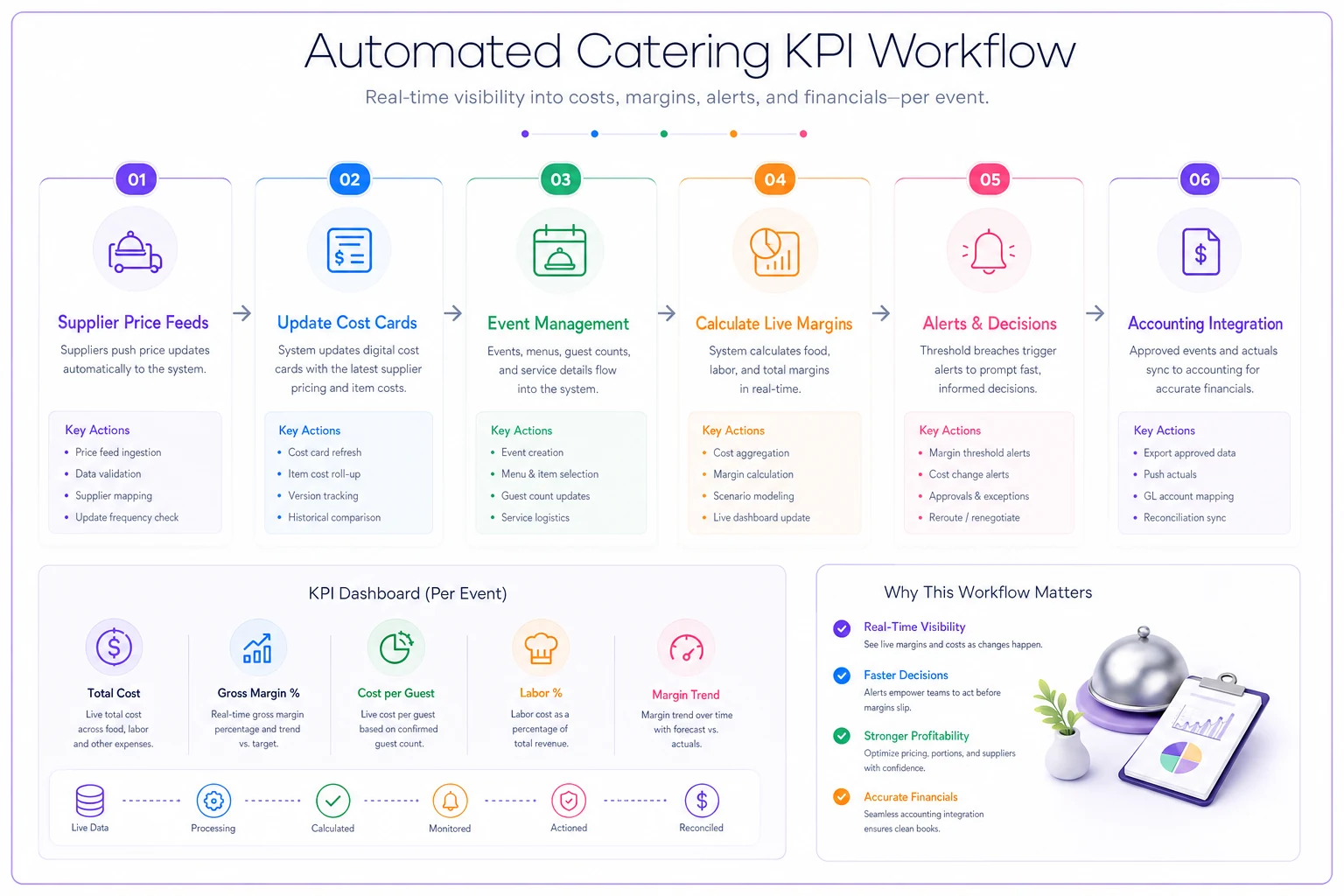
Use this as a reference when designing integrations so alerts land with the right person before a booking window closes.
Our detailed pricing system guide walks through the technical setup for automated cost tracking and trigger implementation. The key is connecting supplier data directly to your event pricing so margins update automatically as costs change.
Reading the forward indicators
The CNBC report on May's PCE data suggests this isn't a temporary blip. Core inflation trending above 3% means costs will keep climbing through summer. Caterers already taking defensive positions are doing a few specific things:
-
Supplier negotiations
Lock in 60-day pricing agreements where possible, especially on proteins and dairy. Even if prices are higher than January, certainty beats volatility when you're quoting events months out.
-
Contract modifications
Add explicit inflation adjustment clauses to all bookings beyond 45 days. Language like "Pricing subject to adjustment if supplier costs increase more than 5% between booking and event date" gives you real flexibility.
-
Menu engineering
Build alternate menus around inflation-resistant ingredients. Pasta-based buffets, seasonal vegetables, and chicken-focused options provide margin protection when beef and seafood prices spike.
-
Deposit restructuring
Increase deposit percentages and move final payment dates earlier. This improves cash flow and reduces exposure to cost increases between booking and service.
During a PCE spike, prioritize supplier negotiations and deposit restructuring first — they directly reduce your exposure window.
The compound effect of ignoring per-event margins
Here's what the actual trajectory looks like when per-event KPIs aren't tracked during an inflation spike:
Month 1: Food costs are trending slightly higher but it looks like seasonal variation. No action taken.
Month 2: Overall margins compress 3-4% but corporate events are doing well, so aggregate numbers look acceptable. Bookings continue at standard rates.
Month 3: Multiple large social events hit simultaneously. Overtime labor combines with peak food costs. Several events lose money but you don't know which ones.
Month 4: Cash flow tightens as you float higher costs against slow-paying corporate accounts. You start declining events you can't staff without overtime.
Month 5: Reputation takes hits from renegotiating or canceling bookings you can't profitably service. Premium clients go elsewhere.
Month 6: Desperate for cash flow, you take any booking at any price, locking in losses for the next quarter.
This is completely preventable with per-event KPI tracking and decisive operational responses. The caterers who survive inflation spikes are the ones who spot margin compression early enough to still have options.
Moving from reactive to proactive margin management
The current PCE spike won't be the last disruption to hit catering operations. Whether it's another inflation surge, a supply chain problem, or a labor shortage, the operations that hold up are those with systems to detect and respond to margin pressure before it compounds.
Stop managing with monthly averages and quarterly reviews. Every event is its own P&L — track it that way. Per-event KPI monitoring not only protects you during inflation, it positions you to capture more profit when conditions improve because you actually understand which event types and clients drive your margins versus which ones just look profitable inside a blended monthly report.
Your competitors are still looking at last month's food cost percentage while you're adjusting next week's menu based on this morning's supplier price update. That gap compounds over an entire summer season.
Ready to elevate your catering business?
Join 500+ caterers trusting Caterngly to save time, reduce errors, and deliver flawless events.