

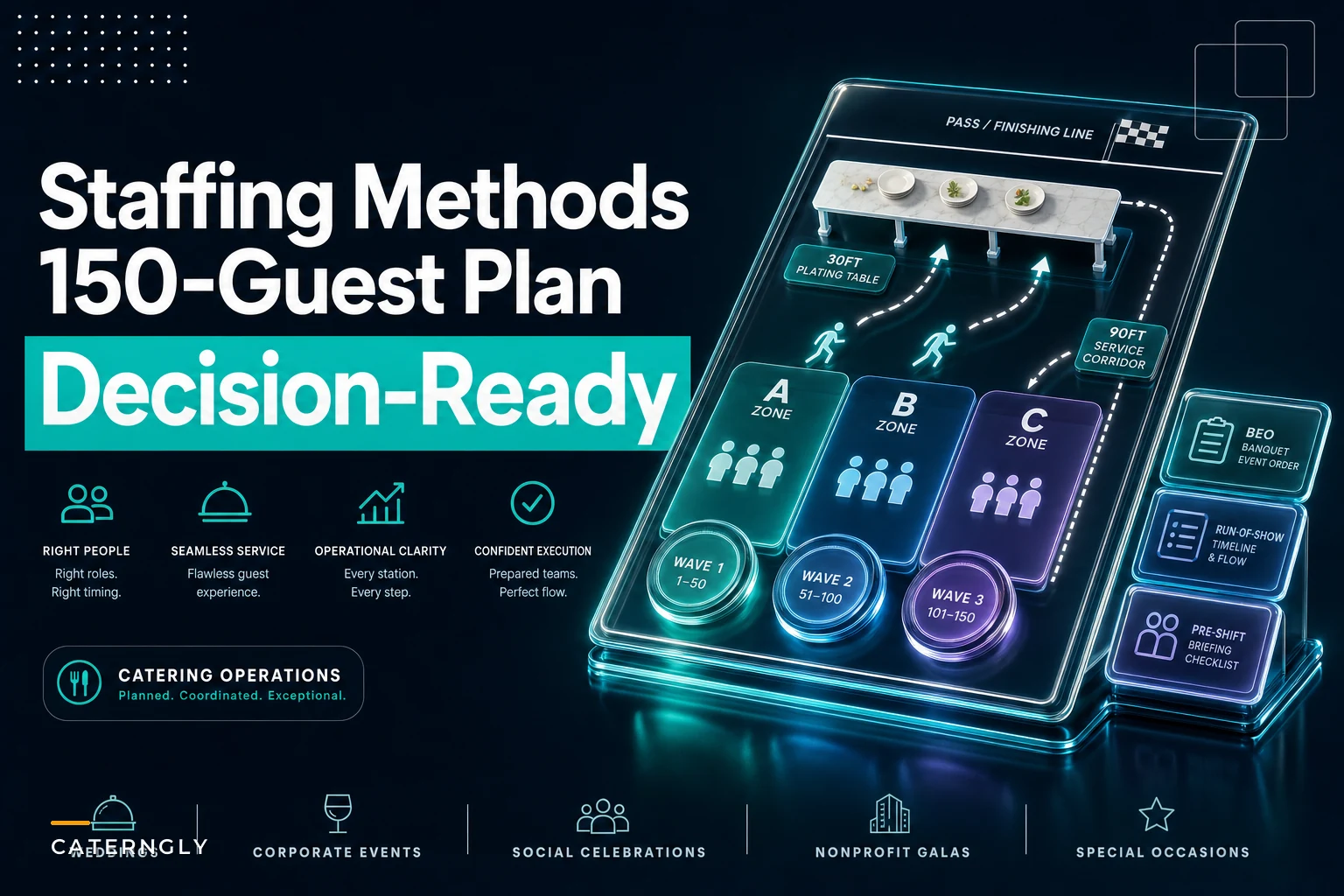

Three caterers can look at the exact same 150‑guest plated wedding and land on three completely different headcounts — 11 servers, 15 servers, 13 servers plus two floaters — and all three can defend their number. That's not incompetence. It's a method problem. Each one reached for a different estimation tool, and none of them stress‑tested it against the thing that actually breaks plated service: the kitchen pass.
So rather than argue in the abstract, let's run all three methods against the same event, same assumptions, and see where they diverge. Then we'll build the BEO, the rolling plate schedule, the pre‑shift cards, and convert everything into labor dollars so you can see which method would've cost you money.
If you want the deeper mechanics behind time‑per‑cover specifically, the plated‑service labor estimator with time‑per‑cover matrices and staging rules goes further into the matrix math than this piece will. This one is about the comparison and the applied worked example.
The base assumptions (lock these first, or nothing else matters)
Every method falls apart if people are silently assuming different things. So here's the shared scenario, written down the way it should live on the BEO:
-
Guest count 150 confirmed, seated at 15 rounds of 10.
-
Service style Full plated, synchronized courses. Three courses: salad (pre‑set), entrée (hot, dual‑choice beef or salmon), plated dessert.
-
Target service windows Salad already down before guests sit. Entrée fully delivered within 18 minutes of the fire call. Dessert delivered within 12 minutes.
-
Venue Single ballroom, kitchen 90 feet from the back service door, one service corridor. No freight elevator issues.
-
Pass capacity Finishing line can plate at a sustained ~40 entrée plates per 10 minutes once rolling (we'll test this number hard later).
-
Guest profile Wedding, so expect a toast and a first dance that can shift the entrée fire by 10–15 minutes without warning.
-
Wage assumptions for the dollar conversion Servers $22/hr loaded, captains $30/hr, runners $20/hr, back‑of‑house platers $24/hr, dish $18/hr. (Loaded = wage + payroll tax + the small stuff, not benefits.)
Notice what's already doing heavy lifting here: the dual entrée choice and the 18‑minute entrée window. Those two facts alone will separate the three methods. A single‑entrée plated meal with a relaxed window would let all three converge. Weddings rarely give you that.
Method 1 — Time‑per‑cover matrix
This is the engineering approach. You assign a per‑cover time cost to each service task, multiply by covers, divide by the window, and get bodies.
End chaos with centralized catering management.
Caterngly helps you plan, confirm, and manage every catering event seamlessly.
- Unified event and order management
- Real-time client updates
- Staff and resource scheduling
No credit card required
A reasonable matrix for a dual‑choice plated entrée with a 90‑foot carry:
| Task | Time per cover | Covers | Total task‑minutes |
|---|---|---|---|
| Salad pre‑set (before seating) | 0.35 min | 150 | 52.5 |
| Entrée run (pick, carry, place, mark) | 0.75 min | 150 | 112.5 |
| Entrée clear | 0.45 min | 150 | 67.5 |
| Dessert run | 0.55 min | 150 | 82.5 |
| Dessert clear | 0.40 min | 150 | 60 |
| Water/bread/coffee touches | 0.30 min | 150 | 45 |
The binding constraint is the entrée push: 112.5 task‑minutes that have to happen inside an 18‑minute window. That's 112.5 ÷ 18 ≈ 6.25 people working the entrée run simultaneously — but only if everyone is 100% productive, which never happens. Apply a real‑world utilization factor of about 0.75 (people reset, dodge each other in the corridor, re‑fire a dropped plate):
6.25 ÷ 0.75 ≈ 8.3 → 9 bodies on the entrée run.
-
Servers (section service + marking)
9
-
Dedicated runners (BOH to staging only)
3
-
Captain (calls the floor, syncs with kitchen)
1
-
BOH platers on the finishing line
4
-
Dish
1
Front‑of‑house total: 13. Full crew: 18.
The matrix's strength is that it surfaces the entrée window as the actual problem. The weakness is that it's only as good as your per‑cover numbers — and most caterers are using numbers borrowed from a venue that was 40 feet from the kitchen, not 90. Stale per‑cover times are probably the most common reason a "calculated" plan still runs late.
Method 2 — Rule‑of‑thumb covers‑per‑server
The back‑of‑napkin method. Plated fine‑dining weddings typically run 1 server per 10–12 covers for synchronized service, dropping to around 1:16 for relaxed plated.
-
Aggressive (1
16): ~9 servers
-
Standard (1
12): ~13 servers
-
Premium/synchronized (1
10): 15 servers
Most caterers quoting a wedding will grab 1:12 → 13 servers and feel covered.
Method 2 headcount by role (as typically assigned):
-
Servers
13
-
Captain
1
-
Runners
usually folded into the server count, or 1–2 added
-
BOH
estimated separately, often undercooked at 2–3 platers
Front‑of‑house total: 13–15. Full crew: often 16–17.
The quiet problem with covers‑per‑server: it says nothing about the window or the pass. A 1:12 ratio for a leisurely plated dinner with a 30‑minute entrée window is comfortable. That same ratio for an 18‑minute synchronized dual‑choice push is tight, because the ratio was never designed around fire window compression.
Operators who live by covers‑per‑server tend to do fine on normal events and then get crushed on the one wedding where the planner wants all 150 entrées down before the band restarts. The ratio didn't warn them.
When covers‑per‑server is actually fine: single‑entrée plated, generous windows, a venue you've worked before, a crew you know. Fast, good enough, and the overhead of building a full matrix isn't worth it.
When it's the wrong tool: dual or triple entrée choice, compressed windows, an unfamiliar venue with a long carry, or a demanding planner. That's exactly this event.
Method 3 — Event‑specific staging plan
This method ignores ratios entirely and builds backward from the physical choreography. You decide how the food moves, in what batches, through what zones — and the headcount falls out of the plan.
For this wedding, the staging logic:
-
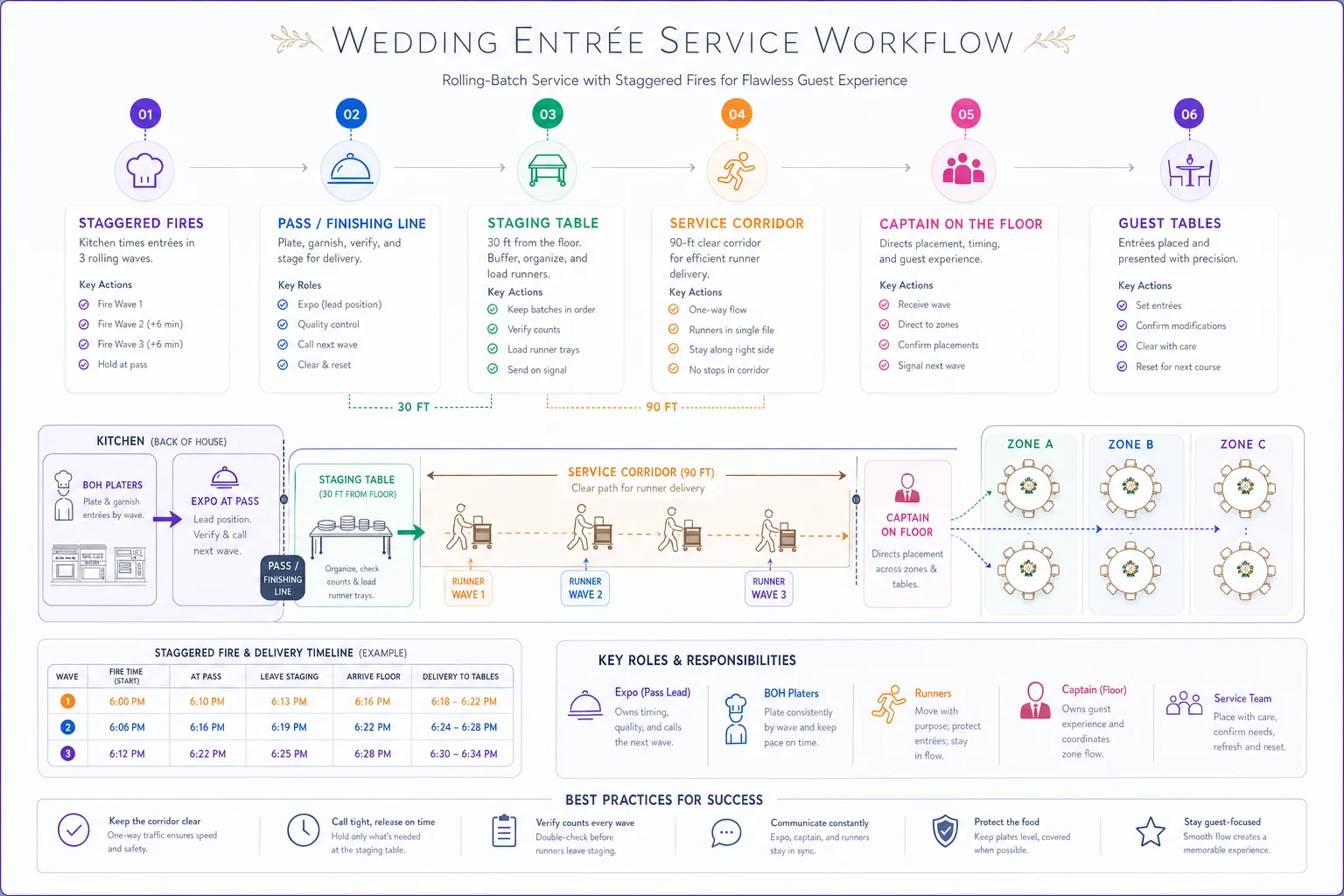
The corridor fits two‑way traffic but gets ugly with more than 6 people carrying at once. So entrée delivery happens in a rolling batch of 6 runners, each making staggered trips, fed by a staging table 30 feet from the floor.
-
Tables are delivered in three waves of 5 rounds (50 covers each) so the pass isn't asked to produce 150 plates in one impossible burst.
-
Each wave gets marked by 4 section servers who also handle clears, water, and the dessert run.
-
A captain on the floor and an expo at the pass keep the two halves synchronized by radio.
Method 3 headcount by role:
-
Section servers (floor)
8
-
Runners (staging table ↔ floor, rotating)
6
-
Captain (floor)
1
-
Expo (at the pass)
1
-
BOH platers
5
-
Dish
1
Front‑of‑house total: 16. Full crew: 22.
Staging plans almost always produce the highest headcount because they refuse to pretend one person can both mark a table and sprint to the pass during the push. The payoff is that the plan is executable — it maps to real bodies in real corridors rather than to an average.
Here's a visual of the staging workflow to make the choreography clear.
The failure mode is over‑staffing simple events. Build a full staging plan for a 60‑guest single‑entrée dinner and you'll quote yourself out of the job.
Side‑by‑side: where the three methods land
When you put all three next to each other, the biggest gap isn't the total crew count — it's how each method handles runners. Covers‑per‑server folds running into serving and calls it done. The matrix and the staging plan treat them as separate labor pools, which on a 90‑foot carry with a tight window is entirely the right call.
| Role/Metric | Time‑per‑cover | Covers‑per‑server | Event staging |
|---|---|---|---|
| FOH servers | 9 | 13 | 8 |
| Runners | 3 | 0–2 | 6 |
| Captain/Expo | 1 | 1 | 2 |
| BOH platers | 4 | 2–3 | 5 |
| Dish | 1 | 1 | 1 |
| Full crew | 18 | 17–20 | 22 |
| Accounts for entrée window? | Yes | No | Yes |
| Accounts for corridor/physical flow? | Partly | No | Yes |
| Risk of over‑staffing simple events | Low | Low | High |
| Quoting speed | Slow | Fast | Slowest |
Servers who have to abandon their sections to run food are why synchronized service collapses. That distinction — runner vs. server — is the whole game on a job like this.
The rolling‑batch plating schedule
This is what actually keeps the 18‑minute window honest. Pass capacity is roughly 40 plates per 10 minutes, so dumping 150 at once is physically impossible. Three waves of 50:
-
T‑0
00
— Expo calls fire. Line begins Wave 1 (Tables 1–5, 50 plates). -
T‑0
00 to 0:06
— Wave 1 plated and loaded to staging table. Runners begin carrying. -
T‑0
04
— Line starts Wave 2 (Tables 6–10) while Wave 1 is still being carried. -
T‑0
06 to 0:12
— Wave 1 fully down on the floor. Wave 2 plating finishes, carry begins. -
T‑0
08
— Line starts Wave 3 (Tables 11–15). -
T‑0
12 to 0:18
— Waves 2 and 3 land. Last table set by roughly T‑0:17.
The overlap is the trick. If the line waits for each wave to fully clear the floor before starting the next, you blow the window. Staggering the fires so the line is always producing while runners are always carrying is what gets 150 plates down in 18 minutes with a 40‑plate pass.
Sensitivity check — what if the pass only does 30 plates per 10 minutes? Smaller line, or a venue kitchen you've never seen. Three waves of 50 won't finish in 18 minutes. You need either a fourth smaller wave, a wider window (negotiate 22 minutes with the planner ahead of time), or another plater. Run this check before the event.
Populated Banquet Event Order / run‑of‑show
Event: Garcia–Okafor Wedding | 150 guests | 15 rounds of 10 Service: Plated, dual entrée (85 beef / 65 salmon per confirmed counts)
| Time | Action | Owner |
|---|---|---|
| 2:00 PM | Crew call, uniform check, zone assignments | Captain |
| 2:30 PM | Table set, salad pre‑set staged in walk‑in | Section servers |
| 4:30 PM | Ceremony (offsite area) — crew flips to dinner | All |
| 5:15 PM | Guests seated, salads down within 6 min | Section servers |
| 5:45 PM | Toasts (variable — expect ±15 min drift) | Captain monitors |
| 6:05 PM | Entrée fire call (adjust to real toast end) | Expo |
| 6:05–6:23 | Rolling‑batch entrée service (3 waves) | Runners + servers |
| 6:50 PM | Entrée clear begins | Section servers |
| 7:10 PM | First dance | — |
| 7:25 PM | Dessert fire | Expo |
| 7:25–7:37 | Dessert service | Runners + servers |
| 8:00 PM | Coffee/tea service, cake cut | Section servers |
| 9:30 PM | Breakdown begins per zone | Captain |
The single most important line on this BEO is "6:05 PM entrée fire — adjust to real toast end." Weddings drift. A plan that assumes a fixed fire time is a plan that serves cold salmon. The expo holds the fire until the captain confirms toasts are wrapping, then compresses nothing — the rolling batch already has the window built in.
Sample pre‑shift cards
Each role gets a card, not a speech. Three examples:
Section Server (Zone A — Tables 1–5):
-
Your tables
1, 2, 3, 4, 5
-
Salads down by 5
21. Waters filled before guests sit.
-
On entrée fire you MARK and PLACE Wave 1. Do not leave your zone to run.
-
Beef = no garnish flag. Salmon = lemon‑side flag. Confirm counts per table before fire.
-
Clear entrées only when Zone B captain signals synchronized clear.
Runner (rotating):
-
Report to staging table, not the floor.
-
Carry max 3 plates. Beef right hand lead, salmon left. Call "behind" in the corridor.
-
Return empty trays to staging, not the pass. Keep the pass clear.
Expo (at pass):
-
Hold fire until captain radios "toasts closing."
-
Fire Wave 1 (T‑6, T1–5), Wave 2 at +4, Wave 3 at +8.
-
Call out plate counts per wave. Flag any entrée count mismatch immediately.
Pre‑shift cards cut the single biggest source of plated chaos: servers improvising when the plan lives only in the captain's head. Write the zones down.
Zone map (text)
[ PASS / FINISHING LINE ] | [ STAGING TABLE ] (30 ft from floor) | ----- SERVICE CORRIDOR (90 ft) ----- | ZONE A ZONE B ZONE C T1 T2 T6 T7 T11 T12 T3 T4 T5 T8 T9 T10 T13 T14 T15 (servers 1-3) (servers 4-6) (servers 7-8)
Zone C carries three extra tables with two servers, so it draws runner support first. Mapping zones to carry distance — rather than just splitting tables evenly — is a detail covers‑per‑server never surfaces.
Staff‑hours → labor dollars
Assume an 8‑hour call (2 PM–10 PM) for everyone, breakdown included.
| Role | Count (staging method) | Hours each | Rate | Subtotal |
|---|---|---|---|---|
| Section servers | 8 | 8 | $22 | $1,408 |
| Runners | 6 | 8 | $20 | $960 |
| Captain | 1 | 8 | $30 | $240 |
| Expo | 1 | 8 | $24 | $192 |
| BOH platers | 5 | 8 | $24 | $960 |
| Dish | 1 | 8 | $18 | $144 |
| Total | 22 | ~$3,904 |
Now the comparison that matters for your margin:
-
Covers‑per‑server (17 crew, same hours) roughly $3,000–$3,300 in labor.
-
Time‑per‑cover (18 crew) roughly $3,200–$3,400.
-
Event staging (22 crew) ~$3,900.
The staging plan costs roughly $600–$900 more on this event. The question isn't which is cheapest — it's whether the extra cost is justified by the risk. For a demanding dual‑entrée wedding with an 18‑minute window and a 90‑foot carry, those extra runners are cheap insurance against a cold‑food refire that eats your gratuity and your referral. For a 70‑guest single‑entrée corporate lunch, that same spend is waste.
One more sensitivity check — skill mix. The dollar table assumes competent runners. If half your runners are new hires working at reduced effective speed, the 0.75 utilization factor in Method 1 drops toward 0.6, and your 9 entrée bodies become closer to 11. Green crews don't need a different ratio — they need more bodies or a wider window. That's a pre‑event decision, not a day‑of scramble.
A quick real scenario
A mid‑size caterer running mostly corporate work took a 150‑guest wedding and defaulted to their usual 1:12 math — 13 servers, 3 BOH, no dedicated runners. Entrée window was 18 minutes, dual choice, roughly a 100‑foot carry.
What happened: servers kept abandoning their sections to run plates because nobody else was doing it. The push stretched to about 31 minutes. The back half of the room got lukewarm salmon, the planner noticed, and the final gratuity came in soft.
The fix for their next comparable wedding wasn't a new ratio. It was staging‑plan logic: three waves of 50, six dedicated runners who never touched a section, an expo holding the fire. Crew went from 16 to 22. Labor cost rose a few hundred dollars. The entrée push landed in roughly 19 minutes, the complaints disappeared, and that planner booked them twice more. The extra labor paid for itself on referral alone.
So which method should you actually use?
Not one — two, layered. Use covers‑per‑server as your fast first pass to get a quoting number quickly. Then, for any event with a compressed window, multiple entrée choices, a long carry, or an unfamiliar venue, validate with a staging plan before you lock the crew. The time‑per‑cover matrix sits in between: reach for it when you want to know specifically how many bodies the entrée window demands, independent of how you label them.
If a client is booking a wedding in a venue you haven't run, build a quick 3‑wave staging sketch during the quote — it takes 10 minutes and prevents a cold‑food refire.
The mistake that costs caterers money isn't picking the wrong method. It's picking the fast method and never pressure‑testing it against the pass, the corridor, and the window. Those three constraints are what actually decide whether 150 hot plates land on time — and none of them show up in a covers‑per‑server ratio. Build the ratio for speed, build the staging plan for the events that can hurt you, and keep your per‑cover numbers current to the venues you actually work.
The mistake that costs caterers money isn't picking the wrong method. It's picking the fast method and never pressure‑testing it against the pass, the corridor, and the window. Those three constraints are what actually decide whether 150 hot plates land on time — and none of them show up in a covers‑per‑server ratio. Build the ratio for speed, build the staging plan for the events that can hurt you, and keep your per‑cover numbers current to the venues you actually work.
Ready to elevate your catering business?
Join 500+ caterers trusting Caterngly to save time, reduce errors, and deliver flawless events.