
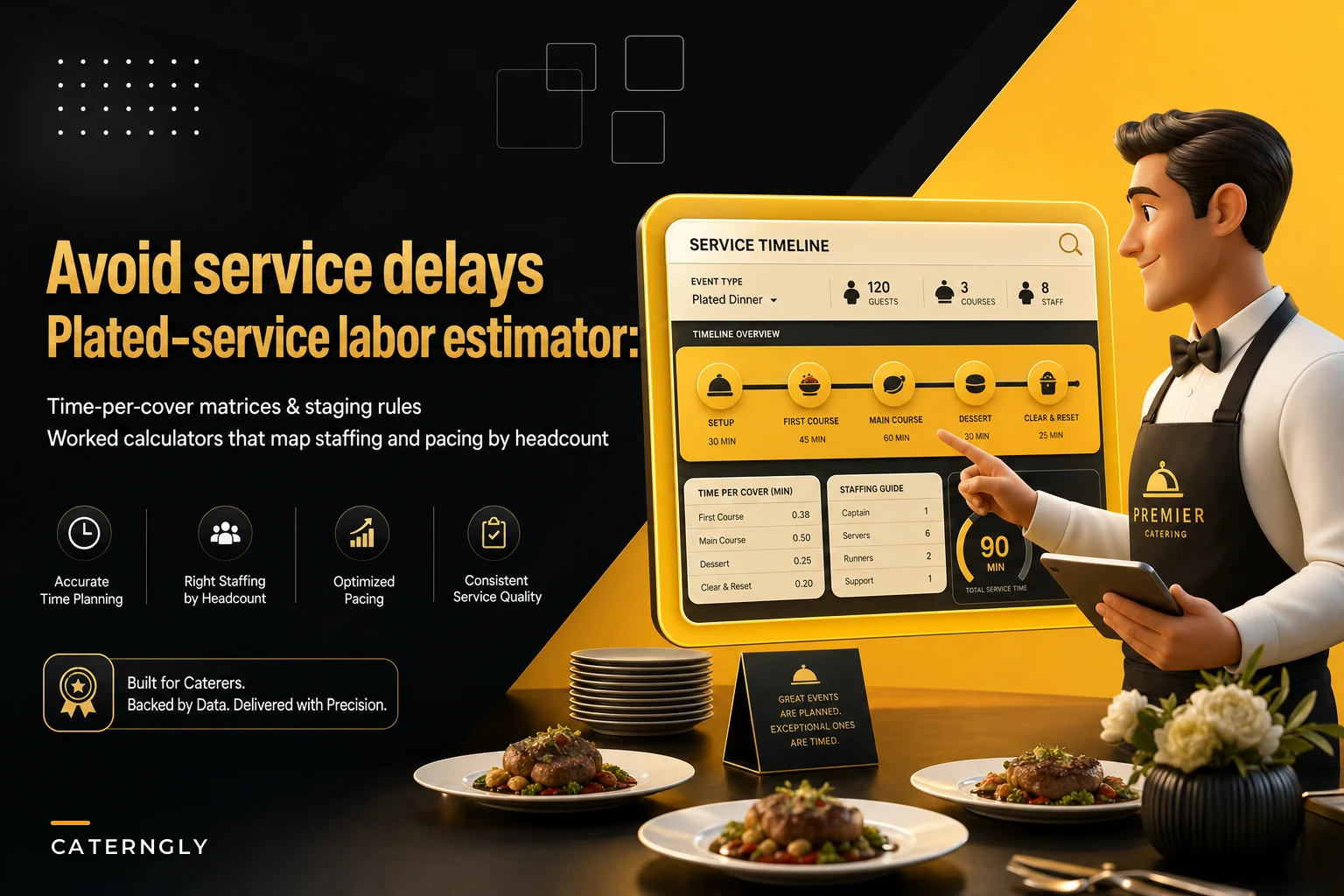

A plated dinner for 175 guests shouldn't require crisis management at minute 47. But when your lead server is still plating entrées while tables 14 through 18 are finishing their salads, you've already lost the timeline.
The difference between smooth plated service and operational chaos usually comes down to one calculation most caterers get wrong: actual time-per-cover requirements based on service style, not optimistic guessing.
How plated service timelines actually fall apart — and what to do about it
A plated dinner for 175 guests shouldn't require crisis management at minute 47. But when your lead server is still plating entrées while tables 14 through 18 are finishing their salads, you've already lost the timeline.
The difference between smooth plated service and operational chaos usually comes down to one calculation most caterers get wrong: actual time-per-cover requirements based on service style, not optimistic guessing.
The staging nightmare that hits around cover 120
Plated service falls apart predictably. Not randomly, not mysteriously — predictably, at specific guest counts when your labor model breaks.
End chaos with centralized catering management.
Caterngly helps you plan, confirm, and manage every catering event seamlessly.
- Unified event and order management
- Real-time client updates
- Staff and resource scheduling
No credit card required
Watch what happens at a 150-person corporate gala with a three-course plated menu. Your team starts strong. First 40 covers go out clean, synchronized, professional. Then around cover 60, the kitchen starts lagging. By cover 90, servers are standing around waiting for plates. At cover 120, half your team is in the kitchen trying to help plate while the other half is clearing courses that finished 15 minutes ago.
The breakdown pattern stays consistent across different event sizes because the core problem doesn't change: caterers use flat labor estimates that ignore how service requirements compound at different stages of an event.
Buffet service for 150 people scales roughly linearly — double the guests, roughly double the staff. Plated service doesn't work that way. The jump from 100 to 150 covers doesn't just add 50% more work. It creates entirely new bottlenecks that require different staging logic.
Breaking down real time requirements by service style
These aren't theoretical numbers. They come from tracking service times across real events, measuring each step from plate-up to table clear.
-
**Traditional Plated Service (3 courses) - 50 covers
2.8 minutes per cover - 100 covers: 3.4 minutes per cover - 150 covers: 4.1 minutes per cover - 200 covers: 4.7 minutes per cover
-
**French Service (tableside finishing) - 50 covers
4.2 minutes per cover - 100 covers: 5.1 minutes per cover - 150 covers: 6.3 minutes per cover - 200 covers: 7.5 minutes per cover
-
**Family Style (platters per table) - 50 covers
1.6 minutes per cover - 100 covers: 1.9 minutes per cover - 150 covers: 2.2 minutes per cover - 200 covers: 2.4 minutes per cover
-
**Buffet with Attended Stations - 50 covers
0.8 minutes per cover - 100 covers: 0.9 minutes per cover - 150 covers: 1.0 minutes per cover - 200 covers: 1.1 minutes per cover
Notice how those time-per-cover jumps aren't proportional? Larger events introduce coordination overhead that smaller ones simply don't have. At 50 covers, your servers can basically memorize the room. At 200 covers, you need systems, staging areas, and dedicated runners just to keep things moving.
The staging rules most caterers skip entirely
The typical failure mode: caterers treat service positions as interchangeable. They think "I need 12 servers" without defining what those 12 people actually do at each stage of service.
Proper staging means different team compositions at different points of the event. Your salad course might need 3 servers on the floor and 9 in the kitchen plating. Your entrée course reverses that — 8 servers delivering and 4 supporting from the kitchen.
-
**Pre-service staging (30 minutes before first course) - 2 servers setting water and bread - 6 servers in kitchen for salad prep - 2 floaters checking table settings - 1 captain coordinating with kitchen
-
**Salad service staging - 8 servers running plates - 3 servers staying in kitchen for continuous plating - 1 server pre-bussing water glasses and bread plates
-
**Entrée transition (critical 8-minute window) - 4 servers clearing salad plates - 5 servers in kitchen starting entrée plate-up - 2 servers resetting water and wine - 1 captain confirming dietary restrictions with kitchen
-
**Entrée service staging - 10 servers running plates (maximum floor coverage) - 2 servers remain in kitchen for re-fires and special requests
One thing worth noting: the servers who excel at plating often struggle with tableside communication. Your fastest runners might not have the finesse for dessert presentation. Most caterers create one list of "servers" and hope it works out.
Building your labor matrix with buffer zones
Raw calculations give you minimums. Real events need buffers — not padding, not excessive coverage, but strategic buffers placed where service typically breaks.
Start with base time-per-cover for your service style. Then add:
-
15% buffer for events over 150 covers
-
20% buffer for venues with kitchen-to-dining distances over 50 feet
-
10% buffer for each additional course beyond three
-
25% buffer for outdoor events (weather variables)
A 180-person wedding with plated service, four courses, and a 75-foot kitchen run works out like this:
Base calculation: 180 covers × 4.3 minutes = 774 minutes of service time Add 15% for size = 890 minutes Add 20% for distance = 1,068 minutes Add 10% for fourth course = 1,175 minutes Total service minutes needed = 1,175 With a 90-minute service window, you need 1,175 ÷ 90 = 13.1 effective servers. Round up to 14, then add 1 captain and 2 bussers for a 17-person floor team.
That calculation assumes perfect efficiency, which doesn't exist. Real service includes bathroom breaks, brief confusion about table assignments, one server helping a guest with a spilled drink. Buffer zones absorb those disruptions without destroying the timeline.
When standard matrices fail
Certain event characteristics break standard labor calculations entirely.
Multi-room service is one example — cocktails in one space, dinner in another. Labor needs spike during the room flip when half your team is breaking down the cocktail space while the other half is trying to serve the first course.
Dietary restrictions multiply complexity fast. An event with 15% special meals doesn't just need 15% more kitchen attention. It needs dedicated runners who know exactly which plates go where, pulling people away from standard cover service.
Station changes mid-event create another multiplier. Passed appetizers, then stationed displays, then plated dinner — you're essentially staffing three different events. The transitions between service styles often require more labor than the service itself.
Live entertainment changes everything about timing. You can't serve during speeches. You can't clear during the first dance. Those hard stops compress your service windows and require surge staffing to hit shortened timelines.
Translating matrices into actual schedules
The math tells you how many people you need. Operations tells you when they need to arrive and what they need to know.
A 6 PM plated dinner for 150 doesn't mean everyone arrives at 5 PM. Your setup team arrives at 3 PM. Prep cooks at 2 PM. Service captain at 4 PM to walk the space. Floor servers at 5 PM for briefing. Bussers at 5:30 PM for water service.
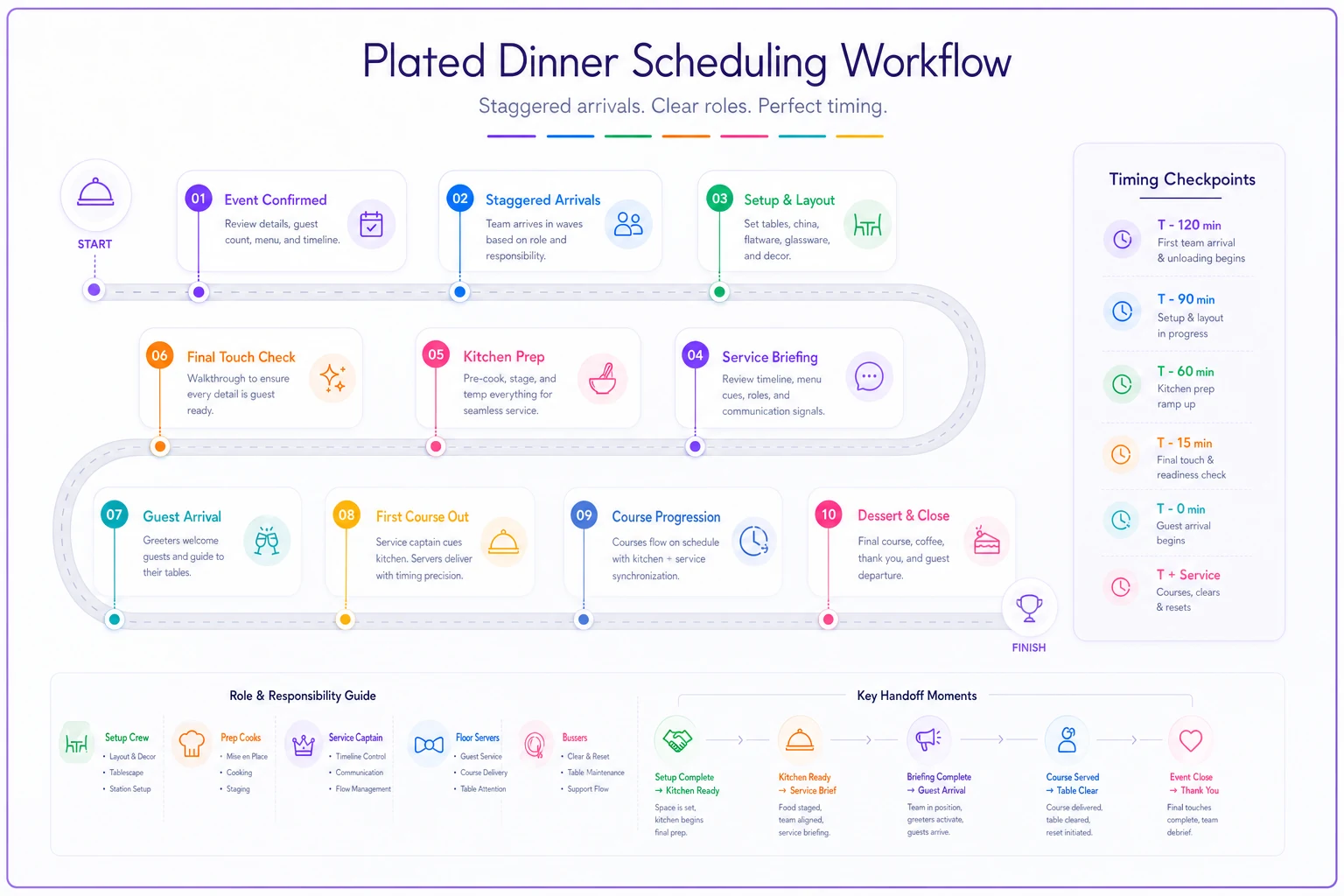
Each position needs different information. Servers need table layouts, course timing, and allergy alerts. Kitchen staff need plate counts, firing sequences, and holding temperatures. Bussers need clear points and breakdown staging. But most catering schedules just list names and arrival times without any role clarity.
This granular scheduling prevents a classic problem: twelve servers standing around at 4 PM with nothing to do while the kitchen desperately needs prep help, then scrambling for floor coverage when service actually starts.
Your scheduling system for overlapping events needs to account for these staggered arrivals and role transitions. The server who helps with prep from 4–5 PM might be running low by course three at 7:30 PM. The busser who's been there since 3 PM for setup shouldn't be your closer at 11 PM.
Pacing plans that prevent bottlenecks
Even perfect staffing falls apart without proper pacing. Course intervals need to match your kitchen capacity, not arbitrary timeline preferences.
Kitchen capacity usually bottlenecks at plating, not cooking. A kitchen that can prep 200 entrées might only be able to plate 40 per ten-minute window given available counter space and heat lamp capacity. That hard limit defines your entire service pace.
ROLLING BATCH OVERLAP — 150 covers, 40-plate batches Batch 1 (covers 1–40) ████████░░░░░░ Batch 2 (covers 41–80) ████████░░░░ Batch 3 (covers 81–120) ████████░░ Batch 4 (covers 121–150) ████████ Minutes: 0 4 8 12 16 20 24 28 32
The overlap accounts for servers returning from delivery. By minute 8, your first wave is back for batch 2 while stragglers from batch 1 are still delivering. This rolling overlap prevents the kitchen backup that kills service timing.
Course spacing needs similar thought. Standard "clear and serve" protocols suggest 20-minute course intervals, but that assumes instant clearing and plating. For 150+ covers, you realistically need 25–30 minutes between courses:
-
5 minutes for slowest tables to finish
-
8 minutes for complete clearing
-
7 minutes for kitchen plating
-
5 minutes for service to last table
-
5 minutes buffer for coordination
Compress those intervals and you'll find servers stacking dirty plates on service stations because bussers are overwhelmed, or half-plated entrées sitting under heat lamps because servers are still clearing salads.
Most of these timing failures are predictable. Planning for them in advance — rather than reacting when the wheels come off — is what separates clean service from damage control.
Technology's role in labor optimization
Manual tracking of service times usually means guessing based on how stressed everyone looked afterward. When your scheduling and event management systems are actually connected, you start seeing patterns emerge over time that you'd never catch otherwise.
Maybe Tuesday corporate lunches consistently run 15% faster than weekend weddings. Maybe your team needs 20% more time at venues with narrow service corridors. Maybe one service captain consistently delivers events under projected labor hours.
Those patterns let you build venue-specific and team-specific matrices grounded in real performance data. Your operations playbook stops being a static document and becomes something that actually updates based on what happens in the field.
Some catering operations platforms now use AI automation to surface these patterns without requiring someone to manually dig through event reports. They'll flag when projected labor looks low based on similar past events, or highlight staging adjustments worth considering given venue logistics. It's not magic — it's pattern recognition applied to data most caterers already have but never use systematically.
The hidden costs of bad labor estimates
Underestimating service labor doesn't just mean overtime costs. The cascade is worse than most caterers realize.
Service delays mean extended venue time, which can trigger overtime charges from the venue itself. Kitchen holds mean food quality drops, which leads to comp costs and post-event complaints. Stressed servers break more glasses, forget more special requests, and create more friction throughout the night.
The reputation damage compounds. Clients remember chaotic service long after they forget what they ate. Venues stop recommending caterers who consistently run behind schedule. Eventually, experienced servers start avoiding your shifts because they know certain events will be understaffed.
Over-staffing has its own problems though. Beyond labor waste, too many servers creates confusion about responsibilities. They duplicate efforts, get in each other's way, and paradoxically deliver worse service than a properly-sized team would.
Adjusting matrices for team skill levels
A veteran server handles roughly 40% more covers per hour than someone in their first six months. Most labor calculations ignore this completely.
Build skill multipliers into your matrices:
-
New servers (under 6 months)
0.7x efficiency
-
Competent servers (6–24 months)
1.0x efficiency
-
Veteran servers (2+ years)
1.4x efficiency
-
Service captains
1.2x efficiency plus coordination value
For a 150-cover event needing 12 base servers, actual needs shift based on team composition:
All veterans: 12 ÷ 1.4 = 9 servers needed Mixed team (50% veteran, 50% competent): 12 ÷ 1.2 = 10 servers needed Training-heavy team (50% new, 50% competent): 12 ÷ 0.85 = 14 servers needed
This isn't about penalizing newer team members. It's about setting realistic expectations. Pair new servers with veterans. Assign them to specific stations rather than roaming responsibilities. Build in extra transition time between their assignments.
Creating venue-specific matrices
A hotel ballroom with an adjacent kitchen operates nothing like a historic mansion with a basement prep kitchen and two flights of stairs. Your labor matrix needs venue-specific adjustments that go well beyond simple distance calculations.
Track these venue variables:
-
Kitchen to service distance (steps and elevation changes)
-
Service corridor width (can servers pass each other with plates?)
-
Kitchen pass size (how many plates can stage at once?)
-
Dishwashing location (affects bussing patterns)
-
Storage accessibility (mid-event supply runs?)
-
Guest flow patterns (multiple entrances? bathroom locations?)
One yacht club consistently required about 25% more labor than the standard matrix suggested. Narrow corridors meant servers couldn't pass each other. The kitchen pass held maybe 20 plates, creating constant bottlenecks. A single service elevator meant clearing and serving couldn't happen simultaneously.
Once a venue-specific matrix got built for that location, estimates became accurate and service improved — more kitchen-based plating, fewer servers on the floor at once, a dedicated person managing elevator timing.
Beyond the basics: complex event structures
Some events break every standard calculation. Progressive dinners where guests move between spaces for each course. Mixed service with plated dinner for VIPs and buffet for general admission. Staggered arrivals where some tables start eating 30 minutes before others.
These scenarios need modular labor planning. Instead of one matrix for the whole event, you build mini-matrices for each segment:
| Phase | Time | Service Type | Guests | Servers Needed |
|---|---|---|---|---|
| Phase 1 | 5:30–6:30 PM | Passed apps | 200 arriving | 6 |
| Phase 2 | 6:30–7:00 PM | VIP plated appetizer | 75 | 4 |
| Phase 3 | 7:00–8:30 PM | Buffet dinner | 275 | 8 attendants |
| Phase 4 | 8:30–10:00 PM | Dessert stations + coffee | 275 | 4 |
Total unique positions: 22, but only 12–14 concurrent based on phase overlaps. This approach prevents the common mistake of staffing for peak requirements across the entire event. There's no reason to pay 22 servers for four hours when you only need that many for about 30 minutes.
Implementing without overwhelming your team
New systems fail when they're too complicated for daily use. Your service team doesn't need to understand the math behind time-per-cover calculations. They need clear direction about where to be and what to do.
Translate matrices into simple tools:
-
Pre-event cards showing position assignments by time
-
Floor diagrams with server zones clearly marked
-
Kitchen timing sheets with batch numbers and fire times
-
Service captain checklist with transition triggers
Pair pre-service prep shifts with specific floor assignments to avoid fatigue later in the event.
The complexity lives in your planning. Execution stays simple. When servers arrive, they see specific assignments, not formulas. The service captain manages transitions based on visual cues, not minute-by-minute calculations.
Refining estimates with post-event analysis
Every event generates data that improves future estimates. Most caterers never capture it — they're too exhausted after service to document what actually happened versus what was planned.
Build simple post-event tracking:
-
Actual versus projected service times per course
-
Bottleneck locations and causes
-
Staff utilization by position
-
Guest feedback about service pace
-
Venue-specific challenges encountered
A plated dinner for 160 that required 14 servers instead of the projected 12 tells you something. Maybe the matrix needs adjustment. Maybe that venue warrants its own calculation. Maybe the client's program changes compressed your service windows.
Without documentation, you'll make the same estimating errors on repeat. With it, your matrices get more accurate over time — and that compounds fast once you have a few dozen events worth of clean data.
Making better decisions with accurate matrices
Accurate labor estimation changes how you price and what you promise. When you know a plated dinner for 200 requires 18 servers to execute properly — not the 14 your competitor quoted — you can either price accordingly or pass on the business.
This precision stops the profitability leak where you win jobs by underestimating labor and then lose money delivering them. It also prevents the reputation damage of consistently running behind schedule because you committed to timelines your staffing model can't support.
More practically, accurate matrices let you have honest conversations with clients. When they want to compress service from 90 to 60 minutes for their program, you can show exactly how many additional servers that requires and what it costs. When they want to add a course last-minute, you can explain the real impact on staging and timing.
Precision planning prevents service disasters
A plated service labor estimator isn't about complicated math or rigid rules. It's about understanding how service requirements compound at different scales and building systems that anticipate bottlenecks before they blow up your timeline.
The matrices and staging rules here came from tracking real events — ones that either flowed smoothly or fell apart in predictable ways. The patterns are consistent: labor needs jump non-linearly with guest count, staging requirements shift throughout service, and venue logistics multiply base calculations in ways that catch even experienced caterers off guard.
Building your own time-per-cover matrices starts with tracking actual service times at your next several events. Note when bottlenecks occur, which positions scramble at what points, and how venue characteristics affect flow. Within a month or so, you'll see patterns that generic industry formulas miss entirely.
The caterers who consistently deliver clean service aren't necessarily more talented than the ones who scramble. They've just built the discipline to measure, calculate, and staff based on operational reality rather than optimistic estimates. Once that's baked into your planning process, what used to feel like crisis management starts to feel like predictable execution.
The caterers who consistently deliver clean service aren't necessarily more talented than the ones who scramble. They've just built the discipline to measure, calculate, and staff based on operational reality rather than optimistic estimates. Once that's baked into your planning process, what used to feel like crisis management starts to feel like predictable execution.
Ready to elevate your catering business?
Join 500+ caterers trusting Caterngly to save time, reduce errors, and deliver flawless events.