

Three months ago, a catering company in Austin served 400 guests at a corporate gala. Everything went perfectly — until 72 hours later when fourteen attendees reported foodborne illness. The caterer had pristine HACCP logs, temperature records showing proper cold-holding, and documented timestamps for every prep station. Still lost around $280,000 in settlements because their contract had no temperature variance clause and their insurance explicitly excluded "improper food handling" without defining what that meant.
This disconnect between food safety operations and legal protection ruins catering businesses every year. You follow HACCP protocols religiously, maintain solid documentation, yet when something goes wrong, your contracts and insurance leave gaps that turn manageable incidents into business-ending disasters.
Building a catering risk compliance playbook isn't about adding more paperwork. It's about creating operational language that bridges what you do in the kitchen and what actually protects you legally. Most caterers treat HACCP as a food safety system and contracts as a separate legal concern — and that separation creates vulnerability at every event.
Why traditional HACCP training falls short in real catering operations
HACCP gives you critical control points and temperature thresholds. Your team knows cold foods stay below 41°F and hot foods above 135°F. But operational reality rarely matches the textbook.
A wedding reception runs two hours longer than planned. An outdoor corporate event hits 95°F. The client insists on serving sushi at their beachside celebration with no refrigeration access for three hours. These situations happen constantly, and HACCP alone doesn't tell you how to handle the business fallout.
The real failure point isn't temperature control — it's decision authority. When your lead server discovers the portable cooler isn't holding temp at hour two of a five-hour event, who makes the call to pull items from service? What contractual protection exists if the client overrides that decision? How does your insurance respond if you keep serving under client pressure?
Standard catering contracts mention food safety in vague terms like "industry standards" or "proper handling procedures." These phrases mean nothing when defending a claim. Insurance policies use equally ambiguous language about "reasonable care" and "standard practices." Neither document connects to your actual decisions during service.
The gap becomes obvious when you map real scenarios. Your HACCP plan says discard any perishable held between 41°F and 135°F for more than four hours. Your contract says you'll provide "safe food service." But what happens when the client's venue loses power at hour three? Who bears liability if you continue service? What if you stop service and the client claims breach of contract?
Building decision rules that connect kitchen operations to contract language
Effective risk compliance starts with translating HACCP control points into contractual decision authority. Every temperature threshold needs corresponding contract language about service modifications or cancellations.
End chaos with centralized catering management.
Caterngly helps you plan, confirm, and manage every catering event seamlessly.
- Unified event and order management
- Real-time client updates
- Staff and resource scheduling
No credit card required
Traditional vague clause: "Caterer will maintain proper food temperatures throughout service." Operationalized clause: "If ambient temperature exceeds 85°F or refrigeration equipment cannot maintain 40°F or below, Caterer has sole discretion to modify menu items, suspend service of specific items, or implement alternative service methods. Client acknowledges that outdoor events and extended service times may require menu modifications for food safety. Any service continuation beyond recommended safety parameters requested by Client transfers liability for foodborne illness claims to Client."
The difference protects your business when real situations come up. You're not asking permission to follow food safety protocols — you're establishing decision authority before the event starts.
Temperature variances need specific thresholds and response protocols:
| Variance Scenario | Decision Threshold | Contract Authority | Insurance Trigger |
|---|---|---|---|
| Cooler temp rises above 41°F | 30 minutes | Remove affected items | Document and photograph |
| Hot hold drops below 135°F | 15 minutes | Reheat or discard | Log with timestamp |
| Ambient temp exceeds 90°F | Immediate | Modify service method | Notify carrier within 24hrs |
| Power loss at venue | 1 hour | Cancel perishable items | Invoke force majeure |
| Transport delay | 2 hours cumulative | Assess upon arrival | Pre-event notification |
Each threshold connects to specific contract language giving you authority to act without waiting for client approval. The insurance triggers ensure documentation meets carrier requirements for coverage.
Put specific temperature thresholds and response actions into a contract exhibit so staff and clients have a single referenced standard.
Every temperature variance you define operationally reduces ambiguity for courts and carriers alike.
Insurance alignment with HACCP documentation requirements
Most catering insurance policies contain exclusions that directly contradict HACCP best practices. The policy excludes "improper food handling" but doesn't define what proper handling means. It requires "immediate notification" of incidents but doesn't specify the window.
Alignment means building a documentation bridge between HACCP logs and insurance requirements. Your temperature logs need fields that match insurance claim forms. Your incident reports need language that triggers coverage rather than exclusions.
Standard HACCP documentation tracks temperatures and times. Insurance-aligned documentation adds decision points and mitigation steps. When you log that a cooler hit 43°F at 2:47 PM, you also document: "Removed items A, B, C from service. Notified event captain. Transferred items D, E, F to backup cooler maintaining 38°F. Client informed of menu modification at 3:15 PM."
This documentation pattern prevents insurance denials based on "failure to mitigate" or "continued negligent practice." You're showing active risk management, not just recording that a problem occurred.
The critical insurance checklist for every event:
-
Pre-event venue assessment documenting refrigeration capacity
-
Power source verification with backup plan noted
-
Ambient temperature forecast with service modifications if needed
-
Client sign-off on outdoor event temperature risks
-
Transport route with timeline and contingency stops
-
Equipment redundancy plan for critical control points
-
Post-event temperature log certification
Missing any element creates a coverage gap. The venue assessment proves you evaluated risks beforehand. The client sign-off transfers liability for their venue choice. The redundancy plan demonstrates reasonable care in prevention.
Incident escalation templates that preserve legal protection
When problems occur during service, your team's response in the first thirty minutes shapes legal outcomes months later. Most caterers rely on informal escalation — someone calls the owner when things go sideways. That informality creates legal vulnerability through inconsistent documentation and slow response.
Structured escalation templates protect your business while managing the client relationship. The template guides staff through immediate actions, documentation requirements, and communication protocols.
Hour 1 Discovery Protocol:
-
Isolate affected items immediately
-
Document with photos showing timestamp
-
Check all related equipment and items
-
Notify event captain and kitchen manager
-
Begin temperature recovery procedures
Hour 2 Assessment Protocol:
-
Determine scope of impact
-
Identify alternative service options
-
Calculate time/temperature exposure
-
Document mitigation attempts
-
Prepare client communication
Hour 3 Decision Protocol:
-
Make serve/no-serve determination
-
Implement approved alternatives
-
Document client response if override requested
-
Notify insurance carrier if threshold exceeded
-
Complete incident report with all supporting data
The escalation path needs names, not just roles. "Contact manager" becomes "Text Sarah at [number], then call if no response within 10 minutes. If Sarah unavailable, contact Tom at [number]." That specificity prevents delays that courts interpret as negligence.
Your change-order workflow for scope modifications should integrate with incident escalation. When clients request changes that affect food safety — like extending cocktail hour outdoors — the same documentation protects against both scope creep and safety liability.
Defensible cancellation rules for weather and venue failures
Cancellation decisions paralyze catering operations. You're balancing food safety, client relationships, revenue protection, and legal exposure all at once. Without clear rules, these calls become emotional rather than operational.
Weather-based cancellations need objective triggers. "Too hot for safe service" isn't defensible. "Ambient temperature exceeding 95°F for outdoor service without adequate refrigeration access" creates a measurable standard. Your contract needs these specific thresholds, not generic "adverse weather" language.
The decision matrix for service cancellation:
Proceed with full service:
-
All equipment functioning within specs
-
Ambient conditions within safe range
-
Backup systems available
-
Client acknowledges any limitations
Proceed with modifications:
-
Non-critical equipment failure
-
Partial menu items affected
-
Alternative service methods available
-
Client approves modifications in writing
Cancel perishable service only:
-
Cold-holding compromised beyond recovery
-
No backup refrigeration available
-
Time/temperature thresholds exceeded
-
High-risk items cannot be protected
Full cancellation required:
-
Venue power failure without recovery timeline
-
Transportation accident affecting food safety
-
Health department stop-service order
-
Multiple critical system failures simultaneously
Each category needs supporting contract language. The client can't claim breach of contract when you follow pre-agreed cancellation triggers. Your insurance can't deny coverage when you document following established protocols.
Repurposing protocols that manage liability across back-to-back events
Multi-event weekends create unique liability chains. Saturday's wedding buffet becomes Sunday's corporate lunch. That operational efficiency makes sense until someone gets sick at the second event and investigators trace it back to the first.
Repurposing rules need both food safety and legal components. HACCP tells you the food is safe if properly stored and reheated. But legal protection requires documentation showing chain of custody, storage conditions, and decision authority for repurposing.
Your repurposing decision tree:
-
Initial event documentation
Log what remains, temperatures, and time of last service
-
Storage transition
Document transfer method, temperature during transport, storage location
-
Repurpose assessment
Evaluate condition, calculate total time/temperature exposure
-
Client disclosure
Inform if using previous event items — some contracts may require this explicitly
-
Service documentation
Log reheat times, temperatures, and service duration
The legal risk isn't just foodborne illness — it's fraud claims if clients discover they received leftover food without disclosure. Some corporate clients explicitly prohibit repurposed items in their contracts. Missing that clause creates liability beyond food safety.
Your pack-and-load checklists should include repurposing fields. When items return from events, the checklist captures whether they're eligible for repurposing or must be discarded — which prevents accidentally serving items that exceeded safe holding times across multiple events.
Sample contract clauses that operationalize food safety requirements
Force Majeure expansion for food safety: "Force Majeure includes any condition preventing safe food service including but not limited to: venue refrigeration failure, ambient temperatures exceeding 95°F for outdoor service, power outages exceeding one hour, water supply interruption, or health department restrictions. Caterer may modify or cancel service without penalty when Force Majeure conditions affect food safety."
Client override provision: "If Client requests service continuation despite Caterer's food safety concerns, Client assumes all liability for foodborne illness claims. Such requests must be documented in writing. Caterer reserves the right to refuse service that violates health codes regardless of Client preference."
Temperature variance authority: "Caterer has sole discretion to modify service methods when temperature control is compromised. This includes but is not limited to: switching from buffet to plated service, eliminating specific menu items, adjusting service times, or implementing alternative cooling/heating methods."
Venue responsibility clause: "Client warrants that venue provides adequate refrigeration, power supply, and environmental controls for safe food service. Caterer may assess venue prior to event and refuse service if conditions are inadequate. Client bears responsibility for venue-related food safety issues."
Insurance coordination language: "Both parties maintain insurance covering their respective obligations. Caterer's coverage includes general liability and food-borne illness protection. Client's coverage includes venue-related incidents and guest injuries. Parties will coordinate coverage for any claims arising from service."
These clauses transform vague responsibilities into specific operational standards. They're enforceable because they describe measurable conditions and clear decision authority.
Creating your integrated compliance system
A functioning catering risk compliance playbook connects every operational decision to supporting documentation and contractual protection. This isn't a binder that sits on a shelf — it's an active system your team uses during every event.
Start with your highest-risk scenarios. Map the decision points, documentation requirements, and contract language for each. A summer outdoor wedding needs different protocols than a climate-controlled corporate lunch. Build templates for your most common event types, then customize for specific risks.
The integration points across your operation generally look something like this:
Kitchen prep → HACCP logs include fields for contract compliance and insurance documentation Transport → Manifests note temperature maintenance and contingency plans Setup → Venue assessment confirms contractual requirements are met Service → Decision logs connect to escalation protocols and client communications Breakdown → Post-event certification captures final compliance state
Some catering businesses use AI-powered operational software to keep this integration running without burying staff in paperwork. The software prompts for required documentation at each stage, flags when thresholds are exceeded, and maintains audit trails that satisfy both health inspectors and insurance adjusters. Incident reports get generated with proper language automatically, and escalation protocols are followed consistently instead of varying by who's on shift.
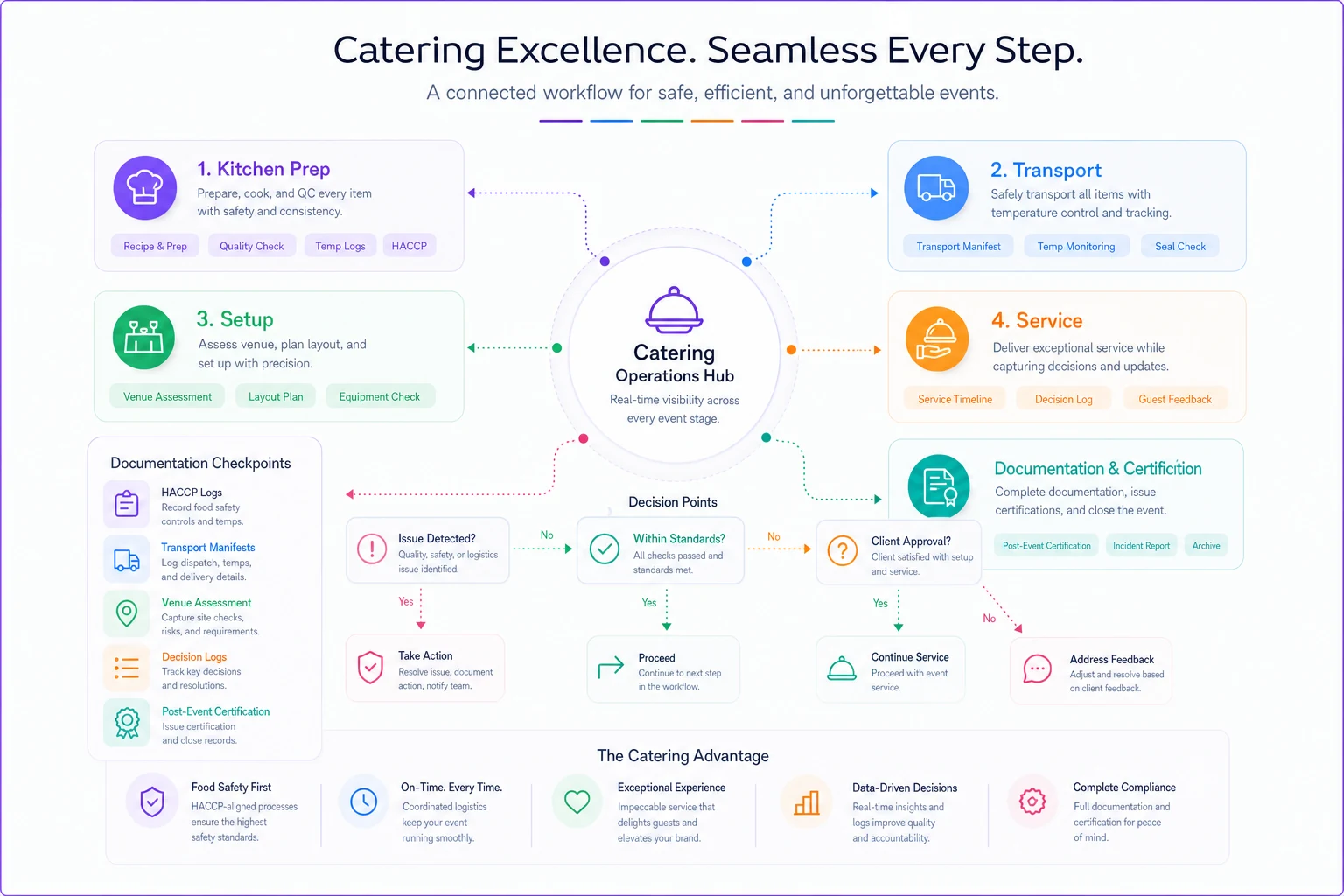
This diagram shows where decision authority, documentation, and contractual checks should align during an event.
When integrated properly, the compliance system prevents problems rather than just documenting them. Temperature alerts trigger before hitting critical thresholds. Contract conflicts get flagged during booking. Insurance requirements are verified before service begins.
Start by picking one event type — your highest-volume or highest-risk category — and building complete protocols for that first. Train your team thoroughly on that category before expanding. Once the first system runs smoothly, the rest comes together faster than you'd expect.
The compound effect of integrated risk management
Most caterers who implement comprehensive risk compliance see returns fairly quickly through reduced insurance premiums. Carriers offer better rates when you demonstrate systematic risk management. But the real value builds over time through avoided disasters.
Every clean event strengthens your defensibility. Documentation patterns establish consistency. Contract language prevents disputes before they start. Escalation protocols catch problems early. These compound into a reputation for reliability that attracts better clients willing to pay for it.
The catering businesses that survive long-term aren't necessarily the ones with the best food. They're the ones that systematically manage operational risk while maintaining service quality. An integrated compliance playbook makes that balance sustainable rather than exhausting.
Building your catering risk compliance playbook takes roughly 40-60 hours upfront, then maybe a few hours monthly to maintain and update. Compare that against a single foodborne illness claim or contract dispute. The math isn't complicated.
Start by picking one event type — your highest-volume or highest-risk category — and building complete protocols for that first. Train your team thoroughly on that category before expanding. Once the first system runs smoothly, the rest comes together faster than you'd expect.
This kind of systematic risk management can feel like overkill right up until the moment it saves your business.
Ready to elevate your catering business?
Join 500+ caterers trusting Caterngly to save time, reduce errors, and deliver flawless events.