

Most caterers treat equipment maintenance like it's optional—until it obviously isn't.
The maintenance crisis that quietly kills catering profits
That convection oven making weird noises for three weeks? The one your team keeps forgetting to mention? It's going to fail during your biggest wedding of the season. Equipment doesn't break randomly in catering. It breaks at maximum load, during peak service, when you absolutely cannot afford it.
A single chafing dish fuel failure means scrambling to keep 150 portions warm. A transport van breakdown mid-delivery puts thousands in contracted revenue at risk. A refrigeration failure discovered Saturday morning before three weekend events isn't just an inconvenience—it's a business-ending scenario.
Yet most catering operations treat maintenance as an afterthought. Something that happens when equipment breaks or when someone happens to remember. They're running a $200,000 equipment investment on hope and duct tape, then acting surprised when emergency repairs and last-minute rentals eat straight into event margins.
Why equipment fails exactly when you can't afford it
Equipment failure in catering follows patterns tied directly to event load. Your commercial mixer doesn't randomly break on a Tuesday afternoon. It fails Friday night when you're prepping for Saturday's 300-person corporate gala plus Sunday's wedding brunch.
End chaos with centralized catering management.
Caterngly helps you plan, confirm, and manage every catering event seamlessly.
- Unified event and order management
- Real-time client updates
- Staff and resource scheduling
No credit card required
-
Load clustering
The majority of equipment usage gets compressed into weekends—sometimes well over half of monthly wear happening in a fraction of available time
-
Temperature cycling
Cold storage units opening 200+ times during Friday prep versus maybe 20 times on Monday
-
Transport stress
Delivery vehicles making 8–10 stops in a single Saturday run versus 2–3 during the week
-
Cleaning shortcuts
Speed-cleaning between back-to-back events instead of proper protocols
Each event adds cumulative stress that traditional maintenance schedules miss entirely. A monthly check on the 15th means nothing if you just ran seven events the previous weekend.
Consider what happens to a hot box during wedding season. Between April and October, a busy caterer might push that unit through 150–180 events. Each one means loading at minimum 165°F, transport vibration for 30–45 minutes, multiple door openings during service, and post-event cleaning with aggressive chemicals.
By event 130 or so, heating elements are struggling. Door seals are compromised. Thermostat accuracy has drifted. But the monthly check happened during a slow week, so everything looked fine on paper.
Building maintenance around actual event load
Real preventive maintenance needs to track with your business rhythm, not arbitrary calendar intervals. That means creating triggers based on actual usage patterns rather than dates.
Instead of "check the oven monthly," the trigger becomes "check after every 20 events or 30 days, whichever comes first." This catches problems while they're developing, not after they've already wrecked a Saturday night.
For a 250-person wedding caterer running roughly 35 events monthly, a reasonable maintenance map looks something like:
-
Critical equipment (immediate event impact)
- Hot boxes: Visual inspection after each event, full service every 15 events - Refrigerated trucks: Daily pre-trip inspection, mechanical service every 2,000 miles or 25 events - Ovens/ranges: Calibration check every 20 events, deep clean every 10
-
Support equipment (service quality impact)
- Chafing dishes: Fuel system check every 5 events - Coffee urns: Descale every 12 events or when brew time increases noticeably - Warming lamps: Bulb inventory check weekly during peak season
-
Mobile equipment (transport damage risk)
- Cambros: Seal inspection before each use - Rolling racks: Wheel and brake check every 10 events - Folding tables: Stability check when loading for events
Frequency should also adjust seasonally. During peak wedding season—May through September—you might be running 50+ events monthly, so intervals compress. During slower January and February periods, you can extend them slightly but never past reasonable thresholds.
| Equipment Category | Inspection Trigger | Notes |
|---|---|---|
| Hot boxes | After each event / full service every 15 events | Door seals, heating elements |
| Refrigerated trucks | Daily pre-trip / service every 25 events | Temperature accuracy, door seals |
| Ovens/ranges | Every 20 events / deep clean every 10 | Calibration, ignitors |
| Chafing dishes | Every 5 events | Fuel system, frame condition |
| Coffee urns | Every 12 events or when brew slows | Descale, spigots |
| Rolling racks | Every 10 events | Wheels, brakes |
| Cambros | Before each use | Seal compression |
Frequency should also adjust seasonally.
Spare parts: stocking for your actual failure patterns
A spare parts strategy in catering isn't about hoarding extras—it's about understanding where things actually fail and stocking accordingly. Most caterers either have random parts nobody needs or nothing useful when something actually breaks.
Smart spare parts inventory follows roughly the 80/20 rule. Most problems come from a handful of components. For most operations, the consistent offenders are:
-
Chafing dish fuel holders (they crack, warp, fail to seal)
-
Hot box door gaskets (compression failure from overloading)
-
Transport cart wheels, especially brake mechanisms
-
Oven ignitors (they don't gradually fail—they just stop)
-
Refrigeration door seals (torn by hurried loading)
But what matters more than what you stock is how you organize it—by event criticality, not equipment type.
-
Event-critical spares (failure stops service)
- Fuel cells for chafing dishes: 20% excess of maximum event need - Hot box heating elements: 1 spare per 3 units owned - Generator spark plugs: 2 complete sets - Van belts and hoses: 1 complete set per vehicle
-
Quality-impact spares (failure degrades service)
- Serving utensil springs and hinges - Coffee urn spigots and seals - Tablecloth clips and weights - Lighting bulbs for food stations
-
Efficiency spares (failure slows operation)
- Dish rack wheels - Prep table adjustment bolts - Storage container lids - Equipment power cords
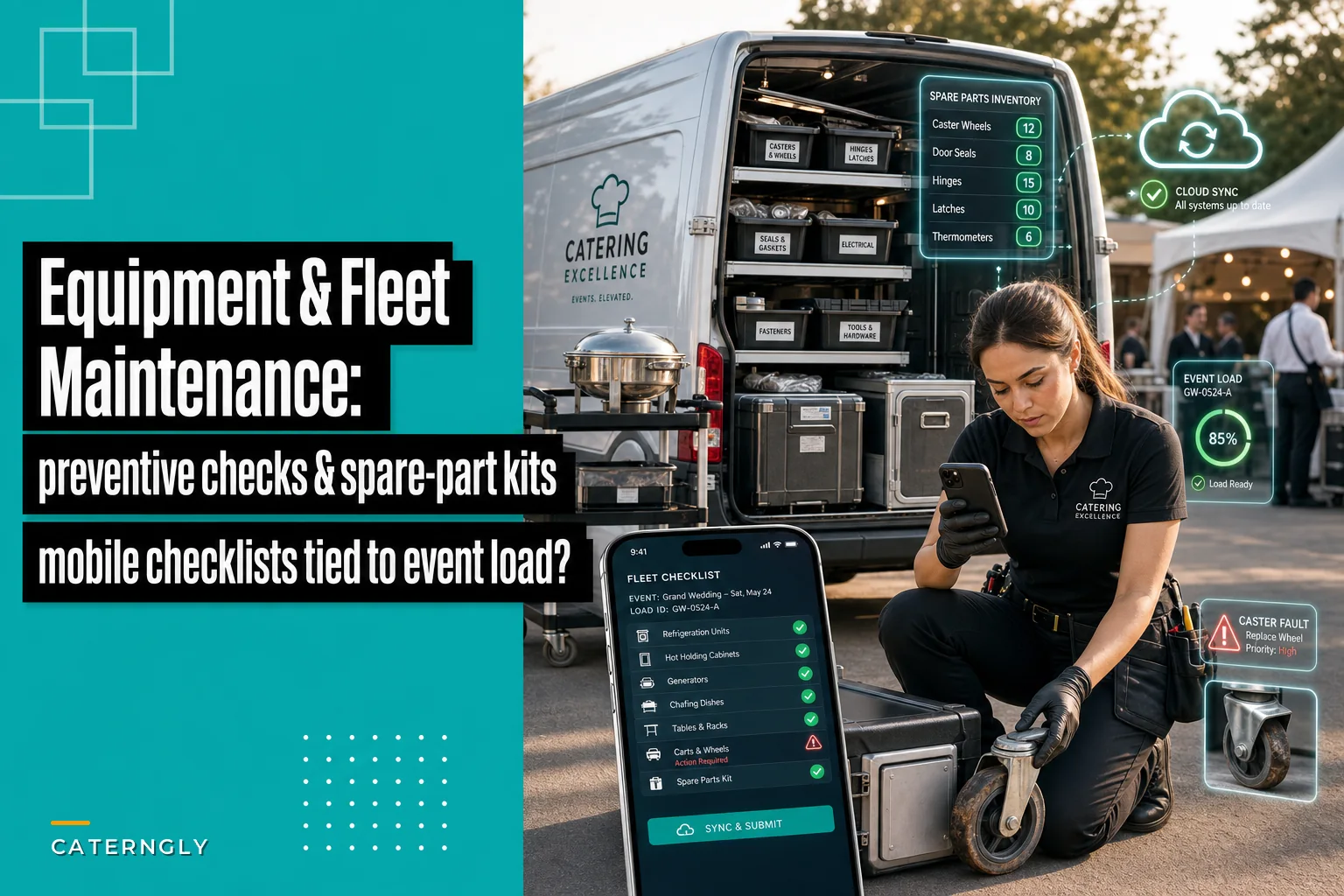
Your field repair kit should travel to every event—not sit in a storage room 20 miles from the venue. A proper kit includes:
-
Universal gasket material (cut to fit)
-
Food-safe adhesive and tape
-
Replacement fuel cells
-
Basic electrical
fuses, wire nuts, outlet testers
-
Mechanical basics
adjustable wrench, screwdrivers, hex keys
-
Cleaning supplies for emergency sanitation
Label spares by event-criticality and store kits by route so teams can grab the right parts for that day's events quickly.
Your field repair kit should travel to every event—not sit in a storage room 20 miles from the venue.
Mobile checklists that actually get used
Paper checklists in a filing cabinet are useless. Maintenance needs to live where your team works—on their phones, accessible during prep, usable with greasy hands at 11 PM during breakdown.
The difference between a checklist that gets used and one that gets ignored is workflow integration. Nobody's stopping mid-service to fill out a form. But they will tap a few buttons while waiting for the van to warm up.
A simple workflow keeps checklists fast and actionable.
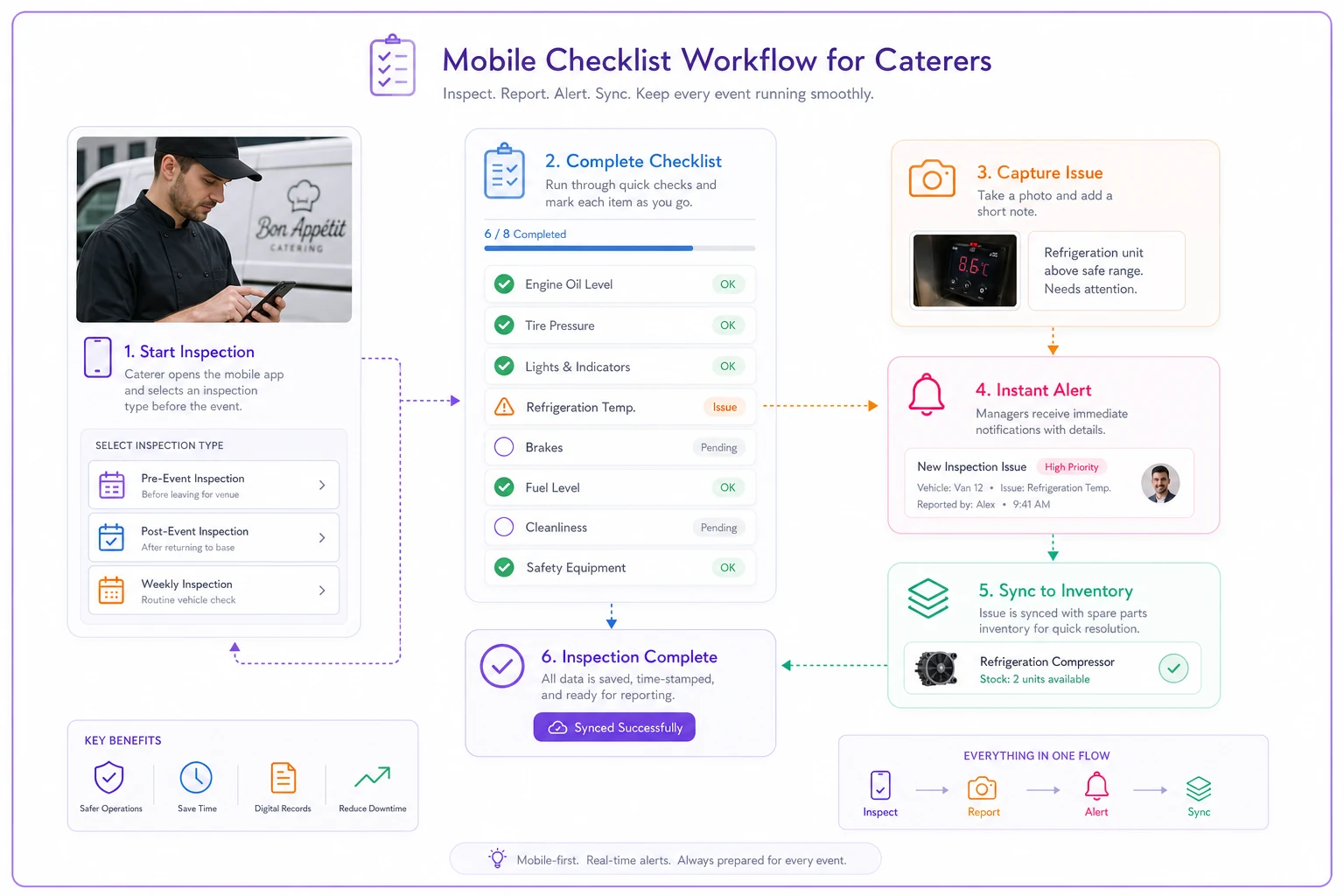
Pre-event vehicle inspection (2 minutes):
-
Fluid levels visual check (oil shows on dipstick?)
-
Tire pressure visual (any obvious low spots?)
-
Load security (everything strapped?)
-
Temperature units running (cold is cold, hot is hot?)
-
Emergency kit present (spare fuel, basic tools?)
Post-event equipment check (during breakdown):
-
Hot boxes
Heating elements glowing evenly?
-
Chafing dishes
Any fuel leaks or damaged frames?
-
Coffee service
Any slow brewing or temperature issues?
-
Transport equipment
Wheels rolling smooth?
-
Note any issues staff mentioned during service
Weekly deep inspection (30 minutes):
-
Refrigeration temperatures logged
-
Oven calibration tested with thermometer
-
Vehicle mileage recorded
-
Inventory of spare parts
-
Schedule upcoming service needs
Pre-event check happens during morning coffee. Post-event review happens while loading the van. Weekly inspection fits into Monday morning prep. When you're scaling operations to handle multiple simultaneous events, mobile maintenance tracking becomes even more critical—teams at different venues need to flag issues immediately, not wait until they're back at the commissary.
Failure escalation that saves events
Equipment failure during an event needs a completely different response than failure during prep. You need escalation plans that match the urgency of live catering service—not something your team is improvising under pressure.
The escalation system should answer three questions instantly:
-
Can we fix this now without stopping service?
-
What's the backup plan if we can't?
-
Who makes the call to implement plan B?
-
Level 1
Field-fixable
(5-minute resolution): - Chafing dish fuel failure → Replace with spare fuel cell from kit - Coffee urn slow brewing → Switch to backup urn, descale after event - Hot box temperature drift → Adjust thermostat, monitor hourly - Decision maker: Lead server or kitchen manager -
Level 2
Service adaptation
(15-minute workaround): - Oven failure during reheat → Transfer to hot boxes at higher temp - Refrigeration failure on-site → Ice bath setup for cold items - Generator failure → Reconfigure to venue power if available - Decision maker: Event captain calls operations manager -
Level 3
Emergency replacement
(30-minute solution): - Transport vehicle breakdown → Dispatch backup vehicle or rental - Complete hot holding failure → Restaurant partnership for emergency prep - Multiple equipment failures → Implement service style change - Decision maker: Operations manager with owner approval
Each level needs pre-written client communication. Your team can't be crafting explanations while managing a crisis.
If hot food holding fails during cocktail hour, for example: "We're implementing an enhanced butler-service format for hot appetizers, ensuring everything arrives at perfect temperature directly to your guests. This actually provides more attentive service than the planned station setup."
The client hears enhanced service, not equipment failure.
The maintenance math most caterers get wrong
Maintenance isn't a cost center. Run the actual numbers and it's clearly a profit protector.
| Scenario | Monthly Cost | Annual Impact |
|---|---|---|
| Emergency repairs (no PM) | $1,800–2,500 | — |
| Equipment rental replacements (no PM) | $800–1,200 | — |
| Lost revenue from failures (no PM) | — | $12,000–32,000 |
| Total without preventive maintenance | — | $35,000–45,000 |
| Scheduled maintenance (with PM) | $600–800 | — |
| Spare parts inventory (with PM) | $200–300 | — |
| Total with load-based preventive maintenance | — | $15,000–20,000 |
The gap—somewhere in the $20,000–25,000 range annually—drops straight to bottom line. That's before factoring in reputation protection and the quieter benefit that rarely gets mentioned: your team stops running paranoid.
When staff know equipment won't fail, they stop over-packing "just in case" items. They stop arriving two hours early to "make sure everything works." They stop the equipment hoarding that clutters your warehouse and your pack-and-load processes.
Why spreadsheets fail at maintenance tracking
Spreadsheets are passive. They can't alert you when the convection oven hits 25 events since its last service. They can't remind your team to check the generator before tomorrow's outdoor wedding. They definitely can't track which spare parts got used last weekend.
-
Automatic usage tracking
The system counts events per equipment piece and triggers maintenance alerts based on actual use rather than dates.
-
Mobile-first inspections
Teams complete checks on phones with photo documentation, and issues get flagged immediately to management instead of sitting in a notebook nobody reads until Monday.
-
Spare parts intelligence
Automated reorder points when parts are used, with usage patterns that start predicting future needs over time.
-
Escalation coordination
Instant notification chains when issues are reported, with pre-loaded vendor contacts for emergency service already in the system.
-
Cost visibility
Real maintenance cost per event, ROI tracking on preventive versus emergency repairs—numbers that actually show up in your margin reporting.
When your team can pull up equipment history during an event, check spare parts inventory from the venue, or trigger emergency escalation with a few taps, maintenance stops being reactive scrambling and starts running in the background without constant attention.
Common maintenance mistakes that kill catering operations
Even caterers who try to run preventive maintenance get tripped up in predictable ways:
-
Mistake 1
Calendar-based scheduling
Checking equipment monthly regardless of usage means over-maintaining during slow seasons and under-maintaining during peak periods. -
Mistake 2
Single-point responsibility
Making one person "the maintenance person" guarantees nothing happens when they're sick, on vacation, or overwhelmed with events. -
Mistake 3
Warehouse-only focus
Maintaining equipment at your facility while ignoring transport damage and field conditions misses a significant chunk of where failures actually originate. -
Mistake 4
Generic parts inventory
Stocking manufacturer-recommended parts instead of parts based on your actual failure patterns wastes money and shelf space. -
Mistake 5
Post-crisis amnesia
After surviving an equipment failure, most caterers return to normal operations without implementing any systematic changes. Until it happens again.
The operations that handle maintenance well treat it as part of service delivery. Every team member understands basic inspection points. Every event includes maintenance observation. Every failure triggers improvement, not just replacement.
Making maintenance sustainable
The best maintenance system means nothing if your team won't follow it. Sustainability comes from integration, not imposition.
-
Add 5-minute vehicle checks to morning routine
-
Include equipment notes in event close-out reports
-
Stock one emergency kit that travels to every event
-
Create photo-based wear indicators for common failures
-
Schedule maintenance during existing prep downtime
Build momentum through visible wins. When your team sees that checking tire pressure prevents a flat during delivery, they'll believe in the system. When spare fuel cells save service at a wedding, they'll protect that emergency kit like it's valuable cargo.
The goal isn't perfection—it's consistency. A basic maintenance system followed reliably beats an elaborate system that nobody actually uses.
Predictive patterns, once you're tracking consistently
Once you've established consistent maintenance tracking, patterns emerge that let you anticipate failures before they happen.
Hot boxes typically show temperature drift 10–15 events before heating element failure. Coffee urns slow their brew time noticeably before scaling causes complete blockage. Refrigeration units start cycling more frequently as insulation degrades—often observable weeks before actual failure.
-
Equipment age versus maintenance frequency
-
Event type versus equipment stress
-
Seasonal trends in specific failures
-
Team involvement versus equipment lifespan
These patterns let you schedule replacement during slow periods rather than scrambling during peak season. You negotiate better service rates without emergency pressure. Your team stops carrying the background anxiety of not knowing what might break next.
Advanced operations also track correlation patterns:
The bottom line
Equipment failure isn't random bad luck—it's predictable operational failure. Every breakdown during service is a series of missed prevention opportunities.
Build maintenance intervals around event load, not calendar dates. Stock spare parts based on actual failure patterns. Create mobile checklists that match real workflow. Develop escalation plans before you need them.
Treat maintenance as part of service delivery, not separate from it. Your equipment enables every promise you make to clients. When it fails, your reputation takes the hit—not just your Saturday revenue.
The difference between caterers who survive and those who actually grow often comes down to Saturday night at 8 PM. When equipment fails—and it will—do you have systems that save the event, or do you have apologies and refunds? That answer determines whether you're building a real catering business or just renting equipment and hoping for the best.
The difference between caterers who survive and those who actually grow often comes down to Saturday night at 8 PM. When equipment fails—and it will—do you have systems that save the event, or do you have apologies and refunds? That answer determines whether you're building a real catering business or just renting equipment and hoping for the best.
Ready to elevate your catering business?
Join 500+ caterers trusting Caterngly to save time, reduce errors, and deliver flawless events.