


A guest slips on a wet floor near your beverage station. A server's tray tips and someone's suit jacket is now covered in demi-glace. A rental chafing dish knocks a Sterno canister and scorches a client's tablecloth. Your crew does what good crews do — they help the person, mop the floor, apologize, and keep the event moving.
That instinct is exactly what quietly kills the claim two months later.
When the insurer or the client's attorney asks what happened and who saw it, you've got a captain who half-remembers, a floor that dried an hour ago, and zero photos. The event went fine. The paperwork didn't exist. Now you're paying out of pocket or absorbing a premium hike on a claim you probably could have defended.
The gap isn't whether your team responds well in the moment. It's that the catering incident claim workflow — the part that actually protects you legally and financially — almost never gets built into the day-of choreography. This is about fixing that specific gap: what your crew does in the first 20 minutes, and what turns into a clean insurer packet afterward.
The problem isn't the incident — it's evidence decay
Every incident has a short window where evidence exists in a recoverable form. A wet floor is visible for maybe 10 minutes. A witness is standing right there for maybe 30 seconds before they drift back to their table. A guest's account of "I only had two drinks" is honest at 8:40pm and sounds very different by the time a lawyer has coached them six weeks later.
The response instinct and the documentation instinct work against each other. The captain runs toward the person who fell — correct — and in doing so, nobody photographs the floor, nobody grabs the name of the guest at the next table who saw everything, and nobody notes that the wet floor sign was actually up and three feet from the spill.
Two months later you have a claim where:
-
The physical scene is gone
-
The witnesses are anonymous
-
Your crew's account is a group text of vague memories
-
The client remembers it however is most favorable to them
Insurers price this gap. An adjuster looking at a bare-bones incident report with no photos and no witness statements treats the claim very differently than one with a timestamped photo set, two named witnesses, and a chain-of-custody note on the damaged linen. Same incident. Wildly different outcome.
On-the-spot triage: the first 20 minutes
The goal is a two-track response. One person handles the human. A different person handles the record. If the same person tries to do both, the record loses every time.
End chaos with centralized catering management.
Caterngly helps you plan, confirm, and manage every catering event seamlessly.
- Unified event and order management
- Real-time client updates
- Staff and resource scheduling
No credit card required
Build this into your captain's role explicitly. The captain triages; a designated second — usually your lead server or event coordinator — becomes the documenter the moment anyone says "hurt," "damaged," "sick," or "spilled on."
The triage sequence
-
Care first, always. Attend to the injured or affected person. If it's a medical situation beyond first aid, call EMS before anything else. No photo is worth delaying care.
-
Preserve the scene for 10 minutes. Don't mop, don't move the broken glass, don't clear the table. Rope it off with a couple of chairs if you have to. This is the single most-skipped step and the most valuable one.
-
Photograph before you fix. Wide shot, mid shot, close-up. The floor, the spill source, the surroundings, any signage that was present. Timestamped.
-
Capture witnesses while they're still standing there. Two named witnesses beat ten anonymous ones. Get name, phone, and one sentence in their own words.
-
Note the conditions. Lighting, floor type, whether it was raining and guests tracked in water, how many drinks the affected guest had if relevant. Facts, not interpretations.
-
Then clean up and keep the event running.
The whole documentation track takes one person about six or seven minutes if they know the sequence cold. The problem is never time — it's that nobody rehearsed who does it.
A quick note on tone
Train your team on one phrase and one non-phrase. The phrase: "Are you okay? Let's get you taken care of." The non-phrase: anything that sounds like admitting fault — "I'm so sorry, we should have mopped that," "that's our fault," "we'll cover everything." Your crew can be genuinely kind without narrating a confession that an adjuster will read back to you three months later.
Assign a specific documenter on every event so the captain can focus on care.
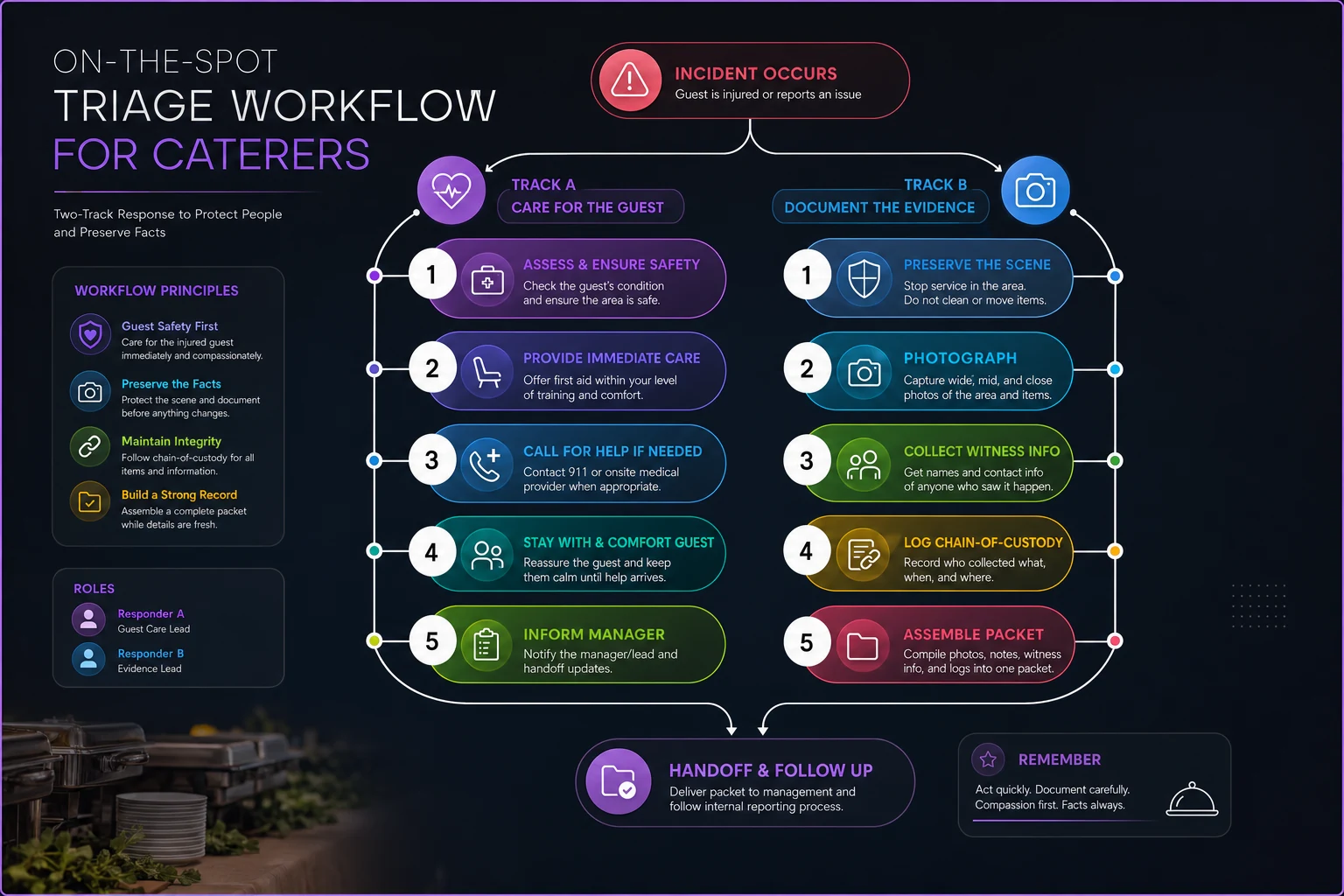
A simple graphic of the two-track steps makes the flow obvious to crews.
Photo and witness templates that actually hold up
A photo without context is nearly useless to an adjuster. A photo with a caption, a timestamp, and a location note is evidence.
The photo capture rule
-
One wide shot showing the area in context — where in the venue, relative to stations, exits, signage
-
One or two mid shots of the immediate area
-
One or two close-ups of the actual hazard, damage, or source
-
One shot of any relevant signage or safety measure — wet floor sign, cord cover, barrier
Shoot before cleanup for the scene, and after care for any injury the person consents to being photographed. Never photograph an injured person without their permission.
The witness statement template
| Field | Example entry |
|---|---|
| Date / time | Sat 10/12, ~8:35pm |
| Witness name | Marcus Bell |
| Phone / email | (contact) |
| Relationship to event | Guest, table 6 |
| What they saw (their words) | "She was walking toward the bar and slipped. There was a sign but it was kind of behind the ice bucket." |
| Signature / verbal consent noted | Verbal, captured by J. Ortiz |
The magic is in the "their words" line — and the fact that you captured a sign was present detail from a neutral party. That single sentence has flipped liability on more than one slip claim.
Chain-of-custody for physical evidence
Almost nobody does this part, and it's the part that wins the odd, higher-value claim — the damaged $900 designer jacket, the "your equipment ruined our rented linens" dispute, the food-safety complaint where the leftover food itself is the evidence.
If a physical object is part of the incident, you need to prove it's the same object, untampered, from the moment of the incident to the moment the insurer sees it.
A simple chain-of-custody note per item:
-
What it is e.g., scorched client tablecloth, section near head table
-
When and where collected timestamp and location
-
Who collected it name
-
How it's stored bagged, labeled, sealed, kept in the office — or photographed in place if you can't physically take it
-
Every handoff after that who touched it, when, why
For food-safety incidents specifically, this ties directly into your broader food-safety controls. If a guest reports illness, the retained sample and the temperature logs become your defense. The same discipline covered in the catering risk & compliance playbook that links HACCP decision rules to contract clauses is what makes a food-illness claim defensible instead of a he-said-she-said.
The pattern worth internalizing: if you can't retain the object, retain the record of it. Photograph, log, and note who handled it. An adjuster doesn't need the physical tablecloth if you have a clean chain of photos, a labeled storage note, and a signed pickup slip.
The insurer-exhibit packet checklist
Everything above feeds one output: a packet you can hand to your insurer, broker, or attorney without them chasing you for three weeks. The difference between a claim that resolves in a month and one that drags for a year is usually just packet completeness.
Assemble this within 48 hours while memory is fresh:
-
Incident summary — one page, factual, chronological, no speculation about fault
-
Event details — client name, venue, date, contract reference, headcount
-
Timestamped photo set — wide, mid, close, signage
-
Witness statements — at least the named ones, in their words
-
Crew accounts — captain and documenter, written same night
-
Chain-of-custody notes for any physical evidence
-
Relevant logs — temperature logs, setup checklists, signage confirmation
-
Contract and insurance certificates — your COI, venue requirements, any indemnity clauses
-
Any communication with the affected party — factual exchanges only; run sensitive ones past your broker first
-
Rental/equipment condition records if gear was involved
That last item matters more than people expect. When a rental item is part of the incident — a wobbly table, a faulty warmer — your check-in/check-out condition records become evidence that the item was fine when it arrived or flagged as damaged before the event started. The same manifests that prevent surprise rental losses double as incident evidence. If you're already keeping them, you're most of the way there.
Escalation timelines: who gets told, and when
Speed of notification affects coverage. A lot of policies have notice requirements, and "we told the insurer six weeks later" is a real reason claims get contested.
| Timeframe | Action | Who |
|---|---|---|
| Immediate (0–20 min) | Care, scene preservation, triage | Captain + documenter |
| Same night | Written crew accounts, packet started, owner notified | Captain → Owner |
| Within 24 hrs | Broker/insurer notified of potential claim | Owner |
| Within 48 hrs | Full exhibit packet assembled | Owner / coordinator |
| Within 5–7 days | Follow-up with affected party per broker's guidance | Owner |
| Ongoing | Log every contact, keep packet updated | Owner |
The judgment call most owners get wrong: notify the broker even when you think it's nothing. A guest who says "I'm fine" at the event and files three weeks later is more common than you'd think. Late notice looks like concealment. Early notice — even on a non-event — costs you nothing and protects the policy.
A real scenario
A mid-sized off-premise caterer running around 120–150 events a year had a guest go down near a bar station at a wedding. A server helped her up, someone mopped, the event carried on. Six weeks later: a claim for a wrist injury, alleged wet floor, no warning signage.
They had nothing. No photos, the floor had long since dried, no idea who witnessed it. Their carrier settled to avoid litigation costs — somewhere in the low five figures — and their premium moved at renewal.
The owner rebuilt their response around the two-track model. About four months later, near-identical situation: guest slipped near a station. This time the documenter roped off the area, photographed the floor with the wet-floor sign clearly visible three feet away, and captured two guests who both confirmed the sign was up. When the claim came in, the packet went to the broker inside 48 hours. The adjuster reviewed it and the claim closed with no payout — the documented signage established the guest had been warned.
Same type of incident. The only variable was whether the evidence existed. One cost a settlement and a premium bump. The other cost about seven minutes of a coordinator's time.
Where this quietly falls apart — and how to keep it from happening
The workflow isn't complicated. Keeping it alive across dozens of events with rotating staff is the hard part.
What tends to break it:
-
The captain is slammed and skips the packet "just this once"
-
The documenter role isn't assigned, so everyone assumes someone else handled it
-
Photos live on a personal phone that walks out with a seasonal server at the end of the night
-
Nobody consolidates crew accounts the same night, and by Monday the details are mush
Centralizing the record helps more than any clever process step. When incident capture lives in the same operational system that already holds event details, staffing, rental manifests, and food-safety logs, the packet half-assembles itself — the contract reference, headcount, check-in records, and temp logs are already attached to that event.
That's where AI-assisted operational platforms start making a real difference for caterers running real volume. The documenter fills a short structured form, uploads photos, and the escalation timeline and packet checklist run automatically instead of depending on a stressed captain remembering the sequence at 8:40pm on a Saturday. The packet is organized and ready to send before anyone has to think about it.
You don't need software to do any of this. A phone, a printed template, and a rehearsed two-track response gets you most of the value starting tonight. But if you're running enough events that incidents are a when not an if, pulling the capture into your existing operations platform is what turns a good intention into something that actually happens every time.
The one thing to take away
Your crew already responds well to incidents — that's not the gap.
The gap is that responding well and documenting well are two different jobs that can't be done by the same person in the same moment. Assign the documenter, rehearse the 20-minute sequence, and build the packet while the evidence is still recoverable. The claims you'll win are the ones you prepared for before you knew you'd need to.
Your crew already responds well to incidents — that's not the gap. The gap is that responding well and documenting well are two different jobs that can't be done by the same person in the same moment. Assign the documenter, rehearse the 20-minute sequence, and build the packet while the evidence is still recoverable. The claims you'll win are the ones you prepared for before you knew you'd need to.
Ready to elevate your catering business?
Join 500+ caterers trusting Caterngly to save time, reduce errors, and deliver flawless events.