


You shipped out twelve gold Chiavari chairs to the Riverside Country Club wedding. The venue coordinator swears they only received ten. Now you're eating $280 in replacement costs because nobody documented what left your warehouse versus what actually arrived on-site.
The real cost of rental equipment disputes
Most caterers treat equipment losses as an occasional cost of doing business. But when you actually track the numbers, the financial damage becomes clear. A mid-sized catering operation running 40 events monthly can easily lose between $1,800 and $3,400 per month on unaccounted equipment and damage disputes — and that's before factoring in the hours spent on back-and-forth trying to resolve claims.
The operational impact extends beyond direct losses. Staff waste time searching for missing items before events. Replacement orders throw off inventory planning. Client relationships deteriorate when surprise damage charges appear weeks after their event. Some caterers try to compensate by inflating rental prices, which makes them less competitive when bidding.
What makes this particularly frustrating is that most losses are preventable. The equipment isn't vanishing into thin air — there's simply no clear documentation trail showing custody transfers and condition at each handoff point.
Why standard tracking methods fail
Traditional equipment tracking relies on paper manifests that get coffee-stained, lost in truck cabs, or filled out hastily during load-out. Even digital spreadsheets fail because they capture quantity but not condition. You might know that eight tablecloths went out, but there's no record of the wine stain on tablecloth number three that was already there before shipping.
End chaos with centralized catering management.
Caterngly helps you plan, confirm, and manage every catering event seamlessly.
- Unified event and order management
- Real-time client updates
- Staff and resource scheduling
No credit card required
Warehouse to truck: Items get counted but not inspected. That cracked serving platter makes it onto the truck because the loader is focused on quantity, not quality.
Truck to venue: Delivery drivers hand off equipment to whoever's available — sometimes a janitor, sometimes an assistant planner. No signature, no verification count, definitely no condition check.
Event breakdown: Tired staff at 11 PM are focused on getting home, not documenting every scratch on every chair. Items get tossed into bins without inspection.
Return processing: By the time equipment returns to the warehouse, nobody remembers what condition it left in. Arguments about pre-existing damage become impossible to resolve.
Building a photo-evidence manifest system
The solution isn't complicated technology — it's a systematic approach to documentation that creates accountability at every handoff point. When properly implemented, this framework has proven to reduce equipment disputes by roughly 85%.
Pre-event documentation workflow
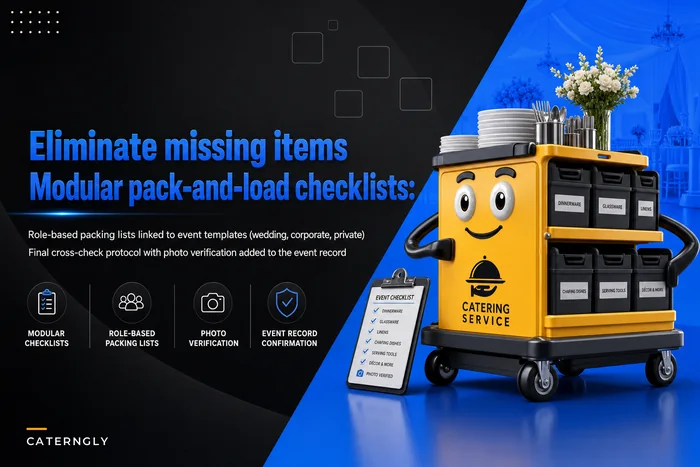
Start documentation during the packing process, not at delivery. As equipment gets staged for an event, photograph each category of items showing both quantity and condition. You don't need individual photos of every fork — batch photos work fine for undamaged standard items. But any equipment with existing wear should get individual documentation.
Start with high-value and known-problem items when rolling out the photo-manifest system to build compliance without overwhelming staff.
Create a digital manifest that links to these photos. This isn't just a packing list — it's a visual record of exactly what's leaving your facility. Include serial numbers for high-value items like coffee urns or warming equipment. Note any existing damage with close-up photos and descriptions.
The manifest should include clear custody chain fields: packed by, verified by, transported by, received by. Each person adds their digital signature with timestamp. This creates accountability at every step and eliminates the "nobody told me" excuse when items go missing.
Venue handoff protocol
Delivery drivers need more than basic drop-off instructions. They should arrive with a tablet or phone showing the visual manifest. The venue contact reviews the manifest, physically checks high-value items, and signs digitally to confirm receipt. If they refuse to verify, the driver documents this refusal and photographs the equipment in its delivered location.
For venues that claim they're "too busy" for proper receiving, a graduated fee structure works well. Standard delivery includes basic drop-off. Verified delivery with full documentation costs extra but protects against disputes. Most venues quickly find time for verification when they realize the alternative leaves them liable for discrepancies.
Return inspection process
Post-event equipment inspection can't wait until Monday morning when memories have faded. Build a rapid triage system where returning equipment gets sorted into three categories: clean/undamaged, minor issues, and damage requiring follow-up.
Photograph everything in the second and third categories before cleaning. Compare return condition photos against pre-event documentation. When damage appears, you have timestamped evidence showing the item's condition at departure versus return. This transforms subjective arguments into objective comparisons.
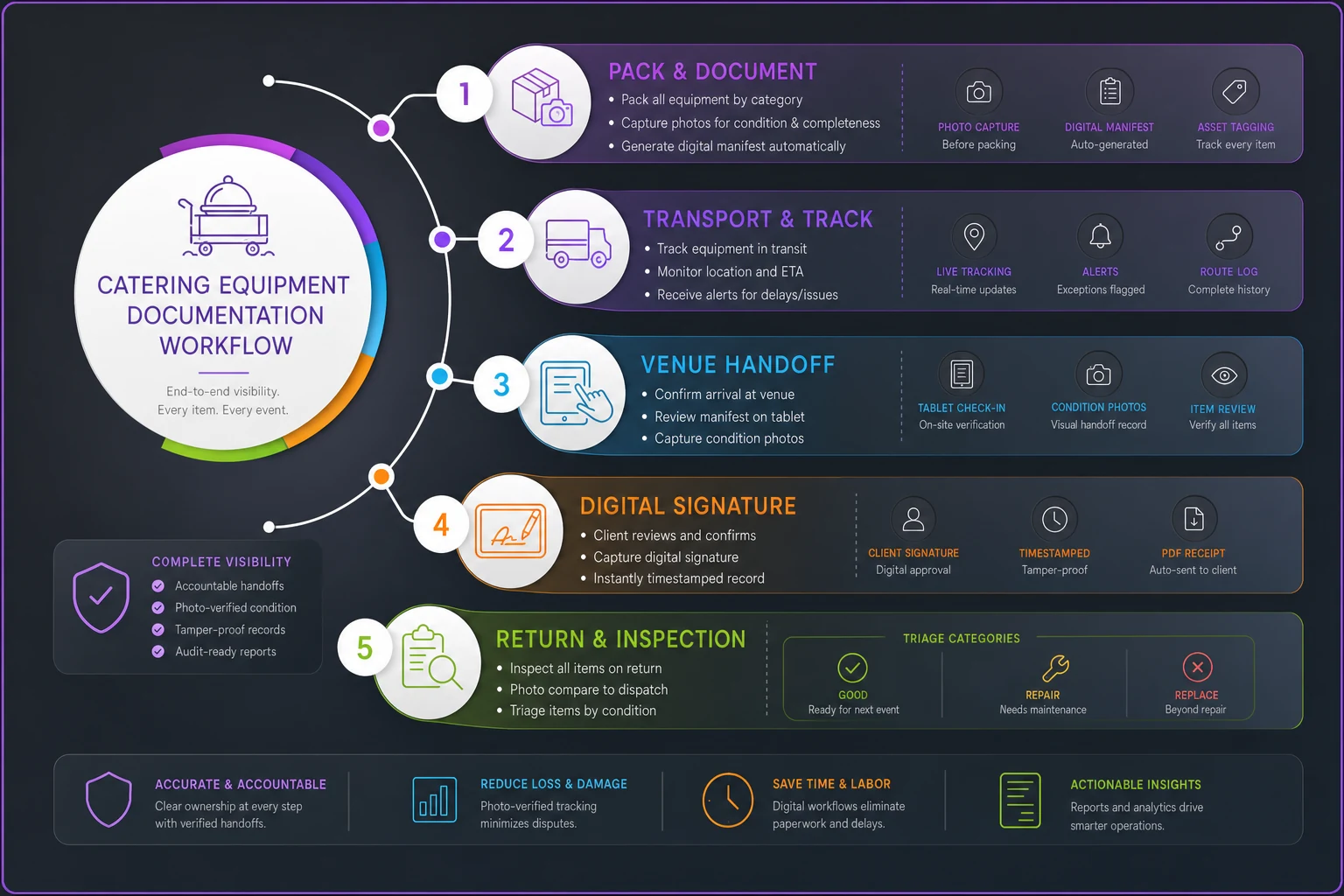
This diagram shows the end-to-end documentation flow from packing to final reconciliation.
Deposit structures that prevent disputes
Traditional flat deposits don't account for varying risk levels across different events and venues. A corporate luncheon at a controlled office environment carries different risk than an outdoor festival with public access. Your deposit structure should reflect that reality.
Risk-based deposit calculation
Create a base deposit framework that considers three factors: Event environment risk: Outdoor events, venues without dedicated staff, and public-access events require higher deposits. Indoor corporate events at professional venues can use standard rates. Equipment value tiers: Group your rental items into value categories. Premium linens, specialty serving pieces, and electronic equipment warrant separate deposit lines rather than getting buried in a general deposit. Client history score: New clients start at standard deposit levels. Clients with clean return histories earn reduced deposits over time. Those with past issues face elevated rates. This creates a financial incentive for careful equipment handling.
| Category | Items | Base Deposit | Risk Adjustment | Final Deposit |
|---|---|---|---|---|
| Seating | 150 Chiavari chairs | $300 | Outdoor venue (+25%) | $375 |
| Linens | Premium tablecloths, overlays | $200 | Standard risk | $200 |
| Service | Chafing dishes, serving utensils | $150 | Standard risk | $150 |
| Specialty | Champagne fountain, warming equipment | $400 | High-value items | $400 |
| Total | $1,125 |
Automated deposit release rules
Manual deposit processing creates delays and inconsistencies. Establish clear automatic release triggers tied to equipment return status. If all items return undamaged within 48 hours, deposits release automatically. Minor damage below a set threshold (say $50) gets deducted without requiring approval. Major damage triggers a review process with photo evidence attached.
This systematic approach removes emotion from deposit decisions. Clients understand the rules upfront, and your team follows consistent procedures rather than making judgment calls on the fly.
SLA templates for different venue types
Service Level Agreements with venues clarify responsibilities before problems arise. But generic SLAs don't address the specific challenges of different venue categories. You need targeted templates built around real operational friction points.
Country clubs and private venues
These venues often have their own equipment mixed with yours. The SLA must specify segregation requirements — your items stay in designated areas with clear labeling. Include provisions for venue staff training on handling specialty items. Address scenarios where venue staff "borrow" your equipment for other events without permission.
Specify access windows for setup and breakdown. Many private venues restrict vendor access around member events, creating compressed timeframes that increase damage risk. The SLA should include rush fee provisions when access limitations force hurried work.
Hotels and conference centers
Hotel venues present unique challenges around equipment routing through service corridors and freight elevators. Your SLA needs clear language about equipment inspection at loading dock receipt, not just at the event space. Hotels often claim items never arrived when they're actually sitting in a storage room three floors away.
Include provisions for equipment storage between multi-day events. Hotels sometimes move your equipment without notice, leading to frantic searches before day-two setup. The SLA should require notification and documentation of any equipment movement.
Outdoor and unconventional spaces
Parks, museums, and historic properties require detailed SLAs addressing ground protection, weather contingencies, and restricted access areas. Include specific protocols for weather-related cancellations — who makes the call, when equipment can be pre-positioned, and how weather damage responsibility gets allocated.
These venues often lack receiving staff, so the SLA must designate a specific contact for equipment handoffs. Include escalation procedures for when the designated contact is unavailable. Without this clarity, your delivery team wastes time hunting for someone to accept responsibility.
Automated ledger adjustments and reconciliation
Traditional month-end reconciliation means disputes surface weeks after events when details are fuzzy. Operational software with built-in automation enables real-time ledger adjustments that prevent surprise charges and maintain cash flow visibility.
Real-time damage assessment workflow
When damaged items return, the warehouse team photographs and categorizes the damage immediately. This triggers an automated workflow:
-
Photos upload to the event record with damage classification
-
Replacement or repair costs calculate based on pre-loaded item values
-
Client receives notification with evidence and proposed charges
-
48-hour response window before automatic deposit application
-
Ledger adjusts with detailed documentation trail
This immediate processing prevents the pile-up of unresolved damages that create month-end surprises. Clients can dispute charges while events are fresh in memory, leading to faster resolution.
Intelligent deposit reconciliation
Your operational platform should automatically match deposits against actual charges, releasing differences back to clients without manual intervention. But intelligence means more than simple math. The system should recognize patterns — if a venue consistently generates damage claims, flag this for review. If a client disputes every charge regardless of evidence, require management approval before releasing deposits.
Build escalation rules based on amount and frequency. Damage under $100 processes automatically. Amounts between $100–$500 require supervisor review. Anything over $500 or the third claim within 60 days triggers management involvement. This keeps human attention focused where it actually matters while routine adjustments handle themselves.
Integration with existing operations
Photo-evidence systems and deposit automation only work when they integrate smoothly with your existing workflows. Forcing staff to use separate systems for documentation creates compliance problems and data gaps.
Your catering rental equipment tracking system should connect directly with your packing and loading checklists, allowing photos to attach to specific manifest line items. When warehouse staff check off "12 gold Chiavari chairs loaded," they simultaneously capture and link condition photos.
Similarly, deposit calculations should pull from your existing pricing database. When you update rental rates, deposit structures adjust automatically. This prevents the common problem where deposits stay static while replacement costs increase, leaving you underprotected.
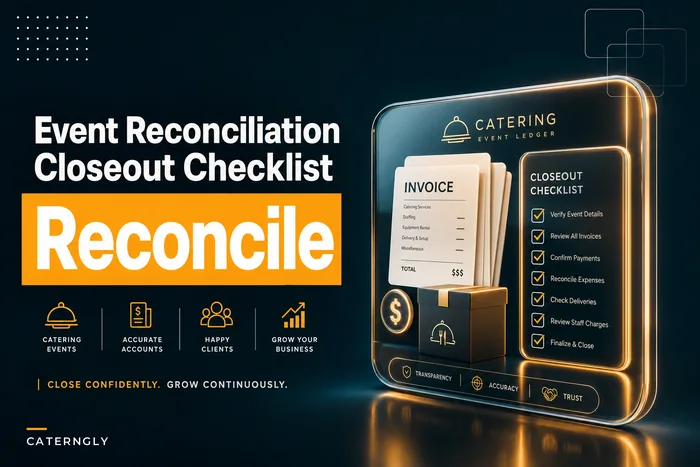
The return inspection process also needs to align with your post-event reconciliation workflows. Damage documentation should flow directly into invoice adjustments without duplicate data entry. This reduces errors and ensures billing accurately reflects equipment status.
Common implementation mistakes to avoid
The most frequent error is trying to document everything at maximum detail from day one. This overwhelms staff and creates pushback against the new system. Start with high-value items and known problem categories. Once the workflow becomes routine, expand coverage gradually.
Another mistake is treating all events equally. A small corporate lunch doesn't need the same documentation intensity as a 300-person outdoor wedding. Build simplified workflows for low-risk events while maintaining full documentation for complex situations.
Some caterers create elaborate damage classification systems with fifteen categories and subcategories. This complexity kills compliance. Keep it simple: undamaged, minor wear, needs repair, or needs replacement. Add nuance once the basic system is running smoothly.
Avoid making venue partners feel like suspects. Position documentation as mutual protection, not accusation. Share access to photo evidence so venues can use it to address issues with their own staff. When venues see you're documenting fairly and not trying to inflate claims, cooperation improves considerably.
Measuring system effectiveness
Track three key metrics to validate your documentation system is actually working:
Dispute rate: Calculate the percentage of events generating equipment disputes before and after implementation. A functioning system should reduce disputes by at least 70% within the first ninety days.
Resolution time: Measure hours spent resolving each dispute. Photo evidence should cut resolution time from hours of back-and-forth to minutes of evidence review.
Recovery rate: Track what percentage of damage costs you successfully recover. This should climb from the industry average of around 40% to above 80% with proper documentation in place.
Don't just track problems — monitor smooth transactions too. If 95% of events complete without any equipment issues, your system is working. The goal isn't to catch more problems but to prevent them through accountability.
Technology considerations for scaling
Small operations might manage with smartphone photos and spreadsheets initially. But as event volume grows, manual systems break down. Around 20 events monthly, you need purpose-built catering rental equipment tracking software that automates workflows rather than just storing data.
Modern platforms can identify equipment from photos automatically, reducing manual data entry. They flag anomalies — like when expensive items don't appear in return photos — without someone having to catch it manually. Integration with your equipment maintenance schedules ensures damaged items route to repair queues rather than going back into rental rotation.
The right operational software turns documentation from a defensive measure into a genuine profit center. When you can prove equipment condition conclusively, you recover more damage costs. When clients know you document thoroughly, they handle items more carefully. When venues understand their accountability, mysterious losses start to decrease.
Equipment disputes don't have to be an accepted cost of catering operations. With systematic documentation, thoughtful deposit structures, and automated reconciliation, you can reduce losses while actually improving client relationships through transparency.
Start with your next high-value event. Document equipment condition, establish clear custody chains, and process returns immediately. Once you see the dispute reduction from just one properly documented event, expanding the system becomes an obvious priority.
The caterers who thrive in competitive markets aren't necessarily those with the finest linens or most extensive inventory. They're the ones who run tight operations where every dollar of equipment investment gets protected through consistent tracking and accountability. When you stop accepting "surprise" losses as normal, you discover most were preventable all along.
Ready to elevate your catering business?
Join 500+ caterers trusting Caterngly to save time, reduce errors, and deliver flawless events.