

Every catering event generates a paper trail that most operators never fully reconcile. Vendor invoices arrive days later. Delivery receipts get stuffed in folders. Rental returns process separately. Staff timesheets sit in payroll. Meanwhile, your event ledger shows one number, your bank account shows another, and nobody can explain the difference. Post-event reconciliation isn't just about matching receipts. It's about catching the operational gaps that quietly drain $2,000–$4,000 per event in untracked costs, disputed charges, and missed billing opportunities.
The hidden cost of delayed reconciliation
Most caterers close out events informally — deposit the final payment, file the paperwork, move to the next booking. The real financial picture shows up weeks later when vendor invoices trickle in with costs nobody anticipated.
A 150-person corporate lunch looks profitable on the initial invoice. Three weeks later, the linen company bills for stain removal. The rental company adds a late return fee. The staffing agency tacks on overtime nobody approved. The produce vendor's delivery invoice shows quantities 20% higher than ordered. Each charge seems minor on its own, but across 15–20 events monthly, these discrepancies compound into real margin erosion.
The problem gets worse when multiple events overlap. That Saturday wedding, Sunday brunch, and Monday corporate lunch share overlapping vendor orders. Which strawberries went to which event? Did the extra chafing dishes get returned from the right venue? Without systematic reconciliation, you're essentially guessing at per-event profitability.
Building your event ledger framework
Your event ledger needs to capture more than just revenue and food costs. A functional post-event reconciliation system tracks every financial touchpoint from initial deposit through final vendor payment.
End chaos with centralized catering management.
Caterngly helps you plan, confirm, and manage every catering event seamlessly.
- Unified event and order management
- Real-time client updates
- Staff and resource scheduling
No credit card required
Start with a spreadsheet structure that separates pre-event estimates from actual costs. Create columns for:
-
Revenue tracking
-
Contract amount
-
Deposit received (date and amount)
-
Final payment
-
Additional charges approved
-
Gratuity collected
-
Payment method and processing fees
-
Direct event costs
-
Food purchases (itemized by vendor)
-
Beverage costs
-
Disposables and supplies
-
Equipment rentals
-
Venue fees or commissions
-
Transportation costs
-
Labor costs
-
Kitchen prep hours
-
Service staff hours
-
Breakdown/cleanup time
-
Overtime charges
-
Contract labor fees
-
Variable charges
-
Last-minute additions
-
Damage fees
-
Cleaning charges
-
Waste disposal
-
Emergency purchases
For each line item, track both the estimated amount and the actual invoice amount. The variance between those numbers is where your estimates consistently miss reality.
The three-day reconciliation window
The most effective catering operations complete initial reconciliation within 72 hours of event completion. This window matters because memories fade, receipts disappear, and disputes get harder to resolve.
Day one is about immediate documentation. Before trucks leave the venue, photograph all returned equipment. Document any venue damage. Collect receipts from emergency purchases. Record actual staff hours including setup and breakdown. These details vanish quickly once everyone disperses.
Day two is vendor communication. Email each vendor confirming quantities delivered and picked up. Request immediate invoicing rather than waiting for monthly statements. Flag discrepancies while the event is still fresh. A Monday email about Saturday's linen count gets resolved faster than discovering the issue three weeks later.
Day three completes internal matching. Compare delivery receipts to purchase orders. Match staff timesheets to scheduled hours. Review change orders against final billing. Calculate actual food cost percentages. This systematic review catches errors before they become permanent.
Here's a simple visual of the three-day workflow to keep the team focused.
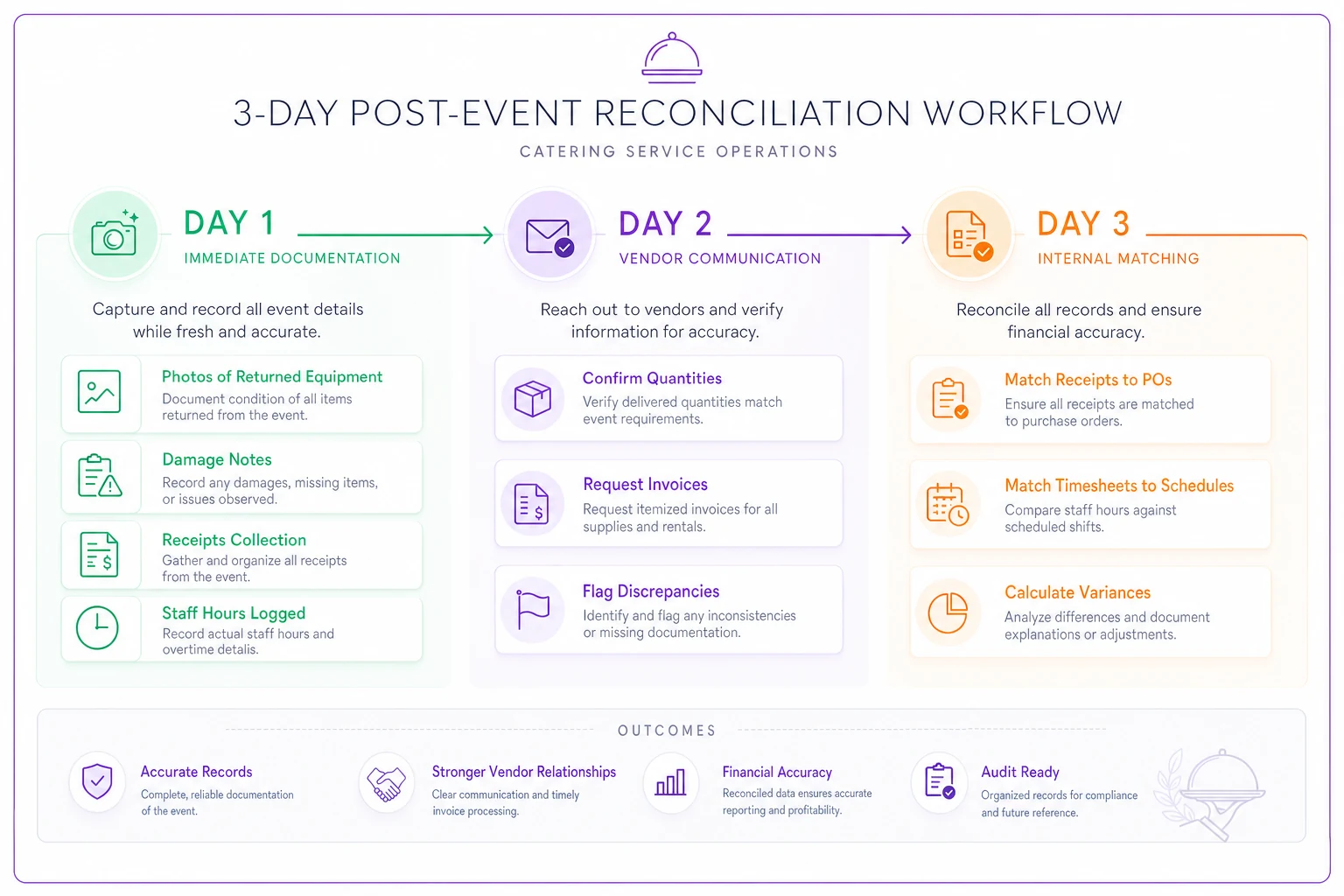
This visual helps teams remember the sequence and ownership for each day's tasks.
Invoice matching rules and discrepancy protocols
Every catering operation needs clear rules for handling invoice variances. Without defined thresholds and escalation paths, small discrepancies pile up into major losses.
Set specific variance thresholds that trigger different actions:
| Variance Amount | Action Required | Timeline |
|---|---|---|
| Under $50 | Note and approve | Same day |
| $50–$200 | Verify with records | 24 hours |
| $200–$500 | Contact vendor | 48 hours |
| Over $500 | Full investigation | Immediate |
Document standard causes for variances. Price increases need written confirmation before the event. Quantity overages require delivery receipt verification. Quality issues need photo documentation. Damage charges need incident reports. These rules prevent vendors from adding unexplained charges weeks after service.
Create reconciliation checkpoints for common problem areas:
Rental equipment: Count items at venue departure, not just arrival. Photograph any existing damage before loading. Require vendor signatures on return receipts. Disputed damage claims without documentation are nearly impossible to fight.
Perishable deliveries: Weigh or count high-value items immediately on receipt. Seafood invoiced at 30 pounds but weighing 24 pounds is a 20% overcharge. Produce quality issues need same-day documentation for any credit to stick.
Staffing charges: Match invoice hours to actual sign-in/sign-out times. Verify overtime calculations. Confirm agency fees align with contracted rates. Staffing agencies frequently round up hours or apply incorrect overtime multipliers — it happens more than you'd expect.
Journal adjustments and correction workflows
Even careful operations generate reconciliation errors. The goal is systematic correction, not endless investigation.
When variances exceed acceptable thresholds, create journal adjustments that maintain accurate event profitability tracking. If March's Smith wedding gets charged for April's Johnson luncheon rentals, both events show incorrect margins until corrected.
Common adjustment scenarios:
Shared purchases across events: That 50-pound salmon order served three events over a weekend. Allocate costs based on guest counts or portion usage rather than dumping everything onto Friday's event.
Delayed vendor credits: The produce vendor agrees to credit $200 for poor quality strawberries. Record that credit against the original event, not whenever it actually processes through your account.
Commission corrections: Venue commissions calculated incorrectly need backdating to the service date for accurate margin analysis.
Emergency purchase allocations: Forgotten dessert plates bought at restaurant supply go to petty cash. Reallocate them to the specific event for true cost visibility.
Document every adjustment with context, not just the transaction. "Moved $340 rental charge from Event #2431 to Event #2429" tells you nothing six months later. "Corrected rental invoice — deliverer mixed up Johnson and Smith venue addresses" actually builds an audit trail.
Connecting reconciliation to operational improvements
Post-event reconciliation data reveals patterns that financial reports miss. Invoice variances and adjustment patterns point to specific operational failures.
Consistent produce overages might indicate ordering problems or a vendor worth replacing. Frequent rental damage charges could mean equipment handling needs attention. Regular overtime surprises usually point to unrealistic event timing estimates. The reconciliation process becomes a diagnostic tool, not just an accounting exercise.
Link reconciliation findings directly to your KPI dashboard. Track metrics like:
-
Average days to full reconciliation
-
Percentage of events with variances over $200
-
Vendor dispute resolution time
-
Month-over-month variance trends
-
Recovery rate on disputed charges
These metrics turn reconciliation from administrative burden into operational intelligence. A caterer who notices their average reconciliation time climbed from 3 to 7 days can investigate before it becomes a cash flow problem.
Real scenario: The $18,000 reconciliation recovery
A Dallas catering company averaging around 18 events monthly never reconciled systematically. Invoices got paid when they arrived. Nobody tracked variances. Event profitability used estimates, not actuals.
Implementing structured post-event reconciliation revealed some uncomfortable gaps. Linen invoices included $400–$600 monthly in charges for items that were supposedly unreturned but actually had been returned. Produce invoices consistently exceeded orders by 15–20%. Staffing bills included overtime hours that didn't match timesheets. Altogether, the company was losing roughly $3,000 monthly to unverified charges they were just paying.
The three-day window changed things. Quick variance identification led to $18,000 in recovered overcharges over six months. And once vendors realized their invoices were being scrutinized, the number of "errors" dropped significantly.
Technology and reconciliation efficiency
Manual reconciliation is manageable at 5–10 events monthly. Beyond that, spreadsheet tracking gets unwieldy fast. Modern operational software can automatically match invoices to purchase orders, flag variances exceeding thresholds, and maintain running event ledgers without someone manually updating everything.
AI-powered platforms can now scan invoice PDFs, extract line items, and compare them against event budgets automatically. This doesn't replace human review — it just compresses the matching process dramatically. What used to take four hours of manual work happens in minutes, with your team focused on exception handling rather than data entry.
When scheduling, purchasing, and financial tracking are connected in one system, duplicate entry disappears. When your Saturday wedding needs 150 dinner plates, that flows from the event sheet to the rental order to reconciliation. Variances get flagged immediately rather than discovered weeks later when it's much harder to dispute anything.
Building your reconciliation playbook
Start with your next event, not after reorganizing your entire operation. Pick one high-value booking and track every financial element from deposit to final vendor payment. Document what works and what doesn't.
Keep templates simple enough that your team will actually use them. A 20-field reconciliation spreadsheet nobody completes is useless. A 5-field worksheet that gets filled out consistently is worth more.
Start with a single high-value event so the team sees measurable ROI and habits form faster.
Focus first on your largest variance sources. If rental discrepancies cause the biggest losses, start there. Food cost reconciliation can come later. Consistent reconciliation on your problem areas beats imperfect reconciliation across every category.
Train your team on why it matters for their work specifically. Kitchen managers who understand that reconciliation reveals over-ordering tend to adjust purchasing. Service captains who see overtime patterns start modifying schedules. Done right, reconciliation drives operational improvement, not just accounting compliance.
The compound effect of consistent reconciliation
Catering businesses that reconcile consistently see benefits beyond just recovered overcharges. Accurate event profitability data sharpens pricing decisions. Vendor relationships improve when discrepancies get resolved quickly and professionally. Cash flow becomes more predictable when you know true event margins.
More than anything, systematic post-event reconciliation moves catering from "hope we made money" to an operation that actually knows. You understand which event types generate real profit, which vendors need monitoring, and which operational habits need changing.
Spend 90 minutes per event on systematic reconciliation, or lose $2,000–$4,000 per event to untracked variances. In catering's thin-margin reality, reconciliation isn't optional paperwork — it's how you stay viable.
Ready to elevate your catering business?
Join 500+ caterers trusting Caterngly to save time, reduce errors, and deliver flawless events.