

When inventory complexity becomes the thing that quietly kills your margins
Running multi-event catering inventory feels like three-dimensional chess — blindfolded. You're tracking perishables across different event dates, juggling vendor lead times that shift based on order size, and trying to batch purchases without ending up with either empty shelves or a dumpster full of spoiled produce.
The math gets ugly fast. A wedding on Saturday needs fresh arugula delivered Thursday. The corporate lunch on Tuesday uses the same greens but needs them Monday. Your vendor requires 48-hour notice for orders under $500 but offers same-day for orders over $1,000. Meanwhile, you're trying to figure out if buying 15 pounds for the week actually saves money versus three separate 5-pound orders — knowing arugula has a 4-day shelf life once delivered.
This compounds across every ingredient, every vendor, every event. Most caterers end up either massively overordering to play it safe (waste eats the margins) or constantly scrambling for last-minute vendor runs (emergency pricing and extra labor eat the margins differently). Neither is sustainable.
Why standard inventory formulas fail for multi-event operations
Traditional restaurant inventory math assumes steady daily consumption. The reorder point formula looks clean: average daily usage × lead time + safety stock. Catering breaks every assumption behind it.
Your "daily usage" might be zero for three days, then 200 portions Thursday, zero Friday, then 500 portions Saturday. Lead times aren't fixed — they depend on order size, day of week, and which vendor you're using. Safety stock calculations assume predictable variance, but catering demand clusters around events with completely different consumption patterns.
EOQ models assume holding costs and ordering costs stay constant. In catering, your holding cost for produce changes daily as items deteriorate. Ordering costs shift depending on whether you hit vendor minimums, qualify for free delivery, or end up sending someone to Restaurant Depot for a retail run.
What usually happens in practice: the chef builds a mental model from experience, orders extra to be safe, and hopes the waste doesn't get too visible. That works until you scale past around eight events per week. Past that threshold, the mental math collapses and waste quietly starts eating double-digit percentages of food cost.
The perishable reorder-point calculation that actually works
The reorder math that handles multi-event complexity looks different than the standard formula. Instead of averaging daily demand, you calculate forward-looking event demand within your maximum holding window.
End chaos with centralized catering management.
Caterngly helps you plan, confirm, and manage every catering event seamlessly.
- Unified event and order management
- Real-time client updates
- Staff and resource scheduling
No credit card required
-
Leafy greens
4 days from delivery
-
Tomatoes/peppers
7 days
-
Root vegetables
14 days
-
Dairy
7–10 days depending on type
-
Proteins
3–5 days fresh, 30+ frozen
Your reorder point becomes: sum of demand within (lead time + usable life window) + variance buffer based on portion uncertainty.
Back to the arugula example. If today is Monday and you're calculating Tuesday's order with 48-hour lead time, you look at all events from Thursday through Sunday — delivery day through last usable day. Sum the arugula requirements across those events, add 15% for portion variance, subtract current inventory. That's your order quantity.
The portion variance buffer should scale with event certainty. Confirmed corporate lunches with locked headcounts might need only 10% buffer. A wedding cocktail hour where "150 guests" could realistically mean anywhere from 120 eating to 180 eating needs closer to 25%. This beats generic safety stock because the buffer reflects actual uncertainty rather than historical averages.
Here's a quick visual of that reorder workflow.
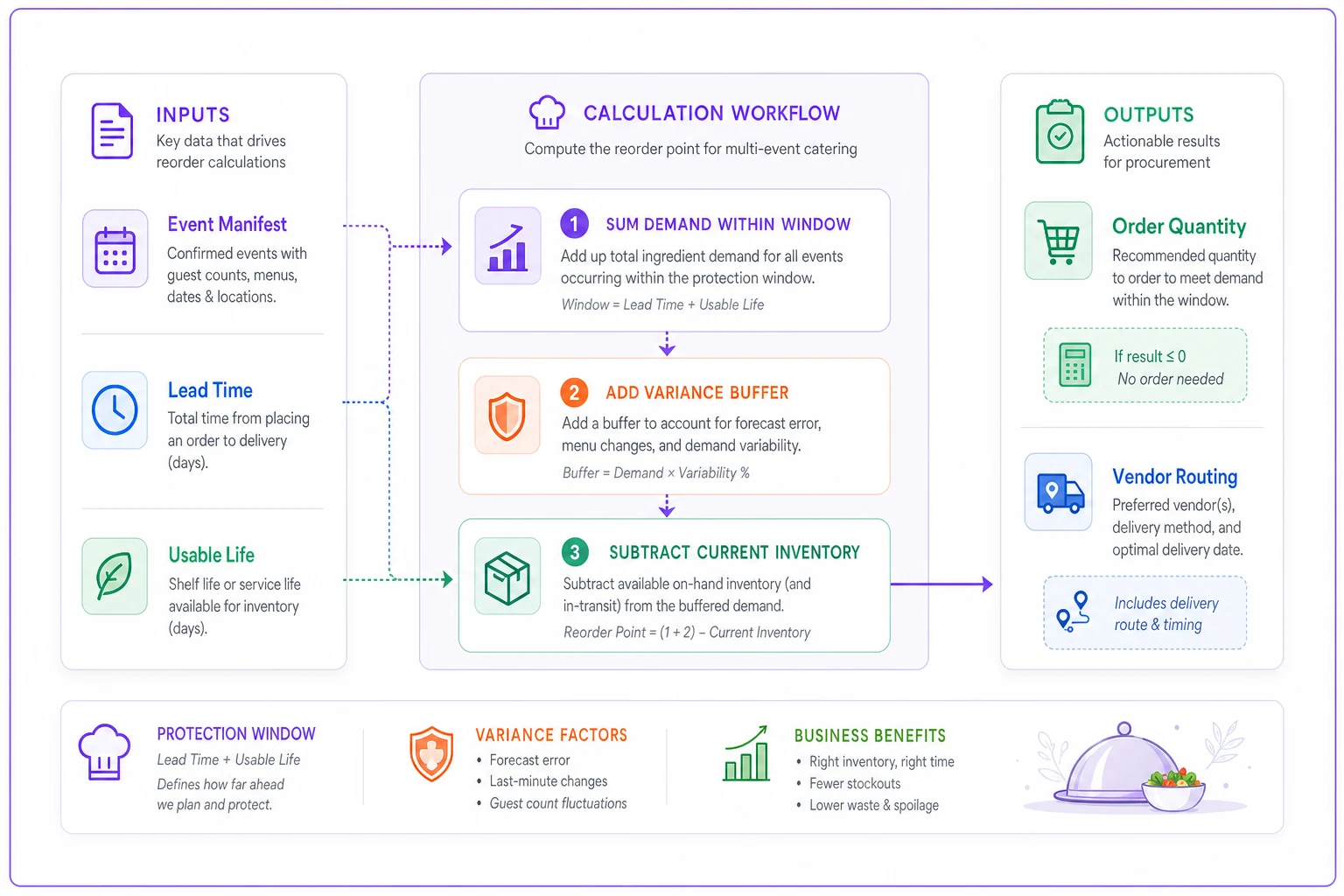
The workflow ties event dates, vendor lead times, and usable life into one forward-looking calculation so you order what you need for the usable window instead of relying on smoothed averages.
Lead-time smoothing across multiple vendors
Most caterers work with four to eight primary vendors, each with different lead times, minimums, and delivery schedules. The goal is mapping these into a decision matrix that routes orders to the right vendor based on timing and quantity.
-
Standard lead time (24, 48, 72 hours)
-
Expedited options and costs
-
Minimum order thresholds
-
Delivery days and cutoff times
-
Quality consistency scores
-
Price breaks at volume points
When you calculate need-by dates, check this matrix to find the lowest-cost vendor that can actually hit the timing. If you need produce Thursday and it's Monday afternoon, your primary vendor with 48-hour lead time works fine. If it's Tuesday evening, you route to your same-day vendor despite the 20% premium — because the alternative is sending staff to buy retail at 40% over cost.
The smoothing part happens when you intentionally pull orders forward to hit better vendor terms. If Thursday's event needs $400 of produce and Saturday needs $650, ordering $1,050 on Tuesday for Thursday delivery might qualify for free delivery and a 10% volume discount — offsetting any holding cost for the extra two days.
Pooled ordering rules that minimize waste while maximizing vendor terms
Pooling orders across multiple events only makes sense when the math works across three factors: vendor terms improvement, holding cost impact, and waste risk.
First, calculate the vendor benefit of pooling. If combining Tuesday and Thursday orders moves you from $400 to $600, crossing the free delivery threshold, that's $30–50 saved. If it pushes into a price break tier, calculate that discount value explicitly.
Second, compute the holding cost. This isn't just capital cost — it's deterioration risk. Produce held two extra days might lose 20% of its usable life. Proteins approaching their freeze-or-use window create operational stress. Assign a cost to quality degradation, typically 3–5% per day for highly perishable items.
Third, evaluate waste risk based on demand certainty. If both events are confirmed corporate orders with locked headcounts, waste risk stays low. If Thursday's event is tentative or guest count might drop, pooling creates real exposure. Waste rates of 15–25% are common when caterers pool inventory for uncertain events.
The pooling rule: pool orders when (vendor savings + operational efficiency gain) > (holding cost + expected waste cost × probability of waste).
In practice this usually means pooling non-perishables aggressively, pooling produce within 2–3 day windows when vendor benefits exceed $50, and almost never pooling proteins unless events are confirmed and sequential.
Pool produce only within verified holding windows and measure actual waste for each pooling decision.
Track your pooling decisions and outcomes for two weeks — what you pooled, why, and whether waste increased. Most caterers find their initial rules too conservative. They can pool more aggressively once they see the actual patterns.
Weekly purchase-batching tied to event manifests
The most efficient multi-event inventory systems use weekly batching cycles aligned with event patterns rather than daily reorder calculations. You batch purchasing decisions into twice-weekly runs that align with vendor schedules and event clusters.
Map your typical event pattern. Most caterers see clustering around Thursday through Saturday, with scattered weekday events. This creates natural batching windows: Sunday or Monday for Thursday–Saturday events, Wednesday or Thursday for the weekend-to-Tuesday window.
During each batching window, pull your event manifest for the next 7–10 days, calculate aggregate demand by ingredient, check current inventory levels, then generate purchase orders by vendor. This approach typically cuts ordering labor by around 60% compared to daily decisions while maintaining reasonable inventory turns.
The key is building ingredient-to-event linkages that flow automatically from bookings into purchasing. When someone books a 50-person corporate lunch with a Southwest chicken salad option, the system should already know: 12.5 pounds chicken breast, 3 pounds black beans, 2 pounds corn, 15 pounds mixed greens — all with specific need-by dates tied to the event date and prep schedule.
Batching rules also need override triggers. Rush events added inside the normal batch window should trigger immediate reorder calculations. High-value events might justify breaking batch rules to guarantee ingredient quality. Events with unusual menu items may require separate vendor orders outside normal patterns.
A worked example: the true cost of getting it wrong
Here's what poor multi-event inventory management actually cost one mid-size caterer doing 15–20 events weekly at roughly $1.2M annual revenue. They operated informally — experienced chef ordering based on feel, no systematic tracking.
| Problem | Annual Cost |
|---|---|
| Waste from overordering | $44,640 (12% of ~$372K food purchases) |
| Emergency purchase premiums | $18,500 (2–3 runs weekly at ~40% above vendor pricing) |
| Labor for inventory chaos | $15,600 (15 hrs/week at $20/hr) |
| Lost vendor discounts | $12,000 (missed volume thresholds and delivery minimums) |
| Total unnecessary cost | $90,740 |
They were spending 2.5x their annual profit on inventory inefficiency.
After implementing systematic reorder points, vendor matrices, and pooling rules: waste dropped to 4% ($14,880), emergency purchases fell 80% ($3,700), ordering labor dropped to 5 hours weekly ($5,200), and they started consistently hitting vendor discount thresholds.
Net improvement: roughly $67,000 annually — nearly tripling profit without adding a single new customer.
Building your vendor lead-time matrix
Start by documenting reality, not ideal scenarios. Track your actual ordering patterns for two weeks: when orders are placed, when items arrive, what you paid, and any problems that came up.
-
Vendor name and primary contact
-
Item categories they supply
-
Standard lead time by day of week
-
Cutoff times for next-day or same-day
-
Minimum order requirements
-
Delivery fees and thresholds
-
Payment terms and any quick-pay discounts
-
Quality score (1–10 based on consistency)
-
Price index (relative to your baseline vendor)
For each vendor, note the operational quirks that actually matter. Your produce vendor might deliver Tuesday, Thursday, and Saturday — but Saturday delivery requires a Thursday morning order. Your meat vendor might offer same-day for orders over $500 but only if placed before 10 AM. These details either make or break your inventory flow.
Map substitution paths for when primary vendors fail. If your main produce vendor runs out of micro greens, who's the backup? What's the price difference? How much extra lead time? This planning prevents the panicked moments when you discover Thursday afternoon that Friday's garnish isn't available anywhere.
Then use the matrix to build vendor assignment rules. Orders over $1,000 go to Vendor A for the volume discount. Produce for events more than 4 days out goes to Vendor B — longer lead time but 15% better pricing. Emergency needs under $200 go to the local market despite the markup, because the cost of sending staff cancels out the price difference anyway.
The technology layer that makes this manageable
Manual tracking of multi-event inventory becomes genuinely unmanageable somewhere around 10–12 events per week. The overlapping events, varying lead times, and perishability windows create more interdependencies than any spreadsheet handles well.
This is where AI-powered operational software changes the picture. Instead of manually calculating reorder points across hundreds of ingredients and dozens of upcoming events, the system automatically flows from bookings into purchasing requirements — accounting for shelf life, vendor lead times, and pooling opportunities without you having to think through every combination.
Consider what that means in practice: you need 50 pounds of chicken across three events, but Event A needs it fresh on Thursday (order Tuesday), Event B can use the remainder Friday, and Event C on Saturday needs a separate batch because Friday's leftover won't meet your freshness standards by then. Running those calculations across every ingredient, every vendor, every event simultaneously is where automation earns its keep.
Good systems also learn from your actual patterns. If your Tuesday corporate lunches consistently run over by around 10% due to last-minute additions, the system starts adjusting portion calculations. If your seafood vendor reliably shows up late on Fridays, the lead time matrix adjusts accordingly. It can also identify leftover patterns that create repurposing opportunities across back-to-back bookings.
Integration with your booking system means inventory decisions update as events change. When a 100-person wedding grows to 120 guests three days out, the system immediately checks whether existing orders cover the difference or triggers a supplemental order. When an event cancels, it surfaces reallocation options for already-purchased ingredients before they become waste.
Practical steps to implement pooled ordering
Start with your most stable items. Dry goods and non-perishables offer easy wins — combine all next-week needs into one Monday order. Once that rhythm is solid, extend to produce with 5+ day shelf life, ordering twice weekly across multiple events.
Set up pooling groups based on ingredient characteristics:
-
Always pool
Dry goods, canned items, frozen proteins with specific thaw timing
-
Pool within 3 days
Hardy produce, dairy with 7+ day life, fresh herbs kept in water
-
Pool within 2 days
Leafy greens, soft fruits, fresh bread
-
Never pool
Custom-ordered specialties, ultra-perishables like fresh shellfish, ingredients for high-stakes VIP events
Create pooling triggers based on actual economics. If combining orders saves less than $25 in delivery fees or discounts, keep them separate for flexibility. If pooling pushes into a 10% discount tier saving $100+, the slight quality compromise of holding produce an extra day or two is usually worth it.
Track your pooling decisions and outcomes for two weeks — what you pooled, why, and whether waste increased. Most caterers find their initial rules too conservative. They can pool more aggressively once they see the actual patterns.
Build clear override protocols too. The anniversary party where the client specifically asked for "the freshest possible ingredients" doesn't get pooled inventory. The 500-person corporate gala representing 25% of monthly revenue gets dedicated ordering regardless of efficiency math.
Common failure points in multi-event inventory systems
The first breakdown comes from treating all events equally. A confirmed corporate lunch with exact headcount and a standard menu needs different inventory treatment than a cocktail reception where "75–100 guests" might consume anywhere from 50 to 150 portions depending on timing and what else is on the table.
Another common failure: not accounting for prep labor in inventory timing. Ingredients arriving Thursday for a Saturday event sound fine until you realize prep starts Friday morning and Thursday afternoon delivery doesn't give you enough working time. Inventory planning needs to track prep schedules, not just event dates.
Vendor reliability assumptions also create problems. Everyone assumes their primary vendor delivers on schedule — until that critical Friday when half your weekend ingredients show up six hours late or not at all. Building redundancy into vendor coordination is what separates operations that handle these moments from ones that blow up.
Then there's buffer creep — the slow margin killer. Someone runs short on shrimp at one event and adds a 10% buffer to all protein orders. Another shortage adds another buffer. Within six months, you're ordering 30–40% extra "just to be safe," turning a theoretical 30% food cost into an actual 40% through hidden waste.
Poor integration between booking changes and purchasing creates constant friction too. Sales updates an event from 80 to 100 guests but purchasing finds out during prep. An event postpones two days but nobody adjusts the pending produce order. These communication gaps generate both waste and emergency purchases — often at the same time.
Measuring what matters: inventory KPIs for multi-event operations
Waste percentage by category: Measure actual waste (expired, spoiled, or unusable) as a percentage of purchases, broken down by produce, protein, dairy, and dry goods. Over 5% in produce or 3% in proteins signals a process problem worth digging into.
Emergency purchase frequency: Count how often you buy outside normal vendor channels. More than once weekly means your planning has gaps. Track the premium paid too — typically 30–50% above regular vendor pricing.
Inventory turns: How many times do you cycle through inventory monthly? Well-run multi-event operations typically hit 6–8 turns monthly for perishables, 2–3 for non-perishables. Lower turns mean excess inventory sitting around, tying up cash and accumulating waste risk.
Order accuracy rate: What percentage of events run without inventory-related issues — stockouts, quality problems from aging inventory, last-minute substitutions? Top operators stay at 95% or above.
Per-event food cost variance: Track the gap between theoretical and actual food cost per event. Consistent overages point to systematic over-ordering. Large random variances usually mean process breakdowns somewhere in the chain.
These metrics tell you whether your system actually works or just appears to work while quietly bleeding margin through inefficiencies nobody's measuring.
Moving from reactive to predictive inventory management
The shift from scrambling to systematic requires accepting that multi-event complexity exceeds human mental math capacity past a certain scale. You need documented processes, mathematical rules, and usually some technology support to manage the interdependencies without constant firefighting.
Start by mapping your current reality without judgment. Document every emergency purchase, every spoilage incident, every stockout for one month. Calculate the actual cost of your current approach — not just waste, but labor time, the stress on your team, and the missed savings from vendor discounts you're not hitting.
Build the new system incrementally. Implement reorder point calculations for your top 20 ingredients first. Add vendor matrices for primary suppliers. Test pooling rules with non-perishables. Each successful week builds both confidence and refinement.
The goal isn't perfection — it's predictability. When your inventory system gets boring and routine, that's actually a good sign. Your team spends time on food quality and service, not scrambling for missing ingredients. Margins stabilize. Your ability to scale operations improves because inventory complexity stops being the bottleneck.
Multi-event catering inventory will always carry some complexity. The question is whether you manage it through systematic processes and smart automation, or let it manage you through constant crisis response. The math, frameworks, and tools to make inventory boring and profitable already exist — the only decision is whether you implement them before or after inventory chaos eats your margins.
Ready to elevate your catering business?
Join 500+ caterers trusting Caterngly to save time, reduce errors, and deliver flawless events.