

Most caterers don't fire bad vendors. They tolerate them.
The rental company that shows up 40 minutes late, the linen supplier who swaps your ivory for eggshell without a call, the meat distributor whose "fresh" delivery arrives two degrees warmer than it should — these problems rarely trigger a decisive break. Instead they get absorbed. Someone on your team eats the stress, patches the gap, and the vendor keeps the account because switching feels harder than suffering.
That cycle continues not out of loyalty, but because most catering operations have no structured way to prove a vendor is underperforming. Everything lives in memory and gut feeling. And you can't renegotiate a contract, apply a penalty, or walk away confidently when your entire case is "they've been kind of unreliable lately."
A catering vendor scorecard fixes that. Not because scoring is magic, but because it converts scattered irritation into numbers you can put in front of a supplier at renewal — and tie directly to contract clauses that actually cost them something when they slip.
This is the part most catering blogs skip. They'll tell you to "track vendor performance" without explaining what to measure, how to tier it, or how to connect a bad score to a real contract consequence.
Why gut-feel vendor management quietly costs you money
The core problem is information asymmetry. Your vendor knows exactly how they've performed across your last 20 deliveries. You don't. You remember the disasters and forget the near-misses. At renewal, they're negotiating with data and you're negotiating with feelings.
Here's how it usually plays out. A produce supplier has a solid first quarter, so you sign an annual deal. Months three through six, their fill rate drops — substitutions and shorts showing up on maybe one in six orders. Each time, your kitchen lead scrambles, sometimes buying retail to cover the gap, sometimes rebuilding a dish on the fly. None of that gets logged anywhere. When renewal comes, the supplier wants a 4% increase "due to costs," and you have no real ammunition to push back because, officially, nothing went wrong.
The money leaks in three places:
-
Cover costs — buying retail or rush-shipping to fill vendor gaps
-
Labor — the hidden hours your team spends chasing, fixing, and re-planning around the miss
-
Client-facing quality — events where a vendor slip dinged your reputation, never traced back to the actual source
Individually each one feels minor. Stacked across a year, a single unreliable vendor can quietly cost a mid-sized caterer somewhere in the $6k–$12k range — most of it invisible because it never shows up as a line item.
What to actually measure (and what to ignore)
The mistake people make with scorecards is measuring too much. If you track 22 metrics, you'll track none of them. Pick a small set of KPIs that you can capture without a research project and that map to real operational pain.
End chaos with centralized catering management.
Caterngly helps you plan, confirm, and manage every catering event seamlessly.
- Unified event and order management
- Real-time client updates
- Staff and resource scheduling
No credit card required
For catering suppliers, these five carry almost all the weight:
| KPI | What it measures | How to capture it | Target |
|---|---|---|---|
| On-time delivery rate | % of deliveries arriving inside the agreed window | Timestamp at receiving | ≥ 95% |
| Order accuracy / fill rate | % of ordered items delivered correctly, full quantity | Check-in against PO | ≥ 97% |
| Quality/spec compliance | % of deliveries meeting spec (temp, freshness, grade) | Receiving inspection notes | ≥ 98% |
| Responsiveness | Avg time to answer an urgent request | Log first-response time | < 2 hrs |
| Billing accuracy | % of invoices matching PO with no correction needed | Invoice-to-PO match | ≥ 98% |
Notice what's not on there: price. Price belongs in contract negotiation, not a performance scorecard. Mixing them up is how caterers end up keeping a cheap vendor who's a constant operational fire, or dropping a slightly pricier one who never causes a problem. Score reliability. Negotiate price separately.
One note on capture — if logging these feels like extra admin, you're overbuilding it. On-time and accuracy can both be captured at the same moment your team is already checking in a delivery, which, if you've set up a proper receiving process like the one in the multi-event inventory playbook, is already happening. You're just writing down two extra data points.
Building the tiered scorecard
A flat score is nearly useless. A vendor sitting at 91% overall looks fine until you realize they're at 99% on billing and 78% on on-time delivery — which, for a caterer running back-to-back events, is a real problem. Weighting matters, and it should reflect your actual operational risk.
Sample weighting for a rental/equipment vendor:
-
On-time delivery — 35%
-
Order accuracy — 30%
-
Quality/spec — 20%
-
Responsiveness — 10%
-
Billing accuracy — 5%
For a rental vendor, late equipment kills an event, so on-time and accuracy dominate. For a specialty food supplier, you'd shift weight toward quality/spec — a late delivery you can sometimes plan around, but spoiled product you can't.
Tier the results into action bands:
-
Tier A (90–100) Preferred. Gets first call, longer terms, volume commitments.
-
Tier B (80–89) Approved with watch. Fine for now, but flagged. No new volume until they improve.
-
Tier C (70–79) Probation. Formal conversation, corrective plan, 60-day window to improve.
-
Tier D (below 70) Exit track. Start sourcing replacements and run parallel.
The tiers are what make the scorecard operational instead of decorative. A number alone doesn't do anything. A number that triggers a defined next step does.
Wiring performance into contract clauses
This is where most caterers leave money on the table. You measured everything, you tiered it — and then your contract has no teeth to enforce any of it.
The fix is writing performance thresholds directly into the agreement, so a bad score maps to a real consequence rather than an awkward phone call.
Service-level thresholds with credits. Instead of just stating a delivery window, tie it to money. Example language in plain terms: "Supplier will maintain a 95% on-time delivery rate measured monthly. For each full percentage point below 95%, Supplier issues a credit equal to 2% of that month's invoice." Their slippage automatically becomes your discount.
Chronic-failure exit clause. "Two consecutive months scoring below Tier B (80) constitute material non-performance, permitting termination with 15 days' notice and no early-termination fee." This is the clause that turns "I wish I could leave them" into "I'm contractually free to."
Cover-cost recovery. "Where Supplier fails to deliver ordered items, Supplier reimburses documented cost of replacement product sourced elsewhere, up to 130% of the original line price." This one directly stops the invisible retail-buying leak.
Responsiveness SLA. For urgent event-day issues: "Supplier will respond to marked-urgent requests within two hours during business hours; failure to respond three times in a rolling quarter triggers a rate review."
A quick reality check: penalty clauses only work if the vendor believes you're tracking. A clause with no scorecard behind it is theater. The scorecard is what makes it credible.
Renewal negotiation scripts tied to the data
Renewal is where the scorecard pays for itself. The whole point is walking into that conversation with a document instead of an impression.
When the vendor is Tier A and asks for a price increase:
> "You've been at 96% on-time and 98% accuracy all year — genuinely one of our most reliable partners. I want to keep you as preferred and grow volume. Given that track record and what we're bringing in volume, I'd like to hold pricing flat this term and lock a 12-month rate."
When the vendor is Tier C and asks for anything:
> "Before we talk terms, I want to walk through your scorecard. On-time landed at 81%, and we had four short-shipped orders in Q2 that cost us around $1,900 in cover buys. I'm not looking to end the relationship — I'd rather fix it. Here's the corrective plan and the 60-day window. We can revisit pricing once you're back in Tier B."
When you're ready to leave (Tier D):
> "I'll be direct. You've scored below 70 for two straight months, which under our agreement is material non-performance. We're activating the exit clause. I'd genuinely rather have kept the relationship, but the reliability hasn't been there."
Clean, unarguable, backed by a clause you wrote in advance.
How the whole system runs in practice
Once you've got the scorecard set up and the contract language in place, the day-to-day process is pretty simple. Here's how it flows from delivery to decision:
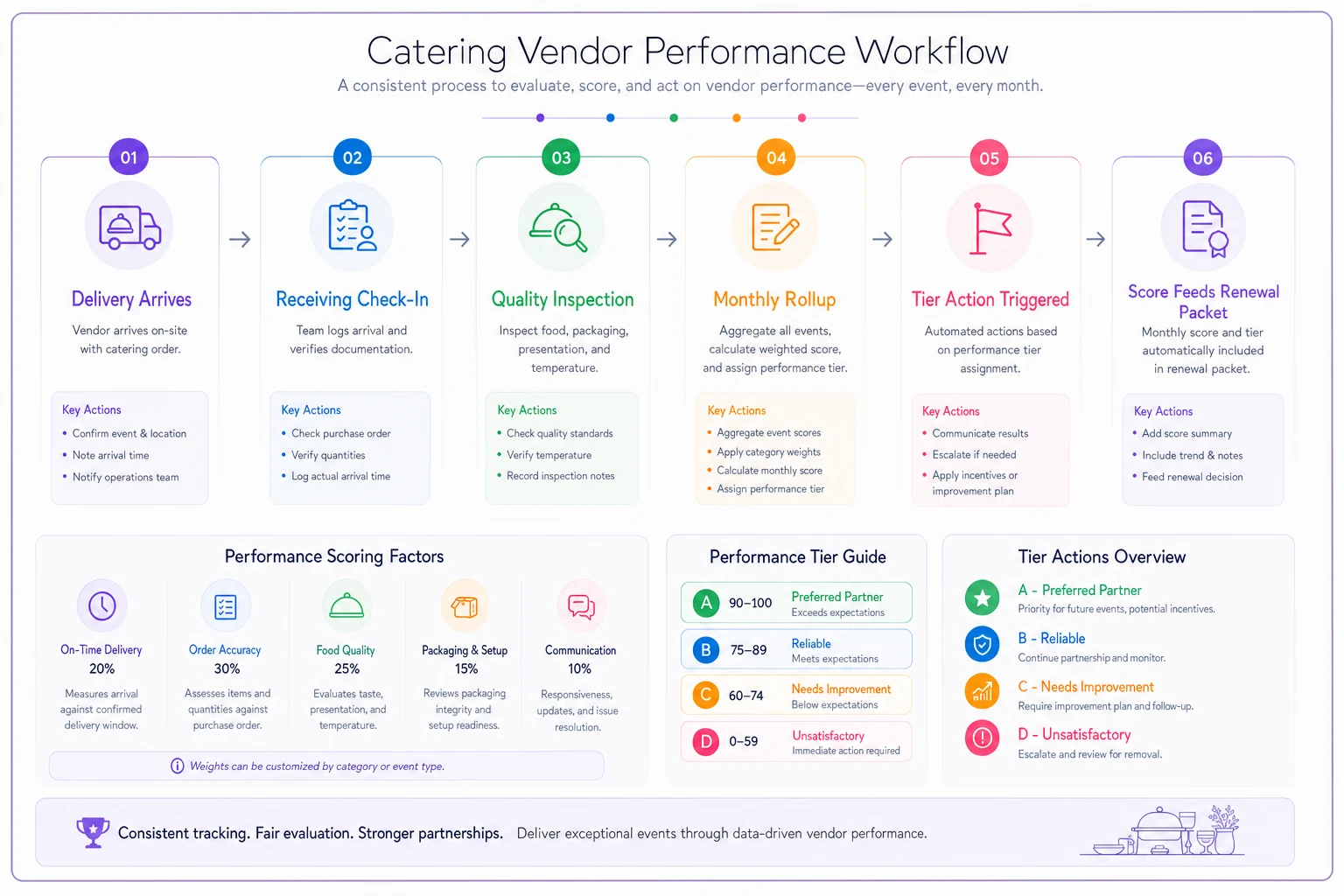
Breaking that down into actual steps:
-
Capture at receiving. Every delivery gets logged for on-time and accuracy at check-in. Two fields, ten seconds.
-
Log quality issues as they happen. Temp fail, wrong grade, spoiled item — noted against that vendor and PO immediately, not reconstructed later.
-
Roll up monthly. Each vendor gets a weighted score and a tier designation.
-
Trigger the tier action. Tier A gets a thank-you and a volume conversation. Tier C gets a corrective-plan email. Tier D goes on the sourcing board.
-
Feed it to renewal. The 12-month rolling score becomes the negotiation packet.
The manual version of this is a shared spreadsheet and a receiving checklist — honestly, that's enough to start.
Caterers who run this process long enough by hand eventually move it into an operational platform where receiving check-ins auto-populate the scorecard and tier changes trigger a reminder to whoever owns the vendor relationship. The value isn't the software; it's that the data gets captured at the moment it happens instead of reconstructed from memory weeks later. Reconstruction is where scorecards die.
A real scenario
A caterer running roughly 90–110 events a year — mix of corporate lunches and weekend weddings — had three rental and food vendors on annual contracts and a growing sense that one of them was "off." No data, just tension.
They set up a basic weighted scorecard, captured on-time and accuracy at every check-in, and logged quality issues whenever something came in wrong. After one quarter the picture was hard to argue with: the linen and rental vendor was sitting at 79% on-time, with two event-day near-misses that had forced last-minute retail runs. Both food suppliers were comfortably in Tier A.
At renewal, the rental vendor opened with a 5% increase. Instead of the usual reluctant back-and-forth, the owner walked through the quarter's scorecard, showed roughly $2,100 in documented cover costs, and offered a choice: hold pricing flat and commit to a 95% on-time SLA with delivery credits, or lose the account. The vendor took the SLA.
Over the next two quarters their on-time climbed into the low 90s — partly because they now knew someone was actually measuring. The direct dollar win came out to somewhere around $3k–$4k across the year between avoided cover buys and held pricing. The bigger win was quieter: the event-day scrambles mostly stopped, and the team stopped absorbing stress that was never theirs to carry in the first place.
When this is worth it — and when it isn't
A scorecard system makes sense when you have recurring vendors on term contracts and enough event volume that one unreliable supplier can hurt you across multiple bookings. If vendor problems keep resurfacing and you keep tolerating them, that's the signal.
It's probably overkill if you run a handful of events a year with one or two vendors you know personally and trust completely. At that scale, a quick note when something goes wrong does the job just fine.
One word of caution: don't use the scorecard as a weapon against a good vendor over a bad week. The whole point is pattern detection, not gotcha moments. A supplier who dips one month because their truck broke down is not the same as one drifting downward for a quarter straight. Reliable vendors are genuinely hard to find — the scorecard should help you keep the good ones and fix the fixable ones, not just collect evidence to cut people loose.
The vendors who cause event-day coordination chaos are a related but separate problem. If your issue is day-of coordination rather than delivery reliability over time, the vendor coordination decision matrix covers that side of it.
The real shift
The change a scorecard creates isn't really about tracking. It's about leverage. Right now, in most catering operations, the vendor holds all the power at renewal because they have the data and you have a feeling. Flip that, and every renewal conversation starts from your numbers instead of their pitch.
You don't need a complex system to get started. Five metrics, a weighted score, four tiers, and a couple of contract clauses with actual teeth. Start capturing at receiving next week, and by your next renewal cycle you'll walk in with something you've probably never had before: a case.
You don't need a complex system to get started. Five metrics, a weighted score, four tiers, and a couple of contract clauses with actual teeth. Start capturing at receiving next week, and by your next renewal cycle you'll walk in with something you've probably never had before: a case.
Ready to elevate your catering business?
Join 500+ caterers trusting Caterngly to save time, reduce errors, and deliver flawless events.