

Most caterers don't have a vendor follow-through problem. The contract gets signed, the first delivery shows up, everyone's relieved it wasn't a disaster, and then nothing. No structured check-in at 30 days. No scorecard at 90. By the time someone notices the linen company is consistently short-folding tablecloths or the specialty cheese supplier quietly swapped grades, you're six months deep and the switching cost feels too high to bother.
The fix isn't a better contract. It's a clock. A vendor onboarding checklist for catering should be time-bound — tied to specific days and specific decisions — so that a vendor either earns renewal or triggers a corrective-action cadence before they've buried themselves into your operation.
This piece lays out the day-1 receiving checklist, the 30/90/180 KPI structure, the corrective-action triggers, and a sample scorecard roll-up that actually feeds a renewal decision instead of sitting in a folder nobody opens.
Why the first delivery is where most onboarding quietly fails
There's a pattern worth naming. Scrutiny on a new vendor peaks the day you're choosing them and then collapses the moment the ink dries. You negotiate hard on price, check references, maybe run a tasting or a sample order — and then the relationship coasts on vibes.
In real operations, the first few deliveries from a new vendor are the most forgiving period you'll ever have and the most predictive. A vendor who short-ships you in week two, when they're still trying to impress you, will short-ship you worse in month four. But because that first miss happens during the "getting to know each other" phase, people excuse it. "They're still learning our dock hours." "The driver was new." Those excuses are exactly how a bad baseline gets locked in.
A typical example: a mid-size caterer brings on a new produce supplier at roughly $4k–$6k per month in volume. First delivery is 40 minutes late and missing two cases of romaine. Nobody logs it. Second delivery, fine. Third, late again. By the time it's a documented pattern, the kitchen has already built workarounds — prepping later, over-ordering as a buffer — and those workarounds cost more than the vendor saved on price.
The day-1 checklist exists to stop that drift before it starts.
The day-1 receiving checklist
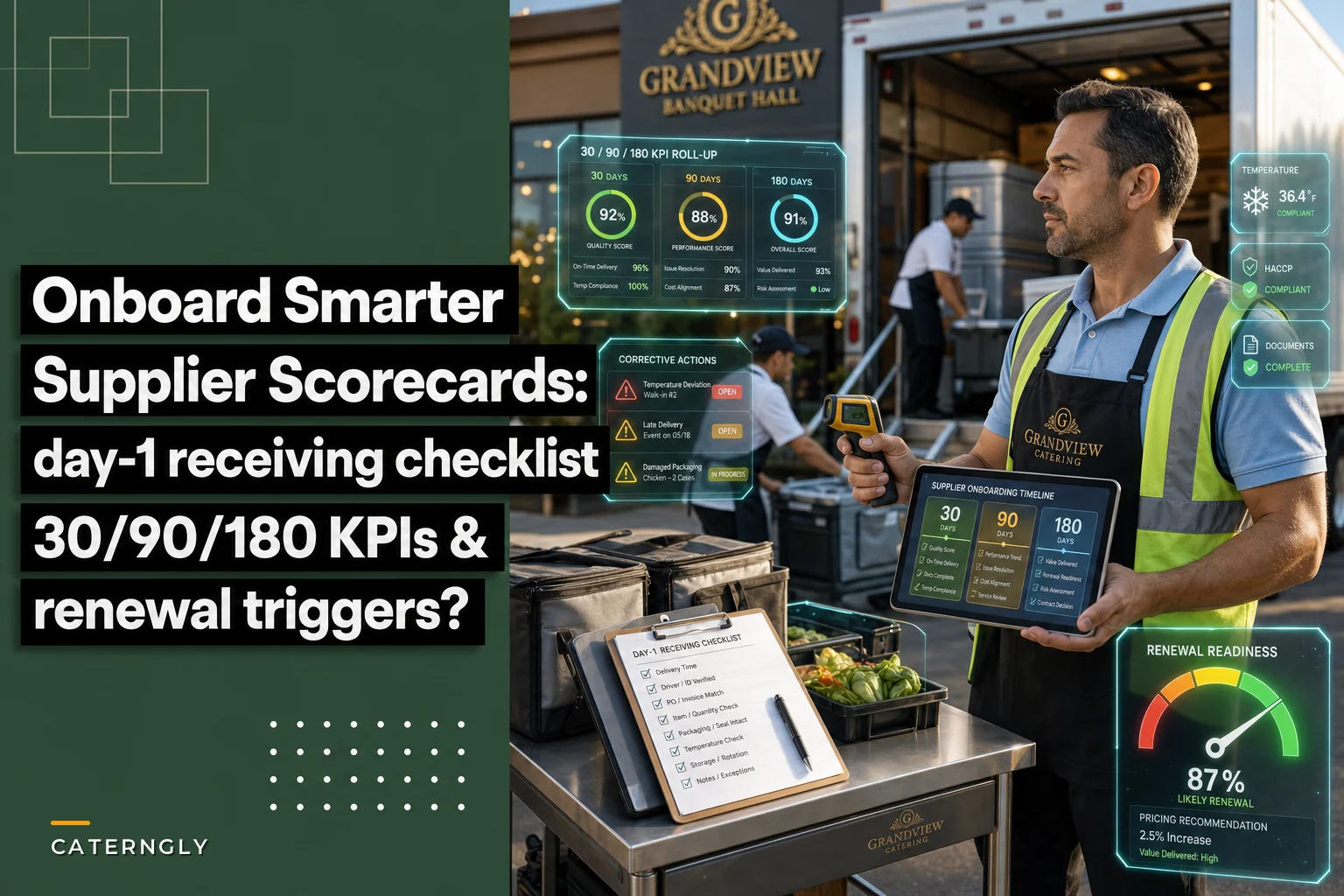
This is not a generic "inspect the delivery" list. It's the first data point in a scorecard, which means it has to capture things you'll measure again at 30 and 90 days. Run this on the first three deliveries from any new vendor, not just the first one.
End chaos with centralized catering management.
Caterngly helps you plan, confirm, and manage every catering event seamlessly.
- Unified event and order management
- Real-time client updates
- Staff and resource scheduling
No credit card required
Day-1 receiving checklist (first three deliveries):
-
- [ ] Delivery arrived inside the agreed window (log actual time vs. promised)
-
- [ ] All line items present and matched against the PO (note any shorts/subs)
-
- [ ] Substitutions, if any, were communicated before arrival — not discovered at the dock
-
- [ ] Temperature-sensitive items within spec on arrival (log actual temps)
-
- [ ] Packaging intact; no crushed, leaking, or re-boxed cases
-
- [ ] Invoice matches PO on both price and quantity (flag any creep)
-
- [ ] Driver had correct paperwork and knew the delivery protocol
-
- [ ] Product grade/spec matches what was quoted (not a quiet downgrade)
-
- [ ] Someone signed off and the receiving notes were entered the same day
That last line is the one everyone skips. A checklist that lives in someone's head is not a checklist. The whole point is to create a written baseline you can compare against later.
One thing worth flagging early: the "substitution communicated before arrival" item is a stronger predictor of a good long-term vendor relationship than almost anything else on this list. Vendors who proactively tell you about a shortage respect your operation. Vendors who let you discover it at the dock, mid-prep, are showing you exactly where you rank.
Track substitution notifications separately so you can quantify proactive communication.
Here's a quick visual of the day-1 checklist workflow.
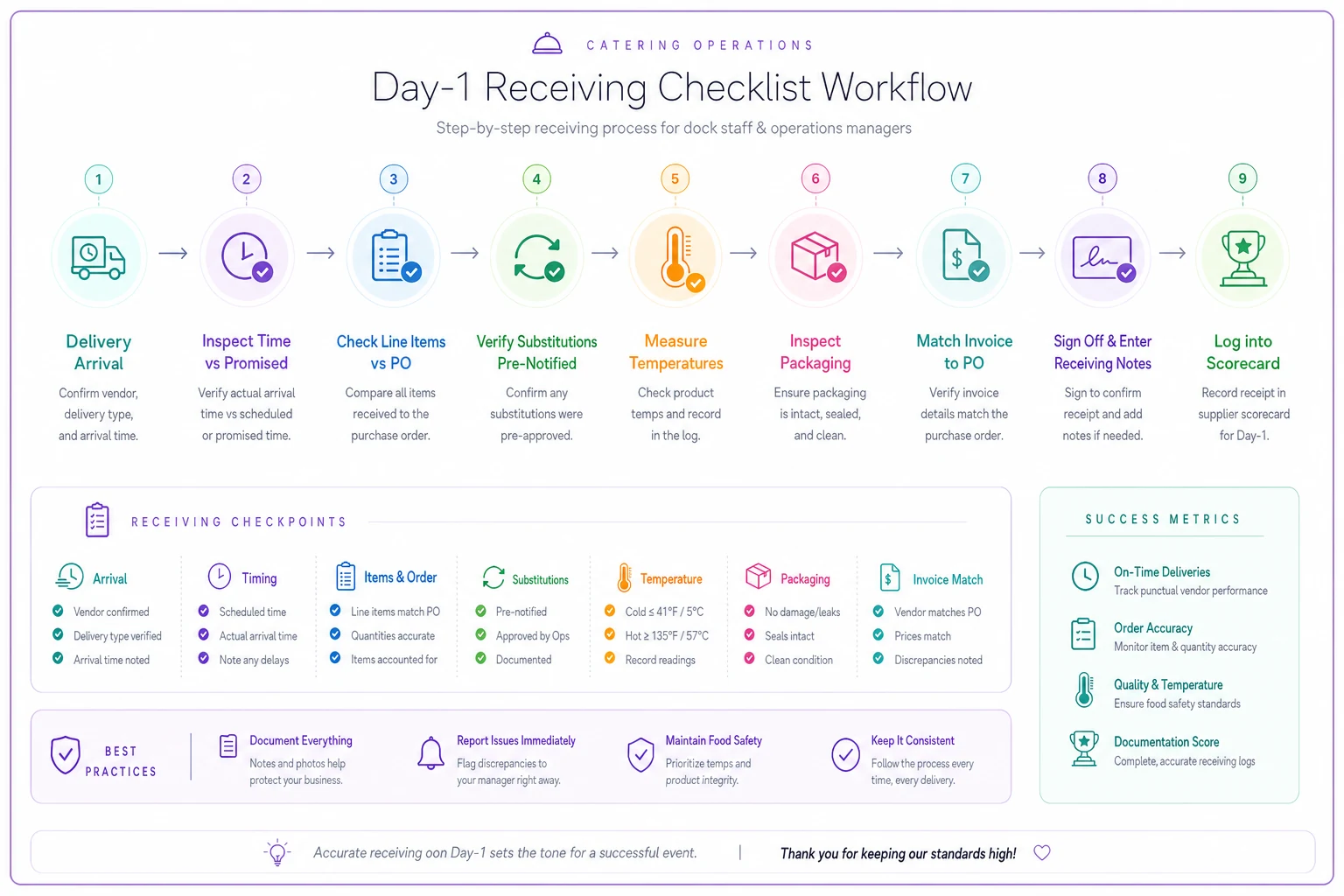
Use this at the dock for training and consistency.
The 30/90/180 structure, and what each checkpoint is actually for
Each checkpoint answers a different question. Confusing them is why most scorecards feel like busywork.
| Checkpoint | Core question | What you're really testing | Decision it feeds |
|---|---|---|---|
| 30 days | Can they execute the basics? | Reliability of fulfillment, accuracy, communication | Keep / fix / exit early |
| 90 days | Are they consistent under normal load? | Patterns across multiple events, invoice discipline | Probation / confirm |
| 180 days | Are they a partner or a liability under pressure? | Performance during peak weeks, flexibility, problem recovery | Renew / renegotiate / replace |
The 30-day checkpoint
Thirty days in, you're not looking for excellence. You're looking for whether the baseline from those first three deliveries held up across a handful more. The metrics are blunt: on-time rate, fill rate, order accuracy, and invoice-match rate.
The mistake here is grading on effort. A vendor who's "trying really hard" but still delivering on time 85% of the time is a 30-day fail, full stop. The 30-day gate is deliberately low — if a vendor can't clear it while they're still motivated to keep your business, the trajectory only goes one direction.
The 90-day checkpoint
By 90 days a vendor has usually serviced you through at least a few distinct events, which means you can see variance, not just averages. A supplier averaging 94% fill rate sounds fine until you notice the two misses both landed on your largest weekend events. Averages hide the failures that actually hurt you.
This is also where invoice behavior reveals itself. Price creep, surprise fuel surcharges, "small order" fees that weren't in the original quote — these tend to show up around month two or three, after the vendor assumes you've stopped checking line by line. The 90-day scorecard should include an invoice-accuracy metric specifically, because this is where margin leaks quietly begin.
The 180-day checkpoint
Six months gets you through at least one genuine crunch — a packed weekend, a holiday stretch, a last-minute large booking. That's the real test. Anyone can deliver on a quiet Tuesday. What you're scoring at 180 days is how the vendor behaved when your demand spiked or when they had a problem on their end.
Did they call you proactively when they couldn't fill an order, or did they stay quiet and hope you wouldn't notice? Did they flex to a rush request, or hide behind the contract? The 180-day checkpoint is where you decide whether this vendor earns a longer-term renewal, gets renegotiated, or quietly moves to your backup list.
Corrective-action triggers (so "we should talk to them" actually happens)
The reason bad vendors coast is that nobody defines in advance what actually triggers a conversation. "They've been kind of flaky lately" isn't a trigger. A number is a trigger.
-
On-time rate drops below 90% in any rolling 30-day window → logged warning + documented conversation
-
Two consecutive deliveries with shorts or unapproved substitutions → formal corrective-action notice
-
Any invoice variance above ~2% vs. PO without prior notice → finance flag + vendor call within 48 hours
-
A single temperature or food-safety failure on arrival → immediate hold + root-cause request before next order
-
A miss on a flagged high-stakes event → counts as a double-weight strike regardless of the monthly average
The food-safety trigger has no tolerance band. On-time delivery can slip and recover. A cold-chain failure on arrival is a different category — it touches liability, and it should route straight into your compliance process, not your "we'll mention it next time" pile.
A scripted escalation sequence keeps these from being awkward one-offs:
-
First trigger documented email, specific and dated. "On [date], delivery arrived at X vs. promised Y, short Z cases. Noting this for our 90-day review." Non-accusatory, but on the record.
-
Second trigger within 60 days a scheduled call, not an email. You're now establishing a pattern and giving them a defined window to correct.
-
Third trigger written corrective-action plan with a fix deadline, tied explicitly to the renewal decision.
The value of scripting it isn't the script itself. It's that you've decided the sequence in advance, so you don't have to muster the courage to confront a vendor in the middle of a busy week. The process does the confronting for you.
Failure to correct by the 180-day gate: move to backup, begin transition.
The scorecard roll-up that feeds renewal
Most caterers collect scores but never roll them into a single number that forces a decision. A scorecard that doesn't end in "renew / probation / replace" is just journaling.
Sample scorecard roll-up (weighted):
| Metric | Weight | 30-day | 90-day | 180-day |
|---|---|---|---|---|
| On-time delivery rate | 25% | — | — | — |
| Fill / order accuracy | 25% | — | — | — |
| Invoice accuracy | 15% | — | — | — |
| Communication / proactivity | 15% | — | — | — |
| Food-safety / spec compliance | 10% | — | — | — |
| Performance on flagged events | 10% | — | — | — |
Score each 1–5, apply the weights, and you get a single rolled-up number per checkpoint. Then the decision bands do the work:
-
4.2 and above → renew, consider expanding volume
-
3.3–4.1 → renew with a documented watch-list item
-
2.5–3.2 → probation, corrective-action plan required
-
Below 2.5 → begin transition to backup
Food-safety and flagged-event performance are weighted lower in the roll-up but still carry the hard triggers above them. That's intentional. The weighting handles routine performance; the triggers handle non-negotiables. A vendor can have a strong rolled-up number and still fail because they blew a cold-chain check — the trigger overrides the average.
What makes this roll-up useful at renewal is that it's cumulative and comparable. When a contract comes up, you're not relying on recent memory — which is always biased toward whatever delivery you remember most vividly. You're looking at six months of structured data against the same yardstick you'd apply to every other vendor. This pairs naturally with a broader vendor scorecard and contract playbook, which covers the contract-side terms that give these scores actual teeth.
A real scenario
A caterer running roughly 12–18 events a month onboarded two new vendors in the same quarter — a linen/rental company and a protein supplier. No structured onboarding; both just started delivering.
The linen vendor looked fine on price but started shorting napkin counts by small amounts — a dozen here, two dozen there. Nobody logged it because each miss was individually trivial. Over about five months it added up to the kitchen quietly over-ordering linens as a buffer, plus two events where the setup team scrambled day-of. Call it a few hundred dollars a month in buffer waste, plus the harder-to-price stress of near-misses.
After implementing the 30/90/180 structure on their next onboarding round, the pattern showed up at the 30-day checkpoint instead of month five. The fill-rate metric flagged the shorts immediately, a documented conversation followed, and the vendor tightened up within two deliveries — because now they knew someone was counting. Same vendor, same price. The only thing that changed was that the misses became visible early enough to matter.
The protein supplier, meanwhile, failed the 90-day invoice-accuracy check — a surprise handling fee had crept onto three invoices. Caught at 90 days, it was a quick correction and a credit. Left until renewal, it would have been six months of silent margin leak baked into the "normal" cost.
Where software quietly carries the load
None of this requires software to work — a disciplined operator with a spreadsheet and calendar reminders can run the whole thing. But the honest failure point is memory and consistency. The 30-day check gets skipped during a busy stretch. The receiving notes don't get entered. Nobody pulls the 180-day roll-up until the contract is already up for renewal.
An AI-assisted operations platform helps most here: logging receiving data at the dock, automatically calculating rolling on-time and fill rates, and surfacing the corrective-action trigger when a threshold is crossed — so the conversation happens because the system flagged it, not because someone happened to notice. The scorecard roll-up builds itself from data you're already capturing instead of becoming a quarterly scramble. The judgment stays with you; the tracking and the follow-up get automated.
That's also where onboarding ties into the upstream work. If your procurement strategy for controlling perishables costs is solid but your onboarding is loose, you negotiate great terms and then let them erode unmeasured. The scorecard is what protects the deal you fought for.
When this full process makes sense — and when it's overkill
Worth the full 30/90/180 treatment: any vendor you depend on for event-critical supply — proteins, specialty items, rentals, linens, anything where a miss shows up in front of a client. Also any vendor representing a meaningful chunk of monthly spend.
Skip the full cadence for: one-off or small vendors — the office coffee supplier, a once-a-year specialty order. A lightweight day-1 check is plenty. Running a weighted six-month scorecard on a $200 annual supplier is motion without value.
Who should skip it entirely: anyone running fewer than a handful of events a month. At that volume you'll notice vendor problems instinctively because you're touching every delivery yourself. The structure matters precisely when you've grown past the point where one person sees everything.
The core idea is simple enough to hold in your head: scrutiny shouldn't peak at signing and then vanish. Put it on a clock, give it thresholds, and let the first six months decide whether a vendor renews — instead of letting inertia decide for you.
Ready to elevate your catering business?
Join 500+ caterers trusting Caterngly to save time, reduce errors, and deliver flawless events.