

Most caterers manage procurement one PO at a time. You get the event count for the week, someone eyeballs the pars, and a purchase order goes out to whoever answered the phone last time. It works until it doesn't — until a produce supplier no-shows on a 300-cover wedding Saturday, or beef primals jump 22% in three weeks and nobody caught it because everyone was busy running events.
The problem isn't that caterers buy badly. It's that they buy reactively, without a system that decides ahead of time which suppliers get locked in, which items get bought forward, which get bought spot, and what happens when a supplier fails. That system is category management, and it's been standard in manufacturing and retail procurement for decades. Almost no small catering operation uses it. This is what it looks like when you apply it properly.
Why per-PO buying quietly bleeds margin
When you buy event-by-event, three things happen that you rarely see on a single invoice but compound across a quarter.
First, you lose leverage. A supplier who sees random, unpredictable orders has no reason to give you a real price. Your "relationship" is just a series of transactions. The caterer three towns over who commits volume gets a landed price you never see quoted.
Second, you carry volatility you didn't need to. Some ingredients swing hard in price — proteins, certain seafood, dairy during holiday runs, anything weather-exposed like berries or leafy greens. Others barely move — dry goods, canned, frozen, packaging. If you treat all of them the same way (spot-buy everything, react to price when it stings), you eat the swings on the volatile stuff and gain nothing on the stable stuff.
Third, contingency failures cost you retail. When your usual supplier can't deliver, you're buying at 4pm on a Friday from whoever has stock, at whatever price they name. That's not a supply problem — it's the absence of a pre-negotiated fallback. The cost shows up as an emergency premium, often 30–50% over your normal landed cost, plus the labor scramble to source it.
Across a year, these three leaks together commonly run 4–8% of total food cost for an operation that hasn't systematized procurement. On a caterer doing around $1.4M in revenue with food cost around 30%, that's somewhere in the neighborhood of $17k–$34k walking out the door invisibly.
Step one: tier your suppliers by criticality × volatility
The foundation of category management is that not all purchases deserve the same effort. You segment them, then apply different rules to each segment. For catering, the two axes that matter most are criticality (how badly a failure hurts the event) and price volatility (how much the cost swings).
End chaos with centralized catering management.
Caterngly helps you plan, confirm, and manage every catering event seamlessly.
- Unified event and order management
- Real-time client updates
- Staff and resource scheduling
No credit card required
-
Criticality = if this item doesn't show up or shows up wrong, what breaks? Center-of-plate protein for a plated dinner is a 5. A garnish herb is a 2. Linens through a food vendor is a 1.
-
Volatility = how much does the price move month to month? Berries, premium seafood, certain proteins: high. Flour, oil, canned goods, disposables: low.
That gives you four practical quadrants:
| Quadrant | Criticality | Volatility | Procurement approach |
|---|---|---|---|
| Strategic | High | High | Lock relationships, dual-source, forward-buy or contract pricing, tight monitoring |
| Bottleneck | High | Low | Secure supply and contingency first; price is secondary — you need it to show up |
| Leverage | Low | High | Play the market; spot-buy, chase price, batch across events |
| Routine | Low | Low | Automate reordering, consolidate to fewest suppliers, stop spending brain cycles |
The mistake almost everyone makes is spending negotiation energy on the wrong quadrant. Owners haggle over the price of disposables — Routine, automate it and move on — while leaving center-of-plate protein on a handshake with one supplier. That's the thing that can torpedo an event and your margin.
Once you've got the map, your effort allocation becomes obvious: heavy contracting and contingency work on Strategic and Bottleneck items, market-chasing on Leverage, and near-zero attention on Routine. This same tiering logic underpins broader supply-chain resilience and procurement strategy for caterers — tiering is the first structural decision everything else hangs off.
Forward-buy vs. spot: a decision rule, not a gut call
The single most useful thing category management gives a caterer is a rule for when to lock a price versus when to buy at market. Owners tend to forward-buy emotionally — they lock in when prices spike out of fear, which is exactly when you overpay, and stay on spot when prices are calm, which is when locking would've actually protected them.
A cleaner way to decide: forward-buy (contract a price, or physically pre-buy freezable/storable stock) when all three are true:
-
The item is in your Strategic or Bottleneck quadrant.
-
Price volatility is trending up or is seasonally predictable (holiday proteins, spring berries).
-
You have committed forward demand — booked events, not hoped-for ones — that consumes the volume before spoilage or before the contract window closes.
Spot-buy when the item is Leverage-quadrant, storage-limited, or when your forward demand is soft enough that committing volume would create waste risk.
A concrete example. Say you cater a lot of holiday corporate dinners and your booking calendar shows you'll need roughly 900–1,050 lbs of a specific beef cut across November–December. Spot price now is $8.10/lb; your supplier offers a forward contract at $8.35/lb locked through year-end.
-
Spot path if the market moves the way it usually does into the holidays (+15–20%), you're buying much of that volume at $9.30–$9.70. Blended cost across the season lands somewhere around $8.90/lb. Total: roughly $8,900 on 1,000 lbs.
-
Forward path locked at $8.35. Total: $8,350.
The contract costs you $0.25/lb today to avoid an ~$0.55/lb blended increase later. On confirmed demand, that's a clear win — around $550 saved on this one line, and more importantly you removed the volatility from a Strategic item. But this only works because the demand is booked, not projected. Forward-buying against a soft calendar is how caterers end up with a walk-in full of protein and a March full of waste.
Contingency contract language: the clauses that actually save you
Your vendor scorecards tell you who's reliable. Your contracts decide what happens when they're not. Most catering supply agreements — where they exist at all — are silent on failure, which means failure defaults to your problem at emergency prices.
For Strategic and Bottleneck suppliers, get these into writing:
-
Substitution rights with a price cap. If they can't deliver the spec'd item, they must offer an agreed equivalent at no more than your contracted price plus a defined ceiling (say +8%). This stops the "sure, we have the premium cut instead, it's just more" trap.
-
Fill-rate and on-time commitments with teeth. Define what "delivered" means (right item, right quantity, right window, right temperature) and attach a credit for misses. A vendor who owes you a 5% credit on a late delivery suddenly prioritizes your dock.
-
Short-notice failure obligation. If they can't fulfill within X hours of delivery, they either source the equivalent themselves or reimburse the delta between contract price and your documented replacement cost. This is the clause that turns an emergency premium from your loss into their accountability.
-
Price-change notice window. No mid-week surprise increases; changes require 14–30 days notice, giving you time to shift to your secondary source.
-
Named backup source. For Bottleneck items especially, agree in advance who the fallback is and at what pricing, so a failure triggers a known process instead of a Friday scramble.
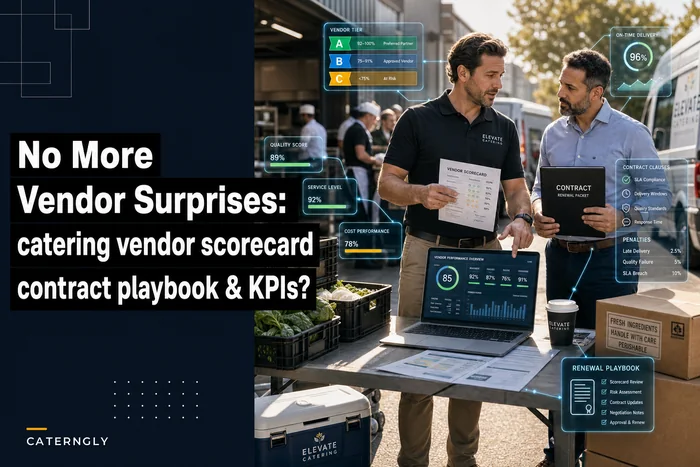
The contract side of this — how to structure terms, escalation, and enforcement — is worth building out properly. The mechanics in a catering vendor scorecard and contract playbook pair directly with the tiering above. Scorecards without contract clauses just document your losses; clauses without scorecards give you no basis to enforce.
PO batching: stop punishing your own margins with fragmented orders
Even with good suppliers and solid contracts, how you place orders drives cost. Caterers running back-to-back events tend to cut a fresh PO per event, which fragments volume, multiplies delivery fees, multiplies receiving labor, and destroys the volume tiers you negotiated.
Batching means consolidating demand across events into fewer, larger, better-timed POs. The workflow looks like this:
-
Aggregate confirmed demand across a rolling window — usually 7–10 days out, tied to your booking calendar. Pull every event's ingredient needs into one demand picture per supplier, not per event.
-
Net against on-hand. Subtract what's already in the walk-in and dry storage so you're only buying the gap. This is where accurate pars matter.
-
Hit volume breakpoints deliberately. If combining two events' produce orders crosses a supplier's price tier, batch them even if it means receiving a day earlier for the second event (shelf life permitting).
-
Sequence by perishability. Dry goods and frozen batch far ahead; delicate produce and seafood batch tight to the event. Don't force everything onto the same cadence.
-
Single receiving event per delivery. Fewer deliveries means fewer receiving errors, fewer invoice mismatches, and less labor at the dock.
A visual of the batching workflow helps make the steps actionable.
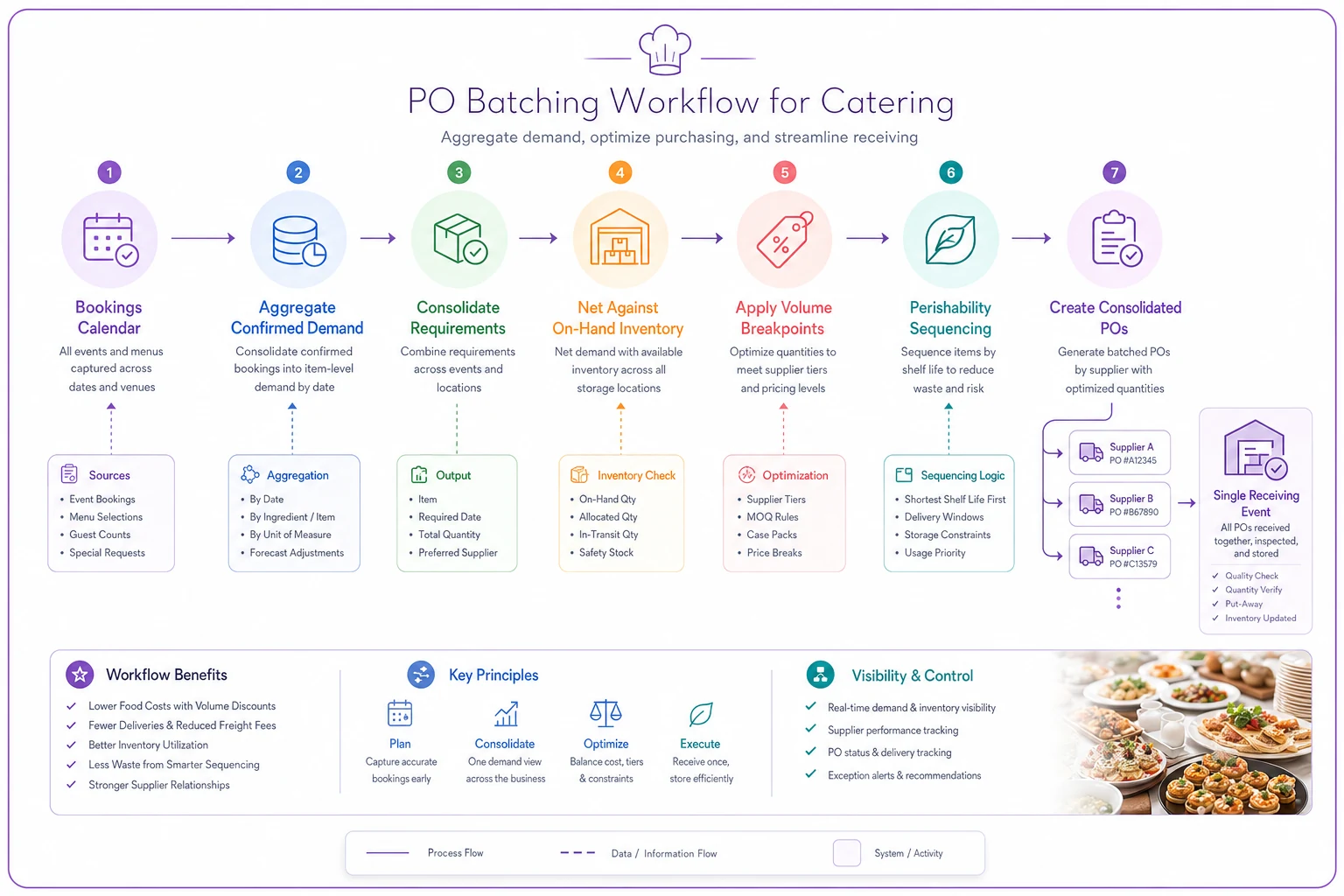
Schedule a weekly PO consolidation review tied to your booking calendar so batching becomes a routine task, not an afterthought.
A caterer running six events across a week might go from around 18 fragmented POs (three suppliers × six events) to five or six consolidated ones. The immediate wins are fewer delivery minimums and fees, cleaner receiving, and access to volume pricing. The reorder math and pooling logic that makes this reliable is covered in depth in the multi-event catering inventory playbook — batching only works when your pars and reorder points are actually trustworthy.
Negotiation scripts that get you real prices
You don't need to be a hardball buyer. You need to give suppliers a reason to quote you their real number, which is almost always predictable volume and reduced hassle. A few framings that work:
For committing volume:
> "We're planning our booked events for the next quarter and I want to consolidate more of our protein spend with one partner. Based on our calendar I can commit roughly [X] lbs a month. What does your landed price look like at that level, and can we lock it?"
For contingency terms:
> "I need to know what happens on the day you can't deliver. I'm not looking to penalize you — I'm looking for a substitution at a capped price and a backup we've agreed on in advance. Can we put that in writing so I can stop keeping an emergency supplier on speed dial?"
For a price increase you want to soften:
> "I understand the market moved. Before I shop this line, what can we do — a longer contract, larger batches, flexible delivery windows — that lets you hold closer to the old number?"
The pattern in all three: you're trading something the supplier values (volume, predictability, longer commitment, easier logistics) for something you value (price, reliability, protection). Caterers who walk in asking only for a discount get nothing. Caterers who show up with a booking calendar and a commitment get quoted like a real account.
Worked total-cost example: what this adds up to
Take a mid-sized caterer, roughly $1.3M revenue, food cost around 31% (~$400k in purchases). Before systematizing:
-
No tiering; all items spot-bought reactively.
-
Two or three emergency substitutions a month at 30–45% premiums.
-
Fragmented POs, missing volume tiers on stable/high-volume items.
-
Occasional forward-buy panic-locks at the top of price spikes.
Estimated leaks: emergency premiums running maybe $6k–$9k/year; lost volume pricing on Routine and Bottleneck items another $8k–$12k; volatility eaten on Strategic proteins that could've been contracted, call it $5k–$10k. Rough total: $19k–$31k/year, sitting inside a food-cost line nobody flagged because no single invoice looked wrong.
After applying tiering, contract contingency clauses, a forward/spot rule, and PO batching, a realistic recovery is roughly half to two-thirds of that in year one — call it $12k–$20k — mostly from killing emergency premiums and capturing volume pricing. That's not a menu change or a price increase. That's the same food, bought with a system.
When this makes sense — and when it doesn't
Category management earns its keep when you have volume and repeatability. If you're running 8–10+ events a week with recurring menus and a booking calendar you can forecast against, tiering and contracts pay off fast.
It's a bad fit for a small operation doing a handful of highly custom events a month with wildly different menus each time. Your demand isn't predictable enough to forward-buy or commit volume, and the contracting overhead won't return the effort. Stay flexible, keep two reliable suppliers per category, and spot-buy.
One thing worth being direct about: nobody should forward-buy against a soft calendar. The fastest way to turn a procurement improvement into a waste problem is locking volume on events you hope to book. Confirmed demand only.
Making the system hold together
The reason this is a system and not a tip list: each piece props up the others. Tiering tells you where to spend effort. Contract clauses protect the Strategic and Bottleneck items tiering flagged. Forward/spot rules only work if your booking calendar feeds real demand into the decision. Batching only captures the volume pricing your negotiations set up. Break any one link and the others weaken — good contracts don't help if you fragment your POs and never hit the volume tiers, and volume commitments don't help if a supplier fails and you've written no contingency.
For most caterers, the honest starting point is a single spreadsheet: every major supplier scored on criticality and volatility, dropped into the four quadrants, with a one-line rule for each — contract, secure-and-backup, spot-and-chase, or automate. From there you rewrite your two or three most important supplier agreements to include contingency clauses, and you start aggregating POs across your booked week instead of cutting them per event.
That's a weekend of work that changes how a five-figure chunk of your food cost behaves for the rest of the year. The caterers who actually control perishables costs aren't necessarily the sharpest negotiators or the ones with the best supplier relationships. They're the ones who decided ahead of time what to buy how, from whom, and what happens when it goes wrong — so that a supplier no-show on a Saturday triggers a process instead of a panic.
Ready to elevate your catering business?
Join 500+ caterers trusting Caterngly to save time, reduce errors, and deliver flawless events.