

Most catering procurement runs fine right up until it doesn't. You order from the same three suppliers, you know your produce guy by name, and things generally show up. Then one August your primary protein vendor gets bought out, their delivery windows shift, and suddenly you're scrambling to source 400 portions of short rib two days before a wedding. That's when you realize your procurement wasn't really a system — it was a habit that happened to work.
The difference between a caterer who absorbs shocks and one who eats the cost every time almost never comes down to having "better suppliers." It's about how procurement is organized. Which items you treat as fragile. Which suppliers you've already got a fallback for. How you decide what to stock versus what to order just-in-time. And how you group your buying so you're not paying rush premiums on half your orders.
This is the layer most catering operations never formalize. So let's build it.
The core idea: not all supply risk is the same
The mistake underneath almost every procurement scramble is treating all ingredients and suppliers as if they carry equal risk. They don't. A missed delivery of table linens is annoying. A missed delivery of the plated entrée protein for a 300-guest gala is a business emergency.
Two things actually determine how dangerous a supply relationship is:
-
Criticality — how badly the event breaks if this item doesn't show up or shows up wrong.
-
Volatility — how unpredictable the item is in price, availability, or quality.
Once you separate those two dimensions, procurement stops being a giant undifferentiated worry and becomes a set of clearly ranked decisions. High-criticality, high-volatility items get the most protection. Low/low items get almost none, because protecting them wastes money.
The supplier-risk matrix
| Category | **Low volatility** | **High volatility** |
|---|---|---|
| High criticality | Manage & monitor — Reliable but essential. Lock pricing, keep one qualified backup on file. (e.g., standard chicken breast, house wine, core rentals) | Fortify — Your danger zone. Pre-negotiated backup contracts, safety stock where possible, active price tracking. (e.g., specialty proteins, seasonal seafood, single-source specialty items) |
| Low criticality | Ignore / autopilot — Standing orders, minimal attention. (e.g., napkins, dry goods, disposables) | Substitute freely — Don't protect, just build swap rules. (e.g., garnish herbs, seasonal produce with easy alternates) |
The "Fortify" quadrant is where most of your money and attention should go, and where most caterers spend almost none of their planning time. The "Ignore" quadrant is where a lot of owners end up overinvested — micromanaging the napkin order while the short rib supplier has no backup at all.
A quick honest way to place items: pull your last 20 events, list every ingredient or supply that either (a) would have visibly ruined a plate if missing, or (b) had a price or availability surprise in the last year. Almost everything on both lists belongs in Fortify. That's usually somewhere between 8 and 15 items — a manageable number, not the whole pantry.
Why procurement breaks the same way across most caterers
The failure patterns are remarkably consistent, and they're almost all structural rather than bad luck.
End chaos with centralized catering management.
Caterngly helps you plan, confirm, and manage every catering event seamlessly.
- Unified event and order management
- Real-time client updates
- Staff and resource scheduling
No credit card required
Single-sourcing by default. You found a great vendor, prices were good, so you gave them everything. Now 40% of your food cost runs through one relationship with no fallback. This works until it spectacularly doesn't — a truck breaks down, they lose a key employee, or they simply prioritize a bigger client during peak season.
No distinction between "out of stock" and "out of stock at a critical moment." Running low on olive oil in a slow week is a shrug. Running low the Thursday before three weekend events is a crisis. Most inventory rules don't account for when the shortage lands relative to your event calendar.
Reactive backup sourcing. When the primary fails, you start calling around. Now you're paying spot prices, from a supplier who has no relationship with you, who knows you're desperate. That premium — often 15–30% over your normal cost — shows up quietly and never gets tracked back to the root cause.
Batching by convenience, not by cost. Orders get placed whenever someone remembers, per event, one at a time. That means small orders, more delivery minimums, more rush fees, and no leverage from combining volume across the week.
None of these are dramatic on any single event. They're a slow leak. And they compound fast as you grow.
What changes at scale
At two events a week, you can hold the whole supply picture in your head. Your memory is the system. At eight or ten events a week, that stops working — and it stops working suddenly, not gradually.
A few specific things break:
-
Overlapping demand. Two events want the same specialty item on the same day, and your one supplier can only half-fill it. You didn't see the collision until it was too late to source around it.
-
Backup relationships go stale. The fallback vendor you used two years ago has new pricing, new minimums, or is now full during your peak weekends. A backup you haven't touched isn't really a backup.
-
Rush costs stop being visible. At small scale you feel every emergency order. At scale they blend into food cost and just look like margin erosion nobody can explain.
We've written before about the mechanics of ordering across a busy calendar in the multi-event catering inventory playbook, and the safety-stock math behind fragile items in the guide to perishable reorder points. This article is the layer above those: how the whole procurement structure stays resilient when volume climbs.
The general rule: procurement breaks roughly at the point where no single person can mentally track every critical item across every upcoming event. That threshold is different for every operation, but you'll know you've crossed it when "wait, who ordered the salmon?" becomes a recurring Thursday conversation.
Pre-negotiated backup contracts (the part everyone skips)
A backup supplier isn't a phone number in your contacts. It's a relationship you've already priced and tested, sitting ready before you need it. The reason most caterers don't have real backups is that setting them up feels like busywork — until the day it saves an event.
For every item in your Fortify quadrant, you want a lightweight standing agreement with a secondary source. Not a giant legal contract — a short, pre-agreed set of terms so that when you activate it, there's no negotiation happening under pressure.
A workable backup-contract template covers:
-
Trigger conditions — what activates the backup (primary can't fill, quality reject, price exceeds a set ceiling).
-
Guaranteed lead time — how fast they'll fulfill an emergency order (e.g., 48 hours).
-
Price ceiling — a pre-agreed max markup over your normal rate so a backup doesn't quietly become a 40% penalty.
-
Minimum order — so you know whether small emergencies even qualify.
-
Quality spec — the same grade/cut/size you'd accept from your primary, written down so there's no debate on delivery.
-
A commitment floor — you agree to route some baseline volume to them periodically (even small) so the relationship stays warm and they take your emergency calls seriously.
That last point is the one people miss. A backup you never buy from will deprioritize you the moment they're busy — which is exactly when you'll need them, because busy season is busy for everyone. Sending them even 5–10% of an item's volume keeps you a real customer.
For a fuller framework on evaluating and structuring these relationships, the vendor scorecard and contract playbook goes deeper on rating suppliers and building the terms that protect you.
A quick process for standing up backups
-
Pull your Fortify list — the 8–15 high-criticality, high-volatility items.
-
Identify one qualified secondary source per item. Sometimes one vendor covers several.
-
Run one small live order through each before you commit. A backup you've never actually received from is theoretical.
-
Lock the short terms above in a one-page agreement.
-
Schedule a small recurring order to each backup — quarterly is often enough — to keep the relationship active.
-
Review the list every season. Suppliers change. Your menu changes. The list is not permanent.
Send backups even 5–10% of an item's volume to keep the relationship warm.
The whole thing takes maybe a day or two to set up initially and a couple of hours a season to maintain. Cheap insurance against the emergencies that actually blow up margins.
Strategic perishables safety stock: what to hold and what to never hold
Safety stock is where good intentions turn into spoilage. The instinct after one bad shortage is to over-buy everything perishable "just in case." That's how you end up throwing away product every week and calling it caution.
The rule that actually works: only hold safety stock on items that are simultaneously critical, hard to source fast, and shelf-stable enough to survive the buffer window. That's a narrow set. Most fresh perishables fail the third test — holding extra fresh fish "just in case" usually just means paying to compost fish.
Safety stock splits by item type:
-
Hold physical buffer on critical items with reasonable shelf life: frozen proteins, hard cheeses, shelf-stable specialty ingredients, back-of-house staples that anchor multiple menus.
-
Hold capacity buffer, not product, on true perishables: instead of extra inventory, you hold a pre-arranged ability to get more fast — that's what the backup contract is for. Your "safety stock" on fresh salmon isn't a freezer full of salmon, it's a 48-hour guaranteed backup line.
-
Hold nothing on easily substitutable items. Your buffer is a substitution rule, not stock.
A practical way to think about buffer sizing for the "hold physical" category: size it to cover your single largest realistic collision — the biggest amount of that item you might need across overlapping events during your primary supplier's replenishment window. Not your average week. Not your worst-case fantasy. Your realistic peak overlap.
When this makes sense — and when it doesn't
Holding safety stock makes sense when: the item is critical, has a genuine lead time to replace, keeps well, and your event density means collisions are likely. Frozen specialty proteins are the classic yes.
It's a bad idea when: the item is highly perishable, cheap to expedite, or easily swapped. Buffering fresh herbs or specialty produce almost always costs more in waste than it saves in emergencies.
Who should skip most of this entirely: very small operations doing a handful of events a month with predictable menus. If you can see every order clearly and rarely have overlap, heavy safety-stock structure is overhead you don't need yet. Build it as your calendar tightens.
PO batching: grouping orders against the event manifest
This is where procurement strategy meets real money, and where most caterers leave the most on the table. If you're placing purchase orders per event, one at a time, you're paying for that convenience in delivery minimums, split shipments, and lost volume leverage.
The better approach is batching POs against your combined event manifests for a buying window — usually a week. You look at every confirmed event in the window, roll up total demand per item, then decide per item whether to buy it as one consolidated order or keep it split.
The tension is always the same: consolidation lowers cost but raises waste risk; splitting lowers waste but raises cost. Batching well means making that tradeoff item by item instead of accidentally.
A worked example
Say you've got three events in one week:
| Item | Total needed (3 events) | If ordered separately | If batched | Difference |
|---|---|---|---|---|
| Chicken (shared across 2 events) | ~65 lb | 2 orders, both under vendor's free-delivery minimum, ~$18 in delivery fees + higher per-lb | 1 order, clears minimum, volume price | ~$40–55 saved, negligible waste (shelf-stable frozen) |
| Short rib (wedding only) | ~90 lb | Single order regardless | Single order | No change — no batching opportunity |
| Fresh berries (brunch + garnish) | ~22 lb | 2 small orders | 1 order for the week | ~$15 saved but berries for Sunday bought Monday risk spoilage — keep split or time it late |
| Mixed greens | ~30 lb | 2 orders | 1 order early in week | Cost saved, but freshness suffers for the later event — split |
The pattern that falls out: batch the shelf-stable and stable-priced items aggressively; keep the fragile-fresh items split or timed close to each event even if it costs a little more. In this week, batching the chicken and dry goods might save $60–90 with essentially zero waste risk, while forcing the berries and greens into one early order would trade that savings right back in spoilage.
That's the whole discipline. Not "batch everything" or "order per event" — decide per item, using the criticality/volatility read you already built.
The batching workflow, in plain terms
Here's how it actually runs each week:
Confirmed events for the window get pulled into one view. Every menu maps to its ingredient demand, and those demands roll up by item across all events. For each item, you check three things: does it keep long enough to buy early, is the price stable enough that buying ahead doesn't lock in a bad rate, and does combining volume actually cross a meaningful pricing or delivery threshold?
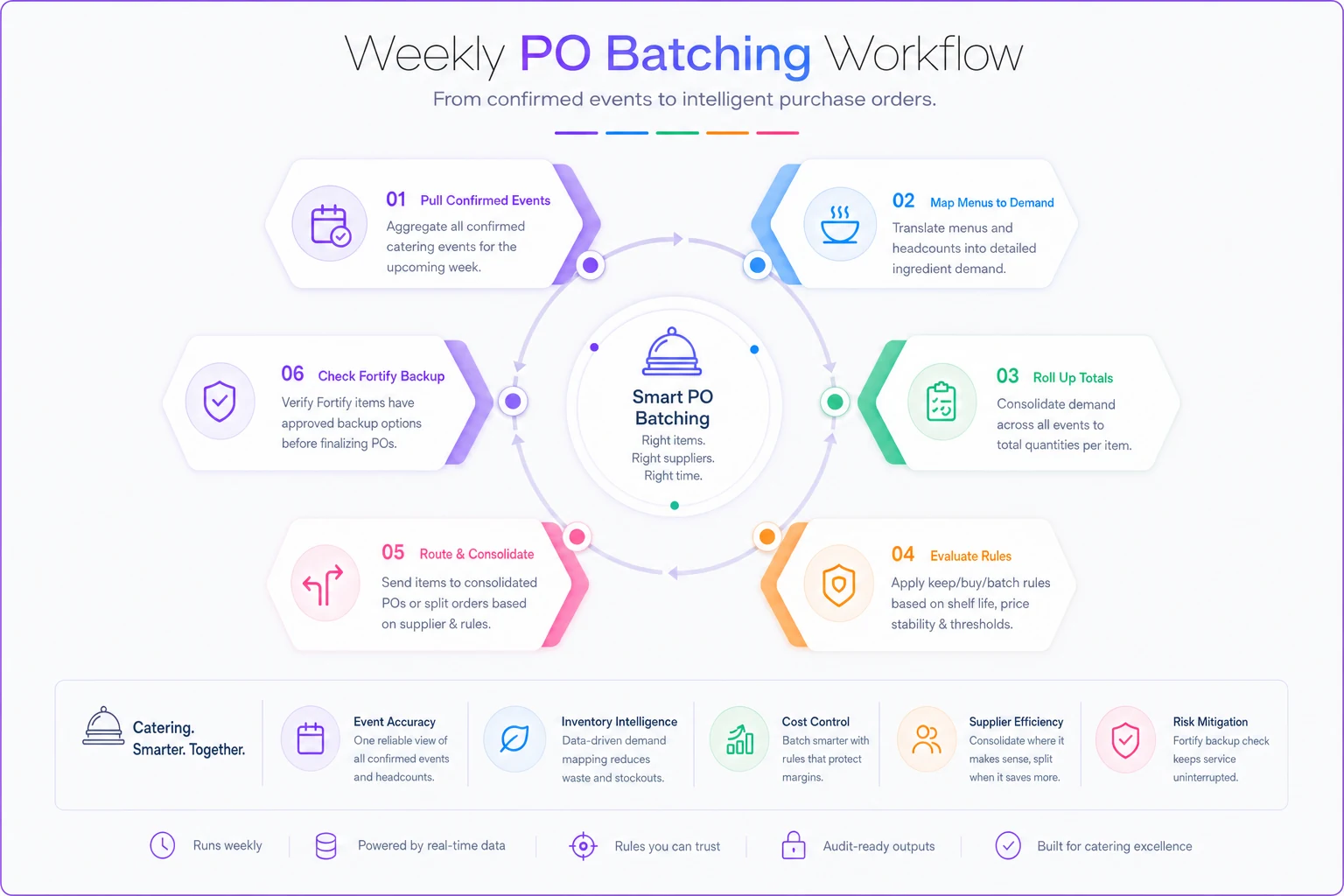
If yes to all three, it goes into a consolidated PO. If it fails on shelf life or freshness, it stays split and gets timed to the event. Fortify-quadrant items get a quick check on backup status while you're at it — is the primary confirmed, is the fallback warm.
Doing this by hand on a whiteboard works up to a point. Once you're running enough overlapping events that the rollup itself becomes error-prone — items double-counted, a menu change not reflected in the order — this is where operational software earns its place. Not as a gimmick, but because rolling event manifests into consolidated, per-item purchasing decisions is repetitive, rule-based, and unforgiving of small mistakes. A platform that ties your event calendar to demand rollups and flags which items should batch versus split removes the arithmetic errors that cause both shortages and overbuying. The judgment stays yours; the tedious rollup doesn't have to be.
A real scenario
A mid-sized caterer running roughly 30–35 events a month kept getting burned two ways at once: emergency reorders on specialty proteins during their busy stretch, and a steady trickle of spoiled fresh product from over-cautious buying. On paper their food cost looked "just a little high" — nobody could point to why.
When they mapped their supply base, the problem was obvious in about an hour. Everything ran through two suppliers, no backups existed, and orders were placed per event with no rollup. Their specialty protein — the item most likely to cause a plated-service disaster — had zero fallback. Meanwhile they were buffering fresh produce that spoiled roughly a quarter of the time.
The fixes were unglamorous. They built the risk matrix, identified their nine Fortify items, and set up backup lines for the four that mattered most, with price ceilings and small quarterly orders to keep them warm. They stopped buffering fresh product entirely and instead relied on 48-hour backup lines. And they moved to weekly batched POs for shelf-stable items while keeping fresh items split and timed late.
Over the next few months, emergency rush orders dropped to nearly none. Produce waste came down noticeably. Food cost settled a couple of points lower, which on their volume was meaningful money, and nobody was making frantic Thursday calls anymore. Nothing dramatic happened. The scrambles just stopped.
The resilience checklist
Before you consider your procurement resilient, you should be able to check most of these:
-
[ ] Every ingredient and supply is roughly placed on the criticality/volatility matrix
-
[ ] Your Fortify list (high/high) is written down and under 15 items
-
[ ] Every Fortify item has a tested, pre-priced backup source
-
[ ] Backup relationships get a small recurring order to stay warm
-
[ ] Backup terms include a price ceiling, guaranteed lead time, and quality spec
-
[ ] Safety stock exists only on critical, shelf-stable items — not fragile perishables
-
[ ] Fresh perishables are protected by fast-sourcing capacity, not by buffer stock
-
[ ] POs are batched weekly against combined event manifests, not placed per event
-
[ ] Batch-vs-split decisions are made per item, using cost and spoilage risk
-
[ ] The whole structure gets a seasonal review — suppliers, menus, and prices all drift
If you can't check the backup and batching items, those are almost always where the fastest money is.
Where this leaves you
Supply-chain resilience in catering isn't about hoarding inventory or signing airtight contracts with everyone. It's about spending your attention and money where the actual risk lives — the handful of items that can ruin an event or spike your costs — and leaving the rest on sensible autopilot.
The caterers who handle a bad season without bleeding margin aren't luckier with suppliers. They've just decided in advance which items get protected, who their fallback is, what they'll hold versus source fast, and how they group their buying. That work happens on a quiet Tuesday, long before the Saturday when it matters. The scramble everyone else experiences is mostly the cost of never having done it.
Ready to elevate your catering business?
Join 500+ caterers trusting Caterngly to save time, reduce errors, and deliver flawless events.