

Most caterers already run experiments. They just don't know it, and they don't track it.
Someone bumps the plated dinner price by $4 per head on corporate jobs. Someone switches the salmon portion from 6oz to 5oz and nobody complains. Someone starts ordering produce two days earlier for Saturday events because last month felt tight. These are all experiments. The problem is they live in people's heads, they never get measured against anything, and six months later nobody can tell you whether the price bump actually stuck or whether that smaller salmon portion quietly cost you three repeat clients.
That's the gap this article is about. Not "you should test things" — you already do — but how to build experiment governance catering teams can actually trust, so changes get measured, bad ideas get caught before they spread, and good ideas get rolled out without guesswork.
This is a systems problem, not a spreadsheet problem.
Why Catering Experiments Are Harder Than Retail or SaaS
The standard A/B test playbook assumes high volume and fast feedback. Change a button color, watch 10,000 visitors, get a result in a week.
Catering has none of that. You might run 20–40 events a month. Each one is different — headcount, menu, venue, staffing, season. The "sample" is tiny, the variables are tangled, and the feedback loop can be weeks long because you don't know if a pricing change hurt rebooking until the rebooking window closes.
So the naive version of testing fails immediately. If you raise prices on five weddings and four of them book, that tells you almost nothing. Weddings book for a hundred reasons. The signal is buried.
What works instead is a discipline built around three things:
-
Canonical metrics everyone agrees on before the test starts
-
Backtesting against your own history so you're not betting blind
-
Governance so experiments don't silently contradict each other or regress things that were already working
Get those three right and you can run meaningful tests at low volume. Skip them and you're just making changes and telling stories about the results afterward.
Start with Canonical Metrics, or Nothing Else Works
The single biggest reason catering experiments produce garbage is that two people measure the same event differently.
End chaos with centralized catering management.
Caterngly helps you plan, confirm, and manage every catering event seamlessly.
- Unified event and order management
- Real-time client updates
- Staff and resource scheduling
No credit card required
Ask three managers what "margin" means on a job and you'll get three answers. One includes delivery labor, one doesn't. One counts comped tastings, one buries them. One uses booked headcount, one uses actual served. When your baseline moves depending on who's calculating it, no experiment is interpretable.
Canonical metrics means you lock the definitions once, write them down, and everyone computes them the same way every time. This connects directly to how you track profit in the first place — if you haven't already built a shared view of per-event economics, start with a KPIs dashboard that exposes per-event profit leaks, because your experiments will inherit whatever definitions live there.
Here's a minimum canonical set worth standardizing before you test anything:
| Metric | Canonical Definition | Why It Gets Messed Up |
|---|---|---|
| Per-cover margin | Revenue minus fully-loaded food + direct labor, divided by covers served | People use booked covers, not served |
| Food cost % | Delivered ingredient cost / event revenue | Waste and tasting costs get excluded |
| Quote-to-book rate | Booked events / qualified proposals sent | "Qualified" is defined loosely |
| Rebooking rate (90d) | Repeat bookings within 90 days of event | Measured on different time windows |
| Stockout events | Count of items reordered emergency / rush | Rush buys don't get logged |
Two rules make these hold up. First, a metric isn't canonical until it has an owner and a documented formula. Second, you freeze the definition for the duration of an experiment — you don't get to change how margin is calculated halfway through, because then you can't tell whether the number moved or the ruler moved.
Store canonical metric formulas in the same KPI dashboard repo or doc so teams reference the exact definition before launching a test.
Worth noting: teams that standardize metrics usually find a pricing or waste problem before they run a single experiment, just from making everyone measure the same way. The cleanup is half the value.
Backtesting Reorder Rules Before You Touch Live Inventory
Reorder rules are the safest place to start experimenting, because you can test them against history without risking a single event.
You already have months of order data and event calendars. Before you roll out a new safety-stock rule or reorder point, replay it against last season and see what it would have done. This is backtesting, and it's dramatically cheaper than learning on live orders.
-
Pull 6–12 months of event history — dates, headcounts, menus, actual consumption per key item.
-
Pull your actual order history for the same items — what you ordered, when, and what got wasted or rush-bought.
-
Write the candidate rule as a formula, for example
"reorder perishable X when projected demand over the next 5 event-days exceeds on-hand plus safety stock of 12%."
-
Replay the rule day by day against the historical calendar, simulating what it would have ordered.
-
Score it against the same canonical metrics
stockout events, total waste, rush-buy count, dollars tied up in inventory.
-
Compare to what actually happened. If the rule would have cut rush buys from 9 to 3 without raising waste, it's a candidate for a live test.
The mistake people make here is backtesting on a single "normal" stretch. Your business isn't stationary. A rule tuned on a quiet February will get destroyed by October wedding density. Always backtest across your full seasonal swing, including your worst back-to-back weekends, so you see the rule under stress and not just under ideal conditions.
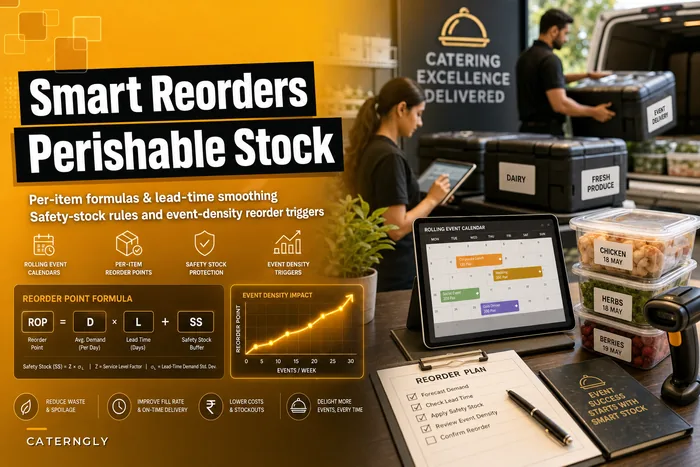
If your reorder math isn't formalized yet, the groundwork for this lives in perishable reorder points and safety-stock rules for rolling-event calendars. Backtesting is what turns those formulas from theory into something you trust enough to run live.
> Backtesting Workflow: From History to Live Rule
>
> Historical Event & Order Data → Write Candidate Rule as Formula → Replay Rule Against Seasonal Calendar → Score Against Canonical Metrics → Compare to Actual Results → Candidate for Live Test
Here's a simple diagram of that backtesting workflow.
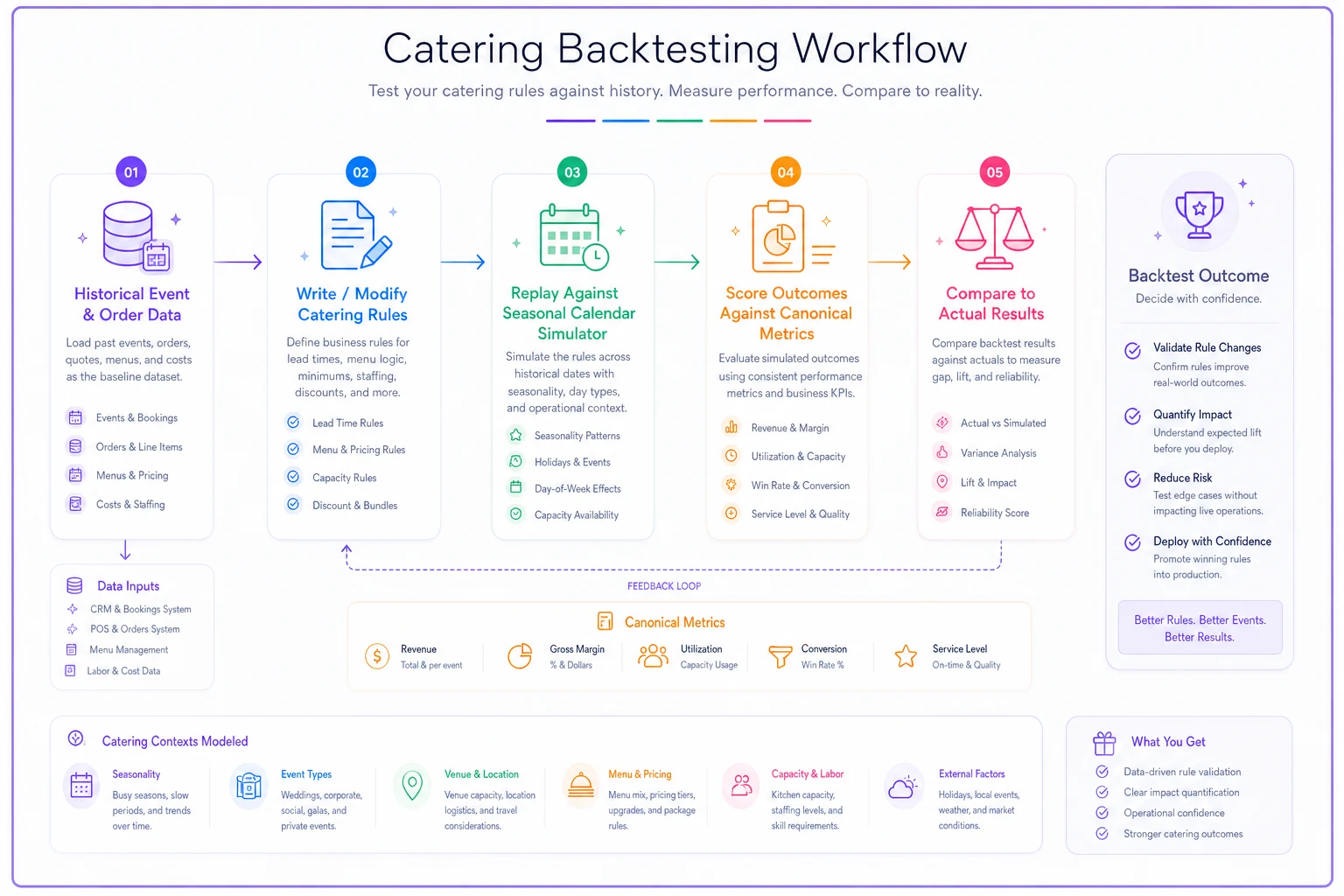
The workflow above shows how a candidate reorder rule moves from historical replay to a scored candidate for live testing.
A/B Test Templates for Pricing and Menu Changes
Pricing and menu tests are where caterers most want to experiment and most often do it badly.
Because volume is low, clean 50/50 splits rarely work. You usually can't say "half my weddings get the new price." Instead, you lean on a few structures that fit catering's reality:
Segment-and-hold. Pick one segment — say, corporate lunch drop-offs under 50 people — and change one variable for all new quotes in that segment while holding everything else steady. Compare against the same segment's trailing history. It's not a pure A/B, but with a tight segment it isolates the variable well enough.
Staggered rollout. Apply the change to one sales rep's quotes or one venue type first, keep the rest as control, then expand if the early numbers hold. This limits blast radius if the change backfires.
Switchback. For recurring menu items, alternate weeks: new portion size odd weeks, old portion even weeks, over a couple months. This washes out seasonality better than a straight before/after.
Here's a template worth copying for any pricing or menu test:
-
Hypothesis one sentence, specific. "Raising corporate lunch minimum from $18 to $21/head will not reduce book rate below 55%."
-
Primary metric the one number that decides it (book rate, per-cover margin).
-
Guardrail metrics things that must NOT get worse (rebooking rate, complaint count, waste).
-
Segment exactly who's in the test.
-
Duration / sample floor minimum events before you call it.
-
Decision rule what result means ship, kill, or extend — written before you start.
That last point is where discipline lives. Deciding the kill condition before you see data is the whole game. Without it, every result gets rationalized. A test that "sort of worked" becomes a permanent change, and nobody ever revisits it.
One thing that comes up repeatedly: the guardrail metric catches more problems than the primary one. A price increase that holds book rate looks like a win — until the guardrail shows rebooking quietly dropped because higher prices attracted more one-off shoppers and fewer relationship clients. Without the guardrail, you'd have shipped a change that raised this quarter's revenue and hurt next year's.
A Real Scenario: The Portion Test That Almost Shipped
A mid-size caterer running roughly 25–35 events a month wanted to cut food cost on their most-booked buffet package. The proposal: drop two protein portions by about 15% and swap one side for a cheaper seasonal vegetable.
Instead of just doing it, they ran a segment-and-hold test on new buffet bookings over about eight weeks, with two guardrails: complaint rate and 90-day rebooking.
The food cost math looked great — roughly $1.80–$2.10 saved per cover, which across their volume penciled out to something like $14k–$18k a year. On the primary metric, nobody complained about portions. Looked like a clean win.
The guardrail is what saved them. Rebooking on tested events ran noticeably lower than their trailing baseline — not catastrophic, but a real gap. When they dug in, repeat clients had noticed the downgrade even though they didn't formally complain; they just didn't rebook as often. The projected lifetime-value loss dwarfed the food savings.
They killed the portion cut and instead tested a plating change that preserved perceived portion while trimming cost a smaller amount. Smaller win on paper, but rebooking held. Without the governance structure — predefined guardrail, predefined kill rule — they'd have shipped the first version and never connected the rebooking dip to it months later.
Model Governance: Stopping Experiments from Fighting Each Other
Once you're running several experiments, a new failure mode shows up: tests that silently contradict each other, and changes that regress things you fixed earlier.
This is what governance is for. It's boring, and it's the difference between a team that compounds improvements and a team that re-learns the same lessons every year.
A workable governance layer for a catering operation needs a few pieces:
-
An experiment registry. One list of every active and past experiment: hypothesis, owner, start date, status, outcome. If it's not in the registry, it's not a real experiment — it's just a change.
-
Conflict checks. Before launching, check whether another live test touches the same segment or metric. Two price tests on overlapping segments make both uninterpretable.
-
Regression tests. When you ship a change, write a simple check that fails if a key metric drifts back below its old baseline. Reorder rules especially need this, because a tweak six months later can quietly undo a fix.
-
A decision log. Why you shipped or killed each test, in plain language. This is what stops the business from re-arguing settled questions every time staff turns over.
The connective tissue here is your data architecture. Governance only works if your event records, orders, and financials live somewhere consistent enough to query. If every experiment requires hand-assembling data from four systems, nobody will maintain the registry past month two. This is exactly why your underlying digital operations architecture — systems of record and sync rules matters so much: experimentation maturity sits directly on top of data maturity. You can't test cleanly on messy records.
Test Scripts That Prevent Regressions
The practical version of regression protection is a small set of scripts or saved checks that run on a schedule and flag drift. You don't need anything fancy. The point is that a human doesn't have to remember.
-
Food cost % by package — alert if it climbs more than a set threshold above the post-experiment baseline.
-
Stockout / rush-buy count — alert if emergency orders exceed what the tuned reorder rule should produce.
-
Book rate by segment — alert if a segment's conversion drops below the floor you accepted during pricing tests.
-
Rebooking rate — the slow one; check monthly, because damage here shows up late.
When one trips, you don't panic — you open the registry, see what changed recently in that area, and investigate. The alert tells you where to look, the registry tells you what might have caused it. That's the whole loop.
Regression checks sound tedious to set up, but once they exist they're basically invisible. The bigger cost is not having them — discovering six months later that a side-effect from a pricing test has been slowly eroding your repeat client base.
Where Software Quietly Earns Its Place
None of this requires a data scientist, but it does require that your records be clean, queryable, and connected — because the registry, the backtests, and the regression checks all read from the same underlying data.
This is the honest case for AI-assisted operational platforms in catering: not flashy predictions, but the unglamorous work of keeping metrics canonical across every event, logging rush buys that staff forget to record, and surfacing when a guardrail metric drifts. When reorder data, event P&Ls, and booking records sit in one connected system, backtesting a new rule becomes a query instead of a week of spreadsheet archaeology. Automation can run the regression checks on schedule and flag drift before it spreads — precisely the work humans skip when they're busy executing events.
That's the realistic role. It removes the manual friction that makes experiment governance collapse in practice. The thinking stays with you. The grinding gets handled.
When This Maturity Is Worth Building — and When It Isn't
When it makes sense: You're running enough volume that bad changes cost real money, you have multiple people making pricing or ordering decisions, and you've already got reasonably clean per-event financials. At that point, ungoverned experimentation is actively leaking margin and you just can't see it.
When it's premature: If you're doing a handful of events a month and one person makes every call, a full registry and regression suite is overhead you don't need yet. Lock your canonical metrics, keep a simple decision log, and skip the rest until volume grows.
Who should not start here: If your core records are still a mess — events in one place, orders in email, financials reconstructed after the fact — don't build experimentation on top of that. You'll be testing against numbers you can't trust. Fix the data foundation first, then layer governance on top.
Pulling It Together
Experimentation maturity isn't about running more tests. Most caterers already change things constantly. It's about making those changes visible, measurable, and reversible — so good ideas compound instead of getting lost, and bad ideas get caught in a backtest or a guardrail instead of quietly costing you clients for six months.
The sequence is steady, not dramatic. Lock your canonical metrics so everyone measures the same way. Backtest reorder rules against your own history before you touch live inventory. Template your pricing and menu tests with predefined guardrails and kill rules. Then wrap the whole thing in light governance — a registry, conflict checks, and regression scripts — so experiments stop contradicting each other and nothing you fixed quietly breaks again.
Do that, and the thousand small changes your team was already making stop being guesses and start being a system that gets smarter every season.
Ready to elevate your catering business?
Join 500+ caterers trusting Caterngly to save time, reduce errors, and deliver flawless events.