


The single worst place to lose money in catering isn't the kitchen, the vendor, or even the deposit schedule. It's the gap between the person who sold the event and the people who have to execute it. That handoff is where guest counts arrive three days late, where the "small dietary note" never makes it to the chef, and where sales promises a plated service the ops team priced as buffet.
Most caterers try to fix this with better communication. Nicer Slack messages. A standing Monday meeting. A shared Google Doc. None of it holds, because none of it is enforceable. What actually fixes the sales-to-ops handoff is treating it like a data contract — a defined set of fields that must be complete, timestamps that must be hit, and consequences when they aren't. That's what a real sales ops SLA for caterers looks like, and it's the difference between a 15-event month that runs smoothly and one that quietly burns a server, a chef, and a client relationship.
This isn't about adding bureaucracy. It's about defining — once — what "a booking is ready for operations" actually means, so nobody has to argue about it at 11pm the night before a wedding.
Why the handoff breaks in almost every growing caterer
When you're doing four events a month, the owner sells and the owner runs ops. The handoff happens inside one person's head. Nothing gets dropped because there's no gap to drop into.
The trouble starts somewhere around 10–15 events a month, usually when the first dedicated salesperson or event coordinator comes on. Now there are two sides, and each assumes the other knows things. Sales assumes ops reads every email thread. Ops assumes sales confirmed the loading dock access. Neither is written down as a requirement, so both get skipped intermittently — and "intermittently" is exactly what makes it dangerous, because it works often enough that nobody fixes it.
A few patterns show up over and over:
-
Partial bookings get thrown over the wall. The event is "confirmed" in the sales tool, but the final headcount, allergen list, and venue contact are still blank. Ops can't start staffing or ordering, but the clock is already running.
-
Changes don't carry a timestamp. A client bumps the count from 120 to 160 on a Wednesday for a Saturday event. Sales updates the proposal but nobody records when that change landed, so there's no way to say whether ops had a fair shot at covering it.
-
Disputes have no resolution path. When something goes wrong, the conversation becomes "you never told me" versus "it was in the email." There's no agreed record of what was supposed to be true and when.
The root cause isn't carelessness. It's that the handoff has no definition. You can't hit a standard nobody wrote down. If you've already built a solid master-data model and data governance layer, this is the operational contract that sits on top of it — governance defines what the fields mean, the SLA defines when they must be complete and handed off.
The canonical booking → ops data contract
A data contract is just an agreement: before a booking counts as "accepted by operations," it must contain these fields, in this state, by this time. No complete record, no handoff. The event sits in a pending state and sales owns it until it's done.
End chaos with centralized catering management.
Caterngly helps you plan, confirm, and manage every catering event seamlessly.
- Unified event and order management
- Real-time client updates
- Staff and resource scheduling
No credit card required
Required at handoff (hard block — ops will not accept without these):
-
Event date, service start time, and service end time
-
Venue name, full address, and on-site day-of contact (name + mobile)
-
Service style (plated / buffet / family / stations / drop-off)
-
Confirmed or contracted guest count (labeled
"contracted minimum" vs "estimate")
-
Menu selection locked to component level
-
Signed contract reference and deposit-received flag
-
Account owner (salesperson) name
-
Load-in access notes (dock, elevator, stairs, parking)
Required but time-boxed (can arrive after handoff, under SLA):
-
Final guaranteed headcount
-
Full allergen and dietary breakdown with counts
-
Rental order confirmation
-
Timeline / run-of-show with key moments (speeches, cake cut)
-
Vendor list (DJ, planner, venue coordinator) with contacts
-
Special equipment or power requirements
Every field needs a named owner and a required-by timestamp. "Allergen breakdown" owned by nobody is how you end up with an anaphylaxis scare. The contract isn't the field list — it's the field list plus who fills it and by when.
One subtle but important rule: distinguish contracted numbers from estimated ones at the field level. An ops team that doesn't know whether "150" is a guaranteed minimum or a hopeful guess will either over-order or under-staff. Make the data type carry that meaning.
The SLA timestamps that actually matter
Fields tell you what. Timestamps tell you when — and the when is where most of the money leaks. The goal is to lock critical information far enough ahead that ops has room to react, and to make lateness visible the moment it happens rather than at the post-mortem.
Think in terms of time-before-event milestones, not calendar dates. Here's a workable baseline for a mid-sized operation running plated and buffet events:
| Milestone | SLA timing | Owner | What it unlocks |
|---|---|---|---|
| Booking accepted into ops (required fields complete) | T‑21 days | Sales → Ops | Staffing draft, procurement planning |
| Menu locked to component level | T‑14 days | Sales + Client | Prep lists, ordering math |
| Rental order confirmed | T‑10 days | Ops | Load manifest build |
| Final guaranteed headcount | T‑5 days (or per contract) | Sales | Final labor + food counts |
| Allergen/dietary counts locked | T‑5 days | Sales + Chef | Special-plate prep |
| Run-of-show / timeline confirmed | T‑4 days | Sales + Client | Day-of staffing sequence |
| Change-order cutoff (no changes without surcharge) | T‑3 days | Sales | Protects prep + labor |
| Final pack-and-load confirmation | T‑1 day | Ops | Execution |
The specific numbers should flex to your lead times — a caterer doing mostly corporate drop-offs can run tighter than one doing full-service weddings. What matters is that the milestones exist, they're measured against the event date, and a missed one triggers something.
The acceptance SLA has to be a gate: at T‑21, every event either has a complete required-field set or it's flagged as non-compliant and escalated.
The most common mistake is setting timestamps and then never enforcing the acceptance one. If "T‑21, required fields complete" is a suggestion, it's worthless. The acceptance SLA has to be a gate: at T‑21, every event either has a complete required-field set or it's flagged as non-compliant and escalated. That flag is the whole point.
Dispute gates: deciding who eats the cost
Every catering operation has disputes between sales and ops. Mature ones have rules for them. A dispute gate is a predefined decision point that says: if this field was late or wrong, here's what happens and who absorbs the consequence.
Without gates, disputes get resolved by whoever argues hardest or has the most seniority — which demoralizes ops and teaches sales that overselling has no cost. With gates, the data decides.
A basic dispute-gate structure:
-
Was the required field delivered by its SLA timestamp? If yes, and ops still missed, it's an ops issue. If no, proceed.
-
Was the lateness logged and acknowledged? A late field that sales flagged and ops accepted is a shared decision. A late field that silently slipped is a sales miss.
-
Did the lateness cause measurable cost? Rush ordering, overtime, a declined upsell because staffing couldn't flex — tie the dispute to the actual dollar impact, not the emotion.
-
Apply the predefined owner. Headcount changes after the T‑3 cutoff carry a surcharge the client pays, and sales is responsible for having that surcharge clause in the contract. If it isn't there, sales absorbs it, not ops.
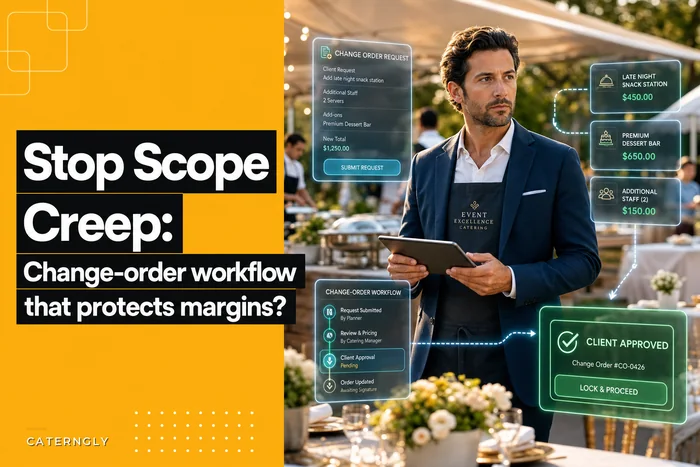
This connects directly to how you handle client-side changes. A clean change-order workflow that protects margins is the external-facing half of this — the dispute gate is the internal accountability half. One protects you from the client; the other keeps sales and ops honest with each other.
The thing most teams miss: dispute gates aren't about punishing sales. They're about making the true cost of late information visible so the organization can decide whether to fix the process or price for it. Sometimes the right answer is "we accept T‑2 headcount changes for this corporate client and build a 12% buffer into their pricing to cover it." That's a business decision — but you can only make it once the gate surfaces the pattern consistently enough to see it clearly.
A worked handoff example
The event: 160-guest plated wedding, Saturday, off-site venue with stair-only load-in.
The messy version: Sales marks it "confirmed" at T‑18 with guest count blank and venue contact missing. Ops doesn't notice the gaps because there's no acceptance gate. At T‑6 the final count comes in at 175, not the roughly 140 ops had mentally assumed. At T‑4, sales mentions the stair-only access in passing. Ops now scrambles: an extra server and runner booked at premium last-minute rates, a rental order amended with a rush fee, a chef prepping 35 more covers than planned. Rough damage: somewhere between $600–$900 in avoidable labor and rush charges, plus a stressed team going into the event. Nobody's "at fault" because nothing was ever required.
The clean version: At T‑21 the booking fails the acceptance gate — count and venue contact are blank. It's flagged back to sales. Sales closes those fields by T‑20. Guaranteed count locks at 175 at T‑5, hitting its SLA. Stair-only access was a required load-in field at handoff, so ops planned the crew for it from day one. The T‑3 change cutoff means any later count adjustment triggers the contracted surcharge — the client pays, not the caterer. Same event, roughly $700 saved, and no 11pm phone calls.
The difference isn't skill. It's that the second version had a contract and gates, and the first had good intentions.
The minimal enforcement stack — tech and org
You don't need a sophisticated platform to enforce an SLA. You need three capabilities, and most caterers already have fragments of them. The question is whether they're wired together so lateness is automatic to detect rather than something a coordinator has to catch by hand.
The org side — roles and cadence:
-
A single acceptance owner. One person (or role) signs off that a booking has passed the acceptance gate. Ambiguity here kills the whole system.
-
A weekly SLA review. Once a week, every event in the pipeline is checked against its next milestone. Anything red gets escalated that day, not at the event.
-
A monthly dispute retro. Pull the month's dispute gates, look for the pattern. If one client or one salesperson generates the majority of late-field incidents, that's a pricing or coaching conversation.
The tech side — minimum viable:
-
Alerts on missed timestamps. The system should flag a field that's blank past its SLA without anyone looking for it. This is the single highest-leverage piece — manual checking always slips.
-
A reconciliation cadence between the sales record and the ops record. Daily during busy season, at least twice weekly otherwise. The two records should agree on headcount, menu, and timing, and disagreements should surface, not hide.
-
An immutable change log with timestamps. You can't run dispute gates without a record of when each field landed or changed.
This is where modern operational platforms earn their keep — not by being flashy, but by handling the tedious enforcement that humans forget. AI-assisted workflow tools can watch field completeness in the background, flag a booking that's past its acceptance SLA before anyone asks, and quietly reconcile the sales count against the ops count each morning so a 120-to-160 change can't slip through unnoticed. The value isn't automation for its own sake; it's that the alert fires whether or not your coordinator was paying attention that day.
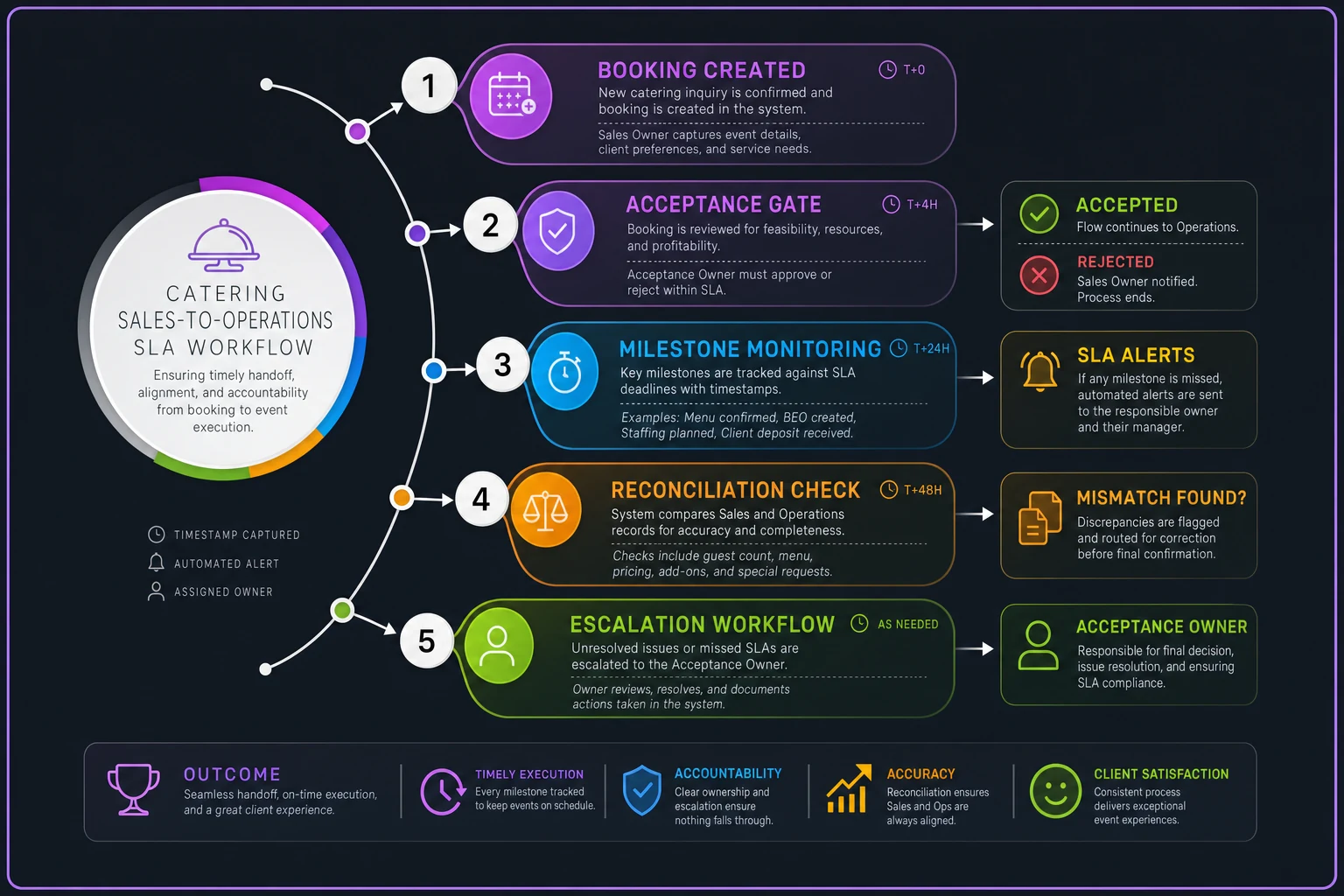
The diagram shows how acceptance gates, timestamp checks, and alerting connect the sales and ops records.
If you're mapping how these roles and escalations connect, it pairs naturally with a documented operations playbook built on modular SOPs and RACI.
Test cases to validate your integration
Before you trust any of this — manual or software-enforced — run it against failure cases. If the system doesn't catch these, it isn't enforcing anything.
-
Incomplete booking at acceptance. Create a booking at T‑21 with guest count blank. The acceptance gate must reject it and flag it back to the owner. If it passes silently, your gate is decorative.
-
Late headcount change. Bump the count at T‑2, past the cutoff. The system should log the timestamp, flag it as post-cutoff, and trigger the surcharge rule. If the change just overwrites the old number with no record, your dispute gate has nothing to stand on.
-
Silent field drift. Change the venue address in the sales record only. The reconciliation check must surface the mismatch within one cadence cycle.
-
Missing-owner field. Leave the allergen breakdown unassigned. The system should refuse to treat the booking as complete — an owned-by-nobody required field is exactly the kind that causes real damage.
-
Timestamp integrity. Edit a field, then check the log. The original value and the time of change must both be recoverable. If edits are destructive, you can't adjudicate disputes.
Run these when you set up the system and again any time you change tools. Integrations break quietly — a field mapping that worked last season silently stops syncing after an update, and you won't know until an event blows up unless you test for it.
When this is worth it — and when it's overkill
A full SLA-governed handoff makes sense once you've got separate sales and ops functions and you're running enough volume that handoff gaps are costing real money — usually somewhere north of 10–12 events a month with at least one dedicated coordinator. Below that, the owner is still the handoff, and formalizing it adds friction without much payoff.
Don't roll out all eight milestones and every dispute gate on day one. Teams push back against enforcement that feels like it dropped from nowhere. Start with the acceptance gate and the final-headcount SLA — the two that cause the most damage — prove they save real stress and money, then layer the rest in over a few months as the team gets comfortable.
And it's genuinely not for the caterer whose entire business is same-week corporate drop-offs with stable, repeating orders. That operation has almost no handoff risk; the information is thin and predictable. The SLA model pays off when events are complex, custom, and far enough out that information arrives in pieces over weeks — that's where a missing field at the wrong moment turns into overtime and rush fees.
The sales-to-ops handoff isn't a communication problem you can nice your way out of. It's a contract problem. When "ready for operations" has a precise definition, when timestamps are measured and lateness is visible, and when disputes resolve against a record instead of a memory, the whole operation gets calmer — not because people try harder, but because the system stops letting things fall through. Build the field contract first. Add the acceptance gate. Wire up the alerts so you're not depending on someone catching the gap by hand. Everything else — the full milestone schedule, the dispute retros, the pricing adjustments for chronically-late accounts — follows naturally once sales and ops are finally being held to the same written standard.
Ready to elevate your catering business?
Join 500+ caterers trusting Caterngly to save time, reduce errors, and deliver flawless events.