

Most caterers don't realize they have a data governance problem until reconciliation hits and nothing lines up. The proposal says 180 guests. The POS rang up 165 covers. Payroll shows a crew of nine when the event brief listed seven. And when the bookkeeper finally tries to build a per-event P&L, the event is somehow both profitable and losing money depending on which system you trust.
This isn't a spreadsheet problem. It's a master-data problem — the same event is living in four systems, each with its own version of "the truth," and no rulebook for which one wins when they disagree.
A catering data governance master data model is basically the agreement your business makes with itself: what an event is, which fields define it, who's allowed to change them, and how those changes flow (or don't) between booking, POS, payroll, and accounting. Get this right and reconciliation stops being detective work. Get it wrong and you'll spend the rest of your operating life chasing $200 discrepancies that eat an afternoon each.
This is the plumbing under everything else. If you've already read about how to design a catering digital operations architecture, think of this as the layer below that — the actual data definitions and stewardship rules that make the architecture hold water.
Why the same event ends up with four different identities
The pattern shows up in nearly every growing catering operation. Each system was adopted at a different time to solve a different problem, and each one invented its own way of identifying an event.
Sales books it in a CRM or events platform — "Henderson Wedding – Sat." The kitchen references it by a job number. The POS knows it as a check named after whoever swiped the card. Payroll tracks it by shift date and location. Accounting files it under an invoice number.
None of those IDs talk to each other. So when someone asks "what did the Henderson wedding actually cost and earn," you're manually stitching five identifiers back into one event. Every human stitch is another chance to grab the wrong record.
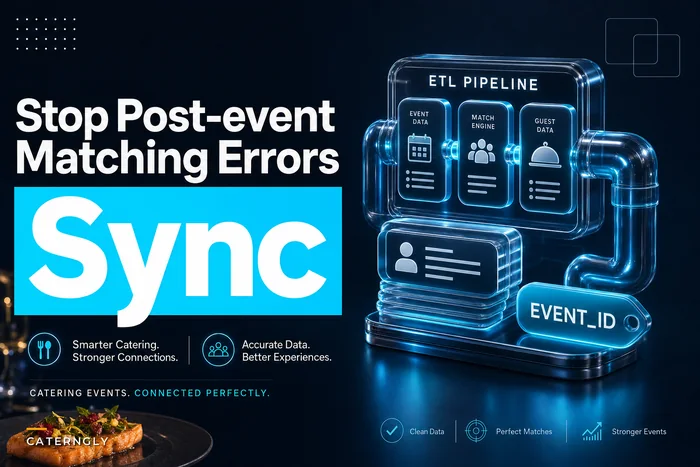
The deeper issue is that nobody ever declared a canonical event ID — one identifier that every system carries, unchanged, from first deposit to final P&L. Without it, your data model has no spine.
A second, quieter problem is that field definitions drift over time. Ask three people what "guest count" means and you'll get the contracted count, the guaranteed count, and the actual served count. All three are legitimate numbers. The problem is storing them in one field and letting whoever touched the record last decide which one it holds.
The canonical event record: fields and timestamps that actually matter
Before you can govern data, you have to define the event object itself. Not everything belongs in the master record — only the fields that other systems depend on or that you'll reconcile against later.
End chaos with centralized catering management.
Caterngly helps you plan, confirm, and manage every catering event seamlessly.
- Unified event and order management
- Real-time client updates
- Staff and resource scheduling
No credit card required
Below is a working core schema. The point isn't to copy it exactly; it's to force the decision of what your canonical fields actually are.
| Field | Definition (single source of truth) | Owning system | Reconciles against |
|---|---|---|---|
event_id | Immutable canonical ID, generated at deposit | Booking | POS, payroll, P&L |
client_id | Master client record link | CRM | Accounting |
event_date | Service date (not booking date) | Booking | Payroll shifts |
venue_id | Master venue/location record | Booking | Route + payroll location |
contracted_covers | Count on signed contract | Booking | — |
guaranteed_covers | Final guarantee at cutoff | Booking | POS covers |
actual_covers | Served count captured day-of | Ops | POS, P&L |
menuversionid | Locked menu at contract signing | Booking | Food cost card |
contract_value | Signed total, net of tax | Booking | POS, invoice |
deposit_received | Amount + timestamp | Accounting | Cashflow |
Then the timestamps. Caterers consistently underinvest here, and it's exactly the timestamps that make SLA rules and audits possible later. At minimum, capture:
-
created_at— when the booking record is first generated -
contractsignedat— the moment terms lock -
guaranteecutoffat— when the guaranteed count becomes binding -
menulockedat— when substitutions stop being free -
eventstartat/eventendat— actual service window -
posclosedat— when the day-of check is finalized -
reconciled_at— when finance signs off the event ledger
What most people miss: timestamps aren't just history, they're triggers. A guarantee cutoff timestamp is what tells payroll to lock the crew plan. A menulockedat is what a change-order workflow checks before deciding whether a client request is free or billable. Fields describe the event; timestamps drive the workflow.
Stewardship: who's allowed to change what
A data model without ownership is just a suggestion. The most common failure at scale isn't bad data entry — it's everyone being allowed to edit everything, so no field has a defensible value.
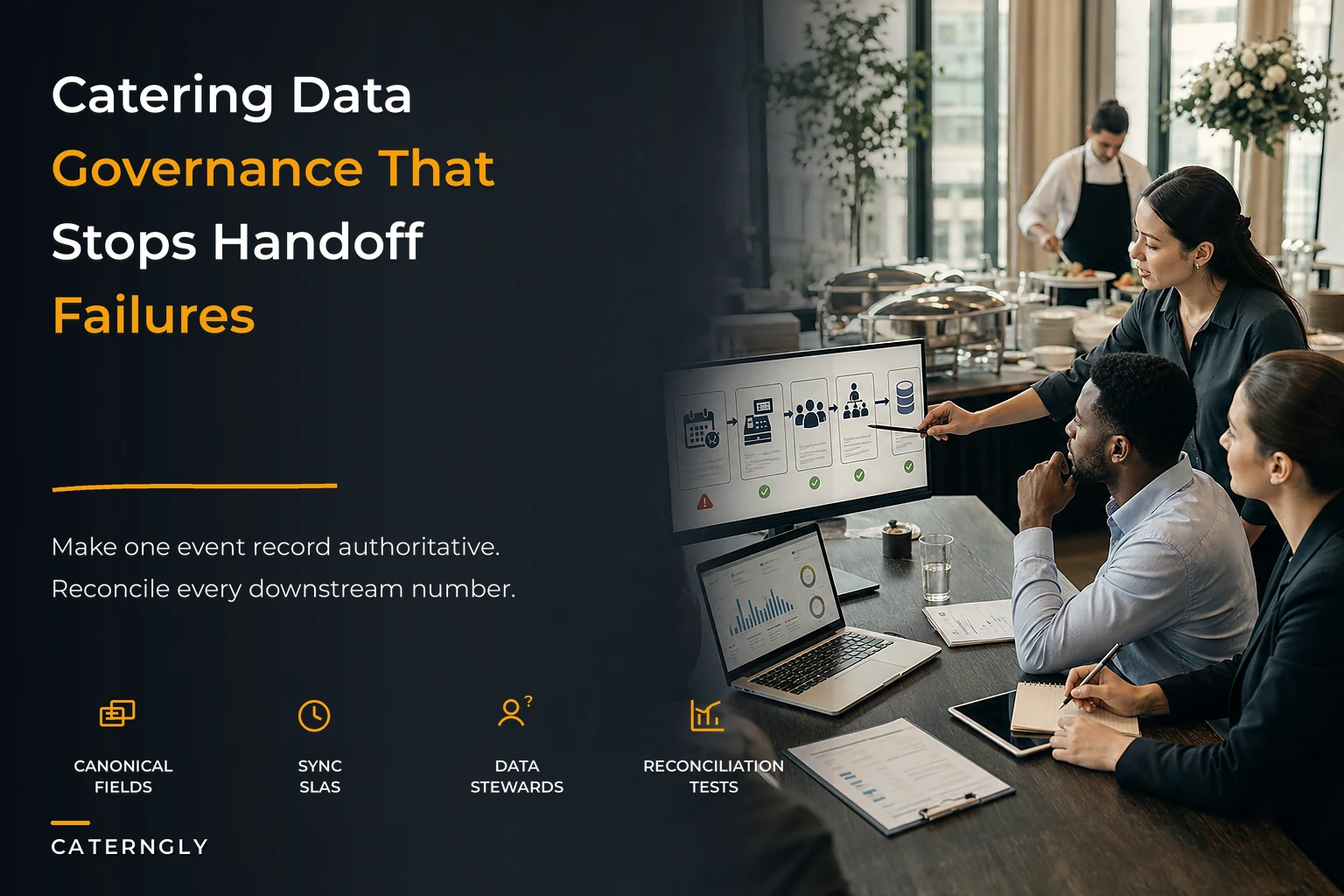
Data stewardship in a catering context breaks into three practical roles. You don't need three separate people — in a smaller shop, one person often covers all of it. What matters is that each field has exactly one steward.
-
The booking steward owns the contractual fields — covers, contract value, menu version, dates. Sales can propose changes; only the booking steward commits them. This is what stops a salesperson from quietly upgrading a package the night before without a change order.
-
The operations steward owns day-of reality — actual covers served, crew that showed, equipment dispatched. These fields don't exist until the event happens, and they're the ones most likely to be entered late or estimated.
-
The finance steward owns the ledger fields — deposits, payments, cost allocations, the
reconciled_atsign-off. Nobody upstream should be able to mark an event financially closed.
Put the one-page ownership map in your ops manual so people can find the steward quickly when questions arise.
The field that causes the most reconciliation pain is almost always the one with no clear steward. Guest count is the classic orphan. Sales thinks ops owns it, ops thinks the contract owns it, finance just uses whatever's in the box. Assign it explicitly — booking steward through cutoff, then operations steward for the actual-served value. Two fields, two owners, no ambiguity.
Write this down as a one-page ownership map. When someone asks "who can change contract value after signing," the answer should be a name, not a shrug.
SLA sync rules: how data moves between systems without corrupting
Once you've got canonical fields and stewards, the next question is timing. When a value changes in the booking system, how fast — and under what conditions — does it push to POS and payroll?
A lot of operations break quietly here. They sync everything, instantly, in both directions. That sounds efficient until a POS correction overwrites a contracted guest count, or a payroll edit rewrites the event date. Bidirectional sync without rules is how you lose your source of truth.
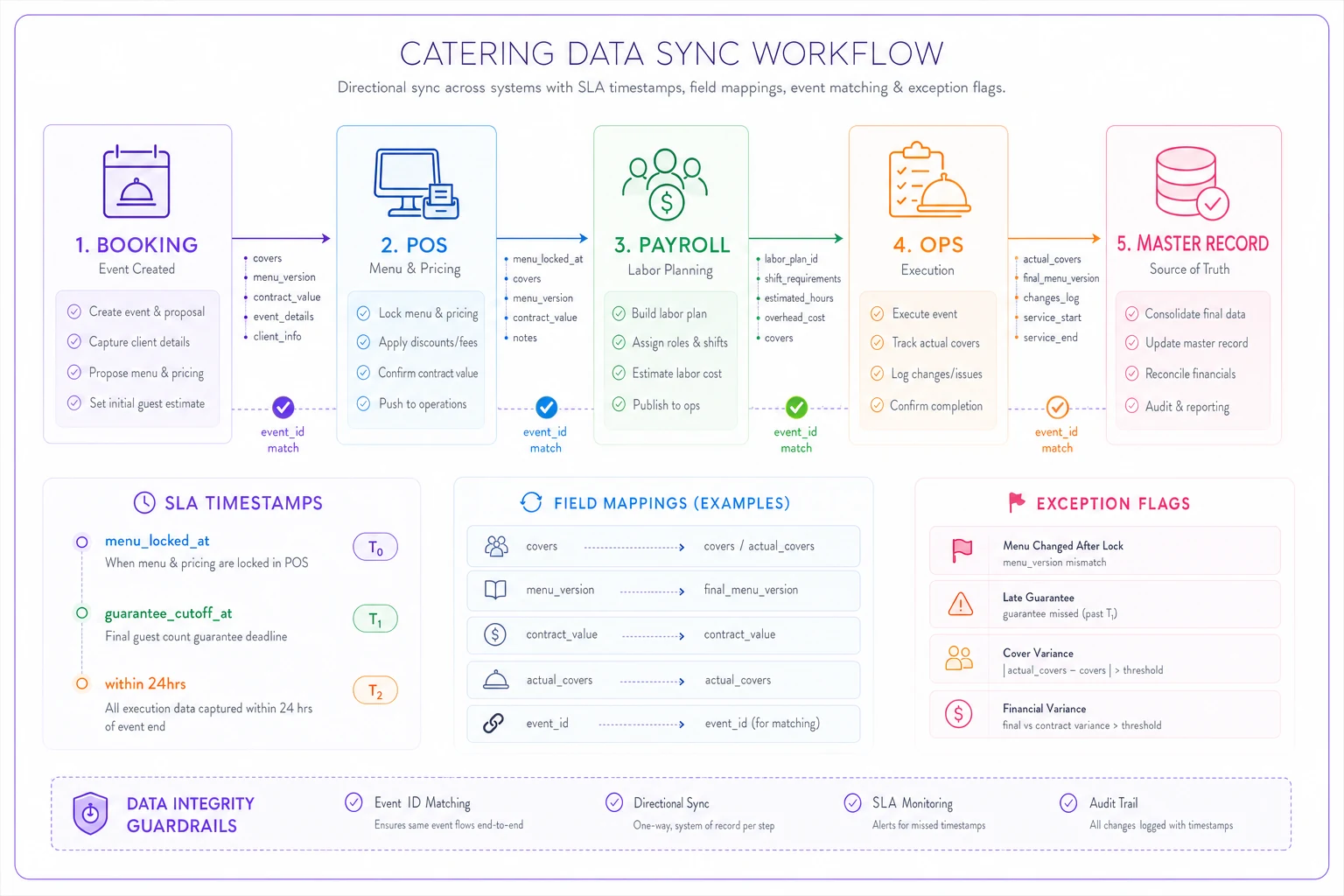
Booking System │ ├──[menulockedat]──────────────► POS (covers, menu version, contract value) │ │ ├──[guaranteecutoffat]────────► Payroll (event date, venue, guaranteed covers) │ Ops (post-event) │ └──[within 24hrs]───────────────► Master Record (actual covers, actual crew) │ POS ──[nightly, by event_id]──► Accounting
A visual workflow of the directional sync and SLAs.
-
Booking → POS
Contracted and guaranteed covers, menu version, and contract value push to POS at
menulockedat. POS may never write back to these — it only reads them to pre-build the check. -
Booking → Payroll
Event date, venue, and guaranteed covers push to payroll at
guaranteecutoffat, which lets the labor plan finalize against a real number instead of a guess. -
Ops → Master
Actual covers and actual crew flow back into the master record within a defined window — 24 hours post-event is reasonable. Miss that window and the record gets flagged as incomplete.
-
POS → Accounting
Rung sales and payments sync nightly, matched by
event_id, not by name.
The SLA part matters as much as the direction. A rule that says "actual covers must land in the master record within 24 hours of eventendat" turns a vague expectation into something measurable. If it's not there, you know before month-end, not during reconciliation.
This directional approach is exactly what prevents the mismatch problems covered in the integrations playbook for mapping bookings to POS, payroll and accounting — the difference is that here we're defining the ownership rules that the integrations then enforce.
Where AI-assisted operational platforms earn their keep is watching those SLA windows and surfacing exceptions automatically. Instead of someone manually auditing which events are missing actual-cover data, the platform flags the events past their sync deadline and routes them to the right steward. The automation doesn't invent data — it just makes the gaps impossible to ignore.
Prioritizing data-cleansing projects (because you can't fix everything at once)
If you've been operating for a few years, your existing data is already messy. Duplicate clients, events with no menu version, deposits attached to the wrong record. Trying to clean all of it at once is exactly how cleanup projects die.
Prioritize by reconciliation impact. A dirty field that never touches the P&L can wait. A dirty field that flows into three systems needs fixing now.
A sane order:
-
Deduplicate the client master. Merge "ABC Corp," "ABC Corporation," and "ABC Corp." into one
client_id. Every repeat-revenue and receivables report depends on this, and duplicates quietly split a good account into three mediocre-looking ones. -
Backfill canonical event IDs. Any historical event without a single ID is invisible to reconciliation. Assign one retroactively — even if you only go back 12–18 months.
-
Reconcile covers fields. Split the single "guests" field into contracted / guaranteed / actual wherever the history allows. This is the highest-leverage cleanse because covers drive both revenue and food cost.
-
Attach menu versions. Events with no locked menu can't be costed accurately, which breaks food-cost variance analysis.
-
Repair deposit-to-event links. Payments floating on the client instead of the event distort per-event cashflow.
A realistic scope note: don't try to cleanse everything historically. Cleanse forward from a cutoff date, fix the highest-impact fields backward, and accept that the old stuff stays approximate. Perfect historical data isn't the goal — trustworthy going-forward data is.
Reconciliation test cases: booking → POS → payroll → P&L
This is the part that proves the model actually works. A solid master-data model lets you run reconciliation as a set of repeatable test cases, not a manual hunt.
Each test is a question with a pass/fail answer, joined on event_id.
Test 1 — Covers consistency
Does actual_covers (from ops) match POS covers within tolerance?
SELECT e.eventid, e.actualcovers, p.poscovers, (e.actualcovers - p.poscovers) AS variance FROM events e JOIN possummary p ON e.eventid = p.eventid WHERE ABS(e.actualcovers - p.poscovers) > 5;
Anything over the tolerance is a flag — usually a comp'd table, a walk-in add, or a miskeyed count.
Test 2 — Revenue tie-out Does the POS-rung total reconcile to contract value plus approved change orders?
SELECT e.eventid, e.contractvalue, c.changeordertotal, p.posrevenue, (p.posrevenue - (e.contractvalue + c.changeordertotal)) AS gap FROM events e JOIN possummary p ON e.eventid = p.eventid LEFT JOIN changeorders c ON e.eventid = c.eventid WHERE ABS(p.posrevenue - (e.contractvalue + COALESCE(c.changeorder_total,0))) > 50;
Test 3 — Labor tie-out
Does payroll for the event's shifts map to an actual event_id, and is the crew count within plan?
SELECT e.eventid, e.plannedcrew, pr.actualcrew, pr.totallaborcost FROM events e JOIN payroll pr ON e.eventid = pr.eventid WHERE pr.actualcrew > e.planned_crew + 1;
Orphaned payroll — shifts with no event_id — is its own critical failure, because that labor lands in overhead instead of the event it belongs to.
Test 4 — P&L completeness
Every event past its reconciled_at SLA should have revenue, food cost, and labor all populated. Any null is an incomplete P&L.
These test cases are what turn the deeper matching work described in the post-event reconciliation process for matching deliveries, invoices and the event ledger into something you can run on a schedule rather than by hand.
Once reconciliation is a set of queries joined on one ID, the volume of events stops mattering much. Ten events or a hundred, it's the same four tests. That's the whole point of the master-data model — reconciliation scales flat instead of growing linearly with your event count.
A quick real scenario
A mid-sized off-premise caterer running roughly 20–25 events a month kept finding that month-end never closed cleanly. Their bookkeeper spent around two full days each month matching POS batches back to events by client name, and about one in six events had some discrepancy nobody could explain.
The root cause wasn't sloppiness. The POS named checks by cardholder, so a corporate event paid by an assistant's card never matched the booked client. No shared ID meant no reliable match.
They did three things: generated a canonical event_id at deposit, pushed it into a reference field on the POS check, and split their single guest-count field into contracted/guaranteed/actual. Nothing exotic.
Within two billing cycles, month-end reconciliation dropped from roughly two days to a few hours, and the mystery-discrepancy rate fell to a handful of genuine exceptions instead of a pile of naming mismatches. The money didn't change — the traceability did. That's usually where the real cost was hiding.
When this is worth doing — and when it isn't
When it makes sense: You're running enough concurrent events that manual stitching has become a real time sink, or you've started making pricing and staffing decisions off per-event P&Ls you don't fully trust. The moment you can't confidently answer "what did that event make," you've outgrown ad-hoc data management.
When it's premature: If you're doing a handful of events a month and one person touches every record, a formal master-data model is overkill. You'll spend more time governing data than the errors cost you. Get the canonical event_id habit in early, but skip the heavy stewardship structure until volume demands it.
Who should not do this: Anyone expecting software alone to fix it. A data model is a set of decisions — which field wins, who owns it, how it syncs. Tools enforce those decisions; they don't make them. Buy a platform before you've defined your canonical fields and you'll just have faster, more confident garbage.
The reason catering numbers feel untrustworthy is almost never the arithmetic. It's that the same event lives in multiple systems under multiple identities, with no rulebook for whose version wins. A master-data model fixes that at the root: one canonical event, defined fields, named stewards, directional sync rules with real SLAs, and reconciliation that runs as repeatable tests instead of monthly detective work.
Start with the one move that unlocks everything else — a single event ID that every system carries. Split your covers field. Assign a steward to the fields that keep causing pain. Do those three things and you'll find that most of your "reconciliation problem" was really an identity problem all along.
Ready to elevate your catering business?
Join 500+ caterers trusting Caterngly to save time, reduce errors, and deliver flawless events.