

Most catering businesses don't fail because they can't cook. They stall because they're running four completely different business models through one set of assumptions — the same staffing ratios, the same deposit logic, the same procurement cadence — and then can't figure out why margins swing wildly month to month.
A wedding is not a corporate drop-off. A recurring cafeteria contract is not a retail counter. But the hybrid operator — the one who takes whatever comes in because capacity is capacity — treats them as basically interchangeable. The result is a kitchen that's overstaffed for low-touch jobs and dangerously understaffed for high-touch ones, with a margin profile nobody can actually read.
This piece lays out the main catering business model archetypes, maps each to its own margin band, staffing template, procurement rhythm, and capacity gate, then covers how to move hybrid operators between channels without letting one quietly cannibalize the other.
The Core Problem: One Operating System, Four Businesses
When you look at a mixed-channel caterer's P&L and can't tell which channel made money, it's almost never an accounting issue. It's that the business runs a single operating model across archetypes with fundamentally different economics.
Weddings carry high revenue per event but enormous coordination overhead and labor intensity. Enterprise accounts carry predictable volume and thin per-unit margins that only work at scale. Recurring contracts live or die on food cost discipline because the price is locked. Retail and grab-and-go flip the whole model — low ticket, high transaction count, inventory-driven.
Each of these has a different shape. The trap is that a profitable wedding month and a profitable enterprise month look identical in the bank account, so owners assume the system is working. It isn't. One channel is subsidizing another, and you can't see which until something breaks — usually a staffing shortage during a double-booked Saturday, or a locked-price contract that goes underwater when beef prices move.
The fix starts with treating each archetype as its own operating map. This is the same logic behind a deliberate channel-mix portfolio strategy — you're not just picking which jobs to take, you're committing to run each one under its own rules.
The Four (Plus One) Archetypes and Their Margin Bands
The differences in band width matter more than the midpoint number.
End chaos with centralized catering management.
Caterngly helps you plan, confirm, and manage every catering event seamlessly.
- Unified event and order management
- Real-time client updates
- Staff and resource scheduling
No credit card required
| Archetype | Typical Gross Margin Band | Revenue Shape | Labor Intensity | What Kills the Margin |
|---|---|---|---|---|
| Weddings / Social | 38–52% | High ticket, low volume, seasonal spikes | Very high | Labor overruns, scope creep, overtime |
| Enterprise / Corporate | 22–34% | Predictable volume, lower ticket | Medium | Volume discounts, delivery logistics |
| Recurring Contracts | 18–28% | Locked price, steady cadence | Low–medium | Food inflation on fixed price |
| Retail / Grab-and-Go | 30–45% (volatile) | Low ticket, high count | Low per unit | Waste, shrink, idle inventory |
| Hybrid / Spillover | wildly variable | Mixed | Unpredictable | Mismatched staffing across all four |
What most owners miss: the width of the band tells you how much operational discipline each channel demands. Weddings have a wide band because you can swing from 52% down to 38% on the same menu depending entirely on how you staffed it and whether the client added a plated course three days out. Recurring contracts have a narrow band, which sounds safer — but narrow means almost no room to absorb a food-price shock. A 4% jump in protein cost can push a recurring contract from thin profit to loss with no lever to pull because the price is contractually frozen.
Enterprise sits in the middle but behaves differently again. Its margin comes from volume and route density, not per-event markup. An enterprise account that's profitable at 12 deliveries a week can be a money-loser at 4, because delivery labor and vehicle cost don't scale down cleanly.
Staffing Templates That Actually Match the Channel
This is where hybrid operators bleed the most. A single staffing ratio applied across archetypes guarantees you're wrong on at least two of them.
Weddings / Social — the high-touch template. Plated weddings need a front-of-house ratio closer to one server per 12–18 covers depending on course count, plus a dedicated captain for anything over 100 guests. Back of house runs heavy during the final push. The mistake is staffing to the headcount instead of the service style. A 120-guest buffet and a 120-guest four-course plated dinner are not the same labor event — the plated version can need 40–60% more floor staff and a tighter kitchen staging plan.
Enterprise / Corporate — the throughput template. Here staffing is about drivers, loaders, and setup speed, not table service. A strong enterprise template leans on a small, cross-trained delivery crew that can turn multiple drops in a morning. The number that matters isn't servers-per-guest, it's drops-per-driver-per-shift. Get that wrong and your thin corporate margin disappears into windshield time.
Recurring Contracts — the lean standing template. Recurring work rewards a fixed, predictable crew that gets faster over time. The whole point is repetition — the same team producing the same volume should see their time-per-unit drop week over week. If it doesn't, you have a training or process problem, not a volume problem.
Retail / Grab-and-Go — the coverage template. Staffing retail is about covering operating hours and peak windows, not events. You schedule to foot-traffic curves. The classic error is staffing retail like an event — fully loaded for a rush that only lasts 90 minutes.
A practical staffing-template checklist before you confirm any event:
-
Which archetype does this job actually belong to? (Not what the client calls it — what it behaves like operationally)
-
Is the staffing ratio pulled from the matching archetype template, or did someone default to "standard"?
-
Does this event overlap a confirmed booking in another channel that's already drawing from the same crew?
-
Are the roles cross-trained enough that a spillover event won't strip a recurring contract of its standing team?
-
Is overtime projected into the labor cost, or just hoped against?
Which archetype does this job actually belong to? Confirm that first to avoid defaulting to a 'standard' staffing ratio.
That overlap question is the one that catches people. You can have a perfectly staffed wedding and a perfectly staffed enterprise route that, run on the same day, leave you three people short for both.
Procurement Rules Change by Channel Too
Procurement is where the archetypes quietly diverge, and most operators run one ordering rhythm across all of them.
Recurring contracts want contracted pricing and standing orders — predictable volume should buy you better unit costs and some protection against spot-market swings. If you're buying for a recurring contract at the same spot prices as a one-off wedding, you're leaving margin on the table and exposing a fixed-price contract to a volatile input.
Weddings want flexibility over price certainty. Menus change, counts shift, and you need suppliers who can tolerate late adjustments. Locking into rigid volume commitments for the wedding channel creates waste when a 150-guest event drops to 120 a week out.
Enterprise sits between — enough predictability to forecast, enough variety to need breadth. Retail is pure inventory management: reorder points, shelf life, and shrink control dominate.
The capacity-gate logic ties procurement to acceptance. Before you say yes to a booking, the question isn't just "can we staff it" — it's "can we procure for it without disrupting the standing orders the recurring channel depends on." A big spillover wedding that forces you to divert product earmarked for a recurring contract is a margin trade you probably didn't mean to make.
Capacity Gates: The Rule That Keeps Channels From Eating Each Other
A capacity gate is a hard limit on how much of a given channel you'll accept into a given window before you stop saying yes. Without them, the highest-touch channel always wins the calendar — weddings book far ahead and feel urgent, while recurring and enterprise work quietly gets squeezed.
Here's the failure mode. An operator with a steady enterprise lunch route and two recurring contracts takes a run of summer weddings because the per-event revenue looks irresistible. By July, the wedding load has absorbed the crew, the recurring contracts get B-team coverage, quality slips, and one contract doesn't renew. The wedding revenue was real — but it cost a recurring account worth more over 12 months than the weddings earned in three.
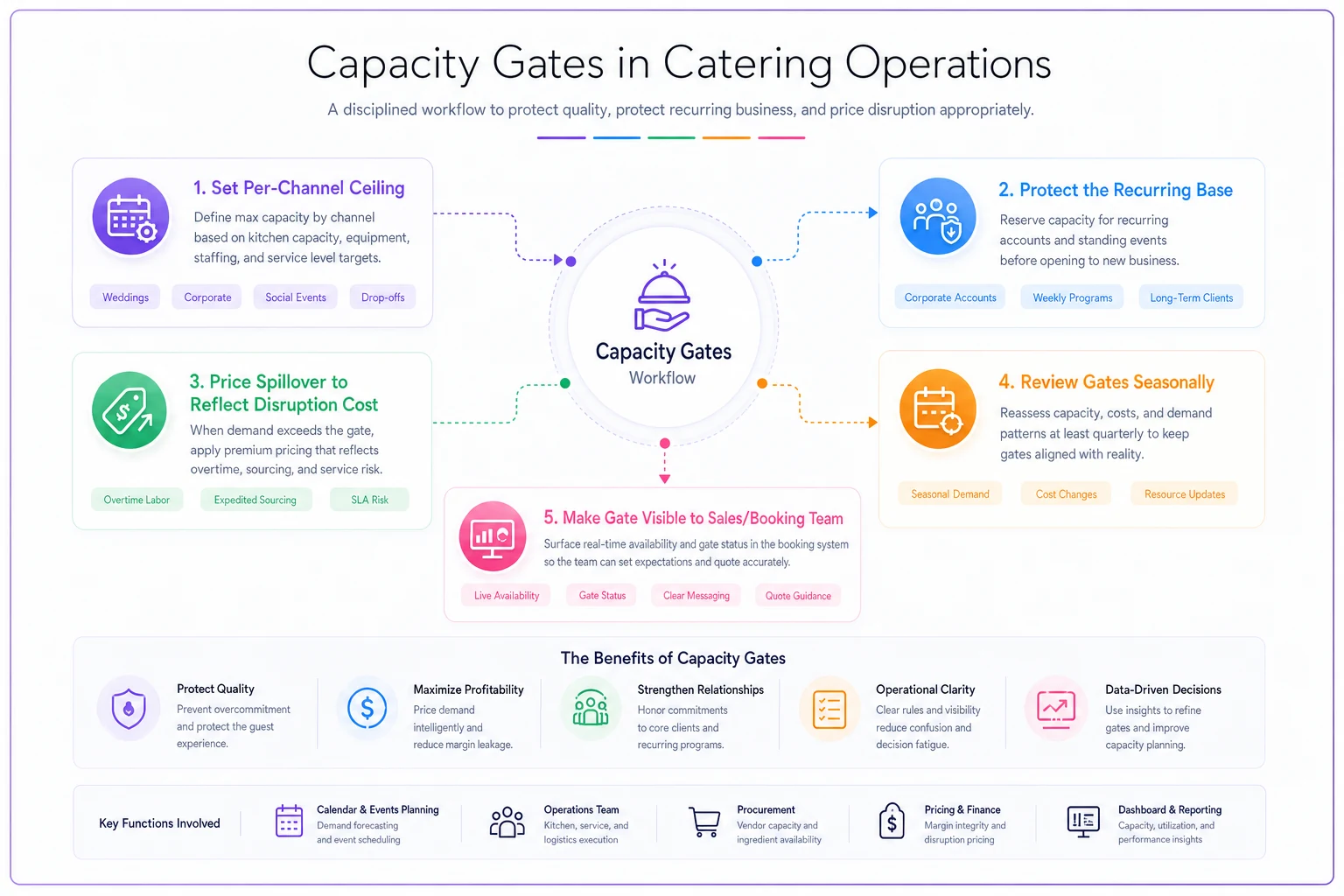
Gates prevent that. A simple gating framework:
-
Set a per-channel ceiling per week. "No more than two full-service weddings per Saturday." "Enterprise route capped at X drops before we need a second vehicle."
-
Protect the recurring base first. Recurring contracts get their crew reserved before any spillover work is accepted into that window.
-
Price spillover to reflect its true disruption cost. If taking a wedding forces overtime or diverts procurement, that cost goes into the quote — not absorbed quietly.
-
Review the gate seasonally. Wedding season and corporate-event season don't peak together; the gates should flex.
-
Make the gate visible to whoever books. A sales function that can't see capacity will sell past it every time.
Here's a simple visual workflow for implementing a capacity gate.
This connects directly to how you run revenue operations and yield management — capacity gates are the operational enforcement layer underneath yield decisions. Yield management tells you which booking is worth more; the gate makes sure the more-valuable channel actually keeps its slot.
A Worked Margin Map: The Hybrid Operator Problem
Consider a mid-sized operator — roughly $1.4M in annual revenue, splitting work across weddings, a corporate lunch route, and one recurring institutional contract.
-
Weddings were running close to 44% — strong, but only on events where overtime stayed controlled. A handful of summer events dipped under 35% because of last-minute staffing scrambles.
-
The enterprise lunch route was barely clearing 24%, and that was before properly allocating vehicle and driver cost. Honest allocation put it closer to 19%.
-
The recurring contract looked fine at signing, around 26%, but had quietly slipped to roughly 20% as protein prices climbed against a locked price.
The blended number hid all of it. The weddings were subsidizing a recurring contract drifting toward break-even and an enterprise route that wasn't earning its logistics cost. Once each channel was mapped to its own band and the enterprise route was re-priced and re-batched for density, the owner had something they could actually steer — not a single average masking two underperformers.
The lesson isn't "drop the weak channels." It's that you can't manage what you can't see separately. Enterprise work, run tight, is genuinely valuable — the discipline for it is laid out well in an enterprise corporate-account operating playbook. But it has to be measured against its own band, not the wedding band.
When Adding a Channel Makes Sense — and When It Doesn't
When it makes sense: You have consistent idle capacity that a second archetype could fill without disrupting the first. A wedding-heavy operator with dead weekday kitchen time is a natural fit for an enterprise lunch route — the demand curves don't collide. The new channel fills troughs the existing one leaves empty.
When it's a bad idea: When the new channel competes for the same resource at the same time as your core. Adding weddings to a recurring-contract operation whose crew is already committed on weekends just means B-team coverage on both. You're not adding capacity, you're splitting attention.
Who should not do this: Operators who can't yet read their channels separately. If you don't have per-channel margin visibility, adding a fourth archetype just adds a fourth thing you can't see. Get the measurement right on two channels before you try to run four.
Transitioning Hybrid Operators Between Channels — A Checklist
When you're deliberately shifting weight from one archetype toward another — say, building up recurring contracts to smooth out wedding seasonality — the transition is where things break. Run through this before you commit:
-
Map the current channel split by margin, not revenue. Revenue share lies; margin share tells you which channel is actually funding the business.
-
Identify the staffing template collision. Does the target channel draw from the same crew as your core during the same windows?
-
Reset procurement before you scale the new channel. Standing orders and contracted pricing need to be in place before recurring volume ramps, not after.
-
Set the capacity gate for the channel you're protecting. Decide what you'll turn away in the core channel to grow the new one — and confirm that trade is actually worth it.
-
Re-price the shrinking channel. As you take fewer of a channel, each remaining job should carry a premium — you've lost the volume efficiency.
-
Run a trial window, not a full switch. Pilot the new channel in one slow season before committing the calendar to it.
-
Rebuild the labor forecast per channel. Blended labor projections mask the shift; forecast each archetype's crew need separately.
Operators who transition well treat it as a staged move with its own gates and templates. The ones who struggle just start saying yes to a new kind of work and assume the existing operating model will stretch to cover it. It never does.
Bringing It Together
The real shift is mental: you're not running a catering company, you're running two to four distinct businesses that happen to share a kitchen. Each archetype has its own margin band, its own staffing logic, its own procurement rhythm, and its own ceiling.
The moment you blend them into one operating model, the strong channel hides the weak one, the high-touch channel eats the calendar, and your margins drift in ways nobody can trace.
Map each channel on its own. Staff it from its own template. Procure for it on its own rhythm. Gate it so it can't cannibalize the others. Do that, and the hybrid model stops being a liability and becomes what it should be — a portfolio where each channel covers the other's weak season instead of quietly draining it.
Map each channel on its own. Staff it from its own template. Procure for it on its own rhythm. Gate it so it can't cannibalize the others. Do that, and the hybrid model stops being a liability and becomes what it should be — a portfolio where each channel covers the other's weak season instead of quietly draining it.
Ready to elevate your catering business?
Join 500+ caterers trusting Caterngly to save time, reduce errors, and deliver flawless events.