


Most caterers don't have a pricing problem. They have a mix problem.
You can price every event correctly, staff each one to plan, and still end the year wondering why margins slipped even though revenue climbed. That gap almost always traces back to how capacity got distributed across event types — and whether anyone was actually managing that distribution or just taking whatever booked first.
Think of your calendar as a portfolio. You have a fixed number of production days, a fixed pool of skilled labor, and a fixed number of Saturdays that will ever exist in a year. Every date you sell to one channel is a date you can't sell to another. The question that separates a shop running at 14% net from one running at 24% isn't "how do we get more bookings" — it's "which mix of bookings makes the best use of the capacity we already have."
This is the part almost nobody models on purpose.
The three channels behave completely differently
Weddings, corporate, and retail (drop-off, boxed lunches, small pickups, holiday trays) aren't just different revenue lines. They consume different resources, at different times, with different reliability, and they leave very different marks on your P&L.
The pattern worth internalizing before you touch a spreadsheet:
-
Weddings produce the highest gross per event and the highest average check, but they're Saturday-locked, labor-heavy, deposit-dependent, and emotionally volatile — scope creep, family opinions, last-minute headcount swings.
-
Corporate is the flywheel. Lower average check than weddings, but repeatable, weekday-heavy, predictable headcounts, faster decision cycles, and far less service labor per dollar. It also fills the days weddings can't touch.
-
Retail / drop-off is the margin sleeper. Low ticket, but almost no on-site labor, tiny coordination overhead, and it soaks up production capacity on dead days. Run well, it can carry a surprisingly good contribution margin per labor hour.
The trap most owners fall into: they judge each channel by gross margin percentage or by average event size. Both are the wrong lens. The right lens is contribution per constrained resource — usually per skilled labor hour on peak days, and per production day overall.
A wedding at 32% gross margin can be worse for your business than a corporate lunch at 26% if the wedding eats a Saturday, six skilled staff, and forty coordination hours while the corporate account fills three weekdays a month with almost no supervision.
Why the mix drifts on its own
Nobody sits down and decides "let's become 70% weddings this year." It happens by default, and the mechanism is pretty predictable.
End chaos with centralized catering management.
Caterngly helps you plan, confirm, and manage every catering event seamlessly.
- Unified event and order management
- Real-time client updates
- Staff and resource scheduling
No credit card required
Weddings book 9–14 months out. Corporate books 3–6 weeks out. Retail books days out. So when your sales calendar is empty in January, the only inquiries with firm dates that far ahead are weddings. You say yes, because saying yes to a real deposit today feels smarter than betting on corporate volume that hasn't materialized yet.
Repeat that for a few months and your best dates — the peak-season Saturdays — are gone before corporate season even warms up. Now you're turning away repeat corporate clients in October because your kitchen is slammed with weddings you committed to in February, and those corporate clients quietly find another caterer who could take the date.
That's the drift. It's not a decision. It's the absence of one.
The shops that avoid this treat their premium dates as inventory to be allocated on purpose, the same way an airline doesn't sell every seat at the walk-up fare.
Date-cap math: reserving capacity before you sell it
The core move is deciding, in advance, how many premium slots each channel is allowed to consume — and refusing to blow through those caps just because an inquiry showed up early.
Start with your real constraint. For most caterers it's peak-season Saturdays (roughly 20–24 of them a year) and skilled labor on those days.
A worked example. Say a mid-sized shop has:
-
22 peak Saturdays
-
Kitchen capacity to run 2 large events OR 1 large + 2 mid-size per Saturday
-
A skilled-labor pool that comfortably staffs 2 concurrent full-service events
Naive booking fills all 22 Saturdays with the first two weddings that inquire each week. That looks like a full calendar. It's actually a capacity leak, because weddings are the least flexible, most labor-intensive use of that slot, and they lock out everything else.
| Channel | Peak Saturday cap | Rationale |
|---|---|---|
| Weddings | 14 of 22 | Highest gross, but cap it so labor and coordination don't overload |
| Corporate (Sat galas, conferences) | 5 of 22 | Repeat-relationship protection; often books later |
| Held / flex | 3 of 22 | Released 60 days out to highest-contribution inquiry |
The "held" bucket is the underrated part. You don't have to guess perfectly in January. Reserve a few slots, then release them to whichever channel shows the best contribution-per-labor-hour as the date approaches. It's a hedge against your own early-year impatience.
Reserve a small held bucket and set a firm release schedule (e.g., 60 days out) to sell to the highest contribution-per-labor-hour inquiry.
Weekdays run on a looser cap because corporate and retail rarely collide the way weekend full-service does. The discipline is almost entirely about protecting the scarce, high-demand dates.
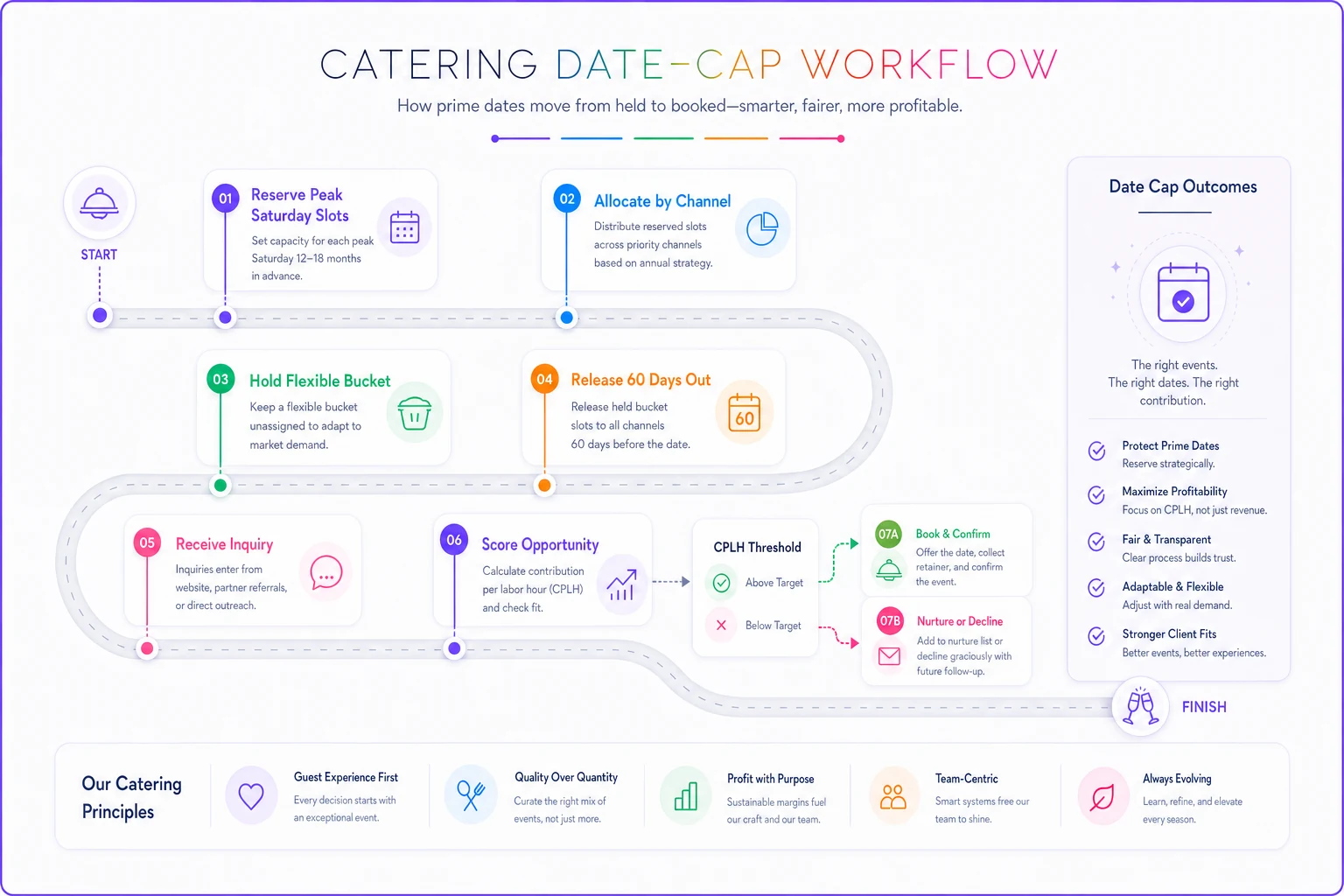
This simple flow — reserve, hold, release to highest-contribution demand — is what keeps premium dates from being spent the moment an early deposit lands.
Capacity → margin: the tradeoff nobody prices
The counterintuitive part: loading more weddings onto peak Saturdays raises revenue and often lowers net margin, because each incremental wedding pushes you into overtime, temp labor at premium rates, and stretched supervision that causes the small errors that eat contribution.
| Wedding share of peak Saturdays | Blended gross margin | Overtime / temp premium load | Net margin (est.) |
|---|---|---|---|
| 55% weddings, 30% corporate, 15% retail | ~34% | Low | ~22–24% |
| 70% weddings, 20% corporate, 10% retail | ~36% | Medium | ~19–21% |
| 90% weddings, 8% corporate, 2% retail | ~37% | High | ~15–17% |
Gross margin rises as you add weddings — they carry the biggest tickets. Net falls, because the last few weddings each Saturday are staffed with your most expensive marginal labor and supervised worst. The blended-margin story and the net-margin story point in opposite directions, which is exactly why owners get fooled.
The optimization isn't "maximize weddings." It's "find the mix where the constrained resource — skilled peak-day labor — generates the most net contribution." That's usually a balanced portfolio, not a wedding monoculture.
If you want to get precise about which events actually clear your threshold once labor and overhead are allocated honestly, the per-event P&L framework with canonical allocation rules and margin bands is the foundation the whole portfolio model sits on. You can't manage the mix if you can't trust the per-event numbers underneath it.
Worked P&L: two calendars, same shop
Same kitchen, same year, two different mixes. Rough numbers, deliberately imperfect.
Calendar A — wedding-heavy (drifted mix)
-
20 weddings @ ~$14k avg = $280k
-
6 corporate events @ ~$6k = $36k
-
Minimal retail = ~$18k
-
Revenue ≈ $334k
-
Food + direct ≈ 34% of rev
-
Peak-day overtime and temp premiums elevated
-
Coordination stretched → 2–3 costly service misses
-
Net ≈ 16–18%
Calendar B — managed mix (date-capped)
-
14 weddings @ ~$14.5k = $203k
-
14 corporate events @ ~$6.5k = $91k
-
Retail / drop-off program = ~$46k
-
Revenue ≈ $340k
-
Weekday corporate runs lean on labor
-
Retail fills dead production days at high contribution/hour
-
Peak Saturdays never over-concentrated → overtime down
-
Net ≈ 22–24%
Nearly identical revenue. The managed mix throws off meaningfully more profit because it stopped spending its scarcest resource — peak-day skilled labor — on its least efficient use.
The retail line does quiet, unglamorous work here. Boxed lunches and drop-off orders on a Tuesday don't feel like a "real" event, but they turn otherwise idle production capacity into contribution with almost no service-labor drag. Shops that dismiss retail as beneath them are usually leaving five figures of net on the table.
Booking rules that keep the mix intact
Caps only work if the people answering the phone follow rules the day an inquiry lands. A few that hold up in real operations:
-
Cap-check before hold. No premium Saturday goes on hold without confirming the channel still has slots left in its cap.
-
Early weddings don't get automatic priority. Booking 11 months out is not a reason to consume a capped slot; it's just the natural rhythm of that channel.
-
Corporate repeat clients get first refusal on a defined number of peak dates each season, communicated before the wedding rush.
-
Release flex slots on a schedule (e.g., 60 days out) to the highest contribution-per-labor-hour inquiry in the pipeline.
-
Score every inquiry on fit, not just size. A big event that wrecks your labor plan is worse than a smaller one that slots cleanly.
That last point connects directly to how you route leads in the first place. If low-fit inquiries are eating your calendar before high-value ones arrive, the problem starts upstream — the lead-scoring and proposal-routing approach for protecting operations is essentially the front door to your portfolio strategy. Date caps decide how much capacity each channel gets; lead scoring decides which specific bookings fill it.
Staffing plans change when the mix changes
Portfolio strategy isn't just a sales exercise — it reshapes how you hire and schedule.
A wedding-heavy shop needs a large bench of trained service staff available Saturdays and almost nothing midweek. That means expensive on-call labor, high turnover on the bench, and constant scramble. A balanced portfolio spreads demand across the week, which lets you build a smaller core of cross-trained staff who work more consistent hours — which improves retention, which improves service quality, which reduces the errors that quietly drain margin.
In practice: you forecast the shape of the calendar first — how many peak full-service events, how many weekday corporate, how much retail volume — then translate that shape into a labor plan with core staff, cross-trained flex, and true on-call. When the mix is stable and planned, the labor plan stabilizes with it. When the mix drifts wedding-heavy, your labor plan lurches toward expensive weekend-only staffing that you can't fully utilize the other six days.
Retail volume is what lets you keep skilled production staff busy — and employed full-time — during the weekday troughs. That's the connective tissue people miss: the drop-off program isn't just a margin line, it's what makes your best kitchen hires worth keeping on payroll year-round.
When a channel-mix portfolio strategy actually makes sense
This discipline pays off when:
-
Your peak dates sell out and you're routinely turning away business
-
You run more than one event type and they compete for the same crew
-
Your net margin is drifting down while revenue holds or grows
-
You have (or want) repeat corporate relationships worth protecting
It's less urgent for a pure single-channel operation — a wedding-only shop with plenty of open dates doesn't have a mix to manage yet.
When it's a bad idea — or premature
Don't over-engineer caps if you're still filling less than half your peak dates. Reserving slots you can't fill just leaves money on the table. Build demand first, then manage its allocation.
Also skip the heavy version of this if your data is unreliable. Date caps and contribution-per-labor-hour math only work if your per-event costs are honest. If you're still allocating overhead by gut feel, fix the measurement layer before you start reserving inventory against numbers you don't trust.
And if you've built your entire brand and referral engine around one channel, don't chase a "balanced" mix for its own sake. Sometimes the right portfolio is concentrated — the point is to choose it deliberately, price the overtime and coordination cost of that concentration, and staff for it, rather than sliding into it by accident.
A short real scenario
A regional caterer doing roughly $1.4M was running about 78% weddings by revenue. Peak Saturdays sold out by early spring. Net hovered around 15%, and the owner kept blaming food costs.
The actual leak was concentration. Every peak Saturday ran two weddings, the second one always staffed with temp labor at premium rates and supervised by whoever was left. Coordination misses on those second events — late courses, wrong counts — were costing thousands per season in comps and rework.
They capped weddings at roughly two-thirds of peak Saturdays, formalized first-refusal dates for three repeat corporate clients, and finally took their long-ignored drop-off inquiries seriously with a proper boxed-lunch and tray menu for weekdays.
Twelve months later: revenue roughly flat (up maybe 3–4%), but net climbed into the low 20s. Overtime dropped noticeably because peak Saturdays stopped running short-staffed second events. And the corporate relationships they'd been accidentally starving turned into a steadier, more predictable base — several of which they later converted into recurring accounts using a proper post-event follow-up motion, the kind laid out in the catering lifecycle blueprint for turning one-off clients into repeat revenue.
Where software quietly earns its keep
None of this requires fancy tooling to understand. It requires discipline to maintain — and that's where most shops fall down, because the caps live in the owner's head while three different people book events.
Running your calendar, per-event costs, and channel caps inside one operational platform — rather than a whiteboard and a shared inbox — is what actually keeps the strategy alive during a busy season. When the booking system knows the caps, flags an inquiry that would blow through a channel's peak-date allocation, and shows contribution-per-labor-hour as you build the proposal, the mix stays managed even when you're not the one answering the phone. AI-assisted booking rules can surface "this Saturday is at its wedding cap — hold or route to flex?" in the moment, without you personally policing every inquiry.
The tool isn't the strategy. The strategy is the portfolio thinking above. The software just makes sure the discipline survives contact with a busy season.
The takeaway worth keeping
Revenue tells you how busy you are. Mix tells you whether that busyness is worth it. Two caterers can post the same top line and end the year fifteen points apart on net, purely because one managed how its scarce peak-day capacity got allocated and the other let the calendar fill itself.
Decide your caps before the season, protect your best dates like the finite inventory they are, and price the true cost of concentration before you accept it. That's the whole game.
Decide your caps before the season, protect your best dates like the finite inventory they are, and price the true cost of concentration before you accept it. That's the whole game.
Ready to elevate your catering business?
Join 500+ caterers trusting Caterngly to save time, reduce errors, and deliver flawless events.