

Most caterers treat each event like a transaction. Quote, deliver, invoice, done. Then they wonder why clients disappear after one booking while competitors somehow lock in monthly corporate accounts and wedding anniversary parties year after year.
The difference usually isn't service quality. It's the catering customer lifecycle — the touchpoints, offers and follow-ups that turn single bookings into predictable repeat business. The caterers who have figured this out mapped every interaction from first inquiry through year-two anniversary outreach, with specific templates, timing and margin thinking driving each step.
The lifecycle architecture most caterers miss completely
A functioning catering customer lifecycle breaks into three distinct phases, each with different operational requirements and profit dynamics. Phase one runs from initial contact through event execution. Phase two covers immediate post-event through 90 days. Phase three handles long-term nurturing and reactivation.
Where this falls apart: caterers typically nail phase one because they have to, completely skip phase two, and randomly attempt phase three with occasional holiday emails that get ignored.
Phase two determines everything. A client who gets the right follow-up in the two weeks after their event books again at a meaningfully higher rate than one who hears nothing. But executing that sequence requires infrastructure most caterers haven't built — automated NPS collection, margin-aware upsell rules, and touchpoint templates tied to specific client segments.
Think about what actually happens after most events. The client gets an invoice. Maybe a thank you email if someone remembers. Then radio silence until next year's "book your holiday party" blast that lands in spam because they haven't heard from you in eleven months.
Meanwhile, the caterer who books that client's next three events sends an NPS survey two days post-event, triggers a personalized offer based on their response, follows up with seasonal menu previews matched to their previous order profile, and drops an anniversary reminder eleven months later with last year's menu attached. It's not magic — it's just infrastructure.
Proposal bundles mapped to margin bands
The lifecycle starts before the first booking. How you structure proposals determines not just whether you win the business, but what kind of relationship develops afterward.
End chaos with centralized catering management.
Caterngly helps you plan, confirm, and manage every catering event seamlessly.
- Unified event and order management
- Real-time client updates
- Staff and resource scheduling
No credit card required
Standard catering proposals quote individual items. Premium chicken entrée: $32 per person. Caesar salad: $8. Dessert station: $12. The client picks and chooses, you calculate the total, everyone moves on. This commodity approach trains clients to shop on price and creates zero switching costs — they could get the same items from anyone.
Margin-mapped proposal bundles work differently. You create three or four standard packages at different price points, each engineered to hit target margins while solving different client problems.
One caterer I worked with — a mid-size operation running mostly corporate and social events — had been quoting line items for years and constantly losing bids to cheaper competitors. When they switched to a bundle approach, close rates improved and margin erosion from client-requested substitutions dropped noticeably. The reason was pretty simple: the bundle shifted the conversation from "why does your chicken cost more?" to "which experience fits what you're trying to accomplish?"
How the tiers tend to work in practice: the entry-level bundle aims for somewhere in the low-to-mid 40% margin range and focuses on operationally efficient items — dishes that share ingredients, require minimal labor, and use equipment already running. A mid-tier "Signature" option adds high-perceived-value touches that cost relatively little extra: garnish upgrades, plating flourishes, a complimentary tasting for larger parties. The top tier includes coordination services that position you as the event partner rather than just the food vendor, and margins can push into the low-to-mid 50s if the service is built around it.
What changes operationally when you present bundles instead of items:
First, sales conversations shift from ingredient costs to event outcomes. Instead of defending why your chicken costs more than a competitor's, you're discussing how the mid-tier bundle includes dedicated day-of coordination.
Second, bundles create natural upsell paths during the lifecycle. When a client books the entry package, your post-event follow-up can reference specific things they missed: "For your next event, you might enjoy the tableside Caesar preparation — it tends to be a real hit."
Third, margin protection becomes more automatic. Individual item quotes often erode as clients request substitutions. With bundles, the package price holds because it assumes the full configuration.
The bundle approach also creates a relationship framework rather than just a pricing structure. Over time, clients learn how your tiers work and tend to self-select upward.
The post-event follow-up window most caterers blow
After seeing enough events come and go, you start recognizing a frustrating pattern. Great event, happy client, enthusiastic promises to book again — then nothing. They ghost. Six months later you see photos from their next event catered by someone else.
The breakdown almost always happens in the 72 hours post-event. That's when clients are most emotionally connected to your service but haven't yet shifted attention elsewhere. Miss that window and you're essentially starting from zero.
A rough map of what an effective post-event journey looks like:
Hour 0–24: Event wraps. Automatic thank you email goes out, with setup photos if you took them. Invoice attaches if not already paid.
Hour 48–72: NPS survey hits their inbox. One question: "How likely are you to recommend us?" Plus an optional comment box. Keep it simple — the shorter the survey, the higher the response rate, consistently.
Day 4–7: Response-triggered pathway activates. Scores 9–10 get a referral incentive (something like 15% off their next event per successful referral). Scores 7–8 get a personal email from the owner acknowledging the feedback. Scores 6 and below get a phone call to address issues directly.
Day 14: Seasonal menu preview based on event type. Corporate lunch client gets new spring boxed lunch options. Wedding client gets romantic dinner packages for anniversaries.
Day 30: For high-NPS clients, a case study or testimonial request. Keep it low-friction.
Day 60: A relevant content piece. Corporate clients might get "how to make team lunches more engaging." Social event clients get trending cocktail hour formats.
Day 90: Booking incentive for their next event category. If they booked corporate, offer a social event discount. If they booked a wedding, suggest holiday party packages.
Automate the NPS deployment so you never miss the 48–72 hour window when responses are highest.
Without automation, this sequence almost never gets executed consistently. Somebody has to manually track every client, remember timing, personalize messages, and monitor responses. That's why it doesn't happen. When these touchpoints trigger automatically based on event completion and NPS scores, every client gets the full journey — not just the ones someone happened to remember.
Retention KPIs that reveal lifecycle health
Most caterers track only backward-looking metrics — last month's revenue, food cost percentage, events delivered. These tell you what happened, not what's about to break.
Catering customer lifecycle health shows up in five forward-looking KPIs:
Repeat booking rate by cohort: What percentage of clients who booked their first event in a given quarter have booked again? Track this over time to spot retention trends before they hit revenue.
Days to second booking: How long between a client's first and second event? Clients who rebook relatively quickly tend to become long-term accounts.
NPS response rate: Below 40% usually means your survey timing or format needs work. Once you're consistently above 60%, you have feedback worth acting on.
Upsell conversion rate: When you present a higher bundle or add-on, how often do clients accept? Low rates usually signal misaligned offers or bad timing.
Reactivation success rate: For clients who haven't booked in six or more months, what percentage respond to win-back campaigns?
These metrics are more connected than they might seem. One catering company noticed their repeat booking rate had dropped steadily over two quarters — not dramatically, just quietly eroding. When they dug into it, they found their NPS response rate had also dropped around the same time. Turns out the survey tool had silently broken and nobody caught it for close to three months. Without incoming NPS scores, the response-triggered follow-up sequences weren't firing at all. Fixing the survey started recovering the lost ground within a few weeks. It wasn't a service problem; it was a broken system nobody had checked.
Anniversary outreach and the compound effect
The most profitable booking you'll ever make is the one that requires almost no selling. Anniversary bookings — clients rebooking the same event type roughly one year later — convert at high rates when you approach them right, and they tend to run cleaner operationally because you already know their preferences.
Most caterers miss these entirely. They either forget to track the dates or send something so generic it lands like spam.
Effective anniversary outreach starts with data capture during the original event. You need:
-
Exact event date
-
Event type and occasion
-
Menu selections
-
Guest count
-
Special requests or dietary needs
-
Key contact and decision maker
Eleven months later — not twelve, because you want to reach them before they start planning elsewhere — an automated sequence starts:
Month 11: "Your anniversary is coming up. Last year's [event type] was beautiful. Would you like us to hold [date + 365 days] for this year?"
Month 11.5: If no response: "I've attached last year's menu for reference. We can recreate what worked or explore this season's new options."
Month 11.75: If still no response: "I wanted to make sure you received my earlier notes about your upcoming date. We're holding it tentatively but will need to release it soon."
The clients who get that first message at month 11 — specific, personal, tied to their actual event — respond very differently than clients getting a generic blast. You're demonstrating that you actually remembered them, not just that you're filling your calendar.
The technology layer that makes lifecycle management possible
Everything described above — the bundles, the follow-up journeys, the KPI tracking, the anniversary sequences — requires multiple systems working together. Your proposal system needs to talk to your CRM. Your CRM needs to trigger email sequences. Email responses need to update client records. Event dates need to populate anniversary reminders.
-
Automated NPS deployment based on event completion
-
Response-triggered follow-up sequences
-
Margin tracking by client and bundle type
-
Anniversary reminders with historical order data
-
Reactivation campaigns for dormant clients
Most caterers try to hold this together with spreadsheets, calendar reminders, and manual processes. That works for a small client load. Beyond that, things start falling apart — someone forgets the follow-up, the anniversary reminder never gets set, the survey sits in a folder nobody checks.
AI-powered operational software changes this by centralizing lifecycle touchpoints into a single platform instead of juggling five tools:
The automation handles the orchestration while you focus on the human moments — the personal call to an unhappy client, the handwritten note to a major account, the custom menu built around a special request. Those things still matter. They just can't be the only thing keeping your lifecycle together.
There's another benefit that's easy to overlook: when clean data flows through one system, patterns become visible that you'd never catch manually. Which bundle tiers lead to faster second bookings. Which event types have the highest anniversary conversion. Where in the follow-up sequence clients tend to go quiet. That kind of operational visibility is basically impossible to manufacture from a spreadsheet.
Cadence templates tied to specific event types
Not all catering clients follow the same lifecycle. A corporate account booking monthly lunch-and-learns needs different touchpoints than a bride planning a one-time wedding. Using the same follow-up sequence for both produces irrelevant messaging and lower engagement.
Effective lifecycle management requires distinct cadence templates for each major client category:
Corporate recurring accounts: These clients value consistency and efficiency. Their cadence emphasizes quarterly business reviews, seasonal menu updates, and automated reorder suggestions based on previous selections.
Social one-time events (weddings, milestones): These clients plan well in advance and invest emotionally in details. Their cadence includes more pre-event touchpoints, day-of coordination updates, and anniversary reminders for related celebrations.
Corporate one-time events (holiday parties, client appreciation): These clients tend to book annually for specific occasions. Their cadence focuses on early-bird incentives, trending format ideas, and comparison to the previous year's event.
Nonprofit and fundraising events: These clients operate on tight budgets with board approval requirements. Their cadence includes budget-friendly package options and multi-year contract incentives.
The corporate recurring segment is where automation pays off fastest. When reorders happen automatically based on previous patterns — the monthly Tuesday lunch, the quarterly all-hands — your sales team barely has to touch those accounts. That frees them up for new business development rather than manually maintaining accounts that should be running on autopilot.
The margin math behind lifecycle optimization
Every touchpoint costs something — email platform fees, staff time for phone calls, discount offers to incentivize rebooking. So does lifecycle optimization actually improve profitability, or does it just create busywork?
| Metric | Without Lifecycle Management | With Lifecycle Management |
|---|---|---|
| New client acquisition cost | $400–600 per booking | $400–600 per booking |
| One-time client rate | ~75% | ~45% |
| Average first-event margin | $2,800 | $2,800 |
| Repeat client margin (no acquisition cost) | — | $3,400 |
These aren't precise figures — the actual numbers vary considerably depending on your market, event mix, and how well the system is actually executed. But the direction is consistently true: repeat clients cost nothing to acquire, so their full margin flows to the bottom line, and they tend to spend more because trust has been established.
The compound effect over multiple years is where it gets meaningful. A client retained for three years generates substantially more profit than three separate one-time clients because you paid acquisition cost only once. The math isn't complicated — it just requires actually running the numbers rather than assuming retention handles itself.
The implementation sequence that works
Building a full catering customer lifecycle system feels overwhelming when you're already juggling daily operations. The caterers who succeed don't try to launch everything at once. They build in stages:
-
Month 1 Map your current client touchpoints. List every interaction from inquiry through 12 months post-event. Most caterers find significant gaps pretty quickly.
-
Month 2 Design your NPS survey and response triggers. This is the foundational piece — get it right before building on top of it.
-
Month 3 Create bundle structures with margin targets. Restructure proposals to present packages rather than itemized lists.
-
Month 4 Build the 90-day post-event sequence. Automate as much as you can, but even a manual version is better than nothing.
-
Month 5 Implement anniversary tracking and outreach. Start with high-value clients, then expand.
-
Month 6 Layer in segment-specific cadences. Corporate accounts need different touchpoints than social events.
-
Month 7+ Refine based on KPI data. Your metrics will show which touchpoints drive bookings and which are just noise.
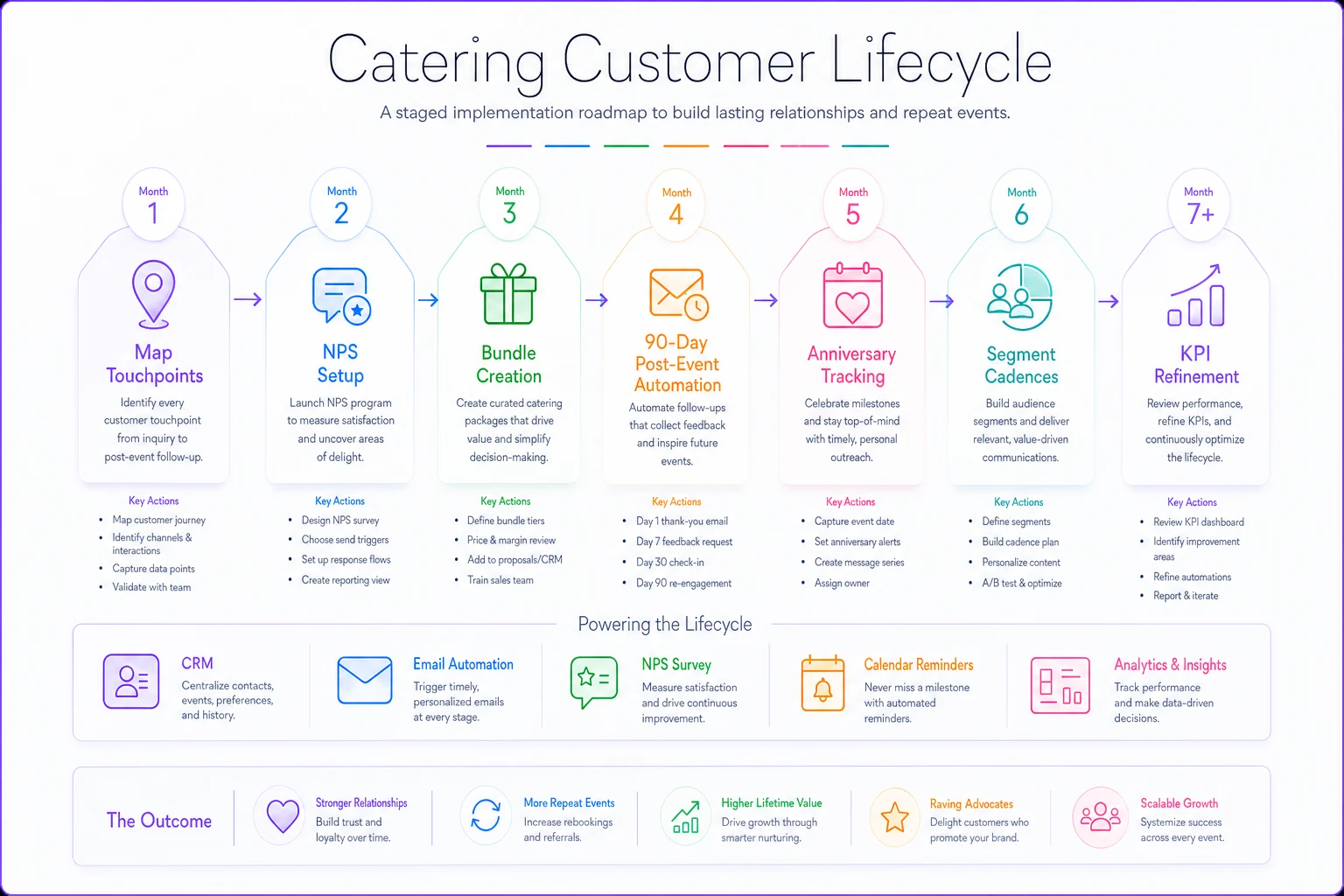
Treat this as a build schedule, not a deadline. Plenty of operations take longer on months two or three because the NPS setup uncovers gaps they hadn't expected. That's fine — moving carefully through those early phases saves a lot of rework later.
Common mistakes that break lifecycle systems
Over-communication in the early phase: One caterer, excited about their new system, sent emails nearly every day for two weeks post-event. Unsubscribe rates climbed fast. Clients want strategic touchpoints, not an inbox takeover.
Under-communication during planning gaps: Three-month gaps between touchpoints feel like abandonment. Clients assume you've forgotten about them and book elsewhere.
Generic messaging to specific segments: Sending "book your holiday party" emails to clients who just held a funeral reception shows you're not paying attention. Segmentation isn't optional.
Margin-blind discounting: Offering the same discount percentage across all packages ignores margin reality. A 20% discount on a thin-margin package can cost you money while the same discount on a higher-margin package stays profitable. You need to know which is which before you offer.
Inconsistent execution across the team: If only some events trigger follow-up sequences, clients experience wildly different service levels. Systematization requires everyone following the same playbook, not just the people who happen to remember.
When lifecycle optimization makes sense (and when it doesn't)
Not every catering operation benefits equally from formal lifecycle management. The investment pays off when:
-
You handle at least 100 events annually (below that, manual touchpoints work fine)
-
Your average event value exceeds $2,500 (lower values can struggle to support touchpoint costs)
-
You serve repeatable client segments (random one-offs don't follow patterns worth systematizing)
-
Your team has basic technical capabilities — someone needs to manage the systems
-
You've already documented core operations, because lifecycle management sits on top of solid execution, not instead of it
Lifecycle optimization might not make sense if you're a specialty caterer handling only large, complex, genuinely unique productions — certain high-end social or corporate events where each client truly is a one-off. Or if you're already at capacity and turning away business. Why optimize retention when you can't handle more volume anyway?
The scaling challenge
As catering operations grow, lifecycle management becomes simultaneously more important and harder to maintain. At 50 events a year, you can remember every client's preferences. At 500 events, you need systems or those relationships quietly evaporate into transactions.
The breakdown usually happens somewhere around 200 events annually. That's when manual follow-up becomes genuinely impossible but the team hasn't yet invested in proper automation. Clients start slipping through cracks. Repeat rates drop. The business starts feeling transactional despite delivering real quality and service.
This is where AI-powered operational platforms provide the most value — maintaining relationship touchpoints at scale so your 500th client gets the same thoughtful follow-up as your 5th. The technology handles the orchestration while your team focuses on the human moments that actually differentiate your service.
Making lifecycle management stick
The caterers who successfully implement lifecycle management tend to share a few characteristics.
They treat touchpoints as operational requirements, not marketing nice-to-haves. Post-event follow-up appears on the same checklist as venue breakdown and final invoicing.
They measure lifecycle KPIs with the same attention they give food cost and labor percentage. Repeat booking rate gets discussed in regular team meetings, not just when someone happens to check.
They connect lifecycle activities to compensation. Service staff earn bonuses tied to NPS scores. Sales reps earn higher commission on repeat bookings than new business. When everyone has skin in the retention game, follow-through improves considerably.
The transformation trajectory
The path from transactional catering to relationship-driven recurring revenue isn't complicated. It's a progression through mapped touchpoints, measured outcomes, and refined execution — built in stages rather than all at once.
Most caterers already have the service quality to earn repeat business. They're just missing the operational framework to actually capture it. Start with NPS surveys and anniversary reminders if nothing else, and the compound effect begins from there.
The caterers still treating each event as a standalone transaction will wonder how you're booking so much business without aggressive marketing. The answer is straightforward: you're not constantly finding new clients, you're keeping the ones you already served. That's the real power of a properly executed catering customer lifecycle.
Ready to elevate your catering business?
Join 500+ caterers trusting Caterngly to save time, reduce errors, and deliver flawless events.