

Most caterers don't lose money on the events they turn down. They lose it on the ones they say yes to too fast.
A 40-person plated dinner three Saturdays from now, in a fourth-floor loft with no service elevator, at a price the client "found cheaper somewhere else" — that's a booking that eats your Saturday crew, your best captain, and probably your margin, while a cleaner 180-guest buffet inquiry sits in your inbox unanswered because everyone's underwater prepping for the loft.
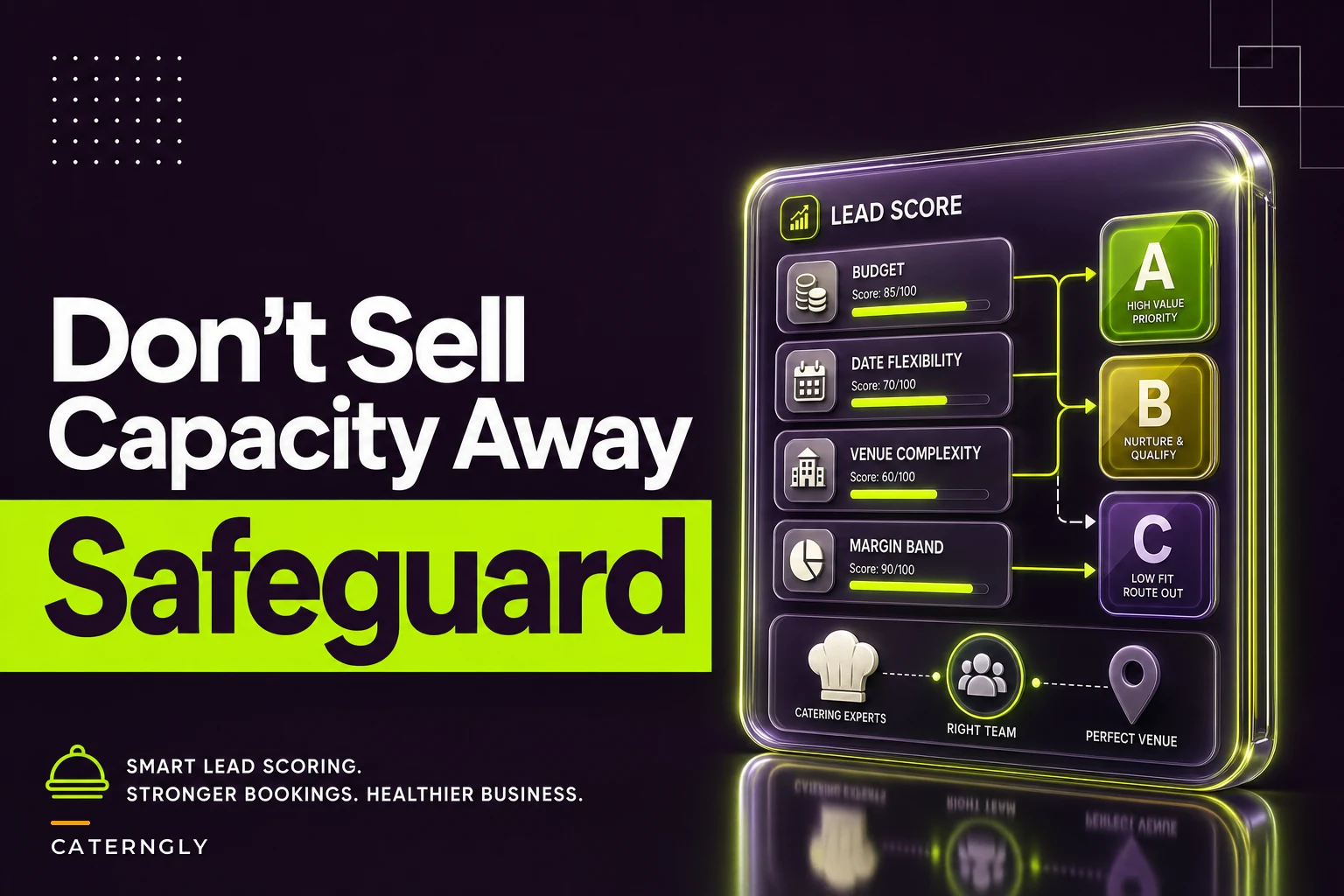
The problem isn't the individual bad deal. It's that most catering shops have no consistent way to tell a good inquiry from a resource sink before they've already invested three hours writing a proposal and gotten emotionally attached to closing it. A catering lead scoring system fixes that — not with gut feel, but with a repeatable scorecard built around the four things that actually predict whether an event will protect or destroy your operational capacity.
The four factors that actually predict operational strain
Everyone scores leads on budget. That's the mistake. Budget alone tells you almost nothing about whether an event will run smoothly. A high-budget event in a nightmare venue with a client who wants to redesign the menu twice a week can be less profitable than a modest buffet in a room with a loading dock.
The shops that protect their margins during peak season score on four dimensions, not one:
1. Budget band. Not just total spend — spend relative to guest count and service style. A $12,000 event for 60 plated guests is a different animal than $12,000 for 200 on a buffet. Score the per-cover budget against your actual cost card for that service type.
2. Date flexibility. This is the factor almost nobody scores, and it's arguably the most important. A client locked into your busiest Saturday costs you the option to take a better event. A client who says "we're flexible on the weekend" is giving you room to slot them where you have slack. Flexibility protects your calendar's ability to absorb high-value work, and that's worth real money.
3. Venue complexity. Loading access, kitchen availability, distance, floor level, power, permits. A venue you've worked before with a dock and a prep kitchen is a 1. A rooftop with a freight elevator that "usually works" and a 45-minute drive is a 5. Venue complexity drives labor hours and risk more than menu ever does.
4. Margin band. Your estimated contribution margin after real labor and food cost, not the sticker price. This is where a lot of shops fool themselves — a big top-line number with a complex venue and an inflexible date can land in a worse margin band than a smaller, cleaner event.
These factors interact. A weak score on one can be rescued by strength on another. An inflexible date is fine if the venue is easy and the margin is strong. A complex venue is manageable if the client is flexible enough that you can staff it on a slower day. The scorecard surfaces those tradeoffs before you commit.
Building the scorecard
Score each factor 1–5, then weight them. The weights matter — this is where you encode what your operation actually cares about.
End chaos with centralized catering management.
Caterngly helps you plan, confirm, and manage every catering event seamlessly.
- Unified event and order management
- Real-time client updates
- Staff and resource scheduling
No credit card required
| Factor | Weight | Score 1 (worst) | Score 3 (neutral) | Score 5 (best) |
|---|---|---|---|---|
| Margin band | ×3 | Below floor margin | At target margin | Well above target |
| Venue complexity | ×2 | Rooftop/no dock/unknown | Known venue, minor friction | Dock + prep kitchen, worked before |
| Date flexibility | ×2 | Locked to peak Saturday | Flexible within a month | Weekday or off-peak, fully open |
| Budget band (per cover) | ×1 | Below cost card | Matches cost card | Premium per cover |
Multiply, sum, and you get a score out of 40. Notice budget carries the least weight. That's deliberate. Budget is what clients lead with; it's the factor you can least trust and the one least connected to whether the event strains your team.
Here's how this plays out with two real inquiries at the same $9,000 budget:
-
Inquiry A 150-guest buffet, known hotel ballroom with a dock, client says any Sunday in October works. Margin lands above target. Score: margin 5×3 + venue 5×2 + date 4×2 + budget 3×1 = 36/40.
-
Inquiry B 70-guest plated, a converted warehouse you've never worked, locked to the second Saturday in October (already your densest weekend), margin just at floor because of the labor. Score: margin 2×3 + venue 2×2 + date 1×2 + budget 4×1 = 16/40.
Same money. Wildly different events. Without the scorecard, both look like "$9k jobs" and get treated identically. With it, you immediately know A gets fast-tracked and B needs a hard conversation about date or price before you spend an hour on a proposal.
Turning scores into tiers
Raw numbers are useless unless they trigger different behavior. Split your scores into three tiers and attach an actual operational response to each.
-
Tier A (30–40)
Fast-track.
These protect capacity. Respond within a few hours, send your premium proposal template, assign a senior estimator. These are the events you want filling your calendar. -
Tier B (18–29)
Qualify hard.
Real potential, but something needs fixing — usually the date or venue logistics. Don't send a proposal until you've run the qualifying script and moved at least one factor up. -
Tier C (below 18)
Redirect or reprice.
Either quote at a premium that makes the complexity worth it, push them to a flexible date, or politely decline. The point isn't to say no to everyone — it's to stop these from silently consuming the hours you owe your Tier A leads.
The pattern worth noticing: most shops treat every inquiry as Tier A by default. Everyone gets a same-day response and a full custom proposal. That's how you end up spending your best proposal-writing hours on your worst events.
Qualifying scripts that move a lead up a tier
A Tier B lead isn't a bad lead. It's a lead with one fixable problem. The job of the qualifying call is to find and fix that problem — usually by trading on date flexibility or clarifying venue realities.
For an inflexible peak date: "That Saturday is one of our most requested dates, so pricing reflects the premium crew we'd staff. If you have any flexibility — even the Sunday, or a Saturday two weeks either side — I can offer meaningfully better pricing and give you our stronger team. Is the date locked, or is there room?"
That single question reclassifies more leads than anything else. Half the time "our date" turns out to be "our preferred date."
For an unknown, complex venue: "Before I put numbers together — has this venue hosted catered events before? I need to confirm loading access, whether there's a prep space on site, and power. If it's a raw space, there's setup labor and equipment we'd need to price in, and I'd rather build that in now than surprise you later."
This does two things: it protects you from a lowball quote you'll regret, and it flags scope early — which ties directly into how you handle change requests once the event is booked. Worth having your change-order workflow ready before you even sign.
For a below-floor budget: "I can absolutely work within that number — here's what it looks like at that price point [simpler menu, buffet vs plated, reduced staff]. Or if the full plated experience is what you want, here's where that lands. Which direction fits better?"
Never negotiate against yourself. Give them the version their budget actually buys.
That single question reclassifies more leads than anything else.
Worth having your change-order workflow ready before you even sign.
Auto-routing: getting the right lead to the right person fast
Scoring is only half the value. The other half is what happens automatically once a lead is scored, so nothing sits in limbo.
-
Inquiry comes in through the web form, email, or phone intake. The four scoring inputs get captured at intake — guest count, service style, date, venue, budget.
-
Score calculates from those inputs.
-
Tier A routes immediately to a senior estimator with a "respond today" flag and the premium proposal template pre-loaded.
-
Tier B routes to a coordinator with the qualifying script attached and a note on which factor is dragging the score down, so the call has a purpose.
-
Tier C routes to a queue with a repricing template or a polite-decline template, depending on how far below threshold it fell.
-
Every lead gets a timestamp, so nothing older than 24 hours goes un-actioned regardless of tier.
The failure this prevents is the quiet one: a Tier A inquiry landing in a shared inbox on a busy Friday and getting buried under three Tier C tire-kickers who happened to email first. First-in-first-out is the wrong order for catering. Best-lead-first is the right one.
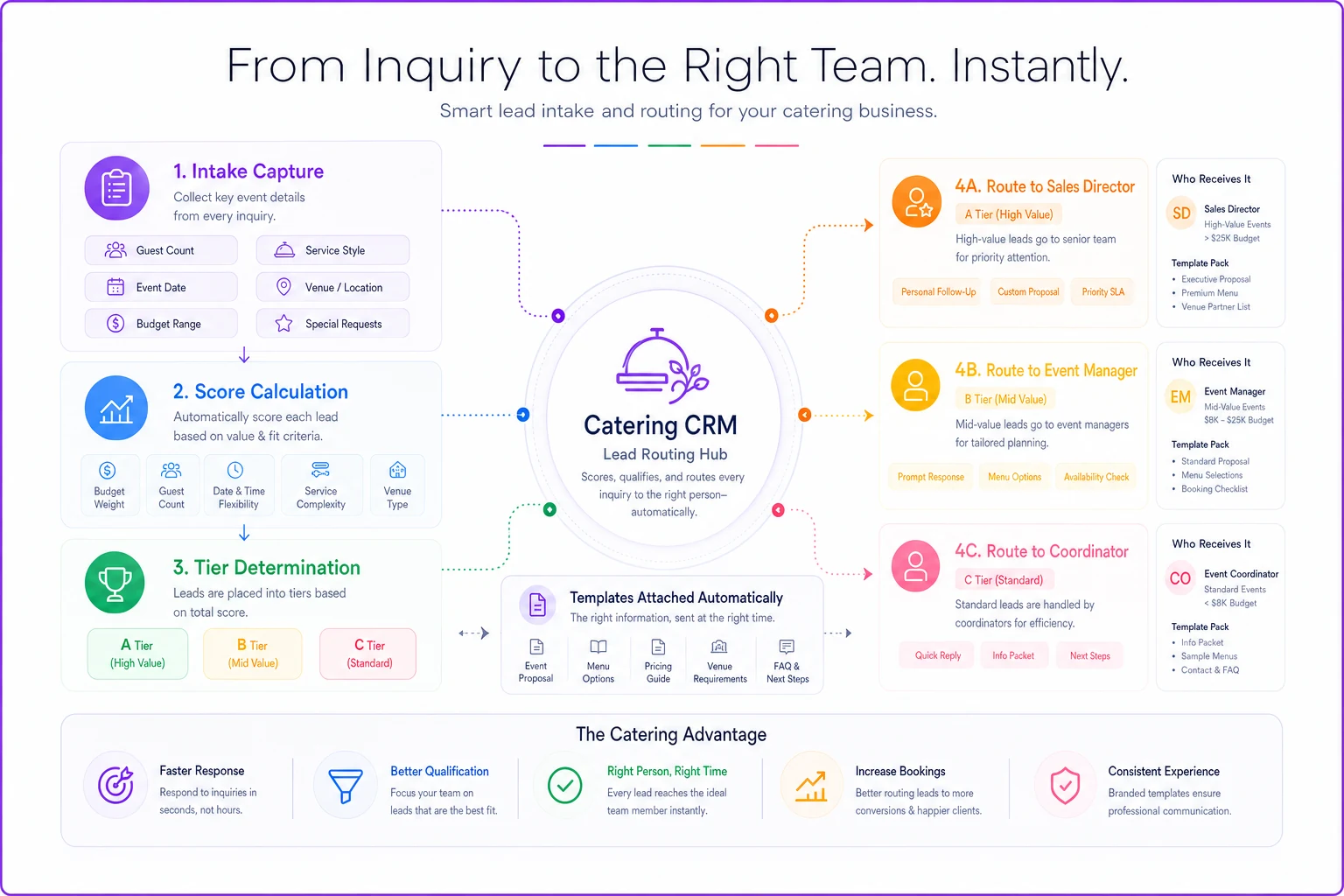
This diagram shows how intake maps to score and then to routing rules so leads reach the right person fast.
This is exactly the kind of rules-based routing that operational software with light AI automation handles well — reading the intake, calculating the score, and pushing each lead to the right person with the right template attached, so your team spends their judgment on the qualifying conversation instead of on triage. The software isn't making the call for you; it's making sure the call reaches the right hands before the lead goes cold.
Proposal templates by tier
Sending the same proposal to every tier wastes your best material. Match the proposal effort to the score.
-
Tier A → premium custom proposal. Full menu design, tasting invitation, service narrative, photos. These clients are worth the hours, and the polish converts them.
-
Tier B → conditional proposal. Priced after qualifying, with the improved factor baked in ("as discussed, pricing reflects the flexible Sunday date"). Cleaner and faster than a full custom build.
-
Tier C → templated quote at premium. A standard package with complexity surcharges clearly itemized. No custom design hours. If they say yes at that price, the event is now worth doing. If they walk, you lost fifteen minutes, not three hours.
One thing worth building into every tier: clear deposit and payment terms tied to how much operational risk the event carries. A complex Tier C event that you did decide to take should carry a firmer deposit schedule — the terms in your deposit and cancellation structure should scale with the risk the scorecard just measured.
A real scenario
A mid-sized catering shop doing roughly 120–140 events a year kept running into the same August crunch: crew maxed out, quality slipping on the big weekends, margins flat. When they looked back at what was actually filling those peak dates, it was mostly small, complex, inflexible events that had arrived first and gotten booked on autopilot.
They put the four-factor scorecard in place before the fall season. Nothing fancy — a shared scoring sheet at intake and three routing rules. Over the next few months, roughly one in five inquiries that would have been booked immediately got flagged Tier C and either repriced with a complexity surcharge or declined. A handful of Tier B leads shifted their dates off peak Saturdays once the qualifying script offered better pricing for flexibility.
The result wasn't a dramatic revenue jump. It was fewer events for slightly more total margin, and a peak season that stopped feeling like a fire drill. Their captains stopped getting the impossible loft jobs. And because Tier A leads now got same-day responses, their close rate on the events they actually wanted went up noticeably.
The quiet win: they turned down more work and made more money doing it.
When this makes sense — and when it doesn't
This works well when you're regularly running near capacity during peak periods, turning down or fumbling good inquiries because bad ones got booked first, or you genuinely can't explain why a busy month produced a thin margin. If you have more demand than crew, scoring is how you allocate that scarce crew to the right events.
It's overkill when you're still building demand and every booking genuinely matters to keep the lights on. If you're taking every event because you need every event, don't spend energy scoring — spend it selling. Scoring is a tool for shops with a demand surplus, not a demand shortage.
One more thing: don't use the scorecard as an excuse to get rigid or dismissive with clients. The point isn't to slam the door on Tier C — it's to price and route them intelligently. A Tier C lead this year can become a repeat Tier A client next year if you handle the decline well. How you treat the events you don't take feeds directly into your longer-term client lifecycle and repeat-revenue strategy.
Getting started
You don't need software to start. Build the scorecard in a spreadsheet, run your last 20 inquiries through it retroactively, and see whether the scores match how those events actually went. They usually do — the events your team remembers as painful almost always score low, which is the whole proof of concept.
Once you trust the scoring, the natural next step is automating the intake capture and routing so scores calculate the moment an inquiry lands and each lead reaches the right person with the right template. That's where operational software earns its keep — not by deciding which events to take, but by making sure your best judgment gets applied to the right leads fast, before capacity quietly gets sold away to the wrong ones.
The shops that survive their busy seasons aren't the ones that book the most. They're the ones that book the right mix. A scorecard is just the discipline that makes "the right mix" something you can actually decide on purpose, instead of whatever happened to email you first.
Ready to elevate your catering business?
Join 500+ caterers trusting Caterngly to save time, reduce errors, and deliver flawless events.