

The one-off wedding pays well and disappears. The corporate account is different. It shows up every Tuesday and Thursday, it wants the same sandwich platters at the same time, and it will quietly renegotiate its expectations every quarter without telling you. Most caterers who land their first big recurring account discover, about four months in, that the thing generating the most revenue is also the thing draining the most attention — and nobody on the team can say exactly why.
That gap between "we have a great account" and "this account is barely profitable" is almost always an operating-model problem, not a sales problem. You sold it fine. You just never built the machinery to run it. An enterprise catering account playbook is that machinery: the onboarding checklist, the service tiers, the pricing logic, the way you handle it when something goes wrong, and the monthly numbers you actually look at.
This isn't about winning bigger contracts. It's about the operational scaffolding that keeps a recurring account from slowly eating your margins while everyone's too busy to notice.
Why recurring corporate accounts break differently than events
A single event has a start and an end. You quote it, you deliver it, you reconcile it, you move on. Mistakes stay contained inside that one job.
A recurring account never closes. That's the whole problem. Errors compound instead of resolving. If your portioning runs 8% over on a standing weekly lunch, that's not a one-time hit — it's the same leak repeating 50 times a year. If billing terms drift because a client contact "just this once" asked for a same-day add-on, that becomes the new normal by month three.
What tends to happen across a lot of catering operations is that the account starts profitable and erodes on a predictable curve. The first few deliveries are tight and well-run because everyone's paying attention. Then familiarity sets in. Setup gets sloppier because "they know us now." Add-ons stop getting logged. The single point of contact on your side gets pulled onto a wedding and someone new fields the client's Thursday email without knowing the account's history. Six weeks later you're absorbing costs nobody approved.
The other thing that breaks: there's no owner. One-off events have a clear lead. Recurring accounts get treated like ambient work — everybody touches them, nobody owns the P&L. That single organizational gap causes most of the damage.
Onboarding: the two weeks that decide the next two years
The way you onboard a corporate account determines whether it runs itself or drains you. Rushed onboarding — "great, we start Monday!" — is where the profit leaks are born, because you skip the boring parts that would have protected you.
End chaos with centralized catering management.
Caterngly helps you plan, confirm, and manage every catering event seamlessly.
- Unified event and order management
- Real-time client updates
- Staff and resource scheduling
No credit card required
Here's the onboarding checklist that actually matters, not the friendly kickoff-call version:
-
Named account owner assigned on your side, with backup coverage explicitly documented
-
Single client-side decision maker identified — who can approve add-ons, who can't, and who pays invoices (often three different people)
-
Standing order baseline locked — exact headcounts, delivery windows, dietary breakdown, packaging expectations, dock/access instructions
-
Change-request path defined — how add-ons and last-minute changes get submitted, approved, and priced before they hit the kitchen
-
SLA tier confirmed in writing, including what happens when the client misses their own deadlines
-
Billing cadence and payment terms set with a real due date, not "net whenever"
-
Cost card built for the standing menu so you have a baseline to measure drift against
-
First-30-days review scheduled before the contract even starts
That last item gets skipped constantly and it's the most valuable. A scheduled 30-day review turns "the account feels off" into a structured checkpoint where you catch scope creep while it's still fixable.
Schedule the 30-day review before the contract starts to catch scope creep early.
One pattern worth flagging: corporate clients almost always underestimate their own variability. They'll tell you "same order every week." Then week two has a board meeting, week four has a client visit, week five someone's on a gluten-free kick. Your onboarding needs to assume variability is coming and build the change path before you need it — not scramble the first time they ask.
SLA tiers: stop giving premium service at a standard price
The most common enterprise-account mistake is offering one level of service to everyone and pricing it like it's simple. Recurring clients have wildly different needs. A law firm that wants hot plated lunches with staff on-site is a fundamentally different operation than an office ordering drop-off bagels.
Defining SLA tiers does two things. It tells your team exactly what a given account is entitled to, and it gives you a pricing structure that reflects real cost. Here's a workable three-tier framework:
| Dimension | Tier 1: Drop-off | Tier 2: Setup & service | Tier 3: Managed on-site |
|---|---|---|---|
| Delivery | Scheduled window, no setup | Setup + display, breakdown later | Full setup, on-site staff, breakdown |
| Change cutoff | 48 hours | 24 hours | 12 hours |
| On-site staff | None | Optional, billed | Included |
| Response to issues | Next business day | Same day | Real-time, on-site |
| Substitution handling | Client notified | Client approval sought | Managed live, logged |
| Typical margin target | 28–34% | 24–30% | 20–26% |
Notice the margin targets get thinner as service intensifies. That's counterintuitive to a lot of owners who assume higher-touch means higher-margin. In practice, on-site labor and real-time responsiveness are expensive and hard to fully price in. Tier 3 accounts feel prestigious and often run the tightest — which is exactly why they need the closest monitoring.
The tier assignment should be explicit in the account file. When a Tier 1 client starts asking for Tier 2 behavior — "can you just set it out nicely this once?" — that's a tier-upgrade conversation, not a free favor. Without documented tiers, your team has no basis to say no or to charge for it.
Pricing bands: the number that protects you from your own kindness
Recurring accounts erode on price the same way they erode on service. The standing rate gets locked at signing and then never revisited while your food costs climb. Twelve months later you're delivering the same platter at the same price against a cost base that's moved 6–9%.
Pricing bands solve this. Instead of a single fixed price, you set a band with a floor, a target, and a trigger point where the price automatically gets renegotiated. A worked example:
-
Standing weekly lunch, 40 covers, Tier 2
-
Cost card baseline
around $14.20 per cover in food and packaging
-
Target sell
$28 per cover → roughly 27% margin after allocated labor and overhead
-
Floor $25 per cover (never go below without owner sign-off)
-
Recalibration trigger when food cost per cover moves more than 5% from baseline, or at the contract's quarterly review — whichever comes first
The band gives your account owner room to handle a slow month or a competitive squeeze without quietly signing away your margin. And the trigger means price reviews happen on a schedule instead of never. Building this properly connects directly to how you structure your per-event P&L and margin bands — the account is just a rolling series of those P&Ls stacked together.
The mistake to avoid: treating the corporate rate as sacred because you're afraid of losing the account. Clients renegotiate you constantly. A quarterly, contractually-agreed price review is normal in corporate procurement. They're often more surprised when you don't have one.
Mapping the account into event-level P&Ls
This is where the whole system either holds together or falls apart. An enterprise account is not one big number — it's dozens of small events, each of which needs its own P&L so you can see which deliveries make money and which don't.
Here's how a recurring account decomposes:
-
Break the account into its recurring event units — each weekly lunch, each standing breakfast, each monthly all-hands is its own P&L line.
-
Assign the cost card for that event's menu, updated when procurement costs shift.
-
Allocate labor using your staffing template for that tier (more on this below).
-
Attribute shared costs — delivery routing, packaging, admin overhead — on a per-event basis, not lumped at the account level.
-
Log every add-on and change against the specific event it belongs to, priced at the change-order rate.
-
Roll the events up to an account-level view once a month.
The reason this matters: account-level averaging hides losers. An account might show a healthy blended 26% margin while its Friday deliveries are actually running at 14% because that's when the client always adds last-minute headcount you never charge for. You can't see that until you're looking at events individually.
| Event | Covers | Revenue | Food+pkg | Labor | Allocated OH | Margin |
|---|---|---|---|---|---|---|
| Mon breakfast | 30 | $540 | $168 | $90 | $70 | ~39% |
| Tue lunch | 40 | $1,120 | $568 | $210 | $95 | ~22% |
| Thu lunch | 40 | $1,120 | $584 | $230 | $95 | ~19% |
| Fri lunch + adds | 45 | $1,180 | $690 | $260 | $100 | ~11% |
Same account, same client, and the Friday delivery is barely breaking even because of unbilled add-ons and the higher labor cost of a Friday scramble. Without event-level P&Ls, this account looks fine. With them, you know exactly which conversation to have.
The event-level view is also what gives you something concrete to bring to quarterly reviews — not "we need to talk about margins" but "here's what Fridays actually cost us, and here's what we're proposing to do about it."
Staffing templates that hold up week after week
One-off events get custom-staffed. Recurring accounts should be templated, because the whole point of recurring work is that it's predictable. If you're rebuilding the staffing plan from scratch every week, you've turned a stable account into 50 mini-projects.
A staffing template ties to the SLA tier and the cover count. For the Tier 2, 40-cover lunch above:
-
1 lead / driver (loads, delivers, sets up, primary client contact)
-
1 setup assistant on higher-cover days (35+ covers)
-
Prep labor allocated from the kitchen's batch time, not counted per-delivery
-
Breakdown handled on the return trip or by client per agreement
The template locks the ratio, so scheduling becomes mechanical: cover count and tier in, staff plan out. This is also what keeps overtime from creeping — when the template is the default, adding a person becomes a deliberate decision instead of a habit.
The failure pattern here is understaffing the "easy" recurring account because it feels routine, then having deliveries run late because one driver can't set up 45 covers alone in the window. Late setup on a corporate account hits harder than on a wedding — the client's whole office is standing around a table that isn't ready, and that story travels. Predictable accounts deserve more discipline in staffing, not less, precisely because a slip becomes a repeated slip.
Billing workflows: where recurring revenue quietly leaks
Billing is where corporate accounts lose money without anyone touching the food. Two big leaks:
Unbilled add-ons. The client adds 8 covers Thursday morning. The kitchen makes them. Nobody logs it against the invoice. Multiply by a year and that's real money walking out the door.
Slow, inconsistent invoicing. One-off events get invoiced immediately because they're front-of-mind. Recurring accounts get batched "at month end" and then someone forgets which weeks had changes. Corporate AP departments are slow enough on their own — you don't need to add ambiguity on top of that.
A clean recurring billing workflow looks like this: every change request goes through the defined path and gets priced at submission, not after delivery. Each event's actuals — base order plus logged changes — get captured at delivery. Invoices go out on a fixed cadence with change-orders itemized so the client's AP team can reconcile them without emailing you back. Payment terms have a real due date and a follow-up trigger if it's missed.
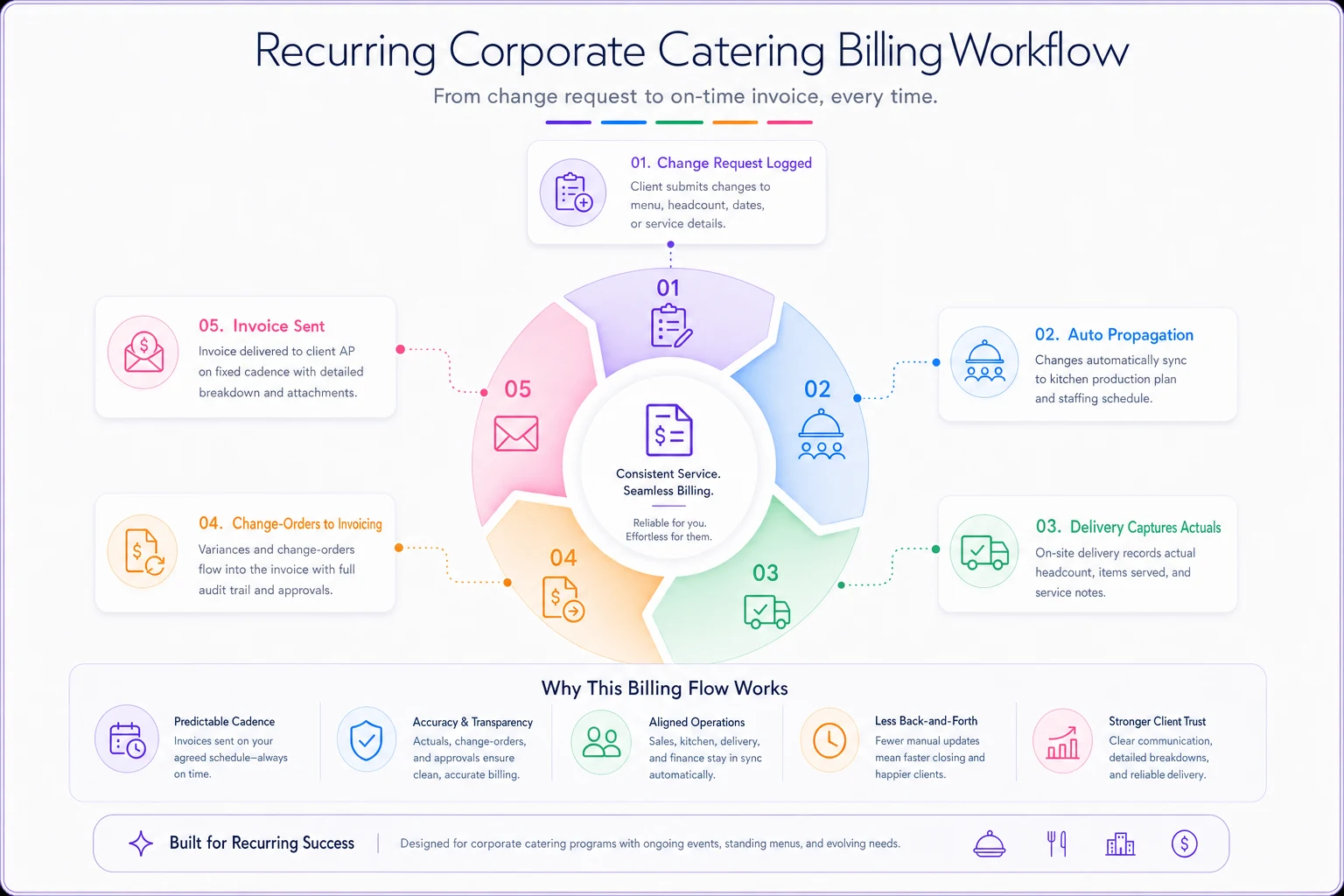
Here's a simple visual of that workflow.
The connective tissue between the kitchen, the delivery team, and billing is where this usually falls down — the change happened, the food went out, but the information never reached whoever cuts the invoice. This is exactly the kind of coordination gap where a shared operational platform earns its keep: when an add-on gets logged once at the point of request and flows automatically into both the staffing plan and the invoice, the leak closes itself. The value isn't the software being clever — it's that the same piece of information doesn't have to be re-entered by three people who might each drop it.
The monthly KPI pack
Every recurring account should generate a one-page monthly review. Not a dashboard nobody opens — a deliberate monthly walkthrough the account owner actually does. The metrics that tell you something real:
-
Margin by event type (not just account blended) — catches the Friday-style losers
-
On-time delivery rate — the leading indicator of client churn on corporate accounts
-
Change-order volume and capture rate — how many add-ons happened vs. how many got billed
-
Food cost per cover vs. cost-card baseline — flags when it's time to hit the pricing trigger
-
Labor hours vs. template — catches quiet overstaffing or overtime creep
-
Client-side satisfaction signal — even a quick note from the on-site lead counts
The capture rate metric is the one most operators have never measured and the one that surprises them most. When you finally count how many add-ons got billed versus made, the answer is rarely 100% — and closing that gap is often the fastest margin win available on a recurring account, because the revenue already exists, you're just failing to collect it.
When a recurring corporate account is actually a bad idea
Not every recurring account is worth having. Turn one down — or price it high enough to walk away — when:
-
The delivery window is impossibly tight and overlaps your peak event days, forcing overtime every week
-
The client refuses any price-review mechanism, locking you into today's food costs indefinitely
-
The change behavior is chaotic and they won't respect a change-cutoff, meaning you can never staff or price it reliably
-
The volume is high but the margin band forces you under your floor to win it
A high-revenue account running at 9% while consuming your best staff every week is worse than no account. It ties up capacity you could sell at better margins elsewhere — which is really a question of protecting your operational bandwidth, the same logic behind having a proper lead-scoring and proposal-routing system so you don't sell away capacity you'll wish you had.
A real scenario
A mid-size caterer picked up a standing account with a professional-services firm — roughly four deliveries a week, around $4,500 in weekly revenue. On paper it looked like a solid win, and for the first quarter nobody questioned it.
By month five the owner noticed the account's blended margin had drifted from the mid-20s down toward 15%. Digging in, two things surfaced: Friday deliveries were routinely running larger than ordered because the client added headcount that never made it onto an invoice, and the standing price hadn't moved while protein costs had climbed noticeably.
The fixes weren't dramatic. They rebuilt the account into event-level P&Ls, which immediately exposed the Friday leak. They introduced a change-order cutoff and started logging every add-on at the point of request. At the next quarterly review they triggered a modest price adjustment the client accepted without pushback — corporate procurement expected it.
Nothing about the food or the service changed. Within about two months the account was back into the low-to-mid 20s on margin, and the Friday deliveries went from the worst-performing to roughly in line with the rest of the week. The account didn't need to be bigger. It needed to be run.
The bigger picture
A recurring corporate account is the closest thing catering has to predictable, compounding revenue — which is exactly why it deserves an operating model instead of goodwill and memory. The onboarding decides your leverage. The SLA tiers protect your team from unpriced expectations. The pricing bands protect you from your own reluctance to renegotiate. The event-level P&Ls keep the losers from hiding inside the winners. The monthly review keeps the whole thing honest.
Do this well and the same discipline turns single wins into durable relationships — the same lifecycle thinking behind turning one-off clients into repeat revenue, just applied to an account that already renews. The caterers who scale cleanly aren't the ones landing the most accounts. They're the ones whose accounts run themselves because the machinery was built before it was needed.
Ready to elevate your catering business?
Join 500+ caterers trusting Caterngly to save time, reduce errors, and deliver flawless events.