


Most caterers price food. Smart ones price dates.
The difference sounds academic until you look at what actually happens in a busy October. A Saturday in peak wedding season is not the same unit of inventory as a Tuesday in February, and yet a huge number of operations quote both the same way — menu cost plus labor plus a markup, same deposit terms, same acceptance logic. That's the equivalent of a hotel charging the same rate for a room on New Year's Eve as on a random Wednesday in March. Hotels figured this out decades ago. Catering, for the most part, still hasn't.
This article is about building a yield management layer on top of your existing pricing. Not a replacement for your cost cards — a system that sits above them and decides which bookings you let onto the calendar in the first place, and at what price, given that your real constraint isn't food. It's dates.
The constraint most caterers refuse to name
Food scales. You can always buy more protein. Staff scales too, within reason — you can pull in casuals, lean on a staffing agency, stretch a shift. What does not scale is the number of premium Saturdays in your region's wedding and corporate season.
In most markets, the high-value window is brutally concentrated. Roughly 18–22 Saturdays a year carry the weight of the entire wedding calendar, and maybe another handful of corporate-heavy Thursdays and Fridays in Q4 do the same on the corporate side. Everything else is shoulder season or dead weight. So when someone says "we're fully booked," what they usually mean is "we sold our 20 good dates" — and the quality of how they sold them determines whether the year was great or merely busy.
Worth internalizing: a fully booked peak calendar can still be a badly run one. Operations hit 95% weekend utilization in season and finish the year with thinner margins than a competitor who booked fewer events. The reason is almost always the same — they filled their scarce dates on a first-come basis, took whatever walked in during February for a September Saturday, then had to turn away higher-value work in July because the date was already gone.
That's the core failure. Treating dates as first-come inventory instead of yield-managed inventory.
Date-cap math: how many premium slots do you actually have?
Before you can manage yield, you need to know your true capacity ceiling per date — not your optimistic one.
End chaos with centralized catering management.
Caterngly helps you plan, confirm, and manage every catering event seamlessly.
- Unified event and order management
- Real-time client updates
- Staff and resource scheduling
No credit card required
-
Kitchen throughput — how many covers your prep capacity can produce to standard on one day
-
Staff availability — how many trained bodies you can field for simultaneous events without quality collapse
-
Logistics — vehicles, hot-holding equipment, and the geographic spread of venues
Your real date cap is whichever of these hits the wall first. And the mistake almost everyone makes is calculating each in isolation. Kitchen says it can do 600 covers. Scheduling says it can field three crews. Logistics says it has two trucks. The actual cap is set by the two-truck constraint, not the 600 covers — and if you booked to the kitchen number, you oversold.
A clean way to express the cap:
| Date tier | Max simultaneous events | Max total covers | Min contribution per date |
|---|---|---|---|
| Peak Saturday (wedding season) | 2 | 350 | $9,000+ |
| Peak Fri/Thu (corporate Q4) | 3 | 500 | $7,500+ |
| Shoulder weekend | 3 | 450 | $4,000+ |
| Weekday / off-season | 4+ | — | opportunistic |
The "min contribution per date" column is the part that actually changes behavior. That number is your floor — below it, you don't take the booking even if you have capacity, because accepting it burns a scarce slot that could carry a larger event. This is the single discipline that separates yield management from just being busy.
Run the math on your own calendar. Multiply your premium Saturdays by your date cap in covers, then by your target contribution floor. That number is your season's structural revenue ceiling. Most owners have never calculated it, which is why they can't tell whether a given year was a good use of their inventory or just a lucky one.
Deposit premiums: pricing the date, not just the plate
Once you accept that peak dates are scarce, the deposit structure should reflect it. A deposit isn't just cashflow protection — it's a signal of how seriously the date is being held, and a lever for pricing scarcity.
The standard approach treats deposits as a flat percentage. A better approach charges a date premium that rises with the scarcity of the slot. When you hold a peak Saturday for a client, you're taking it off the market. If they cancel in July for a September date, you may never resell it at full value. The premium compensates for that risk and quietly filters out tire-kickers.
-
Off-season weekday standard deposit, say 25%, standard terms
-
Shoulder weekend 35% deposit, non-refundable portion kicks in earlier
-
Peak Saturday 40–50% deposit, with a larger non-refundable core and a date-hold premium baked into the contract
A worked example. Two inquiries both want a 150-cover event. One wants a Tuesday in March; the other wants the second Saturday in October. Same menu, same headcount. Under flat pricing you'd quote them nearly identically. Under date-premium pricing, the October booking carries a higher per-cover price and a heavier deposit — because that Saturday is one of maybe 20 you'll ever sell. The client who genuinely wants that date pays for its scarcity. The one who's just shopping walks, which is exactly what you want, because they were going to tie up the slot and possibly cancel anyway.
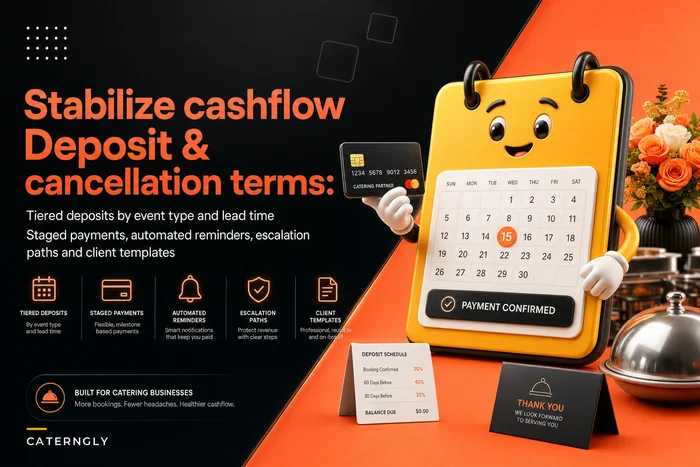
The mechanics of how deposits, non-refundable cores, and cancellation windows fit together deserve their own treatment — we've gone deep on that in the piece on deposit, payment schedule and cancellation terms that stabilize catering cashflow. For yield purposes, the key idea is simpler: the deposit should scale with how irreplaceable the date is, not just the size of the invoice.
Contribution per labor hour, by channel
This is where yield management gets sharp. Not all revenue is equal, and the usual metrics — gross revenue, even gross margin percent — hide the thing that actually constrains you on a peak date: labor.
The metric that matters is contribution per labor hour by channel. Take an event's contribution (revenue minus direct food and direct variable costs), divide by the total labor hours it consumes end to end — prep, transport, setup, service, breakdown. Then compare channels.
| Channel | Contribution per event | Labor hours consumed | Contribution per labor hour |
|---|---|---|---|
| Full-service wedding | $8,500 | ~160 | ~$53 |
| Corporate plated dinner | $5,200 | ~70 | ~$74 |
| Corporate drop-off / boxed | $1,400 | ~12 | ~$117 |
| Social/private party | $2,800 | ~55 | ~$51 |
Look at what this reveals. The wedding has the biggest headline number and eats the most labor — and on a date-constrained basis, it earns among the lowest return per hour. The humble corporate drop-off, which nobody brags about at industry dinners, throws off the highest contribution per labor hour by a wide margin because it barely touches your scarce service staff.
This doesn't mean drop off everything. It means your channel decisions should be made with this number in front of you. On a saturated peak Saturday where labor is the binding constraint, you want the mix of events that maximizes total contribution within your labor ceiling — which sometimes means one big wedding plus a couple of drop-offs beats two weddings that blow your staffing budget into overtime.
Track contribution per labor hour by channel weekly in the lead-up to peak season so your priority-queue scoring reflects recent channel shifts.
We've laid out the broader framework for balancing these revenue streams in the catering channel-mix portfolio strategy to protect capacity and margins. Contribution per labor hour is the number that should drive those portfolio choices, especially once you're running multiple events per date.
A common mistake: operations track contribution per event and optimize for it. They chase the big weddings and feel good about the revenue. Then they look at year-end and wonder why margins are flat despite a record calendar. The answer is sitting in the labor-hour column — they sold their best dates to their worst per-hour work.
Priority-queue mechanics for inquiries
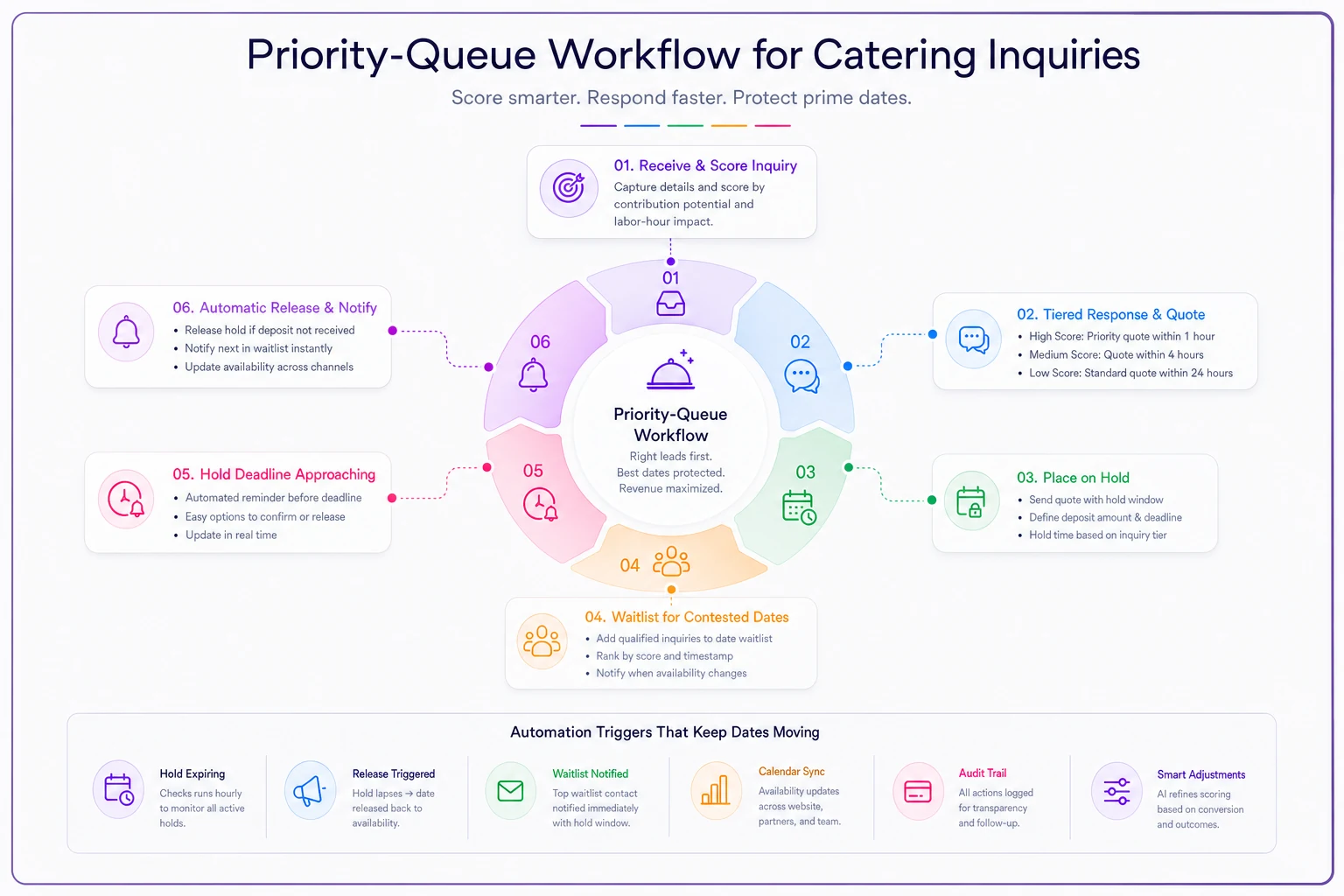
If dates are scarce and you're pricing them for scarcity, you also need a system for who gets the date when multiple inquiries overlap. This is where a priority queue comes in.
The failure mode here is depressingly common: whoever signs first gets the date. That sounds fair until you realize it systematically rewards speed over value. The couple who booked their September wedding eighteen months out, before you understood the season's demand, locks up a premium slot at last year's pricing — and when a higher-value corporate account comes calling in spring, the date's already gone.
-
Score the inquiry on contribution potential, contribution per labor hour, strategic value (repeat client, referral source, corporate account), and date scarcity.
-
Tier the response — high-score inquiries for peak dates get a fast, confident quote; low-score inquiries for peak dates get a quote at or above your contribution floor, no discounting.
-
Hold windows, not open-ended options. A tentative peak date is held for a defined window — five to seven days — with a deposit deadline. No deposit, no hold. The slot re-enters the queue automatically.
-
Waitlist the near-misses. When two strong inquiries want the same peak Saturday, the second goes on a priority waitlist. If the first lets their hold window lapse, the waitlisted client gets contacted immediately — and they already know they're second in line, which tends to accelerate their decision.
-
Release stale holds without guilt. Every soft hold that isn't converting is a scarce date sitting idle. Build a hard rule for releasing them and enforce it mechanically, not emotionally.
The waitlist mechanic is underused and genuinely powerful during peak season. When demand outstrips your date cap, you're not losing those inquiries — you're sequencing them. The goal is to never have a premium Saturday go unbooked because the lead-value client dithered while you politely waited.
Where operational tooling quietly helps
Scoring every inquiry by contribution potential and labor-hour impact, tracking hold windows, releasing stale holds, firing waitlist notifications the moment a date frees up — that's a lot of coordination to run off a spreadsheet and memory, especially mid-season when inquiries are stacking up. This is exactly the kind of repetitive, rules-based work where an AI-powered operational platform earns its keep: flagging when an inquiry falls below your contribution floor for a given date tier, surfacing the waitlisted client the instant a hold lapses, keeping your date-cap math current as bookings land. The judgment stays with you. The bookkeeping and the nudges don't have to.
Here's a simple workflow visualization of the priority-queue process.
The judgment stays with you. The bookkeeping and the nudges don't have to.
Seasonality: different rules for different windows
A yield system that runs the same rules year-round isn't a yield system. The whole point is that scarcity shifts by season, and your acceptance logic should shift with it.
Peak wedding season (your 18–22 premium Saturdays): Maximum discipline. Enforce contribution floors hard. No discounting, no flat deposits, aggressive hold-window enforcement, active waitlisting. This is when you protect inventory most fiercely.
Corporate Q4 crunch: Different shape entirely. Corporate demand clusters on weekday evenings and often books with shorter lead times. The constraint is frequently staff rather than dates, since you may run multiple events in a single evening. The priority queue should weight contribution per labor hour heavily here — pack the date efficiently rather than holding out for a single large event.
Shoulder season: Loosen the floors. Scarcity is lower, so the cost of accepting a modest event is lower. This is the window to take relationship-building bookings, repeat clients, and work that keeps the team sharp and the kitchen moving.
Off-season: Opportunistic. Take almost anything that covers variable cost and contributes something, because the alternative is an idle date earning nothing. The drop-off and boxed-meal channel shines here precisely because it fills otherwise-empty capacity at a high contribution per labor hour.
The mistake to avoid is letting off-season habits bleed into peak season. Operations that spend most of the year in "take whatever we can get" mode build a reflex that costs them dearly in October — they discount a premium Saturday out of muscle memory because that's how they've been quoting since February.
When yield management is overkill — and when it isn't
This system isn't free. It adds friction to your sales process, and for some operations that friction isn't worth it.
It makes sense when: your peak dates are genuinely oversubscribed — you're turning away work on premium Saturdays — and your event values vary enough that which booking takes a date materially affects the year. If you're routinely choosing between inquiries for the same date, you need this.
It's premature when: you're not yet filling your peak calendar. If your best Saturdays still have gaps, your problem is demand generation, not yield management. Adding contribution floors and hold-window enforcement to a calendar that isn't full will just cost you bookings you needed.
Who should probably skip it: very small operations running one event per weekend with a narrow, consistent event type. If every booking looks roughly the same and you're not supply-constrained, the overhead of scoring and tiering won't pay for itself. Revisit when you start saying no to work on your best dates.
A short real scenario
A mid-sized caterer running weddings and corporate work — roughly 90–100 events a year, a core team of around a dozen plus casuals — kept finishing peak season exhausted and only modestly profitable. Their calendar hit about 90% weekend utilization in season, which felt like success.
When they broke down the numbers, the issue was obvious. Their premium Saturdays were going to whoever booked first, often at flat deposits and last year's prices. Several prime dates carried mid-value social events booked a year ahead, while higher-value corporate and wedding inquiries got turned away in spring because the dates were already gone to lower-contribution work.
They introduced three changes: a contribution floor per date tier, a date-scaled deposit premium on peak Saturdays, and a priority waitlist for contested dates. Nothing exotic. The first season under the new rules, total events were actually slightly lower — but peak-date contribution rose meaningfully, overtime dropped because the team stopped cramming two labor-heavy weddings onto a single Saturday, and the waitlist converted a handful of dates that would otherwise have gone to the first mediocre inquiry. The year finished a noticeable step ahead on margin despite doing fewer jobs overall.
The lesson wasn't "do more." It was "be deliberate about which work gets your scarce dates."
How this connects to the rest of the operation
Yield management doesn't live in a vacuum — it's the front end of your cashflow and capacity planning. The deposits your date-premium structure generates feed directly into your forecasting, and the lead times by season shape when that cash actually lands. If you're building out the financial side of this, the three-horizon event-driven cashflow model for caterers shows how deposits, lead times, and event density roll up into forecasts you can actually plan against. Yield management decides which events fill the calendar; the cashflow model tells you what that calendar is worth and when.
The broader point is that revenue operations for a caterer is a loop, not a line. Date caps set capacity. Contribution per labor hour tells you what mix maximizes that capacity. The priority queue decides who gets in. Deposit premiums price the scarcity and protect the cash. Seasonality tunes the strictness of all of it. Break any one piece and the others leak — oversell the date cap and your labor math collapses; ignore contribution per labor hour and you fill scarce dates with low-return work; skip the queue and first-come logic quietly gives your best inventory away.
The caterers who get this right aren't the busiest ones. They're the ones who treat 20 Saturdays a year like the finite, appreciating inventory they actually are — and build the rules to protect them before the season starts, not after it's gone.
Yield management decides which events fill the calendar; the cashflow model tells you what that calendar is worth and when.
Ready to elevate your catering business?
Join 500+ caterers trusting Caterngly to save time, reduce errors, and deliver flawless events.