

Most caterers measure client happiness the same way they measure the weather: they notice it after the fact, comment on it, and move on. A great review lands and everyone feels good. A rough post-event email circulates internally, someone apologizes, and the moment passes. Nothing structural changes. Two months later the same problem shows up at a different venue with a different crew.
That's the gap. Sentiment data — NPS scores, post-event surveys, the offhand comment a planner makes to your site lead — rarely connects to the parts of your operation that could actually prevent the next miss. The feedback lives in one world (client relations, sales, whoever reads the survey inbox) and the fixes live in another (ops, kitchen, logistics). Nobody owns the bridge between them.
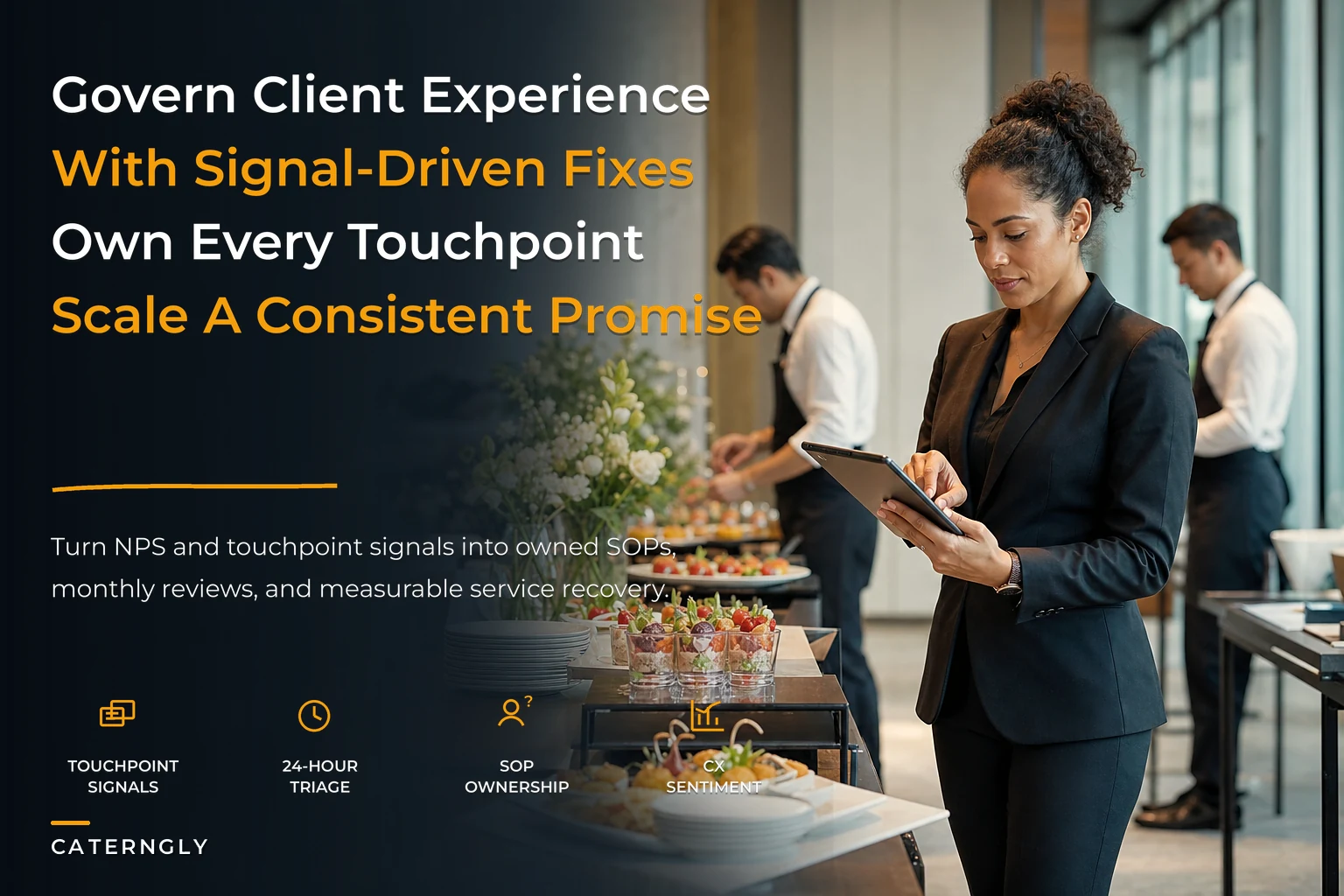
A real catering client experience playbook is that bridge. Not a survey tool, not a customer service philosophy — a governance system that takes every signal a client gives you and routes it to a specific operational response. A photo gate, an SLA check, a corrective SOP. Each with a named owner and an escalation clock. Sentiment goes in one end, concrete ops changes come out the other.
Why sentiment stays disconnected from operations
The pattern is almost always the same regardless of company size. Feedback gets collected in a way that's optimized for reporting, not for action. You end up with a monthly NPS number, maybe a quarterly trend line, and a folder of comments nobody reads systematically.
The problem is that an NPS score tells you that something's wrong, not what to change. A 6 out of 10 from a corporate client could mean the food came out cold, the bar ran dry, the setup was 40 minutes late, or the account manager stopped returning calls. Four completely different operational failures owned by four different parts of your business. Rolling them into a single number strips out everything you'd need to fix any of them.
The catering operations that stall out at a certain size aren't usually the ones with bad feedback systems. They're the ones with feedback systems that don't terminate in a workflow. The survey goes out, the score comes back, and then it sits. The signal never becomes a work order.
There's also a timing problem. Sentiment tends to arrive late. A post-event survey lands three days after the event, gets read a week later, and by the time anyone discusses it, the crew has already worked four more events using the exact process that caused the complaint. The feedback loop is real, but it's slow enough that it can't actually correct anything in time.
The signals worth governing (and the ones that just create noise)
Not every signal deserves an operational response. Part of building governance is deciding which inputs trigger action and which are just background noise.
End chaos with centralized catering management.
Caterngly helps you plan, confirm, and manage every catering event seamlessly.
- Unified event and order management
- Real-time client updates
- Staff and resource scheduling
No credit card required
The signals that actually predict repeat business and reveal ops problems tend to cluster in a few places:
-
Structured NPS or CSAT from the client contact after the event
-
Touchpoint signals during delivery — was the site lead reachable, did the timeline hold, did the setup match the floor plan
-
Micro-complaints logged by your own crew — the stuff staff notice before the client says anything ("we were short two chafers," "the venue power tripped twice")
-
Behavioral signals — did they rebook, did they refer, did they go quiet after a proposal
-
Vendor and venue feedback — planners talk to each other, and a venue coordinator's opinion of your crew shapes future referrals
The mistake most operations make is weighting the survey too heavily and ignoring crew-logged signals entirely. Your own team spots the failure hours before the client articulates it. If your governance system only listens to the client, you're always reacting to the last domino instead of the first.
A quick way to sort signals: does this input point to a repeatable process failure, or a one-off circumstance? A venue's power grid tripping is circumstantial. Your crew not carrying a backup power plan to every off-site event is a process gap. Governance only cares about the second kind.
Mapping signals to operational gates
This is the core of the whole system. The idea is that each category of negative signal maps to a specific gate — a checkpoint in your workflow where the failure could have been caught. Governance means making sure that gate exists, has an owner, and has a defined pass/fail standard.
There are three gate types that cover most catering failures:
Photo gates. Visual proof at defined moments — the buffet line before doors open, the plated presentation, the bar setup, the breakdown after load-out. When a client complains that presentation looked sloppy, you don't argue from memory. You pull the photo taken at the gate. More importantly, the requirement to take the photo forces the crew to look critically at the setup at the exact moment they can still fix it.
SLA gates. Time and responsiveness commitments — setup complete 30 minutes before guest arrival, site lead responds to planner within 5 minutes during service, food temperature checked and logged at specific intervals. An SLA gate turns a vague promise ("we'll be ready on time") into a measurable checkpoint that either passed or didn't.
Corrective SOPs. Pre-written responses that trigger when a gate fails. Not a meeting, not a discussion — a standing procedure. If the setup SLA is missed, the corrective SOP defines who gets notified, what the crew does to recover, and what gets logged for review.
Here's how the mapping looks in practice:
| Signal / Complaint | Root gate | Standard | Owner | Corrective SOP trigger |
|---|---|---|---|---|
| "Presentation looked unpolished" | Photo gate (pre-doors) | Line photo approved by lead | Site lead | Re-plate + note in event log |
| "We couldn't reach anyone during service" | SLA gate (response time) | Reply within ~5 min | Site lead | Backup contact escalation |
| "Food was cold / late" | SLA gate (temp + timeline) | Temp logged hourly, service on schedule | Kitchen lead | Reheat protocol + timeline audit |
| "Setup wasn't finished when guests arrived" | SLA gate (setup complete) | Done 30 min pre-arrival | Logistics lead | Early-crew callout for similar events |
| "Bar ran out of X" | Photo + inventory gate | Par levels verified pre-service | Bar lead | Restock buffer added to SOP |
| Client went quiet after event | Behavioral signal | Follow-up within 48 hrs | Account manager | Recovery outreach sequence |
The value isn't the table itself — it's that every complaint now has a home. When feedback comes in, you're not asking "who should look at this?" You already know which gate failed and who owns it.
The escalation cadence: making sure nothing dies in an inbox
A gate that fails with no clock attached to it will get ignored under pressure. The escalation cadence is what keeps a signal moving until it's resolved, and this is where most homegrown systems fall apart — the routing exists on paper but there's no timer forcing action.
A cadence that holds up under real event volume looks something like this:
-
Signal captured (survey, crew log, planner comment) — timestamped the moment it arrives.
-
Triaged within 24 hours by the signal owner (usually whoever runs client experience). Sorted into: circumstantial, process gap, or urgent-recurring.
-
Routed to the gate owner with a defined response window — 48 hours for standard process gaps.
-
Corrective SOP applied or a fix proposed. The gate owner either confirms the SOP handled it or flags that no SOP exists yet.
-
Escalation if unresolved. If the gate owner doesn't respond in the window, it moves up to the ops manager. If it's a repeat of something logged in the last 60 days, it skips straight to escalation — repeats mean the first fix didn't work.
-
Closed with a note in the event record so the pattern is visible next quarter.
The escalation rule that matters most: recurrence forces a level jump. A first-time complaint gets handled at the gate owner level. The same complaint showing up again within a couple of months is no longer a service miss — it's a system failure, and it goes to whoever owns the process, not the person who executed it. This single rule stops the endless cycle of apologizing for the same problem event after event.
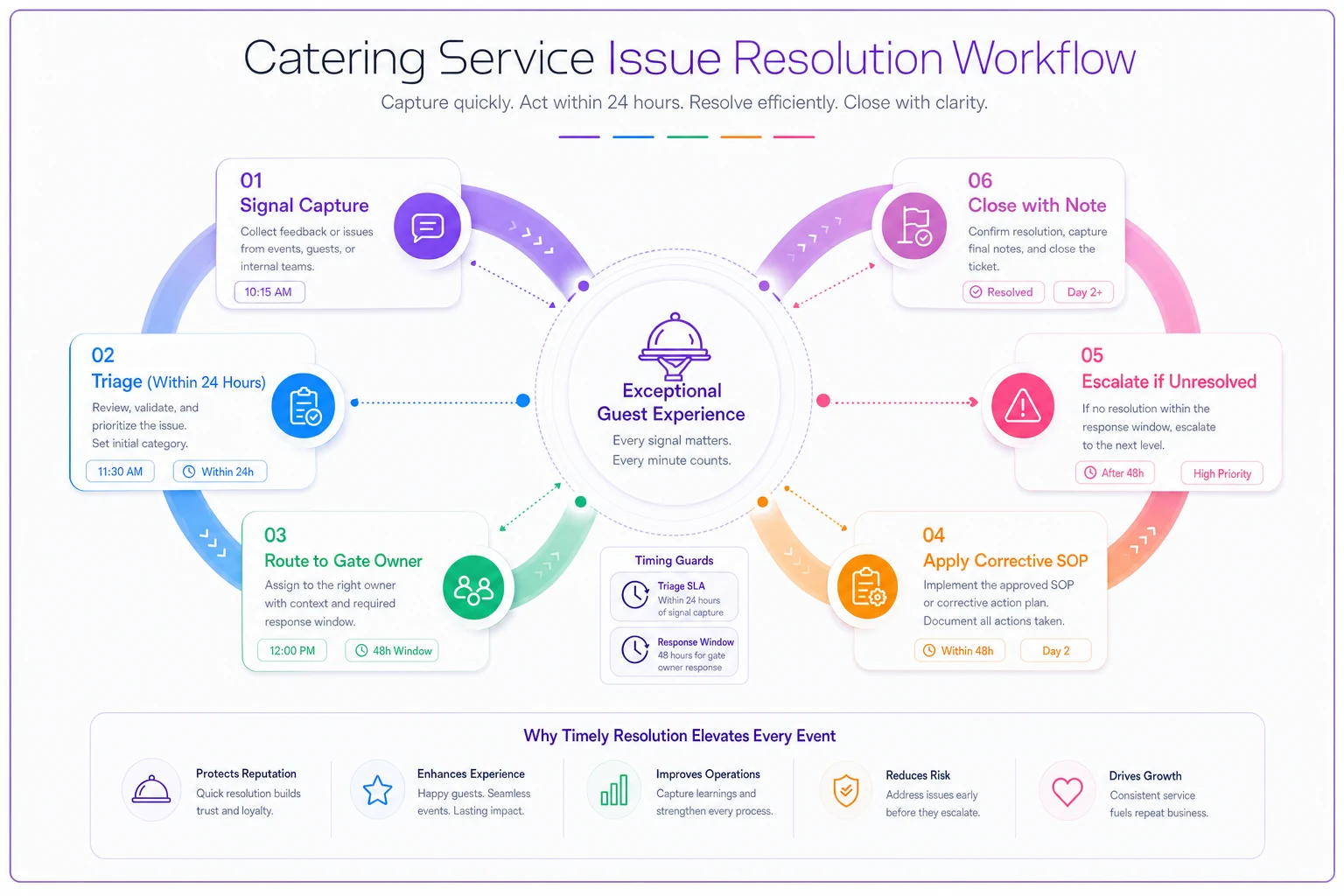
Visualizing the cadence makes the escalation clock and handoffs clearer so nothing stalls in an inbox.
KPI ownership: who actually answers for what
Signals without ownership become everyone's problem, which means they're no one's problem. The governance layer only works if each metric has exactly one name attached — not a department, a person.
The distinction that trips people up: the person who owns a KPI isn't always the person who executes the work. The site lead executes setup, but the logistics manager might own the "setup completed on time" KPI across all events. That separation is intentional. Ownership means responsibility for the pattern, not the single instance.
A workable ownership map:
-
NPS / overall CSAT → Owner of client experience. Answers for the trend, not any one score.
-
Setup SLA adherence → Logistics manager.
-
Service timeline + food temp compliance → Kitchen/culinary lead.
-
Response-time SLA during events → Operations manager (because it spans crews).
-
Rebooking / referral rate → Account management. This is where sentiment becomes revenue, and it connects directly to the work of turning single events into repeat clients — the kind of lifecycle approach that converts one-off bookings into recurring revenue.
-
Corrective SOP completion rate → Ops manager. Tracks whether fixes actually get closed.
When you build these out, resist the urge to give everyone a slice of NPS. Shared ownership of the headline number is exactly why nobody acts on it. Break it into the operational KPIs above, assign each to one person, and let NPS be the roll-up that tells you whether the parts are working together. If you already run a per-event metrics view, this maps cleanly onto the same logic that a KPIs dashboard uses to surface per-event profit leaks — the difference is you're tracking experience gates instead of margin gates, but the ownership discipline is identical.
A real scenario: from repeat complaints to a governed loop
Consider a mid-sized caterer running roughly 15–20 events a month across corporate lunches and weekend weddings. Their NPS sat in the low 40s — not terrible, but they couldn't figure out why certain clients never rebooked despite decent scores.
When they finally sorted their post-event comments by root cause instead of by score, a pattern jumped out. About a third of the detractor comments came down to setup timing at off-site venues. Crews were arriving on schedule but underestimating load-in at unfamiliar spaces, so guests were showing up while tables were still being dressed.
The old response had been individual — the account manager would apologize, maybe comp a service charge, and everyone moved on. No SLA gate existed for "setup complete before guest arrival" at off-site venues specifically.
They added one gate and one corrective SOP: setup confirmed 30 minutes before arrival, verified with a photo of the finished space, and if a venue was new to the crew, an earlier call time was triggered automatically for that booking. Ownership went to the logistics manager, with an escalation rule that any repeat setup-timing complaint jumped straight to ops review.
Over the next couple of quarters, setup-timing complaints dropped to almost nothing. NPS moved into the mid-to-high 50s, but the number that actually mattered was rebooking — corporate clients who'd previously gone quiet started coming back for their next quarterly event. Nothing about their food or pricing changed. They just closed the gap between the signal and the fix.
When this level of governance makes sense — and when it doesn't
When it makes sense: You're running enough concurrent events that the same problem can hide across different crews and venues. Usually that's when you cross into double-digit monthly events with multiple site leads. At that point, informal feedback handling breaks down because no single person sees the whole pattern anymore.
When it's overkill: If you're doing a handful of events a month with one crew and you're on-site for most of them, you are the governance system. Building formal gates and escalation cadences before you have the volume to justify them just adds overhead.
Who should not do this yet: Operations without stable service standards in the first place. Governance assumes there's a defined standard to measure against. If your crews are still improvising setup and service based on who's working that day, start with the baseline — documented standards, onboarding, and QA — before layering sentiment governance on top. There's a real sequencing to this; you need reliable service standards with onboarding and QA audits established first, or your gates will just measure chaos.
Where the system tends to break
A few failure points show up repeatedly once these systems are in place:
-
Gates become box-checking. The crew snaps the photo without actually looking at the setup. The photo exists but the standard erodes. Rotating who reviews photos and occasionally auditing them keeps the gate honest.
-
Corrective SOPs never get written. Signals get routed, owners get notified, but there's no standing procedure — so every fix is improvised from scratch. The SOP library has to grow every time a new failure type appears, or the system just becomes a fancier way to log complaints.
-
Escalation gets muted during busy season. Peak months are exactly when problems multiply and exactly when nobody has time to triage. Governance has to survive your busiest stretch or it's not governance. Keeping the triage step lightweight — sort into three buckets, nothing more — is what makes it survivable.
-
The loop never closes visibly. Fixes happen but nobody logs them, so next quarter you can't tell whether anything actually improved. The close-with-a-note step feels bureaucratic until the day you're trying to prove to yourself that a change worked.
-
Keeping all of this coordinated across events, crews, and venues is where the manual version starts to strain. Once you're routing dozens of signals a month, spreadsheets and email threads stop scaling — the triage lag alone eats the whole benefit. A workflow platform that captures signals, routes them to the right gate owner, and enforces the escalation clock automatically earns its place here. The point isn't the software; it's that the escalation cadence and ownership rules actually hold when volume spikes, instead of collapsing into whoever happens to check their inbox.
Rotate photo reviewers regularly and audit photo gates to prevent box-checking and keep standards real.
Keeping all of this coordinated across events, crews, and venues is where the manual version starts to strain. Once you're routing dozens of signals a month, spreadsheets and email threads stop scaling — the triage lag alone eats the whole benefit. A workflow platform that captures signals, routes them to the right gate owner, and enforces the escalation clock automatically earns its place here. The point isn't the software; it's that the escalation cadence and ownership rules actually hold when volume spikes, instead of collapsing into whoever happens to check their inbox.
Bringing it together
The caterers who scale a consistent brand promise aren't the ones with the highest NPS. They're the ones who've built a path from signal to change short enough that problems get corrected before they repeat. A great score with no operational feedback loop is fragile — it holds until the crew that made it possible has an off week.
Governance is really just discipline about the boring middle: taking a client's frustration, matching it to the exact gate that should have caught it, handing it to one person with a clock running, and closing the loop where the next person can see it. Do that consistently and sentiment stops being something you observe after the fact. It becomes the input that quietly reshapes how you run every event.
Ready to elevate your catering business?
Join 500+ caterers trusting Caterngly to save time, reduce errors, and deliver flawless events.