

You know that sinking feeling when your lead server calls out sick the morning of a 200-person wedding? Or when the new prep cook plates the appetizers backwards during corporate cocktail hour? These aren't just bad days—they're symptoms of a training system held together with sticky notes and hope.
Most caterers train staff the same way they learned themselves: throw them into an event, hope they figure it out, maybe pair them with someone experienced if you're lucky. It works until it doesn't. Then you're watching a $15,000 wedding reception unravel because nobody taught the new server how to properly clear a plated course, or your sous chef quits and takes all the knowledge about your signature sauces with him.
The problem compounds as you grow. That informal mentorship that worked when you had eight employees completely falls apart at 25. The quality gaps clients forgive at intimate 30-person dinners become reputation-destroying disasters at 300-person galas.
Why traditional catering training breaks at scale
Traditional catering training relies on tribal knowledge—the stuff that lives in people's heads and never gets written down. Your kitchen manager knows exactly how thick to slice the beef tenderloin for station carving. Your event captain instinctively understands course pacing at formal dinners. But what happens when they're running different events on the same night?
The typical catering operation loses somewhere around 60% of new hires within the first 90 days. Not because the work is hard (though it is), but because there's no clear path from confusion to competence. New staff get different instructions from different supervisors, learn bad habits from whoever happens to be training them that shift, and never really understand what "good" looks like.
This creates a vicious cycle. Your best people spend all their time fixing mistakes and re-training staff instead of growing the business. Service quality becomes entirely dependent on who shows up that day. Clients notice—one event runs flawlessly, the next feels amateur.
The financial hit adds up fast. A single service failure at a high-profile event can cost you $30,000–50,000 in lost referrals over the following year. Factor in constant recruiting costs, overtime from covering for undertrained staff, and comped items from service mistakes, and inadequate training easily runs mid-sized caterers $75,000–100,000 annually in hidden losses.
Building role-specific onboarding playlists that actually work
The solution isn't more training—it's better training architecture. Every role needs its own learning pathway, with clear checkpoints that prove competency before someone works an actual event.
End chaos with centralized catering management.
Caterngly helps you plan, confirm, and manage every catering event seamlessly.
- Unified event and order management
- Real-time client updates
- Staff and resource scheduling
No credit card required
Start with your core positions. A prep cook needs completely different skills than a banquet captain, yet most caterers run everyone through the same generic orientation. Build separate playlists for:
Kitchen roles:
-
Prep cook
knife skills, portion control, allergen protocols, station setup
-
Line cook
plating standards, timing coordination, special diet modifications
-
Sous chef
production planning, quality checks, team coordination, cost controls
Service roles:
-
Server
table service standards, wine basics, dietary restrictions, client interaction
-
Captain
event flow, vendor coordination, problem escalation, team deployment
-
Bartender
pour standards, specialty drinks, inventory tracking, ID protocols
Operations roles:
-
Driver
vehicle inspection, load securing, route planning, delivery protocols
-
Setup crew
layout interpretation, linen standards, equipment handling, breakdown sequence
Each playlist should follow a logical progression. Don't teach wine service before basic tray carrying. Don't cover complex dietary modifications before standard plating. The sequence matters as much as the content.
Map out what someone needs to know at 30, 60, and 90 days. A new server's first week should focus on basic safety, sanitation, and service standards. Week two introduces specific service styles—buffet vs. plated vs. stations. By week four, they're learning wine service and special event protocols.
Gate criteria: the checkpoints that protect quality
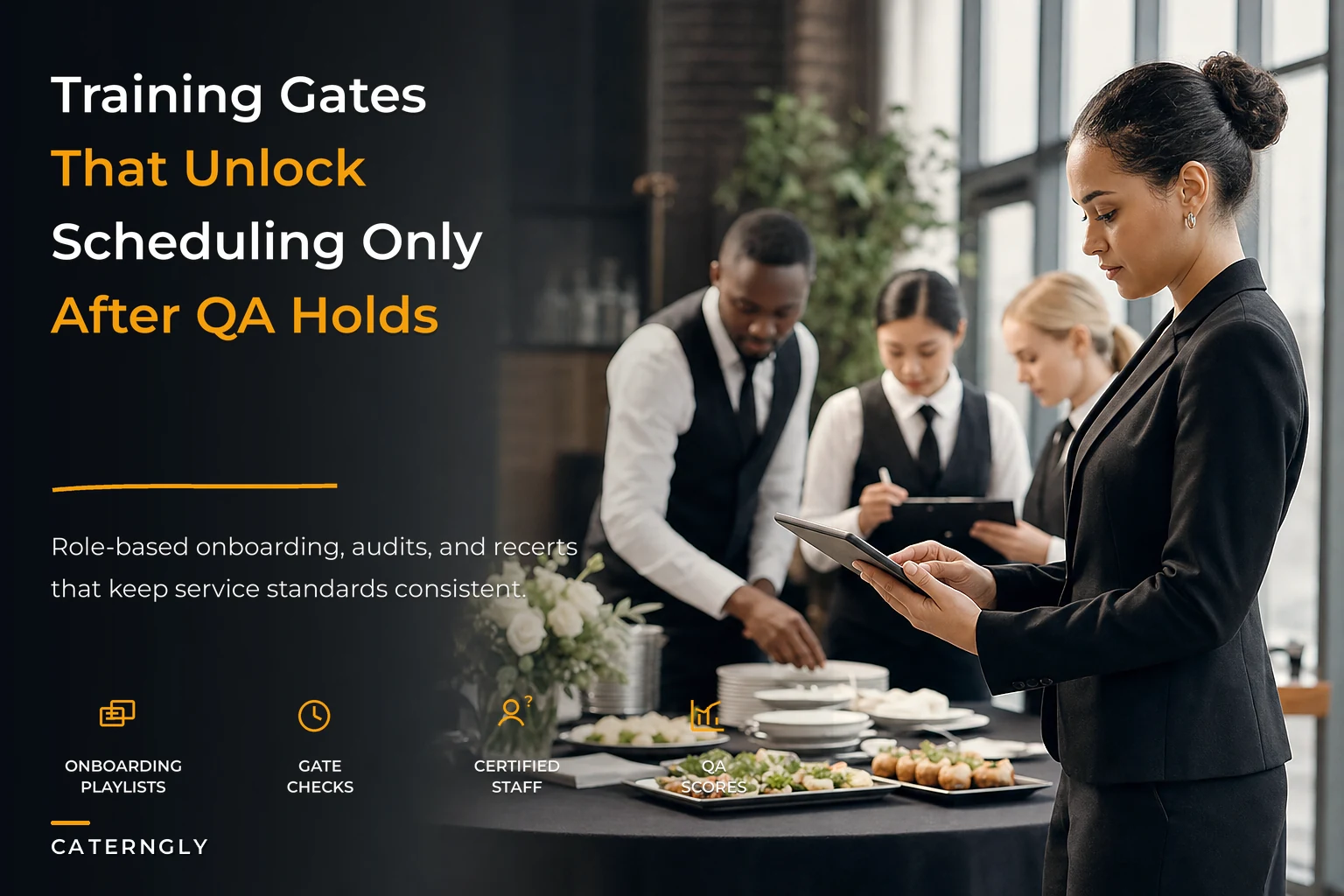
Training without verification is just expensive hope. Every role needs specific gate criteria—measurable skills they must demonstrate before advancing to the next level or working certain event types.
These aren't generic competency checks. They're specific, observable behaviors tied directly to your service standards. For servers, Gate 1 might include:
-
Carry a fully loaded tray (8 dinner plates) up stairs without dropping
-
Properly set a formal place setting in under 90 seconds
-
Identify all 14 common allergens in your standard menu items
-
Demonstrate proper wine service to left, pour to right
-
Clear a 10-top table in under 3 minutes using proper technique
Gate 2—allowing them to work premium events—raises the bar:
-
Execute synchronized service for a 12-top table
-
Handle special dietary requests without kitchen consultation
-
Properly describe wine pairings for a five-course menu
-
Manage a 40-person station service solo
-
Identify and resolve three common service recovery scenarios
Run gate assessments during low-stakes events first so temporary staff can demonstrate skills without risking high-profile service.
The key is making gates objective, not subjective. "Demonstrates professional appearance" is useless. "Arrives in pressed, stain-free uniform with polished shoes and trimmed nails" is verifiable.
Create a simple scoring matrix for each gate. Pass requires 85% or higher. Anything less means more practice in specific weak areas—not starting over from scratch. Track who passes which gates when. This becomes your skills inventory for scheduling staff across overlapping events.
Quarterly QA audits tied to actual event KPIs
Skills degrade without practice. Bad habits creep in without correction. Standards drift when nobody's checking.
Quarterly quality audits keep everyone sharp, but only if they measure what actually matters. Generic restaurant service standards don't translate to catering. You need audits tied to the specific KPIs that determine event success.
Pull your actual event feedback data. What complaints show up repeatedly? Late service? Cold food? Confusion during setup? Missing items? Build your audit criteria around preventing those specific failures.
A typical quarterly audit might evaluate:
| Audit Category | Example Criteria | Scoring |
|---|---|---|
| Service timing accuracy | Appetizers out within 10 min of stated time; no more than 18 min between courses | 1–3 scale |
| Presentation standards | Plate presentation matches photo standards; buffet maintains full appearance | 1–3 scale |
| Communication effectiveness | Proper radio protocol; dietary restrictions tracked and verified | 1–3 scale |
| Operational efficiency | Setup completed 30 min before guest arrival; equipment matched to load list | 1–3 scale |
Score each element on a simple 1–3 scale: Below Standard (1), Meets Standard (2), Exceeds Standard (3). Anyone averaging below 2.0 gets immediate retraining. Anyone consistently above 2.5 becomes a trainer for others.
Here's a breakdown of some specific criteria worth tracking within each category:
Service timing accuracy:
-
Appetizers out within 10 minutes of stated time
-
No more than 18 minutes between courses
-
Final plate cleared within 5 minutes of first
-
Bar breakdown begins within 15 minutes of last call
Presentation standards:
-
Plate presentation matches photo standards (score 1–5)
-
Buffet maintains full appearance throughout service
-
Linen remains wrinkle-free and properly aligned
-
Staff appearance meets grooming standards
Communication effectiveness:
-
Proper radio protocol followed
-
Client requests documented and communicated
-
Dietary restrictions tracked and verified
-
Vendor coordination logged properly
Operational efficiency:
-
Setup completed 30 minutes before guest arrival
-
Breakdown finished within contracted time
-
Equipment inventory matched to load list
-
Vehicle returned clean and refueled
The point isn't to micromanage—it's to catch drift before a client does.
Creating micro-certifications that mean something
Traditional food handler certificates check a legal box but don't improve service quality. Micro-certifications for specific catering skills create real competency and give staff clear advancement paths.
Design 2–4 hour certifications around critical skill clusters:
Formal Service Specialist
-
French service techniques
-
Synchronized plating
-
Wine service protocols
-
Silver service standards
-
White glove requirements
Dietary Specialist
-
Allergen identification and prevention
-
Religious dietary requirements (Kosher, Halal)
-
Medical restrictions (diabetes, celiac)
-
Lifestyle choices (vegan, keto)
-
Cross-contamination prevention
Event Setup Master
-
Blueprint reading
-
Spacing and flow optimization
-
Linen and decor standards
-
Lighting and AV basics
-
Safety and evacuation protocols
Bar Service Professional
-
Classic cocktail preparation
-
Wine and beer knowledge
-
Responsible service protocols
-
Inventory and pour tracking
-
Speed and efficiency techniques
Each micro-cert should include written knowledge checks, practical demonstrations, and scenario-based problem solving. Someone earning "Formal Service Specialist" should be able to handle any high-end plated dinner without supervision.
Make certifications visible. Add them to name badges. List them on schedules. Pay a small premium—$1–2 an hour—for certified skills. This builds motivation for continuous improvement while expanding your bench strength for complex events.
Templates and tools that scale
Every training system needs practical tools that managers can actually use during busy seasons. Theoretical frameworks fall apart when you're onboarding six new servers the week before wedding season.
Printable onboarding checklists by role:
One-page checklists for each position showing exactly what gets covered each day of their first two weeks. Day 1: uniform fitting, handbook review, kitchen tour. Day 2: basic safety training, hand washing certification. Day 3: shadow experienced server, practice tray carrying. Simple, specific, trackable.
Skills matrices for quick team assessment:
A grid showing every employee down the left, every key skill across the top. Color-coded: red (cannot perform), yellow (learning), green (competent), blue (can train others). One glance shows who can handle champagne service, who's certified for allergen management, who can drive the refrigerated truck.
Audit scorecards with clear scoring criteria:
Single-page audit forms for different event types. Corporate lunch buffet has different standards than wedding reception plated service. Include specific measurements—"Buffet refreshed every 20 minutes," not "Buffet maintained properly."
Digital tracking for compliance and progress:
Even basic spreadsheets beat paper tracking. Log training dates, certification expirations, gate passages, audit scores. Set automatic reminders for recertification. Track patterns—if multiple people fail the same gate, the training needs adjustment, not the people.
When this system saves your reputation
A catering company in Denver implemented this exact framework after growing from 8 to 32 employees in under two years. Quality was all over the map. Some events ran perfectly. Others had obvious gaps—forgotten dietary restrictions, mismatched plate presentations, confused service timing.
They built role-specific playlists for five core positions. Created three gate levels for each. Ran monthly mini-audits tied to their most common client complaints. Within four months, event satisfaction scores climbed from around 3.8 to 4.6 out of 5. More importantly, the variance disappeared—every event delivered consistent quality regardless of who worked it.
The real test came during peak season when they had to bring on twelve temporary staff for graduation events. Instead of the usual panic training, they ran everyone through the structured playlists and set clear gates for who could work which events. The temps performed nearly as well as permanent staff because the standards were specific and verifiable.
Their referral rate increased by roughly 40% that season. Not because they changed their food or raised prices, but because clients could trust that every event would hit the same standard. That predictability became their competitive advantage.
Making the system sustainable with smart automation
The biggest challenge with any training system is maintaining it when you're busy—which in catering is always. This is where operational software becomes useful for scaling quality control without adding headcount.
Modern catering platforms can automate the tedious parts of competency tracking. Training completion triggers automatic schedule permissions—finish Gate 2 service certification, become eligible for premium event scheduling. Audit scores link directly to performance reviews. Certification expiration sends automatic retraining reminders before anyone realizes they've lapsed.
The smarter platforms connect training data to actual event outcomes. If servers scoring below 2.3 on quarterly audits consistently correlate with lower satisfaction scores, the system flags them for additional training before they impact another event. If certain micro-certifications predict better client feedback, you know exactly which training investments pay off.
Some AI-assisted platforms can even analyze event feedback to surface training gaps you didn't know existed—multiple mentions of "slow bar service" trigger a recommendation for cocktail speed training, complaints about "confusion during setup" point back to blueprint reading certification. It's not magic, but it removes the guesswork from figuring out where your team actually needs work.
Here's a simple workflow showing how training data connects to scheduling, gating and audits.
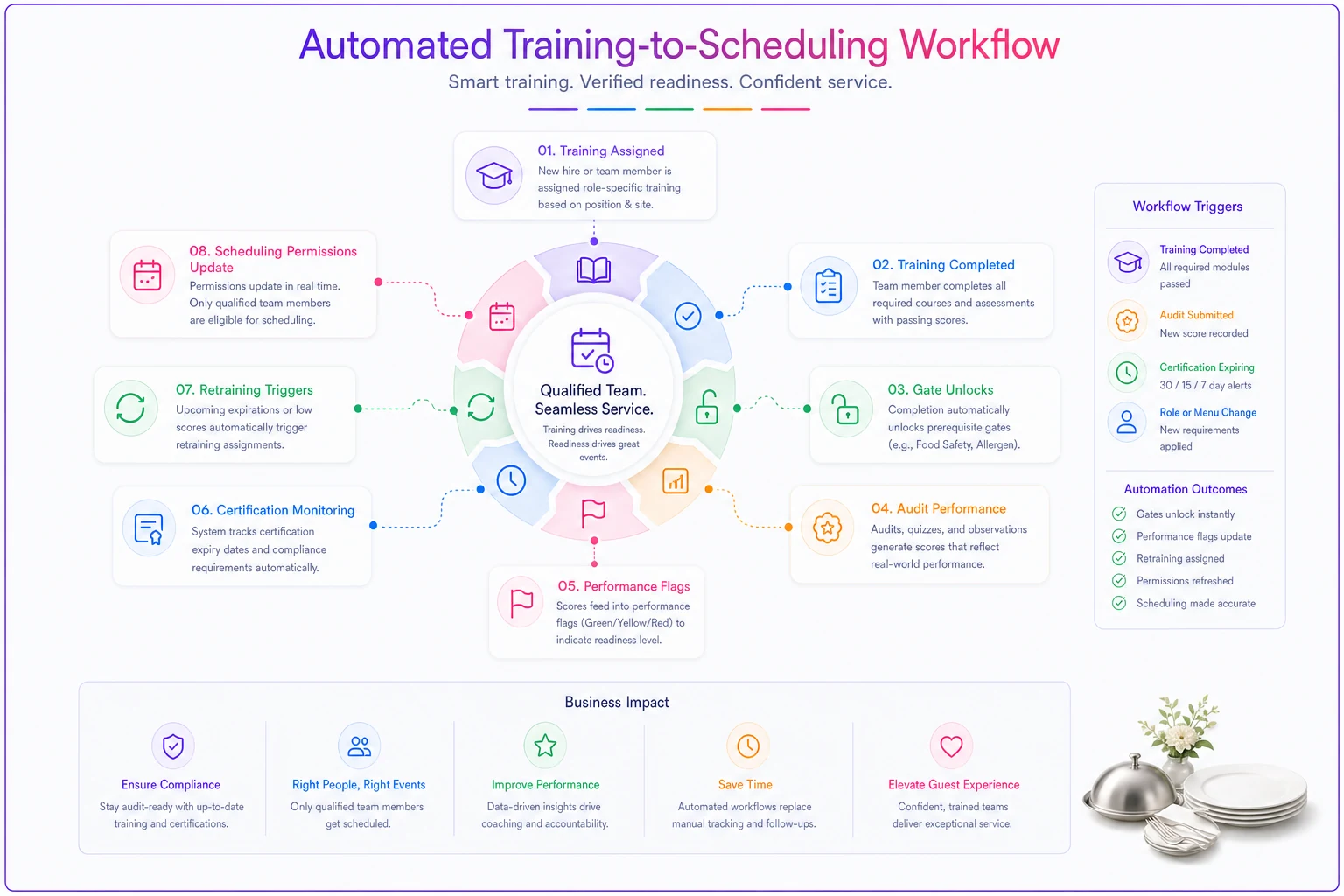
This visual maps triggers like certification completion, audit scoring, and retraining reminders into scheduling and performance flags.
This shifts training from a cost center to a strategic advantage. You're not just teaching people to carry trays—you're building a scalable operation where quality improves as you grow instead of degrading.
The compound effect of systematic competency
Most caterers treat training as emergency response—someone quits, quickly train a replacement. Someone messes up, lecture them about standards. That reactive approach guarantees inconsistent quality and constant stress.
A real catering training competency system creates compound advantages over time. Every properly trained employee becomes a trainer for the next hire. Every documented standard gets easier to maintain. Every successful audit builds client confidence.
Your experienced staff spend less time fixing mistakes and more time improving operations. Your event playbooks get more sophisticated because everyone already understands the basics. Your pricing commands premiums because clients trust your consistency.
Once the system exists, it largely runs itself. New hires follow the playlists. Gates ensure quality before risk exposure. Audits catch drift before clients notice. Micro-certifications motivate continuous improvement. You stop being dependent on hero employees who hold all the knowledge. Stop losing sleep about whether the B-team can handle Saturday's wedding while the A-team does the corporate gala. Stop watching your reputation swing based on who shows up that day.
What you build instead is something more durable than any signature dish or exclusive venue partnership—a catering operation that delivers consistently, scales without breaking, and gets better over time. That's the difference between a professional catering company and a talented cook with a van. And it's what clients are actually paying a premium for.
Ready to elevate your catering business?
Join 500+ caterers trusting Caterngly to save time, reduce errors, and deliver flawless events.