

Corporate RFPs are a strange trap for caterers. They look like the big leagues — a Fortune 500 client, a multi-event annual contract, purchase orders instead of chasing deposits. So you say yes, block off a weekend, and grind through 40 pages of line items, insurance requirements, and pricing grids.
Then one of two things happens. Either you lose to someone who bid 22% under you and you never find out why, or you win and realize six months in that the SLA you casually agreed to is quietly eating your margin on every single event.
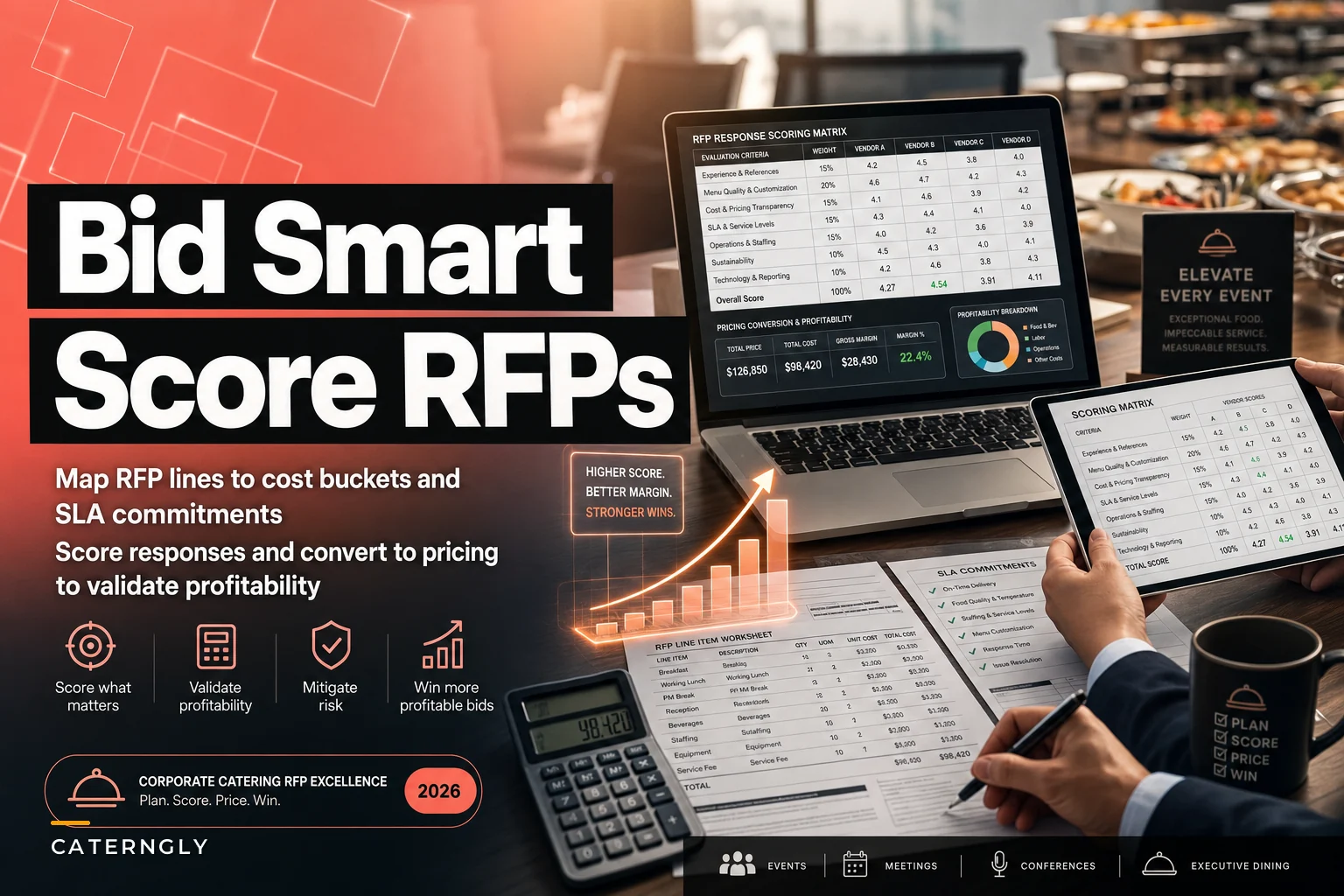
The problem isn't that caterers can't cook for corporate clients. It's that most RFP responses get assembled emotionally — "this is a great logo, we have to win it" — instead of being scored against what the contract actually costs to deliver. What follows is a scoring and pricing-conversion approach that turns an RFP from a wall of text into a bid-or-pass decision you can defend with real numbers.
The real reason corporate RFPs blow up margins
Most catering RFPs don't ask "what's your price per head." They ask forty small questions that each carry a hidden cost, buried inside language that sounds purely administrative.
A line that says "Vendor will provide on-site coordination for all events exceeding 75 guests" isn't a courtesy request. It's a labor line — a coordinator, probably 6 hours, at a rate you didn't build into your per-plate number. A clause requiring "same-day replacement of any food safety incident within 90 minutes" isn't a formality either. It's a standing-capacity commitment that means you can't fully book your kitchen on their event days.
-
Service-level commitments that force you to hold capacity, staff, or inventory you'd otherwise deploy elsewhere.
-
Administrative overhead — dedicated invoicing formats, monthly reporting, portal uploads, W-9 refreshes, quarterly business reviews.
-
Risk transfer — indemnification, penalty clauses, and "vendor bears cost of" language that shifts financial exposure onto you without any line-item price attached.
The scoring template exists to drag every one of those out of the prose and give it a dollar value before you decide whether to bid.
Step one: map every RFP line into an operational cost bucket
Before you score anything, you translate. Every requirement in the document gets assigned to one of five buckets. This is the part almost nobody does, and it's why so many caterers price corporate work like it's a slightly bigger wedding.
End chaos with centralized catering management.
Caterngly helps you plan, confirm, and manage every catering event seamlessly.
- Unified event and order management
- Real-time client updates
- Staff and resource scheduling
No credit card required
-
Direct food & beverage — ingredients, packaging, disposables tied to consumption.
-
Direct labor — prep, service, coordination, teardown, driving.
-
SLA / capacity cost — anything that forces you to reserve or hold resources you can't sell elsewhere.
-
Administrative & compliance — reporting, portal work, insurance riders, audits, dedicated account contacts.
-
Risk-adjusted cost — expected value of penalties, replacements, and liability you're contractually accepting.
Here's how a stretch of typical RFP language converts once you run it through the buckets:
| RFP line item (as written) | Cost bucket | What it actually costs you |
|---|---|---|
| "Menus refreshed quarterly with two tasting sessions per year" | Admin + Direct F&B | ~2 tastings × prep + 3 staff hours each; menu R&D time |
| "On-site lead for events over 75 guests" | Direct labor + SLA | Coordinator ~6 hrs/event, often can't double-book that person |
| "Guaranteed 90-minute food-safety replacement" | SLA / capacity | Held kitchen slack on their event days; near-impossible on peak dates |
| "Net-60 payment terms" | Risk-adjusted | Financing cost on ~2 months of receivables |
| "5% credit per late delivery (>15 min)" | Risk-adjusted | Expected penalty × your realistic late-rate |
| "Monthly consumption + spend reporting via portal" | Admin | ~3–4 admin hrs/month across the account |
| "Vendor supplies all rentals; breakage borne by vendor" | Risk + Direct | Rental markup gone, plus loss exposure you now own |
Once it's in a table like this, the RFP stops being intimidating and starts being priceable. You're no longer reacting to a document — you're costing a set of obligations.
Assign one person to own the initial mapping pass so bucket assignments stay consistent across reviewers.
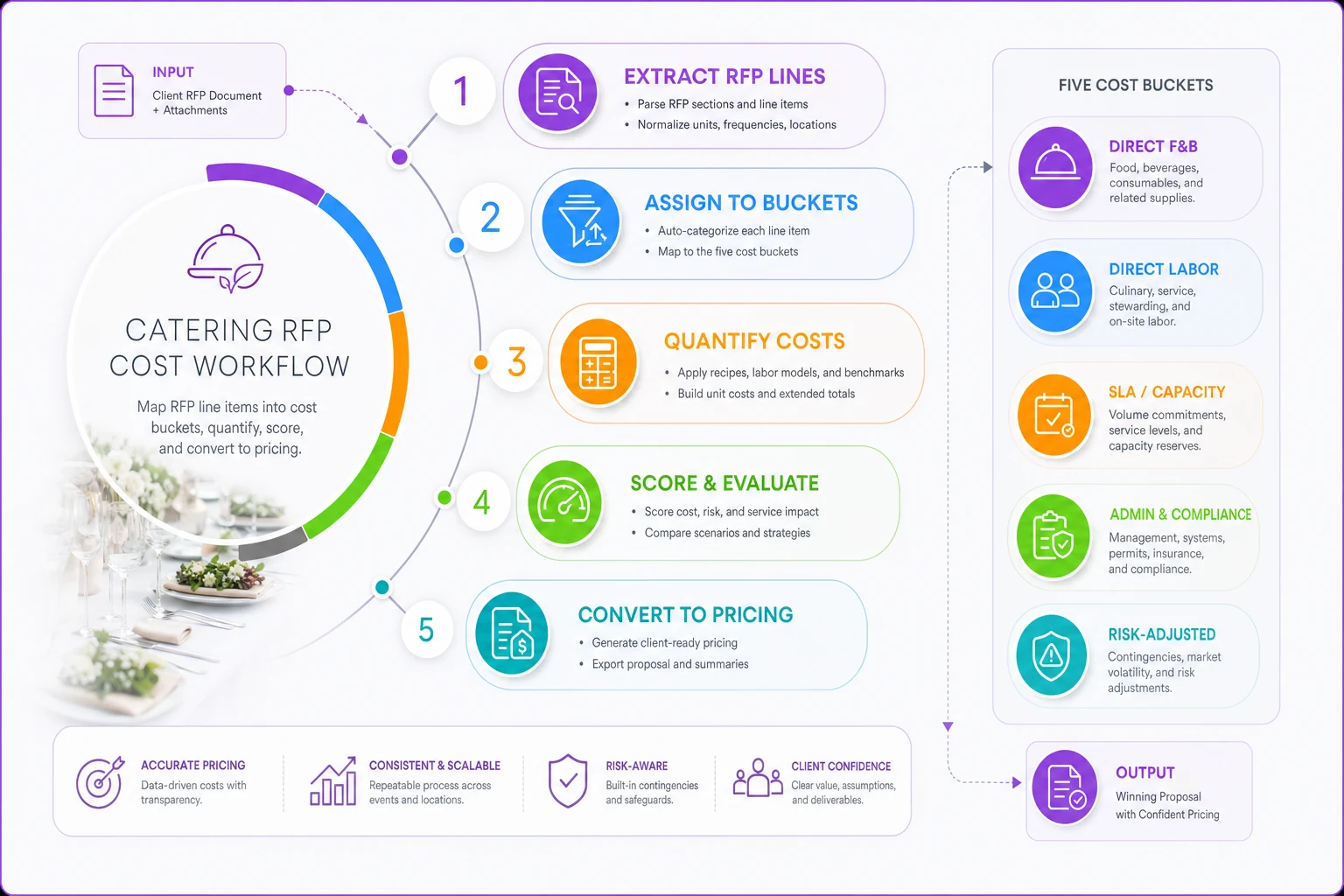
A quick visual like this helps teams run the same mapping process without arguing over definitions.
Step two: score the bid on fit, not excitement
Cost mapping tells you what it takes to deliver. Scoring tells you whether you should. These are different questions, and conflating them is how caterers end up winning contracts they should have walked away from.
Score each RFP across weighted criteria on a simple 1–5 scale. Weights matter more than raw scores — a great logo with terrible payment terms should still fail if cashflow is your constraint.
-
Margin after full cost mapping (weight ×4) — after all five buckets, what's left?
-
Capacity fit on their event dates (×3) — do their peak dates collide with your existing ones?
-
Payment terms & cashflow impact (×3) — Net-30 vs Net-60 vs deposit-based changes everything.
-
Risk exposure from penalty/liability clauses (×3) — how much uncompensated risk are you eating?
-
Strategic value / repeat pipeline (×2) — genuine door-opener or just a large one-off?
-
Operational strain / distraction cost (×2) — will this pull your best people off higher-margin work?
Multiply each score by its weight, total it, and set a threshold. Anything under roughly 55–60% of the maximum possible should be an automatic pass, regardless of how good the name looks on your website.
The scoring step's real job is emotional protection. It gives your team permission to say no to a prestigious client whose terms don't work — because the number said no, not a person.
A worked example: the bid that looked great and scored terrible
A mid-sized caterer doing around $2.1M a year gets invited to bid on a regional tech company's annual contract — recurring lunches, quarterly all-hands, roughly 40–50 events a year. On paper it looks like a $220k–$260k account. Everyone in the room wants it.
Then they run the mapping.
-
Direct F&B and labor come in fine — the menus are simple, mostly buffet, and the per-head math supports solid food margins around 68% gross before overhead.
-
The 90-minute replacement guarantee means holding kitchen slack on roughly 15 event days that overlap with their busiest wedding-season Fridays. That's around $9k–$12k of displaced higher-margin revenue over the year.
-
Net-60 terms on a $230k account means carrying about $38k in receivables at any given time — real financing cost, and a cashflow drag they'd normally avoid with their standard deposit structure.
-
Monthly portal reporting and a quarterly business review eat roughly 55–70 admin hours a year that nobody was going to bill for.
-
A 5% late-delivery credit, against their honest historical late rate of about 8% on cross-town deliveries, prices out to an expected $1,800–$2,400 in credits annually.
Once all five buckets landed in the model, the net margin dropped from the "68% food margin" everyone got excited about to a blended contribution margin of around 11–13% after capacity displacement, financing, admin, and risk. On the weighted scorecard it came in under threshold — mostly killed by the capacity-fit and payment-terms lines.
They didn't just pass, though. The scoring gave them a counter-position: they went back with a bid that priced the 90-minute SLA as an optional premium tier, requested Net-30, and quoted a monthly reporting fee as a separate line. The client accepted Net-30 and dropped the aggressive replacement clause for events under 100 guests. The revised contract scored well above threshold. That's the whole point — the template didn't just say bid-or-pass, it showed them exactly which three levers to negotiate.
Converting the scorecard into an actual price
This is where the mapping pays off. Your price isn't "cost plus markup." It's the sum of five buckets, each with its own margin logic, because they don't behave the same way.
-
Total your direct F&B and apply your normal food margin target.
-
Total direct labor at fully-loaded rates — including the coordinator hours the RFP quietly requires, not just servers.
-
Price SLA/capacity as a premium, not a cost you absorb. If a clause forces you to hold slack, that slack has an opportunity cost, and the client should pay for it or drop the clause.
-
Bill admin as a visible line or fold a transparent monthly fee into the contract. Hidden admin is where recurring accounts silently bleed.
-
Add a risk reserve equal to your realistic expected penalty exposure — not the best-case scenario.
The discipline that separates profitable corporate caterers from the ones who quietly resent their biggest client: every bucket gets its own margin, and SLA commitments are priced as products. A 90-minute guarantee is a service you sell, not a favor you throw in to win the logo.
If you already run a real per-event cost model, this plugs straight into it — the same allocation logic behind a per-event P&L for caterers is exactly what you extend across a multi-event contract term. And because corporate accounts live or die on payment timing, the terms you negotiate should line up with the same principles in deposit and payment schedules that stabilize cashflow — Net-60 on a large account can undo a healthy margin faster than a bad food-cost quarter.
The pre-submission checklist
Before any corporate RFP response leaves your building, it should clear this list. If it can't, you're bidding blind.
-
[ ] Every RFP line item assigned to one of the five cost buckets
-
[ ] SLA and capacity clauses translated into held-resource dollar costs
-
[ ] Realistic penalty exposure calculated using your actual late/incident rates, not zero
-
[ ] Admin hours across the full contract term counted and priced
-
[ ] Payment terms modeled for financing cost (especially anything past Net-30)
-
[ ] Capacity conflict check against your existing peak-date calendar
-
[ ] Weighted scorecard completed and compared to threshold
-
[ ] Two or three specific negotiation levers identified for a counter if the score is borderline
-
[ ] Someone other than the salesperson reviewed the final number
That last line matters more than it looks. The person who wants to win the account should not be the person who signs off on the margin. Separating those two roles catches most of the bids that should have been passes.
When bidding actually makes sense — and when it doesn't
Bid confidently when: the event dates fall in your slower periods (so held capacity costs you almost nothing), payment terms are Net-30 or better, the SLA clauses are reasonable, and the account genuinely opens a pipeline — a corporate campus that'll refer three more, or something that anchors your calendar in a dead season.
Be cautious when: their peak dates collide with yours, the contract carries Net-45+ terms, or the penalty clauses are one-sided. These aren't automatic no's, but they're exactly the things you negotiate before signing, not after.
Walk away when: the scorecard comes in under threshold and the client won't move on the two or three levers dragging it down. A prestigious logo that insists on Net-60, a punishing replacement SLA, and a fixed price grid you can't touch isn't an account — it's a subsidy you're paying to them.
Caterers who scale corporate work well tend to treat their biggest accounts with the same operating rigor described in the enterprise corporate-account operating playbook — the RFP scoring is really just the front door to that discipline. Win the wrong contract and you'll spend a year running that playbook at a loss.
The reason corporate RFPs feel like gambling is that most caterers respond to the words on the page instead of the obligations underneath them. A clause about "on-site coordination" or "90-minute replacement" reads like language, but it's really a price tag with the number torn off. Map every line into a cost bucket. Score the bid on fit and terms, not on how impressive the client sounds. Price your SLA commitments as products with their own margins. And give your team a threshold that makes it acceptable to pass — because the account you don't win at a loss is worth just as much to your business as the one you win at a profit. That's not being conservative. That's just knowing what you're signing before you sign it.
Ready to elevate your catering business?
Join 500+ caterers trusting Caterngly to save time, reduce errors, and deliver flawless events.