

Most caterers don't lose money on rentals because of bad equipment. They lose it in the gap between "the event ended fine" and "the rental company sent an invoice three weeks later for a broken chafer, two bent tripod stands, and a replacement fee you never agreed to."
That gap is almost always a contract problem. The equipment left the warehouse under terms nobody read closely, came back under conditions nobody documented, and got charged under a replacement schedule nobody negotiated. By the time the dispute hits your inbox, you're arguing from a weak position with nothing to stand on.
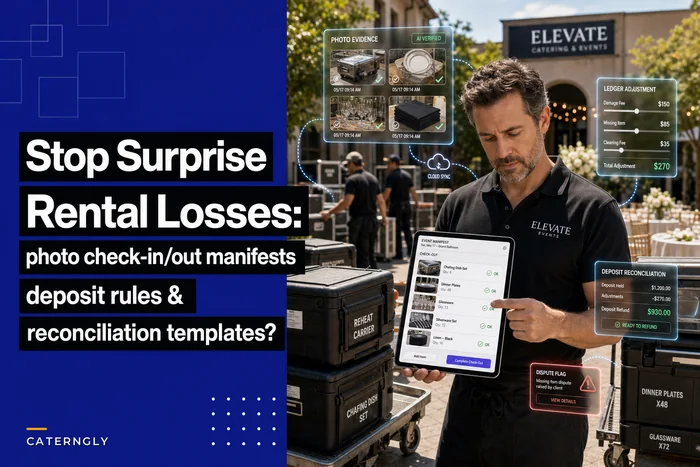
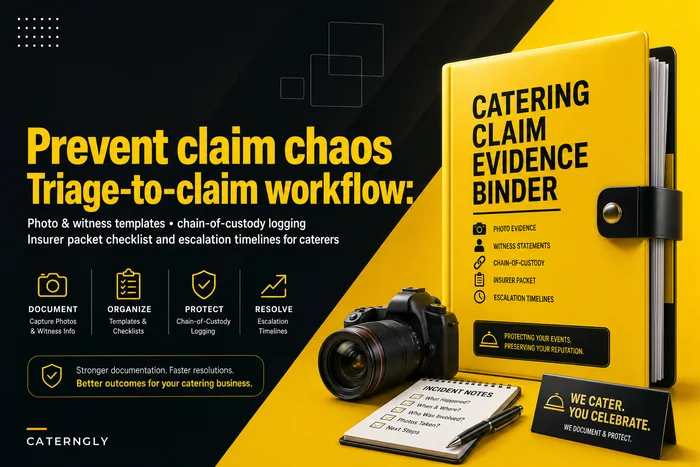
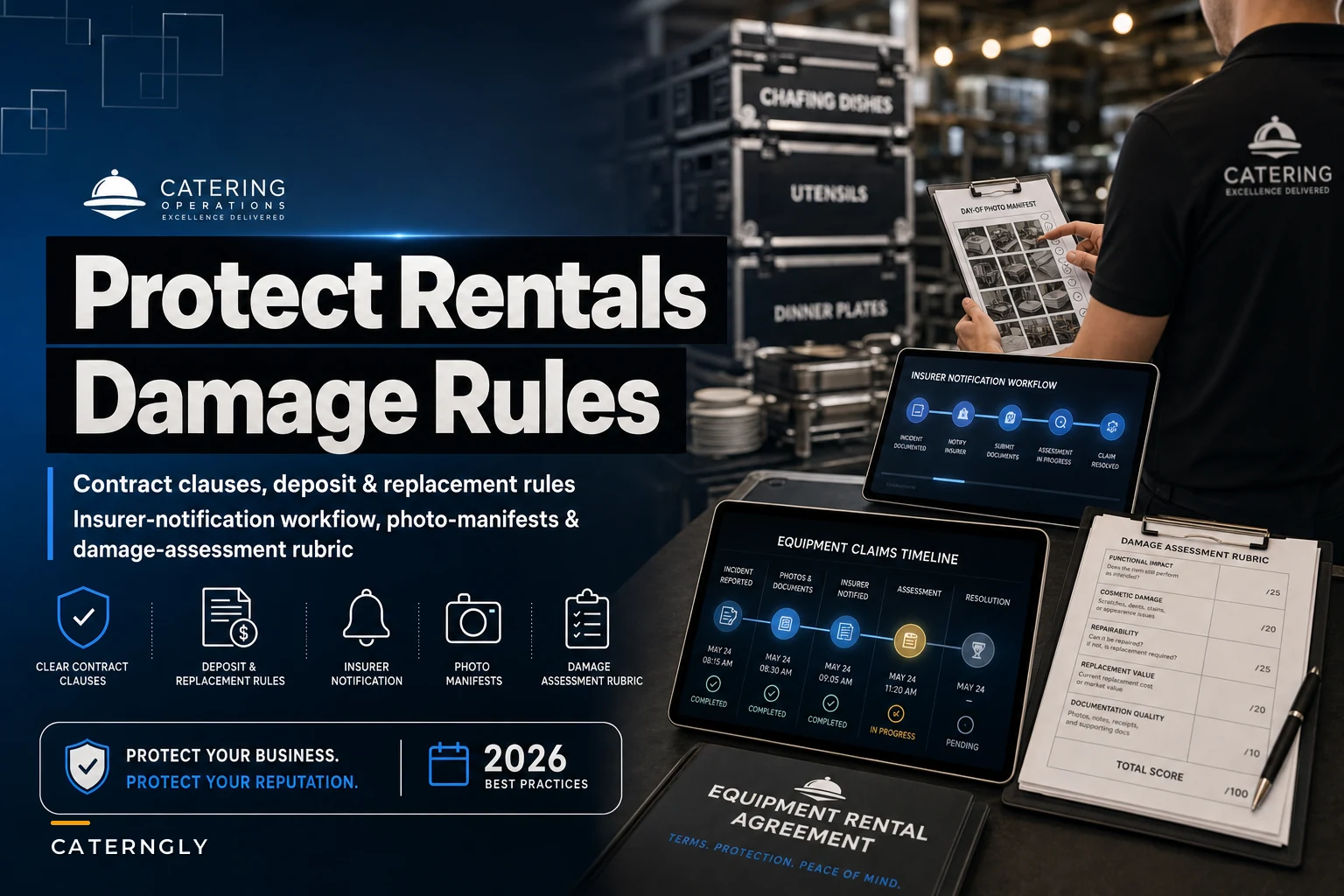
This is a tight, specific topic: the exact clauses that belong in your equipment rental agreements, the deposit and replacement rules that keep disputes short, and the insurer-notification workflow that ties your day-of photos to a claims timeline. If you've already set up photo check-in/out manifests and reconciliation templates, this is the contract layer that makes those photos legally useful instead of just evidence nobody acts on.
The clauses that actually get tested
There's a real difference between the clauses rental companies include and the ones that matter when something actually goes wrong. Standard rental agreements are written to protect the rental company — which is fine, but it means the burden-of-proof language, the replacement valuation, and the notification windows are all tilted against you unless you push back.
1. Condition-at-handover clause. The single most important one. It should state that equipment condition is established by a timestamped photo manifest signed — or acknowledged electronically — by both parties at pickup and return. Without this, the rental company's word becomes the baseline, and "it was fine when it left here" is nearly impossible to disprove.
2. Damage valuation method. Vague language like "damaged items will be charged at replacement cost" is where you bleed. Replacement cost of what — a new unit, a comparable used unit, or just the repair? A cracked glass rack insert might cost $18 to repair and $140 to replace new. The clause should specify repair-first, with replacement only when repair isn't viable, and it should cap replacement at depreciated value for anything over a certain age.
3. Normal wear exclusion. Scuffs on folding tables, minor dulling on serving utensils, cosmetic wear on transport cases — none of that is damage. The contract should explicitly carve out normal wear and tear and define it with examples, not just the phrase itself.
4. Notification window. This cuts both ways. If a rental company has 10 business days to inspect and notify you of damage, they can't surprise you a month later. If you're renting out your own gear, a tight window protects you from clients who "discover" a problem long after the event wrapped.
5. Sub-rental and chain-of-custody clause. When you rent equipment and it sits at a venue overnight, who's liable during that window? If the venue or a third-party cleaner handled it, the contract needs to address custody transfer — otherwise you'll eat damage you didn't cause.
The pattern that keeps showing up: caterers negotiate the rental price hard, then sign the terms without a glance. The terms are where the real cost lives.
Deposit and replacement rules that keep disputes short
A deposit isn't just a security blanket — it's the leverage structure for the entire damage conversation. Set it wrong and you either tie up cash you need or lose your only bargaining chip.
End chaos with centralized catering management.
Caterngly helps you plan, confirm, and manage every catering event seamlessly.
- Unified event and order management
- Real-time client updates
- Staff and resource scheduling
No credit card required
The useful framing is to separate the deposit into tiers based on what's actually at risk:
| Equipment category | Typical replacement range | Suggested deposit basis | Why |
|---|---|---|---|
| Linens, flatware, glassware | $2–$40 per item | Flat pool deposit (e.g., $150–$300) | High count, low per-unit value, loss is the main risk |
| Chafers, serving stations, risers | $80–$350 each | Per-item or 20–30% of replacement | Dents and missing parts are common |
| Convection ovens, hot boxes, refrigeration | $1,200–$5,000+ | Higher held deposit or certificate of insurance | Single incident is expensive |
| AV, lighting, specialty rentals | Highly variable | COI often required instead of deposit | Replacement cost is unpredictable |
The replacement rules matter as much as the deposit size. A good rule set does three things:
-
Repair-first mandate. Damage gets quoted for repair before anyone talks replacement. Replacement only applies when repair exceeds a threshold — commonly 60–70% of replacement value — or the item is unsafe.
-
Depreciation schedule. A five-year-old chafer isn't worth its new-purchase price. Tie replacement charges to an age-based depreciation table so you're not funding someone's equipment upgrade.
-
Documented missing-item grace. Items "missing" at return often turn up in the next load-out. A 48–72 hour reconciliation window before missing-item charges apply prevents billing for things that were never actually lost.
A typical example: a caterer gets billed $420 for a "destroyed" beverage dispenser. The repair — a replacement spigot and gasket — ran $35. Because their agreement specified repair-first, the final charge dropped to $35 plus a small labor fee. That one clause paid for itself many times over.
Tying the insurer-notification workflow to a real timeline
This is where most caterers fall apart. They have insurance. They have photos. But the connection between "something broke" and "the insurer paid" is held together by memory and good intentions — which is to say it isn't held together at all.
Insurance claims die on timelines. Most policies require prompt notice, sometimes within a specific number of days, and insurers routinely deny or shrink claims when notification lagged. If a $3,800 refrigeration unit fails mid-event and you report it eleven days later because you were slammed with other jobs, you've handed the carrier a reason to push back.
The fix is a notification workflow that triggers the moment damage is identified — not when the dust settles. The logic looks like this:
-
Incident identified (at return inspection or during the event). Photo captured immediately, timestamped, tied to the specific rental line item.
-
Severity triage. Under a set dollar threshold — say $250 — it's a deposit-and-repair matter with no insurer involvement. Above it, the claims clock starts.
-
Same-day internal log. The incident gets recorded with event ID, equipment ID, photos, and the responsible party on site. This becomes the packet you hand the insurer.
-
Notice sent within the policy window. Not "when convenient" — within the window the policy actually specifies. Even a preliminary notice preserves your position.
-
Claims timeline tracked to resolution. Follow-up dates, adjuster contact, and document requests all logged against the original incident.
Here's a simple workflow visualization.
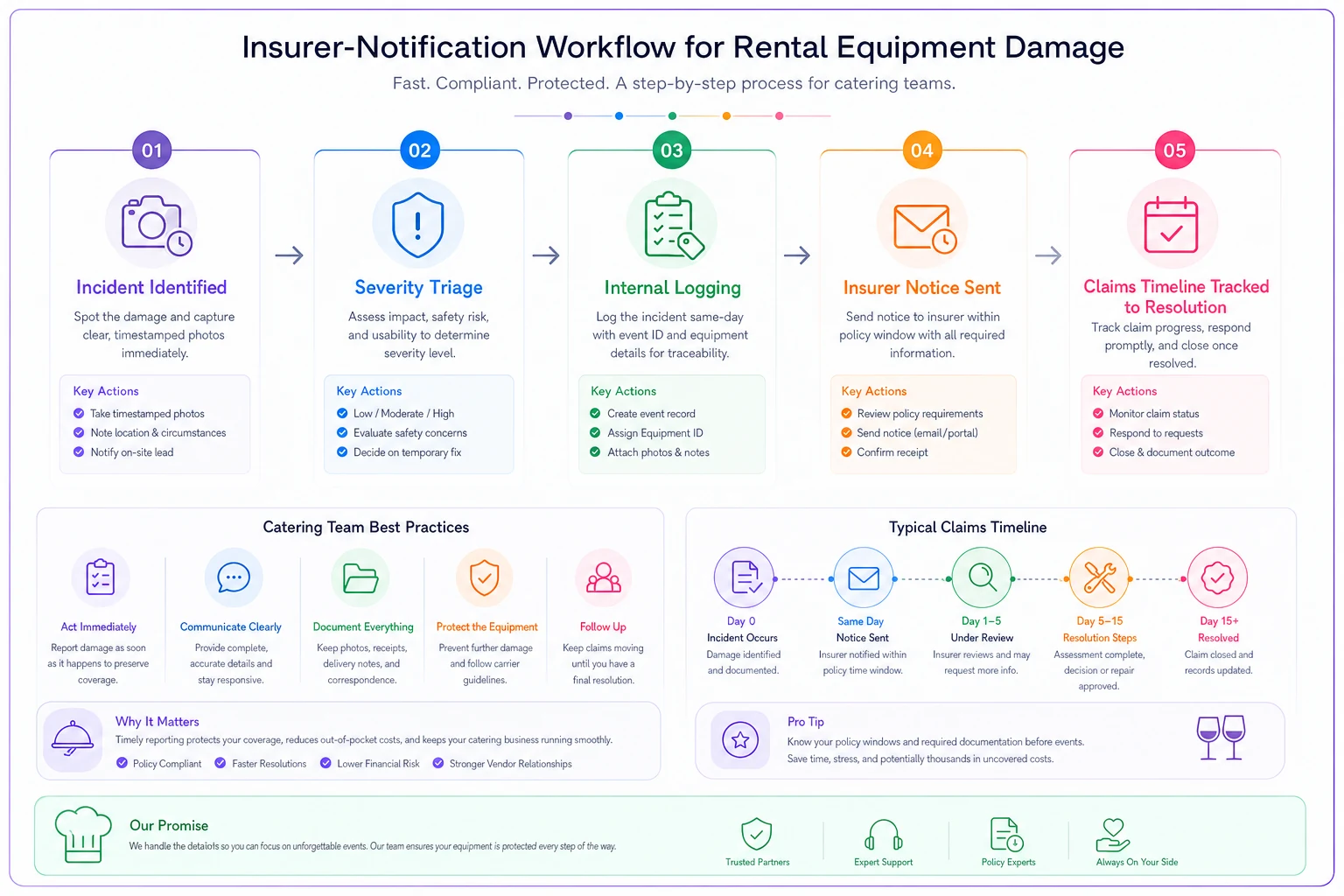
If you've built an on-the-spot incident triage and insurer packet workflow, this slots directly into it. The key difference here is that the damage-assessment rubric and the contract clauses feed the packet from the start, so you're not reconstructing what happened days later.
A damage-assessment rubric tied to day-of photo manifests
The photo manifest is only as useful as the rubric that reads it. A folder of 200 blurry phone pictures doesn't help anyone. What helps is a consistent scoring system applied at return — something your inspection person can work through in under a minute per item:
-
Grade A — Return-ready. No damage beyond normal wear. Photo confirms condition matches handover. No charge.
-
Grade B — Minor, repairable. Cosmetic or small functional issue. Logged with photo. Repair quote requested; charged against deposit if confirmed damage, not wear.
-
Grade C — Significant, repair threshold. Functional damage requiring meaningful repair. Photo and description logged. Enters the repair-vs-replace decision based on the 60–70% threshold.
-
Grade D — Total loss or unsafe. Equipment can't be safely used. Full assessment and insurer notification triggered if over the dollar threshold.
-
Grade M — Missing. Not present at return. Enters the 48–72 hour reconciliation grace window before charges apply.
The grade determines everything downstream — whether it hits the deposit, whether it triggers a claim, whether there's a dispute at all. And because each grade is tied to a required photo, you're never arguing from memory.
Organize return photos by event and item so you can pull handover and return images instantly during a dispute.
One thing worth noting: the caterers who dispute the fewest rental charges aren't the ones with the best equipment handling. They're the ones whose return photos are organized by event and item so they can instantly answer "prove it." When a rental company claims damage, being able to pull the handover photo and the return photo side by side usually ends the conversation in two minutes.
Where the manifests, contract, and claims actually connect
This is the part that trips people up. You end up with three separate systems — contracts in a filing cabinet or Google Drive, photos on someone's phone, claims in an email thread. When a dispute hits, you're cross-referencing all three manually, usually weeks after anyone remembers the details.
The connective tissue is matching every photo and every incident to a specific event ID and equipment line item from the contract. When the condition-at-handover clause, the day-of photo, the return grade, and the claims timeline all reference the same event record, disputes shrink from arguments into lookups.
In practice, this is where an operational platform earns its keep — not by doing anything magical, but by keeping the contract terms, the photo manifest, the damage grade, and the claims clock attached to one event record instead of scattered across four places. AI-assisted tagging can route a Grade C or D incident straight into the claims workflow and flag the policy notification window before it lapses, so nobody has to remember a deadline during the middle of event season. That's the difference between a reconciliation that takes twenty minutes and one that takes a week of email archaeology.
The same logic applies when you're the one setting terms with sub-rental vendors. A clear vendor scorecard and contract playbook keeps the damage and notification language consistent across every supplier you pull equipment from, so you're not negotiating from scratch every time.
When tight contract language is worth it — and when it isn't
Not every rental deserves a negotiated agreement. If you rent a handful of folding tables from the same local company every month and you've never had a problem, re-papering the deal is wasted effort. The flat deposit and a standard agreement are fine.
Tight language earns its keep when:
-
A single piece of equipment is expensive enough that one incident wipes out an event's margin — refrigeration, specialty cooking, AV.
-
You're sub-renting from a vendor you haven't worked with before, where the terms are unknown.
-
You're renting out your own equipment to clients or other caterers, where you're the one exposed.
-
The event is high-stakes enough that overnight custody questions are real — multi-day events, remote venues.
Where it's a bad idea is over-engineering low-value, high-trust relationships. Making your reliable linen supplier sign a six-page agreement for a $200 order burns goodwill you'll want later. Match the contract rigor to the dollar risk.
Real scenario: a mid-size caterer, one disputed invoice
A catering operation running roughly 120–140 events a year rented a double convection oven and two hot boxes for a 300-guest corporate gala. The gear sat at the venue overnight before the rental company's return pickup. Three weeks later, an invoice arrived: $1,650 for "damage to oven door hinge and dented hot box panel."
The caterer had no handover photos and no return photos. The custody question — who had the equipment overnight, the venue or the rental company's own pickup crew — was impossible to answer. They ended up paying around $1,200 after some back-and-forth, mostly because they couldn't prove the damage wasn't theirs.
After that, they added two things: a condition-at-handover clause requiring signed photo manifests, and a chain-of-custody clause assigning overnight liability to whoever physically held the equipment. The next time a rental company flagged damage — a cracked hot box latch — the caterer pulled the handover and return photos, both timestamped, both showing the latch intact at return. The charge, around $280, was dropped entirely. No lawyers, no drawn-out dispute, just two photos and a clause that pointed to them.
The change wasn't dramatic equipment handling. It was making the contract reference evidence that actually existed.
The practical starting point
You don't need to overhaul every agreement this week. Start with the equipment that can hurt you most — the expensive single items — and make sure three things are in writing: condition is established by timestamped photos, replacement follows a repair-first depreciated schedule, and the notification window is tight in both directions.
Then make sure your day-of photos are organized by event and item, not dumped in a camera roll. And connect the whole thing to your insurer's notification window so a damaged $4,000 oven doesn't become an uninsured loss because the claim went out two days late.
The caterers who stop losing money on rentals aren't lucky. They've just closed the gap between what happened and what they can prove — and the contract is where that gap gets closed.
Ready to elevate your catering business?
Join 500+ caterers trusting Caterngly to save time, reduce errors, and deliver flawless events.