


Most catering shops don't have an acceptance policy. They have a sales team that says yes, an operations team that quietly panics, and a chef who finds out about the 400-person plated dinner in a barn with no power roughly three weeks before load-in. The booking got accepted because it looked like revenue. Nobody scored the risk underneath it.
An event acceptance policy for caterers fixes that by making the risk visible before the contract goes out — and then connecting that risk directly to the deposit, the terms, and how the booking moves through your pipeline. Not a vibe check. An actual score. One that changes something downstream.
The problem with most "policies" is they live in someone's head. The owner knows a Saturday wedding in July at a venue with a gravel access road is a nightmare, but that knowledge doesn't transfer. New salespeople don't have it. And even the owner forgets to apply it consistently when the quarter is slow and the deposit looks nice. What you actually need is a single document that turns four buckets of risk — venue, technical, financial, and compliance — into a number, and ties that number to specific contract language and gates in your booking flow.
Why acceptance decisions break down as you grow
At two events a weekend, the owner is in every conversation and risk gets caught informally. The failure mode shows up once you're running three, four, five simultaneous events and the person selling is no longer the person executing.
Sales optimizes for close rate. Operations eats the consequences. There's no shared scorecard between them, so the two teams are measuring completely different things. Sales sees a $28k booking. Operations sees a venue with a 200-foot carry from the loading zone, no on-site refrigeration, a client who's already changed the guest count twice, and a certificate of insurance that hasn't shown up. Same event. Completely different reality.
The other thing that breaks: deposits stop matching risk. Most caterers run a flat deposit — 25% or 50% across the board. That's fine when your book is pretty homogeneous. It falls apart when you're mixing low-risk corporate lunches with high-risk destination weddings, third-party rentals, and a client paying from a personal Venmo account. A flat deposit means your riskiest events are underfunded and your safest ones feel overcharged — which annoys the good clients and exposes you on the bad ones.
And the quiet killer: compliance risk gets discovered too late to act on. By the time you realize the venue requires a specific liability limit you don't carry, or the site has a propane restriction that kills half your menu, you've already signed. The one moment you had leverage to say no or reprice is gone.
The four risk buckets, and what goes in each
A workable scoring model doesn't need forty inputs. It needs the handful that actually predict trouble. Score each bucket, then roll them into a single acceptance number.
End chaos with centralized catering management.
Caterngly helps you plan, confirm, and manage every catering event seamlessly.
- Unified event and order management
- Real-time client updates
- Staff and resource scheduling
No credit card required
Venue risk covers everything about the physical site that affects your ability to execute:
-
Access (loading distance, elevator vs. stairs, gravel vs. pavement)
-
On-site power and water
-
Kitchen or prep space, or the absence of it
-
Distance from your commissary and traffic patterns that affect hot-hold windows
-
Whether you've worked the site before
Technical risk is about the complexity of what you've promised to deliver:
-
Service style (drop-off is low risk; multi-course plated is high)
-
Guest count relative to your comfortable ceiling
-
Special equipment — live-fire stations, ice carving, anything you're renting for the first time
-
Third-party vendor dependencies you don't control
-
Menu complexity relative to available prep space
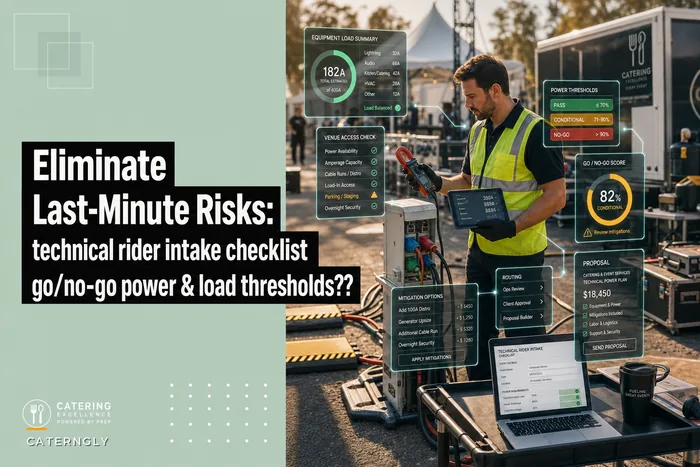
Your technical rider intake checklist with go/no-go thresholds for event sites is where most of these inputs should get captured — the acceptance score reads from that intake rather than duplicating it.
Financial risk is about getting paid and about the event's own margin:
-
Client type (established corporate account vs. first-time individual)
-
Payment method and history
-
Booking lead time (a 10-day-out event carries different cash risk than one booked 8 months ahead)
-
Estimated margin on the event as quoted
-
How much discount pressure came up during the sale
Compliance risk covers anything that creates legal or regulatory exposure:
-
COI requirements from the venue
-
Alcohol service — whether you or a third party holds the permit
-
Food safety constraints (outdoor events, long hold times, high-risk menu items)
-
Permits, fire marshal sign-offs, health department requirements for the site type
Your technical rider intake checklist with go/no-go thresholds for event sites is where most of these inputs should get captured — the acceptance score reads from that intake rather than duplicating it.
Turning inputs into a score that means something
The mistake with scoring is over-engineering it. You don't need a weighted regression model. You need a 1–5 scale per bucket, a rough weighting, and a total that maps to a decision. The goal is consistency, not false precision.
Score each bucket 1 (clean) to 5 (dangerous), apply the weights, and total to a 100-point scale.
| Risk bucket | Weight | What a "5" looks like |
|---|---|---|
| Venue | 25% | New site, long carry, no power, an hour from commissary |
| Technical | 30% | Plated service near capacity ceiling, first-time rented equipment, dependent on vendors you don't control |
| Financial | 25% | First-time individual, short lead time, thin margin, discount already given |
| Compliance | 20% | High COI requirement, third-party alcohol, outdoor food safety exposure |
Technical gets the heaviest weight because that's where execution actually fails on the day. A payment problem you can chase after the fact. A collapsed plated service in front of 300 guests you cannot undo.
Once you have a total, sort every booking into tiers. The tier isn't just a label — it's a trigger.
Mapping scores to terms, deposits, and gates
This is what separates a real acceptance policy from a scoring exercise nobody uses. The score has to change three things automatically: the deposit required, the clauses that appear in the contract, and how much human approval the booking needs before it goes out.
| Tier | Score range | Deposit | Contract posture | Booking gate |
|---|---|---|---|---|
| Green | 0–35 | Standard (e.g. 25%) | Standard terms | Auto-approve, salesperson can confirm |
| Yellow | 36–60 | Elevated (e.g. 40%) | Add tightened change-order and COI clauses | Ops lead review before contract sends |
| Orange | 61–80 | High (e.g. 50–60%) + rental deposit | Add cancellation, force-majeure, indemnity language | Ops + finance sign-off required |
| Red | 81–100 | Full pre-event or decline | Custom terms or no bid | Owner/GM approval only |
Tie the score tiers directly to your deposit and payment-schedule logic so the system, not a rep, sets the terms.
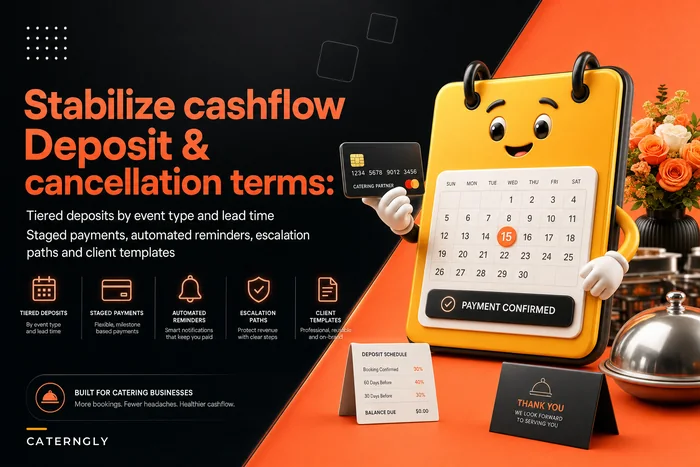
The deposit tiers should connect directly to the logic in your deposit, payment schedule and cancellation terms that stabilize catering cashflow — the acceptance score is what decides which payment schedule a given event lands on, rather than applying one schedule to everyone by default.
Worth calling out: the deposit on Orange and Red events isn't just about cash timing — it's covering real exposure, especially when rentals are involved. When a client walks or damages equipment, the deposit is your first line of recovery. That's exactly why your photo check-in/out manifests and deposit reconciliation rules for rentals should key off the same risk tier. High-risk events need a higher rental deposit and stricter documentation, not one or the other.
The contract clauses also shouldn't get improvised per deal. You want a clause library where each risk trigger pulls in pre-approved language. A high compliance score pulls the enhanced insurance and indemnity block. A high financial score pulls the tighter cancellation ladder. Salespeople assemble; they don't draft. That keeps your legal exposure consistent and stops the "we forgot to include the COI clause" problem from repeating itself.
The workflow, start to finish
Here's how it actually runs when a lead comes in:
-
Intake captures the raw inputs. The salesperson or an intake form pulls venue details, service style, guest count, client type, payment method, lead time, and compliance requirements. Single entry point — data comes in once.
-
The score gets calculated. Each bucket scores 1–5, weights apply, total lands in a tier. This should be automatic — once the intake is complete, the tier is set. Manual scoring quietly stops happening within a few weeks.
-
The gate fires. Green flows straight to contract. Yellow, Orange, and Red route to the right approver before anything goes to the client. Nobody skips the gate to close faster.
-
Contract assembles from the clause library. The tier determines deposit percentage and which clause blocks appear. The document going out already reflects the risk.
-
Deposit terms lock to the tier. The payment schedule and rental deposit are set by the score, not negotiated after the fact.
-
The score follows the event into operations. When the client changes the guest count or swaps the venue, the score recalculates. An event that was Yellow can become Orange after a scope change — and that should re-trigger a review, not silently ride the old terms.
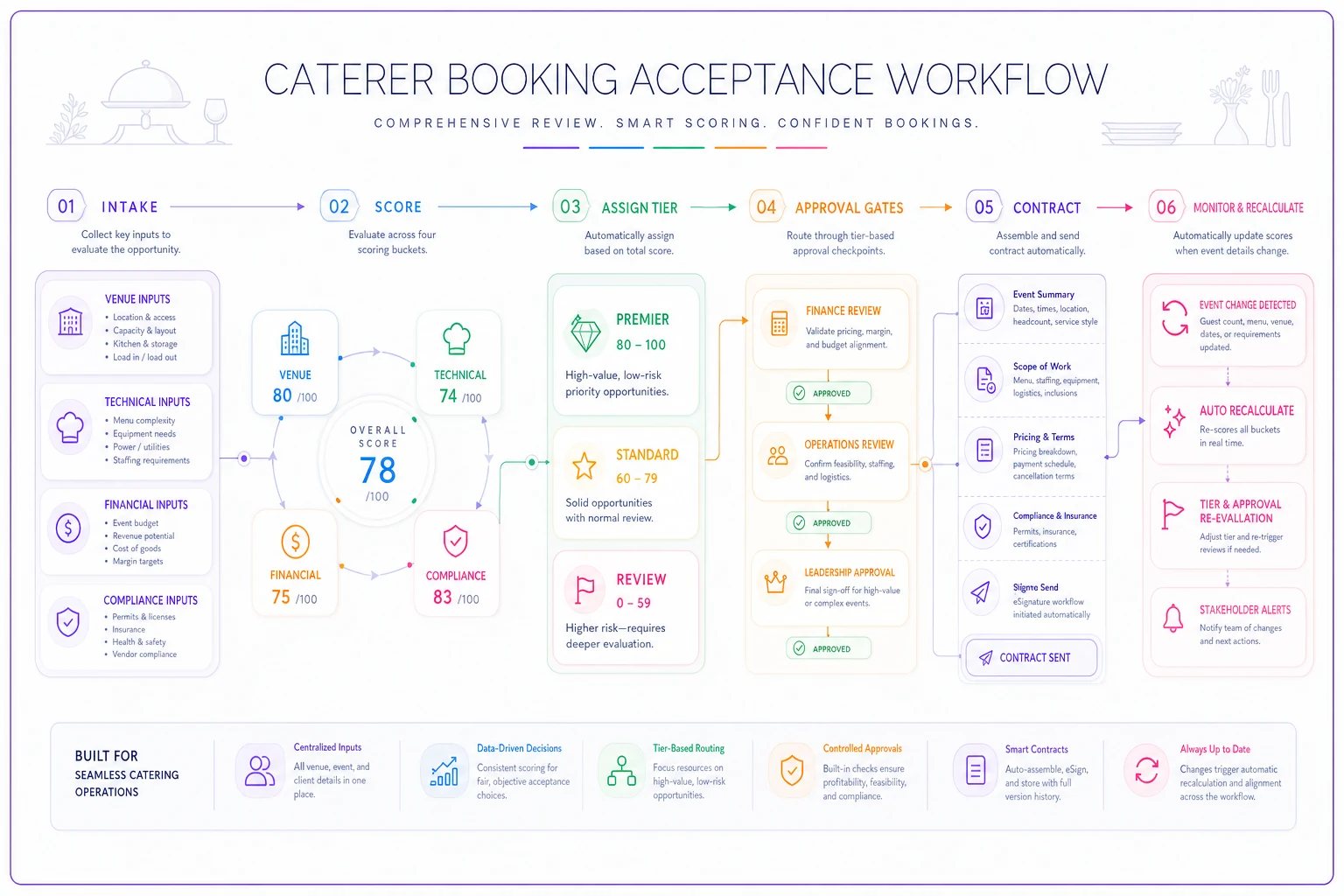
That last point is where a lot of shops leak. They score at intake and never look again. But the risk profile of an event isn't static. A client who moves the date from October to July, adds 80 guests, and switches to an outdoor site has fundamentally changed the risk — and the deposit and terms should have moved with it. Tying the score to a system that recalculates on change, rather than a spreadsheet someone filled out once, is what keeps the policy honest over time. AI-powered operational software earns its keep here specifically: the recalculation and re-approval trigger happen automatically, without anyone remembering to initiate them.
A real scenario
A mid-sized catering company doing roughly $2M a year — mostly weddings and corporate — kept getting burned by the same pattern. First-time individual clients booking summer outdoor weddings within about 60 days of the date, often at venues the team had never worked. Flat 30% deposit across the board.
Two events in one season went sideways: one client fell behind on the payment schedule and the event nearly ran unpaid; another was at a site with no power that required a last-minute generator rental that ate the entire margin.
They built a scoring model close to the one described above. The immediate effect wasn't that they started turning away a lot of work — maybe two or three bookings all year. The bigger shift was repricing. Those short-lead, first-time, outdoor-venue events now landed as Orange, which meant a 50% deposit and a generator surcharge baked into the contract from the start. Events they used to lose money on became roughly break-even or modestly profitable, and the exposure on slow-paying clients basically disappeared because the deposit covered the bulk of food and labor cost before load-in.
The other thing they noticed: sales stopped fighting operations. When the score is on the page and it sets the deposit automatically, the conversation changes. It stops being "why are you making this hard" and becomes "the event scored Orange, here's the deposit requirement." The number does the arguing.
When this makes sense — and when it doesn't
Worth building if you're running multiple simultaneous events, the person selling isn't the person executing, and your book has real variety in venue type, client type, and complexity. If you've lost money on even one or two events per year that should have been priced differently or declined outright, the policy pays for itself quickly.
Overkill if you do a narrow, repeatable product — corporate drop-off lunches at the same handful of office parks, same clients, net-30 terms. Your risk is homogeneous. A simple checklist covers it. Don't build a four-bucket scoring model for events that all score the same.
Not yet if you're a newer caterer still figuring out your own execution ceiling. You can't accurately score technical risk against a capacity you haven't found yet. Do a season or two, learn where things actually break, then codify it. A model built on guesses about your own limits just produces false confidence.
The point of the whole thing
An acceptance policy isn't about saying no more often. Most shops that adopt one decline only a handful of events per year. The real value is that the risky events you do take get priced and papered correctly — and the decision stops depending on who happened to answer the phone and how the quarter was looking that week.
The score connects the parts of your business that usually don't talk to each other — sales, operations, finance, and compliance — around a single number everyone can see. When that number automatically sets the deposit, assembles the contract, and decides who has to approve the booking, the policy stops being a document nobody reads and starts being the actual gate every event passes through. That's the difference between knowing your risky events are risky and actually doing something about it before you've signed.
The score connects the parts of your business that usually don't talk to each other — sales, operations, finance, and compliance — around a single number everyone can see. When that number automatically sets the deposit, assembles the contract, and decides who has to approve the booking, the policy stops being a document nobody reads and starts being the actual gate every event passes through. That's the difference between knowing your risky events are risky and actually doing something about it before you've signed.
Ready to elevate your catering business?
Join 500+ caterers trusting Caterngly to save time, reduce errors, and deliver flawless events.