

Most technical rider problems don't show up in the proposal stage. They show up around 6am on event day, when your convection oven trips a breaker that the venue swore "should have been fine," and now you've got 140 plated covers and no way to hold them hot. The information that would've prevented that was available weeks earlier. Nobody asked for it in a structured way.
That's the real gap. Caterers get incredibly precise about menus, headcounts, and dietary restrictions, then treat the physical site — power, water, access, load-bearing, clearance — like it'll sort itself out. It usually does. Until it doesn't, and the failure is expensive and very public.
This is about building a technical rider intake catering process that scores each site against hard minimums, flags go/no‑go thresholds, and adapts the questions to the event type. Not a generic venue walkthrough form. A scored intake that tells you, before you commit staff and food, whether the site can actually support what you sold.
Why generic site surveys fail
The typical site survey is a page of open-ended questions. "Is there adequate power?" "Where's the kitchen?" "Any access restrictions?" A sales rep or event lead fills it out, everyone nods, and those answers disappear into an email thread.
The problem is that "adequate" is doing all the heavy lifting in that sentence, and nobody defined it. Adequate for a passed-appetizer cocktail hour is completely different from adequate for hot plated service for 200. The person filling out the survey often doesn't know the load requirements of the equipment the kitchen team will actually show up with. So you get confident answers to questions that were never specific enough to matter.
-
The site contact answers based on what they think is true, not what's been measured. "There's plenty of power" usually just means the last party didn't complain.
-
Nobody converts equipment nameplate ratings into actual amperage draw against available circuits.
-
Access constraints — stairs, elevator dimensions, load-in windows, dock height — get noticed too late to actually change anything.
-
Outdoor sites get treated like indoor sites minus a roof, which skips generator sizing, grounding, weather contingency, and grey-water rules entirely.
The fix isn't a longer form. It's a scored one, with numeric thresholds that turn vague reassurances into pass/fail signals.
The core idea: minimum specs, then go/no‑go thresholds
Before you can score anything, you need to know your own minimums. This is equipment-driven, not venue-driven. Sit down with your kitchen lead and document the actual draw of the gear you deploy by service type.
End chaos with centralized catering management.
Caterngly helps you plan, confirm, and manage every catering event seamlessly.
- Unified event and order management
- Real-time client updates
- Staff and resource scheduling
No credit card required
A rough working example for a mid-size plated event:
| Equipment | Typical draw | Notes |
|---|---|---|
| Electric convection oven | ~30–40A @ 208V | Usually needs a dedicated circuit |
| Hot holding cabinet (each) | ~12–16A @ 120V | Two or three of these adds up fast |
| Coffee urns (2x) | ~13A each @ 120V | People forget these; they trip everything |
| Induction burners (per unit) | ~13A @ 120V | Popular for live stations |
| Refrigerated prep unit | ~6–8A @ 120V | Runs continuously |
Once you know your load, the venue question stops being "is there enough power?" and becomes "do you have a dedicated 40A 208V circuit within 50 feet of the kitchen staging area, and how many separate 120V 20A circuits are available in that zone?" That's a question with an actual answer — one you can score.
-
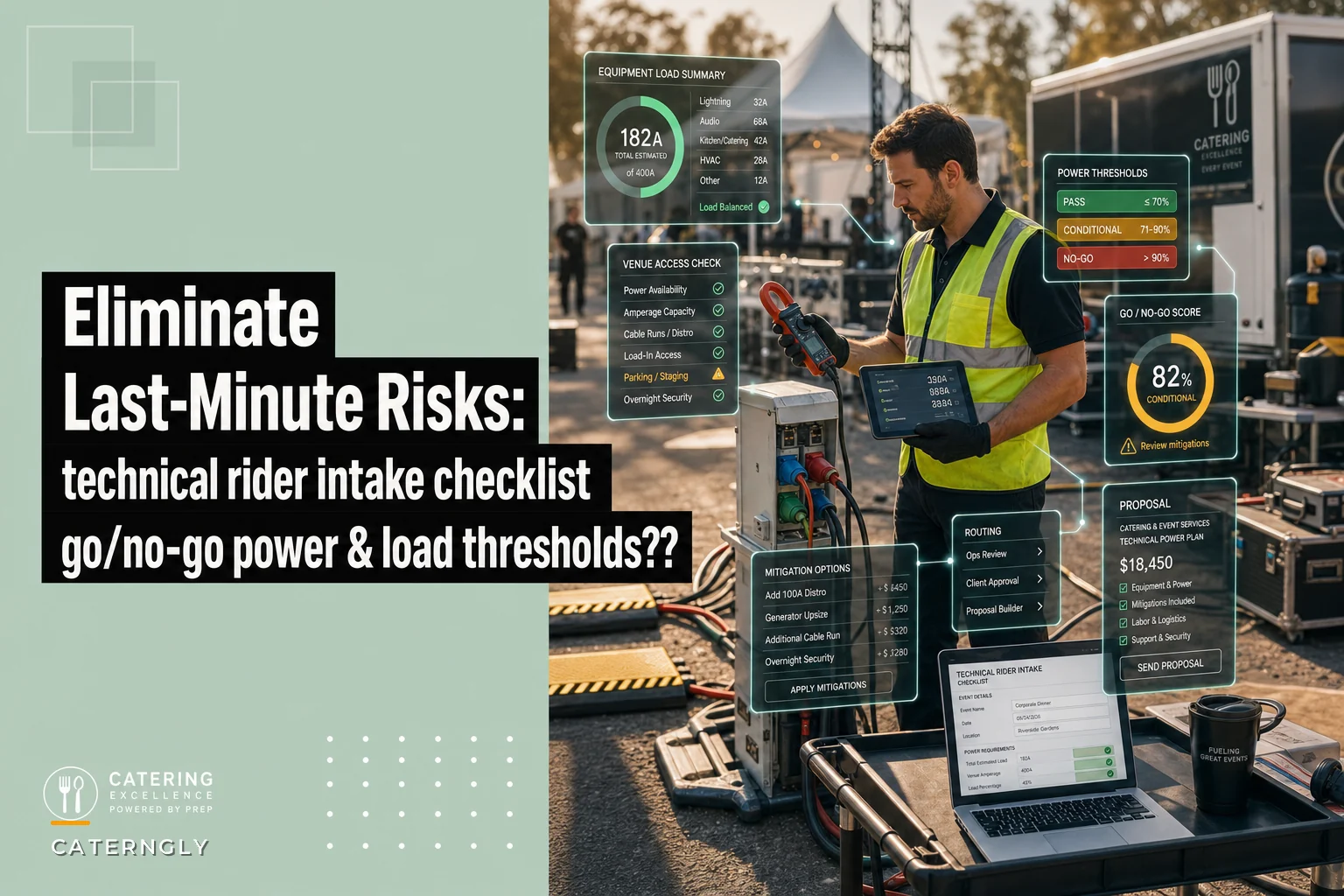
Power If available amperage on the required voltage falls below your equipment total plus a 20% buffer → NO‑GO without a supplemental power plan (generator or venue electrician).
-
Access If the load path requires stairs with no elevator and your hot-box carts weigh 200+ lbs loaded → NO‑GO without additional labor budgeted.
-
Water If there's no potable water source within reasonable hose distance for a hot-service menu → NO‑GO without a water delivery plan.
-
Clearance If the kitchen staging footprint is under your minimum square footage for the covers sold → conditional, requires a menu or service-style change.
A "NO‑GO" doesn't kill the booking automatically. It means the booking can't proceed as sold until a specific mitigation is attached and priced. That distinction is the whole point.
Mapping the intake to event templates
A single flat form is where most caterers go wrong. A backyard wedding, a downtown corporate lunch, and a rooftop product launch have completely different failure modes. The intake should branch by event type, surfacing only the questions that matter and applying the thresholds that fit.
Wedding template
-
Residential vs. commercial panel; total available amperage across the property
-
Distance from staging to the nearest usable power drop
-
Tenting
is a separate service tent budgeted, and what's the ground surface?
-
Restroom and handwashing access for staff
-
Generator permitted? Noise ordinance cutoff time?
The go/no‑go that catches people most often: a beautiful estate with a single 100A residential panel already running the venue's own lighting, sound, and AC. Your hot service alone can eat that. If the intake doesn't force an amperage inventory, you find out when the whole property goes dark mid-toast.
Corporate template
-
Freight elevator dimensions and weight limit (measure it yourself, don't trust the listing)
-
Load-in window — exact start time and hard stop
-
COI requirements and lead time to file
-
Building engineer contact for power access
-
Union labor requirements for load-in (this is a budget bomb if you miss it)
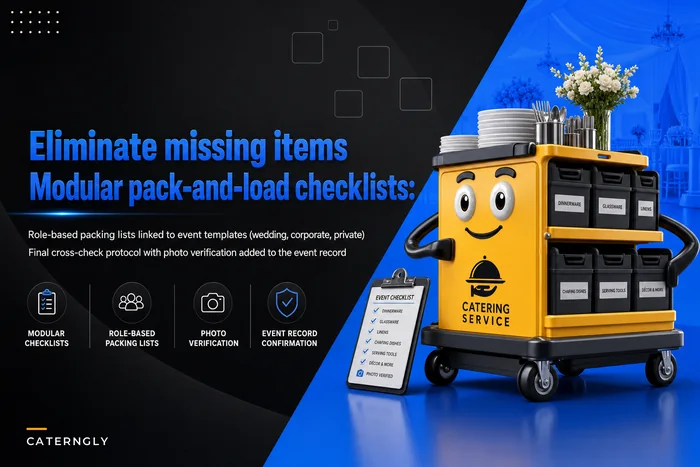
The threshold that matters most: if the load-in window is under two hours for a full plated setup, that's a conditional flag requiring either extra labor or a staggered delivery plan. Tight windows compound with everything else that goes sideways. This is also where a clean pack sequence matters — the discipline behind modular pack-and-load checklists is what lets a crew hit an aggressive dock window without leaving a hotel pan behind.
Outdoor template
-
Generator sizing and fuel plan; grounding requirements
-
Distance from generator to service area (cable runs, tripping hazards, noise)
-
Grey-water disposal rules — some sites forbid dumping entirely
-
Ground surface and slope for equipment stability
-
Weather contingency
tent, sidewalls, wind rating, heat or cold plan
-
Vehicle access to the actual service point vs. a distant parking lot
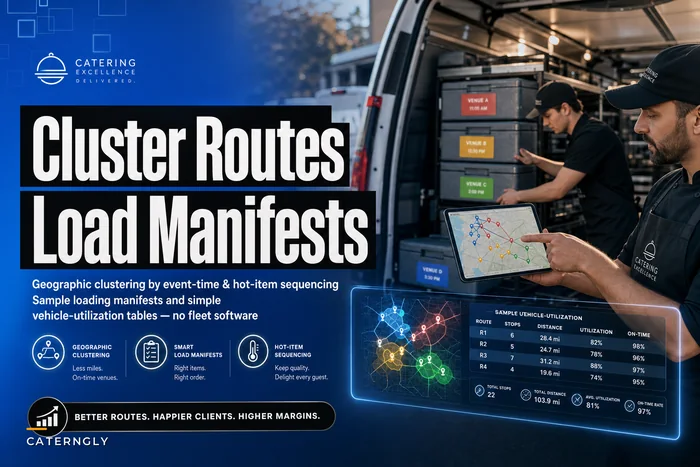
The classic outdoor go/no‑go: no vehicle access to within a reasonable distance of the setup, which means everything gets hand-carried across a field. If your intake surfaces a 300-foot carry over uneven ground, that changes both the labor plan and the equipment plan. The distance and sequencing logic connects directly to how you think about loading manifests and hot-item sequencing — a long carry means hot items load last and move first.
A real scenario
A regional caterer running somewhere around 120–150 events a year kept absorbing the same category of loss: roughly one event a month where the site turned out to be under-provisioned and they had to scramble. Rented a generator at emergency rates, pulled an extra crew member to run a long power drop, or in one case comped part of the bill because service ran 40 minutes late.
These surprises were costing them somewhere in the $600–$1,100 range per incident once you counted emergency rentals, extra labor, and the occasional partial refund. Low five figures a year, plus the reputational drag from events that went sideways in front of the client.
They rebuilt their intake as a scored form with hard thresholds — amperage inventory required, load path measured, event-type branching. The first thing it caught was two bookings that quarter where the venue simply couldn't support the sold menu. Instead of finding out on the day, they priced in a generator and an extra hand before signing and passed the cost through. The day-of scramble events dropped from ten-plus to maybe two or three across the following year. The quieter win: sales stopped promising hot plated service at sites that couldn't run it.
Building the scored intake, step by step
You don't need software to start. You need discipline and a scoring rule.
-
Document your equipment loads by service type. Pull nameplate ratings, convert to amperage, and total them for your standard cocktail, buffet, and plated setups. This is your baseline demand.
-
Set hard thresholds for each critical dimension — power, water, access, clearance, waste. Write actual numbers. "Requires 40A 208V dedicated" beats "needs good power."
-
Branch the form by event type. Wedding, corporate, outdoor each get their own required fields on top of the shared core.
-
Score every field as pass / conditional / no‑go. Conditional means "proceed only with a named, priced mitigation attached."
-
Require the mitigation before the booking advances. A no‑go can't be waved through with optimism. It needs a generator quote, an extra-labor line, or a menu change on the record.
-
Feed the result into the proposal. The intake outcome should directly shape what you quote and what you promise.
Once this lives in a shared platform rather than a PDF, the scoring can run automatically — the system flags a booking the moment the entered amperage drops below your equipment total plus buffer, and routes that flag to whoever owns mitigation. That's where AI-assisted operational tools genuinely earn their place: not writing the checklist for you, but watching every incoming intake against your thresholds and surfacing the ones that need a human decision before anyone commits crew and food.
When documenting equipment loads, include nameplate ratings and at least one measured operating draw to catch differences between nominal and real use.
Here's a simple visualization of the scoring workflow.
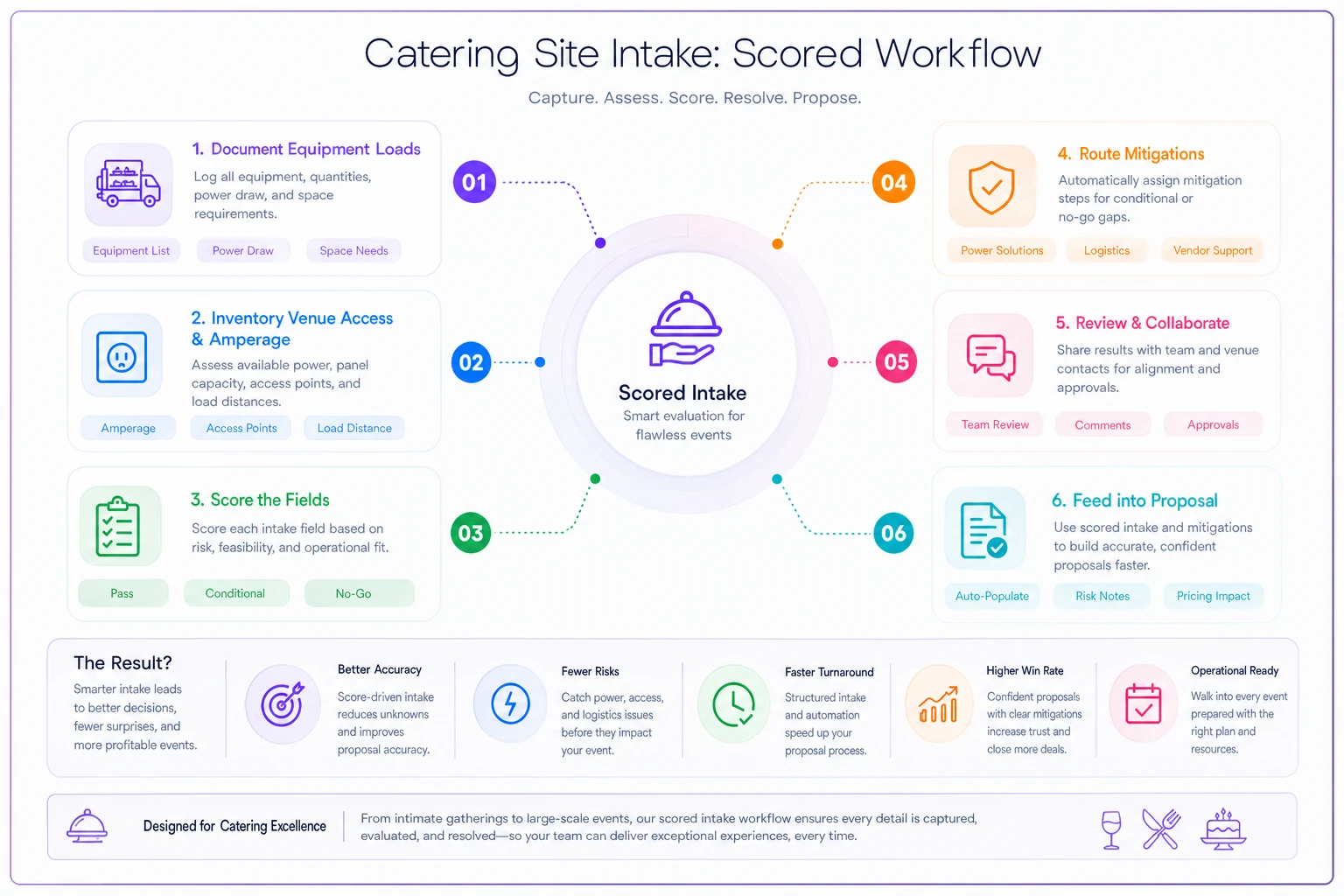
The judgment stays yours; the catching-it-early part gets automated.
Your go/no‑go intake checklist
Use this as the shared core across all event types, then layer the template-specific fields on top:
-
Equipment load total calculated for the sold service style
-
Available amperage inventoried by voltage and circuit, not estimated
-
Power headroom ≥ 20% above equipment total (else flag)
-
Load path measured
distances, stairs, elevator dimensions, dock height
-
Loaded cart weight vs. load path feasibility confirmed
-
Potable water source located and distance recorded
-
Grey-water / waste disposal rules confirmed in writing
-
Staging footprint square footage vs. minimum for cover count
-
Load-in window start and hard stop documented
-
COI / permit / union requirements identified with lead times
-
Every no‑go has a named, priced mitigation attached
-
Intake outcome reflected in the final proposal and promise
When a scored intake is overkill
If you run small, low-complexity events at venues you know cold — a recurring client's office, your own commissary space — a full scored intake is friction you don't need. You already have the answers. Forcing the form there just trains people to click through it without reading.
It becomes essential the moment you take on unfamiliar sites, non-commercial venues, or anything outdoors. Unknown venues are exactly where reassurances are least reliable and the cost of being wrong is highest. New site or new event type → scored intake, no exceptions. Known site, known setup → a lighter confirmation works fine.
Worth naming who shouldn't own this: whoever's closing the sale should not be the sole judge of whether a site is technically viable. The incentives push toward "yes, it'll be fine." The intake should route technical scoring to someone operational, and the day-of handoff should be explicit — which ties into avoiding the vendor coordination mistakes that derail events when nobody owns the technical decisions on the ground.
The point
The events that blow up on-site rarely blow up because of something nobody could've known. They blow up because someone accepted a vague "it'll be fine" instead of a measured number, and because the intake form asked soft questions that produced soft answers. A scored technical rider intake with real go/no‑go thresholds doesn't make sites cooperate — it just moves the discovery of a bad site from load-in morning to the negotiating table, where you can still do something about it. That shift, from crisis to line item, is the entire return on the effort.
Ready to elevate your catering business?
Join 500+ caterers trusting Caterngly to save time, reduce errors, and deliver flawless events.