



There's a specific moment in a catering business where financial governance stops being optional. It's usually not when you hit a revenue number. It's when you walk into a bank or sit across from an equipment lessor and they ask a question your spreadsheets can't answer: "How much does your cash position swing between your busiest and slowest months, and how predictable is that swing?"
Most caterers freeze there. Not because they don't know their business — they know it in their bones — but because that knowledge lives in their head, in a booking calendar, in a QuickBooks file, and in six different places that don't talk to each other. A lender doesn't fund a gut feeling. They fund a system that produces consistent numbers they can trust.
This article is about building that system. Not the generic "track your KPIs" advice you've read a hundred times, but the actual plumbing that connects event-level performance to a budget, connects that budget to a rolling forecast, and connects all of it to exhibits a credit committee will accept. If you've been running on event instinct and want to be genuinely capital-ready, this is the operational backbone.
Why caterers specifically struggle with financial governance
Most financial governance frameworks assume a business with smooth, repeating revenue. A dental practice bills roughly the same every week. A SaaS company has MRR. Catering has neither. You have lumpy, event-driven cash that arrives in deposit chunks, gets spent on perishables and labor in concentrated bursts, and then goes quiet.
That lumpiness breaks standard financial tools in a few predictable ways.
The first break is the averaging trap. When you look at a monthly P&L, a great wedding weekend and three slow weekdays blend into one "okay" month. The average hides the fact that your profit came from two events and the other eleven barely broke even. Lenders know this, which is why they poke at averages hard.
The second break is timing mismatch between booking, cash, and cost. You book a $40k corporate gala in March for a June event. The deposit hits in March, final payment in July, but you're paying for rentals, food, and staff in June. Your accounting might show the revenue in one period and the cost in another, and your cash account tells a third story entirely. Without a model that respects event timing, your financials look either unrealistically rosy or alarmingly broke depending on which week you print them.
The third break is the governance gap between what you measure operationally and what shows up financially. Plenty of caterers have a decent operational dashboard — covers served, labor hours, food cost per head. But those numbers never get translated into a budget variance a CFO or a banker would recognize. The operational world and the financial world run on separate tracks.
Financial governance for caterers, done right, is the discipline of connecting those tracks. Taking the event you already run and making its financial signature legible, repeatable, and forecastable.
The architecture: three layers that have to connect
Before any templates, you need to understand what connects to what. Governance isn't a report — it's a chain. Each layer feeds the next, and a break anywhere makes the whole thing untrustworthy.
End chaos with centralized catering management.
Caterngly helps you plan, confirm, and manage every catering event seamlessly.
- Unified event and order management
- Real-time client updates
- Staff and resource scheduling
No credit card required
Here's the chain, bottom to top:
-
Per-event KPIs — the raw operational and financial signature of each event
-
Budget — your planned financial position, built from an expected mix of those events
-
Three-horizon forecast — your rolling view of where cash and margin are actually heading
-
Governance packs — the monthly and quarterly documents that compare plan vs. actual and feed decisions
-
Lender exhibits — the distilled, external-facing proof of all of the above
The mistake most operators make is building the top and skipping the bottom. They create a nice-looking forecast with no event-level foundation, so when reality diverges, they can't explain why. A credit committee doesn't just want the number — they want to see that you know which event types, seasons, or client segments drive the variance. That only comes from the bottom layer being solid.
If your per-event numbers aren't trustworthy yet, that's the first fix, and it ties directly into having a proper per-event P&L with canonical allocation rules. Governance built on inconsistent event accounting is governance built on sand.
Layer one: per-event KPI templates that actually feed a budget
The point of event KPIs in a governance context isn't operational tuning — you have other tools for that. The point is to capture each event in a form that rolls up cleanly into a budget line. That means every event needs the same fields, calculated the same way, every single time. Consistency matters more than sophistication here.
A per-event KPI template that's governance-ready should capture these fields at close:
-
Event type and channel (wedding / corporate / social / nonprofit; direct / venue-referred / planner-referred)
-
Contracted revenue vs. realized revenue (after change orders, discounts, and write-offs)
-
Food cost % and labor cost % against realized revenue
-
Contribution margin $ and contribution margin % after direct costs
-
Deposit timing (days before event the deposit cleared)
-
Final payment timing (days after event final cash cleared)
-
Overtime hours as a flag, separate from planned labor
-
Scope-change count and value (how much the event drifted from contract)
Notice what's included and what isn't. You're not tracking plating speed or guest satisfaction here — those belong in operations. The governance template is laser-focused on the fields that explain cash and margin.
Here's a simplified example of how two events in the same month can look wildly different once you capture them this way:
| Field | Event A (corporate lunch) | Event B (wedding) |
|---|---|---|
| Contracted revenue | $8,400 | $31,000 |
| Realized revenue | $8,400 | $33,800 |
| Food cost % | 31% | 28% |
| Labor cost % | 22% | 34% |
| Contribution margin % | ~41% | ~31% |
| Deposit timing | 9 days before | 112 days before |
| Final payment timing | 3 days after | 44 days after |
| Overtime hours | 0 | 11 |
| Scope changes | 0 | 4 (+$2,800) |
Both are "good" events. But Event B tied up a deposit for nearly four months, generated meaningful overtime, and only reached final cash a month and a half after the work was done. Event A was smaller but cleaner and faster on cash. A budget that treats both as generic "revenue" misses the entire story — and so does a forecast built on top of it.
The insight most operators miss: two events with identical margin can have completely different cash profiles, and cash profile is what lenders underwrite. Capturing deposit and final-payment timing per event is what lets you build a cash forecast that actually holds up, which is the foundation of any event-driven cashflow model that lenders will accept.
Layer two: tying KPIs to a budget that respects event mix
A standard annual budget for a caterer — "we'll do $1.4M in revenue at 15% net" — is almost useless for governance because it has no texture. The better approach builds the budget from event mix assumptions, so variance can be traced to a cause.
Build your budget as a mix model:
-
Estimate the number of events per type per month, based on last year's calendar adjusted for known bookings and seasonality.
-
Attach a standard contribution margin band to each event type, pulled from your historical per-event KPIs.
-
Attach a standard cash timing profile to each type (deposit lead time, final payment lag).
-
Layer in fixed overhead per month separately — rent, salaried staff, insurance, software.
-
The result isn't one number. It's a monthly budget with an expected event count, expected margin, and expected cash curve.
When April comes in under budget, you don't just know you missed — you can see whether you ran fewer weddings than planned, whether margins compressed, or whether the mix shifted toward lower-margin corporate work. That diagnostic ability is the entire point. A banker trusts an operator who can explain variance by cause far more than one who just reports it.
A quick pattern worth noting: caterers who shift heavily toward venue-referred and planner-referred work often see revenue hold steady while contribution margin quietly erodes, because referral channels carry commission drag and more scope negotiation. A mix-based budget surfaces that erosion months before it shows up as a cash problem. A flat revenue budget never catches it.
This connects naturally to a broader profitability operating system that locks event margins — the budget is where those locked margins get aggregated and tracked against reality.
Layer three: the three-horizon forecast cadence
A single forecast horizon doesn't work for catering because your business operates on three different time scales at once. You're executing events this week, booking events for next quarter, and shaping capacity for next year — and each of those needs a different forecast with a different cadence and different precision expectations.
Here's how the three horizons break down:
Horizon 1 — Committed (0–90 days). This is near-certain. Events are contracted, deposits are in, costs are largely known. This forecast should be nearly precise and refreshed weekly. Lenders care most about this horizon because it's where repayment capacity is most visible. Precision here builds credibility for everything else.
Horizon 2 — Pipeline-weighted (3–9 months). This is contracted events plus weighted probable bookings. You apply conversion probabilities to proposals in your pipeline and blend them with historical seasonal patterns. Refresh this monthly. The honesty of your probability weighting is what separates a serious forecast from wishful thinking — and experienced lenders can smell an un-haircutted pipeline immediately.
Horizon 3 — Strategic (9–24 months). Driven by capacity, market, and seasonal assumptions rather than specific bookings. It's where you model "what if we add a second kitchen" or "what if we push into corporate." Refresh quarterly. Precision is low by design; the value is in the range and the assumptions behind it.
A simple visual of the three-horizon forecast cadence:
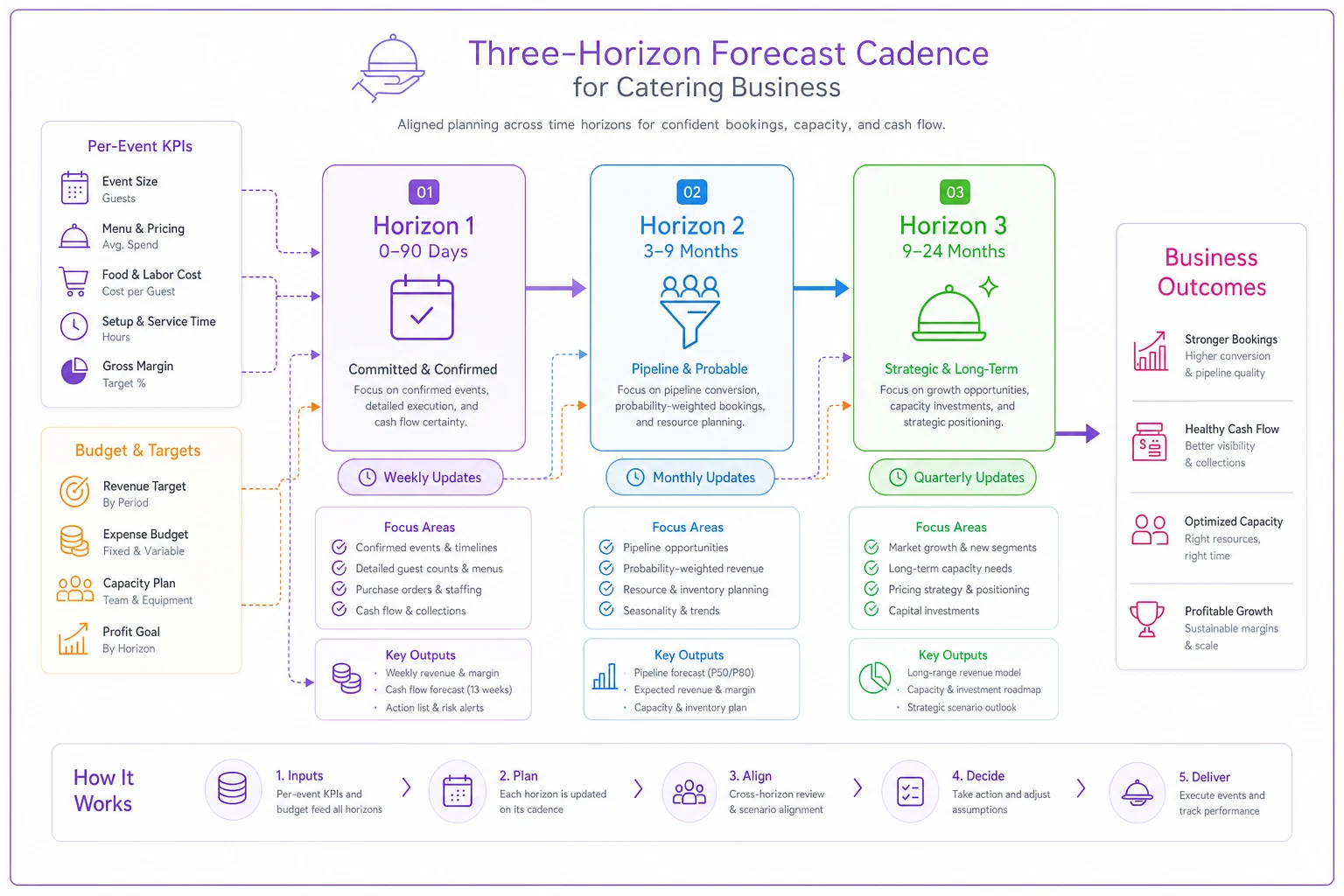
The cadence matters as much as the horizons. A forecast that only gets updated when you're applying for a loan is a dead document. The governance discipline is the rhythm — weekly on Horizon 1, monthly on Horizon 2, quarterly on Horizon 3 — so that when a lender asks for a forecast, you hand them a living one you've been maintaining, not a panicked reconstruction.
One pattern worth flagging: caterers who only run a single blended forecast tend to over-promise on the near term and under-think the long term. Splitting into three horizons forces appropriate confidence at each level. You stop treating a probable June booking with the same certainty as a signed April one.
Layer four: monthly and quarterly governance packs
The governance pack is the document that turns all of this into a decision-making ritual. It's not for the lender yet — it's for you and your leadership, run on a fixed schedule so problems surface early. The discipline of producing it monthly is what makes you genuinely capital-ready, because the lender exhibits become a byproduct rather than a scramble.
A monthly governance pack should contain:
-
Budget vs. actual summary — revenue, contribution margin, and net, with variance explained by event mix and margin, not just totals
-
Event scorecard — the month's events with their KPI signatures, flagging any that fell outside margin bands
-
Horizon 1 cash position — actual cash plus the next 90 days of committed inflows and outflows
-
Pipeline health — proposals outstanding, weighted value, conversion trending
-
Covenant / ratio watch (if you have debt) — current ratio, debt service coverage, days cash on hand
-
Exceptions and actions — a short list of what broke and what you're doing about it
The quarterly pack is heavier. It rolls up the three monthly packs, refreshes Horizon 2 and 3 forecasts, revisits the mix-based budget against reality, and includes a trailing-twelve-month view that smooths the lumpiness lenders find hard to read.
The single biggest governance mistake is treating these packs as reporting instead of decision tools. A pack full of numbers with no "exceptions and actions" section is just a scorecard nobody acts on. The value isn't the data — it's the forced monthly conversation about what the data means and what changes as a result.
> April — Revenue $118k actual vs. $127k budget (−7%). Variance driven by two weddings pushed to May (not lost), partially offset by higher-than-planned corporate volume. Contribution margin held at 29% vs. 28% budget — corporate mix compressed margin less than feared. Action: no concern; May Horizon 1 reflects the shifted events.
That single paragraph tells a lender's analyst more than a page of raw numbers. It shows you understand your own business at the level of cause.
Layer five: lender-ready exhibits
When you actually sit down for financing — a line of credit, equipment lease, acquisition loan — the lender wants a specific, distilled set of exhibits. If you've been running the governance packs, assembling these is mostly extraction, not creation.
The core exhibits a catering lender typically wants:
| Exhibit | What it shows | Where it comes from |
|---|---|---|
| Trailing 12-month P&L (monthly) | Revenue and margin trend, seasonality | Monthly packs rolled up |
| Cash flow statement (actual + 90-day forecast) | Repayment capacity near-term | Horizon 1 forecast |
| Pipeline-weighted revenue forecast | Forward revenue credibility | Horizon 2 forecast |
| Event concentration analysis | Dependency risk on few clients/events | Per-event KPIs aggregated |
| Debt service coverage calculation | Ability to carry the new debt | Budget + forecast combined |
| Mix and margin bridge | Why margin moved period to period | Mix-based budget variance |
The exhibit lenders are most impressed by — and most caterers never think to provide — is the event concentration analysis. It answers "what happens to your numbers if your three biggest clients disappear?" Showing you've already stress-tested that, and that no single client is more than roughly 15–20% of revenue, signals a level of financial maturity that genuinely moves loan terms.
A worked example of a debt service coverage exhibit, simplified:
> Proposed loan: $180k equipment financing, ~$3,400/month over 60 months. > Trailing 12-month EBITDA: roughly $214k. > Existing annual debt service: ~$22k. > New annual debt service: ~$41k (existing + new). > DSCR = $214k / $41k ≈ 5.2x. > Even under the Horizon 2 downside case (−15% revenue, margin compression to 24%), modeled EBITDA holds around $150k, giving a stressed DSCR of ~3.6x — comfortably above the 1.25x most lenders require.
That stressed-case line is what gets deals approved. Anyone can show the base case. Showing you've modeled the downside and still clear the covenant is the difference between "maybe" and "yes."
When this level of governance actually makes sense
Not every caterer needs this full machinery, and building it too early wastes energy you should be spending on sales and execution.
This makes sense when:
-
You're approaching or exceeding roughly $800k–$1M in annual revenue
-
You're actively planning to raise capital in the next 6–18 months
-
Your event volume has grown past what one person can hold in their head
-
You've been burned by a cash crunch during a slow stretch despite a "good year"
This is premature when:
-
You're under a few hundred thousand in revenue and still finding product-market fit
-
Your event volume is low enough that a simple cash buffer covers seasonality
-
You don't yet have consistent per-event accounting — fix that foundation first
Who should probably not attempt the full build alone: operators without reliable per-event data. If your events aren't captured consistently, every layer above inherits the inconsistency. Get the event-level P&L trustworthy before you build the forecast cathedral on top of it.
A short real scenario
A regional caterer doing roughly $1.1M in annual revenue — mostly weddings and corporate, around 90 events a year — wanted a $150k line of credit to smooth their off-season payroll and buy a second refrigerated van. Their first application stalled. The bank's feedback: "We can't get comfortable with the seasonality. Your financials look very different month to month and we can't tell what's driving it."
They spent a quarter building the layered system described here. Per-event KPI capture standardized. A mix-based budget replaced the flat one. A three-horizon forecast refreshed on a weekly/monthly/quarterly cadence. Monthly governance packs with variance-by-cause and an exceptions list.
When they reapproached — same bank — they walked in with a trailing-twelve P&L, a 90-day cash forecast tied to committed events, a pipeline-weighted Horizon 2, a concentration analysis showing no client above roughly 14% of revenue, and a stressed DSCR around 3x. The line was approved within a couple of weeks, at a better rate than originally quoted.
Nothing about the underlying business changed in that quarter. The revenue, the margins, the seasonality — all the same. What changed was that the business became legible. The lender could finally see a system producing numbers they could trust, instead of a talented operator asking them to take it on faith.
The through-line
Financial governance for caterers isn't about more spreadsheets or fancier reports. It's about building an unbroken chain from the individual event all the way up to the exhibit a credit committee reviews — so that every number can be traced, explained, and defended by cause.
The caterers who get funded aren't necessarily the most profitable ones. They're the ones who can answer the hard question: "Show me why your cash moves the way it does, and prove you can carry this debt through your worst month." Everything here — the per-event KPIs, the mix-based budget, the three horizons, the governance packs, the exhibits — exists to answer that one question with confidence instead of a shrug.
Build the chain from the bottom. Make it a monthly rhythm, not a loan-application fire drill. And when capital readiness actually matters, you won't be reconstructing your business from memory — you'll just be printing what you already maintain.
Build the chain from the bottom. Make it a monthly rhythm, not a loan-application fire drill. And when capital readiness actually matters, you won't be reconstructing your business from memory — you'll just be printing what you already maintain.
Ready to elevate your catering business?
Join 500+ caterers trusting Caterngly to save time, reduce errors, and deliver flawless events.