


Most caterers who've been at this a few years already have the pieces. A per-event P&L template someone built in Google Sheets. A POS that spits out deposit records. Timesheets somewhere in a scheduling app. An accountant who closes the books monthly. The problem isn't missing parts — it's that none of them talk to each other, and nobody owns the connective tissue between them.
That's the difference between having profit tools and having a profitability operating system. A caterer with tools finds out an event lost money three weeks after it happened, if they find out at all. A caterer with a system knows a booking is drifting out of its margin band before the van leaves the lot — because the data flows automatically, the trigger rules fire on their own, and there's a monthly ritual that forces someone to actually look.
This article is about building that system. Not another template — the machinery that turns templates into decisions.
Why per-event P&Ls go stale the moment you build them
Here's the pattern. A caterer reads about canonical allocation rules and margin bands, gets excited, and builds a genuinely solid per-event P&L. For about six weeks it's great. Every event gets a clean margin number. Then peak season hits, data entry falls behind, and by October the sheet has gaps for half the fall weddings.
The template didn't fail. The operation around it failed. A P&L that depends on someone remembering to type in labor hours and food costs after a 14-hour event day will always lose to the chaos of actual catering operations. The manual-entry P&L dies quietly — not because it was wrong, but because nobody had time to feed it.
The second failure is subtler. Even when the data gets entered, it gets entered inconsistently. One event books staff meals under food cost. The next books them under labor. Rental breakage lands in "miscellaneous" one week and "equipment" the next. Now your margin numbers are technically populated but not comparable across events — which defeats the whole point of per-event P&Ls, which is to spot patterns across your book of business.
So the first design principle of a profit-ops system: the P&L should assemble itself from systems that already capture the data for other reasons. Your POS already knows deposits and final payments. Your timesheets already know who clocked in and for how long. Your purchase records already know food spend. The job isn't to re-enter any of that — it's to pipe it into the P&L automatically and lock the allocation rules so they can't drift.
The data flow that actually feeds a live P&L
Think of the per-event P&L as a destination, not a document. Data needs to flow into it from three or four sources on a predictable schedule. Here's how that actually works when it's built right.
End chaos with centralized catering management.
Caterngly helps you plan, confirm, and manage every catering event seamlessly.
- Unified event and order management
- Real-time client updates
- Staff and resource scheduling
No credit card required
Revenue side. The booking system holds contract value, deposit terms, and change orders. When a deposit clears in the POS, it should map to a specific event ID — not just land in a daily sales total. This is the single most common break point: payments come in without an event tag, and reconciliation becomes a treasure hunt. Every dollar moving in or out needs an event ID attached at the moment it moves.
Food and goods cost. Purchase orders and supplier invoices need the same event tagging, or at minimum a batch-to-event allocation rule for pooled orders. A caterer buying proteins for three weekend events at once needs a consistent rule — split by cover count, by menu spec, by weight — so the cost lands on the right P&L in the right proportion every time.
Labor cost. Timesheets are where margins quietly bleed. Scheduled hours and actual hours diverge constantly, and the gap is almost always overtime nobody planned. If the P&L pulls actual clock data tagged to the event rather than the estimate from the proposal, you see the real labor cost — including the setup crew that stayed two hours late.
Overhead and allocated cost. Vehicle use, insurance, kitchen rent, admin time. These get allocated by rule, not by guess. A per-cover or per-event-day allocation keeps it consistent.
In plain terms, the workflow looks like this: a booking gets an event ID at contract signing. Every downstream system — POS, timesheets, purchasing — references that ID. On a schedule (nightly, or on event close), the numbers roll up into the event's P&L automatically. Nobody re-keys anything. The P&L is never more than a day behind reality.
The caterers who get this right treat the event ID the way accountants treat a general-ledger code — sacred, universal, attached to everything. The ones who struggle let each system use its own naming convention, then spend the last week of every month matching "Henderson wedding" to "Booking #4471" to "Sat 6/14 dinner."
A simple visual helps make the flow obvious.
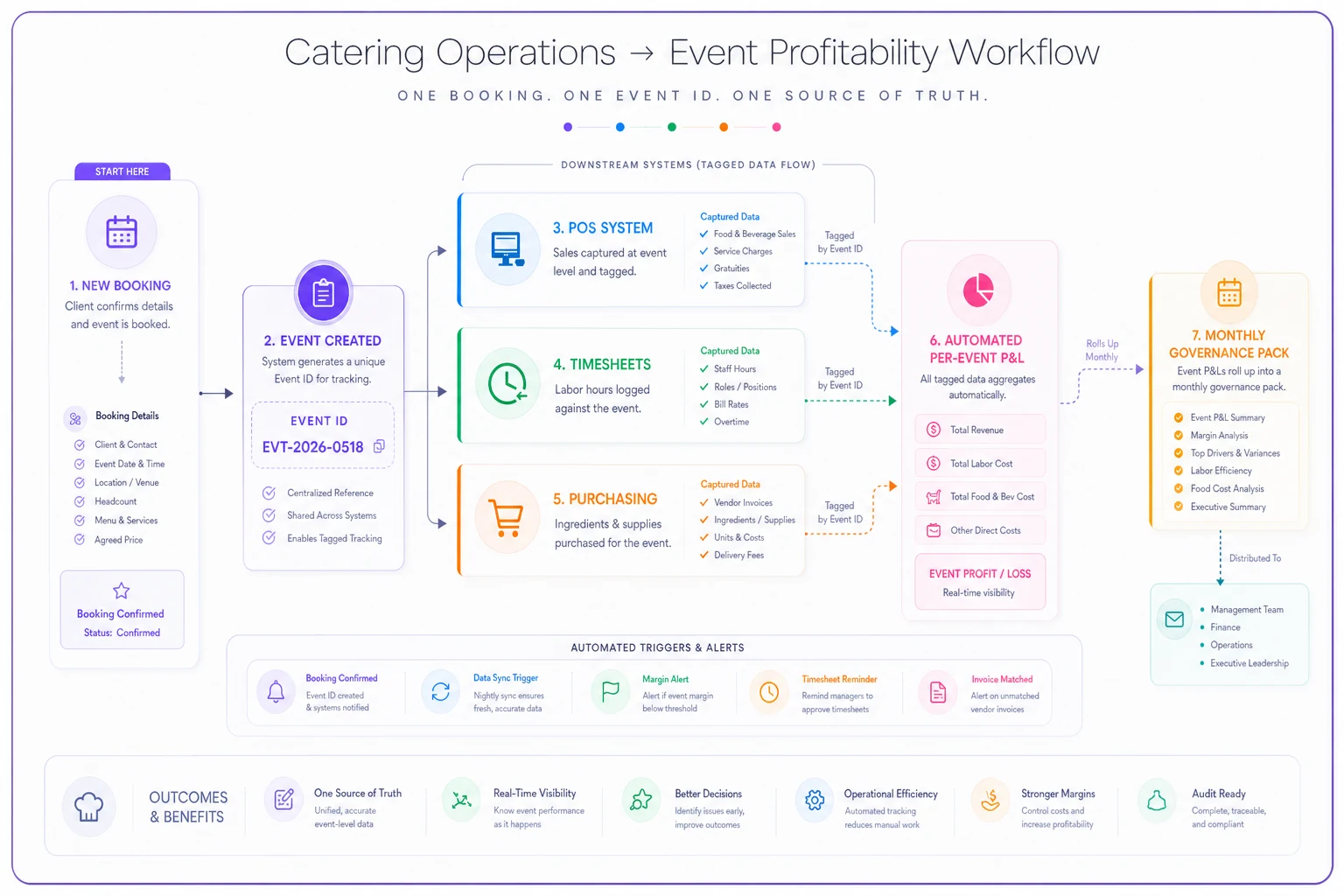
Seeing the event ID travel through systems is the quickest way to decide where to lock tagging and where automation should insert checks.
Trigger rules: the part that turns data into action
A live P&L is useful. A live P&L that flags you when something's wrong is a system. Most caterers stop short here — they build visibility but no automatic response.
Trigger rules are conditional statements that fire when a number crosses a line. The point is catching margin erosion at the earliest possible moment, when you can still do something about it, not at month-end when the event is already history.
A practical starter set:
-
Quote-stage trigger projected margin falls below your floor band (say, under 28% gross) → proposal routes to owner for approval before it goes to the client.
-
Pre-event trigger food PO for an event exceeds the costed estimate by more than ~10% → flag to kitchen lead to review spec or substitute.
-
Staffing trigger scheduled labor hours exceed the proposal's labor budget by more than ~15% → flag to the scheduler before the shift is locked.
-
Change-order trigger client adds covers or upgrades without a corresponding price adjustment → flag before it's confirmed.
-
Post-event trigger actual margin lands more than 5 points below projected → auto-generate a variance note requiring a one-line explanation from the event lead.
That last one matters more than it looks. Requiring a one-line explanation for every big variance is how you build institutional memory about why margins slip. Over a season you'll see the same reasons cluster — "overtime, late venue access," "rental breakage," "extra covers not billed" — and those clusters tell you exactly where your estimating needs work.
The tie-in to pricing is direct. The triggers that fire most often are telling you your cost cards and price triggers need recalibration. A system that logs which trigger fires how often feeds your next pricing review with real evidence instead of gut feel.
Where AI automation quietly earns its keep
None of this requires AI to exist — caterers have run versions of this on spreadsheets and discipline for years. But the discipline is exactly what breaks under volume, and that's the honest place automation helps.
The grind in a profit-ops system is the matching and tagging: connecting a supplier invoice to the right event, splitting a pooled order across three P&Ls, reconciling a batch of deposits against contracts, chasing the event lead for a variance explanation. These are the tasks that get skipped first when things get busy, and skipping them is what makes the whole system rot.
AI-assisted operational software handles the repetitive judgment calls that used to need a human — reading an invoice and proposing which event and category it belongs to, flagging a deposit that doesn't match any contract, drafting a variance note from the data so the event lead just confirms or corrects it instead of writing from scratch. The owner still makes the real decisions. The software removes the data-wrangling that made those decisions arrive too late to matter. Not replacing judgment — just making sure judgment happens on current numbers instead of three-week-old ones.
Monthly governance: the ritual that keeps it honest
Automation feeds the system. Governance is what makes people use it. Without a fixed monthly review, even a perfectly automated P&L becomes wallpaper — numbers nobody acts on.
A monthly governance pack is a standard bundle of outputs, reviewed on the same day every month by the same people, with a short agenda that forces decisions. What goes in it:
| Pack component | What it shows | Decision it drives |
|---|---|---|
| Margin-band summary | Every event's actual margin vs. band | Which event types to re-price or drop |
| Variance log | All events >5 pts off projection + reasons | Where estimating is systematically wrong |
| Trigger-fire report | Which triggers fired, how often | What to tighten in quoting or scheduling |
| Reconciliation status | Unmatched payments, untagged costs | What to clean up before books close |
| Overhead allocation check | Allocation rates vs. actual overhead | Whether per-event overhead needs updating |
The meeting shouldn't take more than 45 minutes once the pack is automated. The discipline is in the regularity, not the length. Caterers who review this quarterly instead of monthly consistently discover margin leaks a season too late — by the time they spot that corporate drop-offs are running thin, they've already booked a full quarter of them at the wrong price.
One thing worth naming: the governance review is also where your cashflow model and your profit model reconcile against each other. Profitable-on-paper events that were cash-negative for weeks — big upfront food spend, slow client payment — only show up when you look at both together. A profit-ops system that ignores cash timing will happily tell you an event was great while your bank account disagreed all month.
A real scenario: the catering company that couldn't explain its own losses
A mid-sized caterer running roughly 18–25 events a month — mix of weddings, corporate lunches, and nonprofit galas — had a persistent problem. Revenue was up year over year, but the bank balance wasn't growing the way it should. The owner had per-event P&Ls, but they were built two to three weeks after each event, and about a third of events never got finished during busy stretches.
When they rebuilt it as a system — event IDs flowing through POS, timesheets, and purchasing, with automated roll-up and a handful of trigger rules — the first month was ugly in a useful way. The variance log showed that corporate lunch drop-offs, which everyone assumed were easy money, were landing around 19–22% margin instead of the 35% they'd been priced for. The culprit: delivery labor and packaging that never made it into the original cost cards, plus frequent last-minute add-ons that got delivered but never invoiced.
Nothing dramatic happened next. They re-priced drop-offs, added a change-order trigger so add-ons got billed, and tightened the delivery-labor line in their estimates. Over the following couple of quarters, blended margins came up somewhere in the range of 6–9 points. Maybe more importantly, the owner stopped being surprised at month-end. The events weren't suddenly making less money. They'd been leaking the whole time. The system just made the leak visible while there was still time to do something about it.
When this makes sense — and when it's overkill
When it's worth building: You're running enough volume that you can't hold every event's economics in your head — roughly a dozen-plus events a month, or any volume with real event-type variety. You've already got a POS and some form of digital timesheets. And you've been burned at least once by an event you thought was profitable.
When it's premature: If you're doing four or five events a month and personally touch every one, a clean spreadsheet P&L and a monthly glance is genuinely enough. Building trigger rules and automated data flows for that volume is effort better spent booking more work. The system earns its keep when the coordination cost of tracking margins manually exceeds the cost of automating it — and that crossover tends to arrive with scale, not with ambition.
Who should not do this: Caterers whose underlying cost data is a mess. If your supplier invoices are inconsistent, your staff clock in sporadically, and nobody tags payments to events, automation will just produce wrong numbers faster. Fix the data hygiene first — consistent event IDs, disciplined time tracking, categorized spend — then build the system on top. Automating garbage gives you confident garbage.
Building it without boiling the ocean
Don't try to roll this out all at once. The caterers who attempt to build the full system in one go tend to stall out around week three. Here's the sequence that actually sticks:
-
Lock the event ID. Pick one identifier and make every system use it. This alone fixes most reconciliation pain and costs nothing but discipline.
-
Automate one data flow first. Usually POS-to-P&L, because revenue is the cleanest data. Get deposits and final payments tagging to events automatically.
-
Add labor. Pipe actual timesheet hours into the P&L next — it's where the biggest surprises hide.
-
Add cost allocation rules. Write down exactly how pooled orders and overhead get split, then apply them consistently.
-
Turn on two or three triggers. Start with the margin-floor quote trigger and the post-event variance trigger. Don't build fifteen rules nobody reads.
-
Stand up the monthly pack. Same day, same people, same agenda. This is what converts all the plumbing into actual decisions.
Lock the event ID first — making every system use a single identifier fixes most reconciliation pain.
Each step delivers value on its own, so even if you stop halfway you're better off than you started. That's the opposite of a template, which is worthless until it's complete and fed.
The real shift
The jump from per-event templates to a profitability operating system isn't about having fancier numbers. It's about when the numbers arrive and who has to act on them. Templates tell you what happened. A system tells you what's happening while you can still change it, and forces a monthly moment where someone looks and decides.
Margins in catering don't disappear in big dramatic losses — they erode in the gap between "we think this event made money" and "we checked three weeks later and it didn't." Close that gap with automatic data flows, rules that fire on their own, and a governance ritual that refuses to let numbers go unexamined, and the leaks stop being surprises. They become things you catch, name, and fix — one event at a time, before the van leaves the lot.
Ready to elevate your catering business?
Join 500+ caterers trusting Caterngly to save time, reduce errors, and deliver flawless events.