

Most catering proposals lose money before the client even reads the food descriptions. Not because the pricing is wrong — because of how the pricing is arranged. The same menu, priced identically, will produce a completely different average event value depending on how the options are ordered, anchored, framed, and grouped on the page.
This isn't about charging more. It's about presenting the same numbers so clients naturally spend closer to the top of their range instead of the bottom. You can raise average event value 8–15% with zero visible price increase, and the client walks away feeling like they got a smart deal.
The three-tier trap most caterers fall into
A caterer builds three packages — Silver, Gold, Platinum — priced at $48, $62, and $88 per head. Feels reasonable. Middle option looks balanced.
The problem is the gap structure. When the jump from Silver to Gold is $14 but Gold to Platinum is $26, the middle option becomes the obvious "safe" choice and almost everyone lands there. You've accidentally trained every client to pick Gold. Average event value flattens right at the middle number, and Platinum becomes decoration nobody buys.
This usually happens because packages get built from cost-up math — what each tier costs to produce plus margin — rather than from how people actually compare options. Cost-up pricing gives you accurate numbers and terrible spacing.
The fix is to design the spacing deliberately. You want the top tier to make the middle tier look like the reasonable choice, not the cheapest one. A typical restructure looks like this:
| Package | Old price/head | Restructured price/head | Role it plays |
|---|---|---|---|
| Essential | $48 | $52 | The anchor floor (rarely chosen) |
| Signature | $62 | $68 | The intended target |
| Premier | $88 | $84 | The decoy that sells Signature |
Notice Premier actually dropped from $88 to $84. That's deliberate. When the top tier sits too far above the middle, clients stop using it as a reference point and ignore it entirely. Pull it closer and it does its actual job: making Signature feel like the sensible middle rather than a splurge.
Moving Essential up to $52 also matters — it narrows the gap to Signature, so trading up feels small. "For $16 more per person I get the carving station and the dessert display" reads very differently than "for $14 more."
These adjustments don't require rewriting your entire cost structure. You're shifting perception, not rebuilding the menu.
Anchoring: show the expensive thing first, always
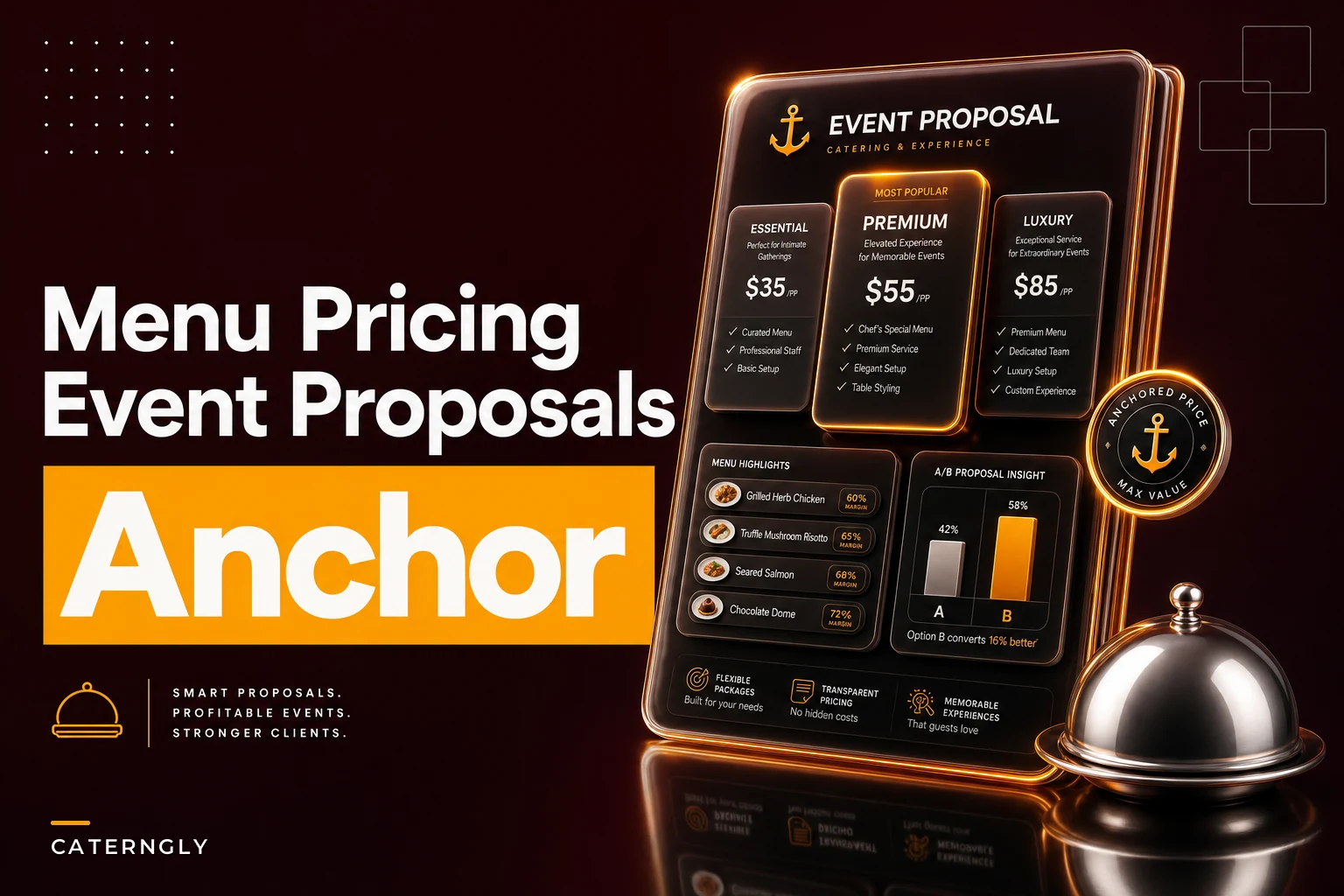
The first number a client sees becomes the reference point for every number after it. If your proposal opens with the $52 package, everything else reads like an upsell. If it opens with a fully-loaded $110 "showcase" option, your $84 Premier suddenly looks restrained and smart.
End chaos with centralized catering management.
Caterngly helps you plan, confirm, and manage every catering event seamlessly.
- Unified event and order management
- Real-time client updates
- Staff and resource scheduling
No credit card required
You don't need clients to buy the anchor. It just has to exist on the page and be seen first.
A practical way to do this: add a top-of-proposal "Chef's Showcase" or "Full Experience" tier that's priced high and genuinely premium. Most clients won't select it. But it reframes the entire menu. Adding a visible high anchor tends to lift selection of the second-highest tier noticeably — even when the anchor itself closes maybe 1 in 20 times.
> Full Experience — $112 per guest > Five-course plated service, dedicated chef station, sommelier-guided pairings, and a bespoke dessert presentation. Designed for milestone celebrations where the meal is the event.
> Premier — $84 per guest > Our most-selected package for weddings and corporate galas. Three-course plated service, carving station, and passed hors d'oeuvres.
The phrase "most-selected" is doing quiet social-proof work there, which brings us to the next lever.
Framing the add-ons as inclusions, not upsells
How you word extras changes how often people take them. "Add a raw bar for $9/person" gets declined because it reads as spending more. "Upgrade to include a raw bar — $9/person" gets accepted more often because "upgrade" and "include" signal completeness rather than cost.
Also: present add-ons as per-guest numbers, not lump sums. A "$1,350 dessert display" triggers sticker shock. The identical thing framed as "$9 per guest" on a 150-person event feels trivial. Same money, completely different acceptance rate.
A short list of framing swaps that move numbers without changing them:
-
"Add" → "Upgrade to include"
-
Lump sums → per-guest pricing on anything under ~$15/head
-
"Premium bar package" → "Premium bar — most couples choose this"
-
"$62/person" → "$62 per guest" (the word guest tests better than person or pp in event contexts)
-
Listing price before the description → listing the description first, price last
That last one matters more than people expect. When the price sits at the top of an item, clients evaluate cost before value. Flip it — description first, then price — and they've already pictured the carving station before they see the number.
Bundling so the math is invisible
Clients scrutinize line items. They don't scrutinize bundles. When you itemize appetizers, entrée, sides, dessert, and service separately, each line becomes a place to negotiate. When you bundle into a named package, the client evaluates the whole thing against their mental budget and either accepts or rejects — no line-item haggling.
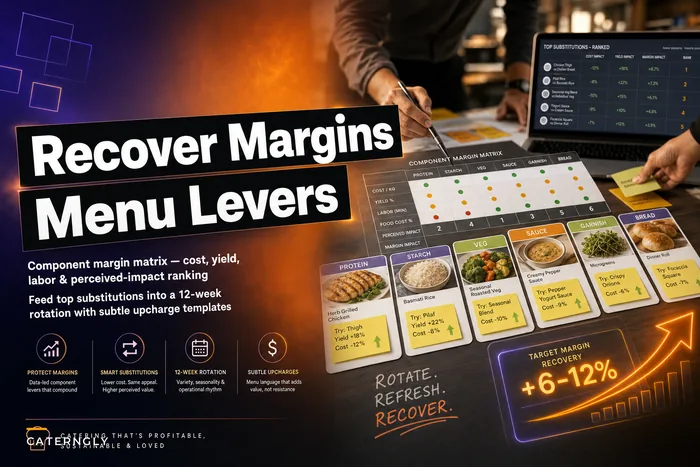
The move is to bundle the profitable components with the ones clients actually care about. Your margin isn't even across a menu — some items carry far more markup than others. If you've worked through your menu-component levers and substitution economics, you already know which components quietly protect margin. Bundling lets you attach those high-margin pieces to the emotional anchor items (the entrée, the dessert display) so they ride along instead of getting cut.
A workflow that makes this repeatable:
-
Tag every menu component by margin tier — high, medium, low.
-
Build each package so its "hero" item is what clients emotionally buy (the entrée or station).
-
Attach 2–3 high-margin components into the same bundle so they're never itemized separately.
-
Only itemize things you're comfortable having negotiated — never the margin protectors.
This also connects to how pricing gets recalibrated over time. If your tiers are anchored to real cost cards, seasonal shifts don't erode your spacing.
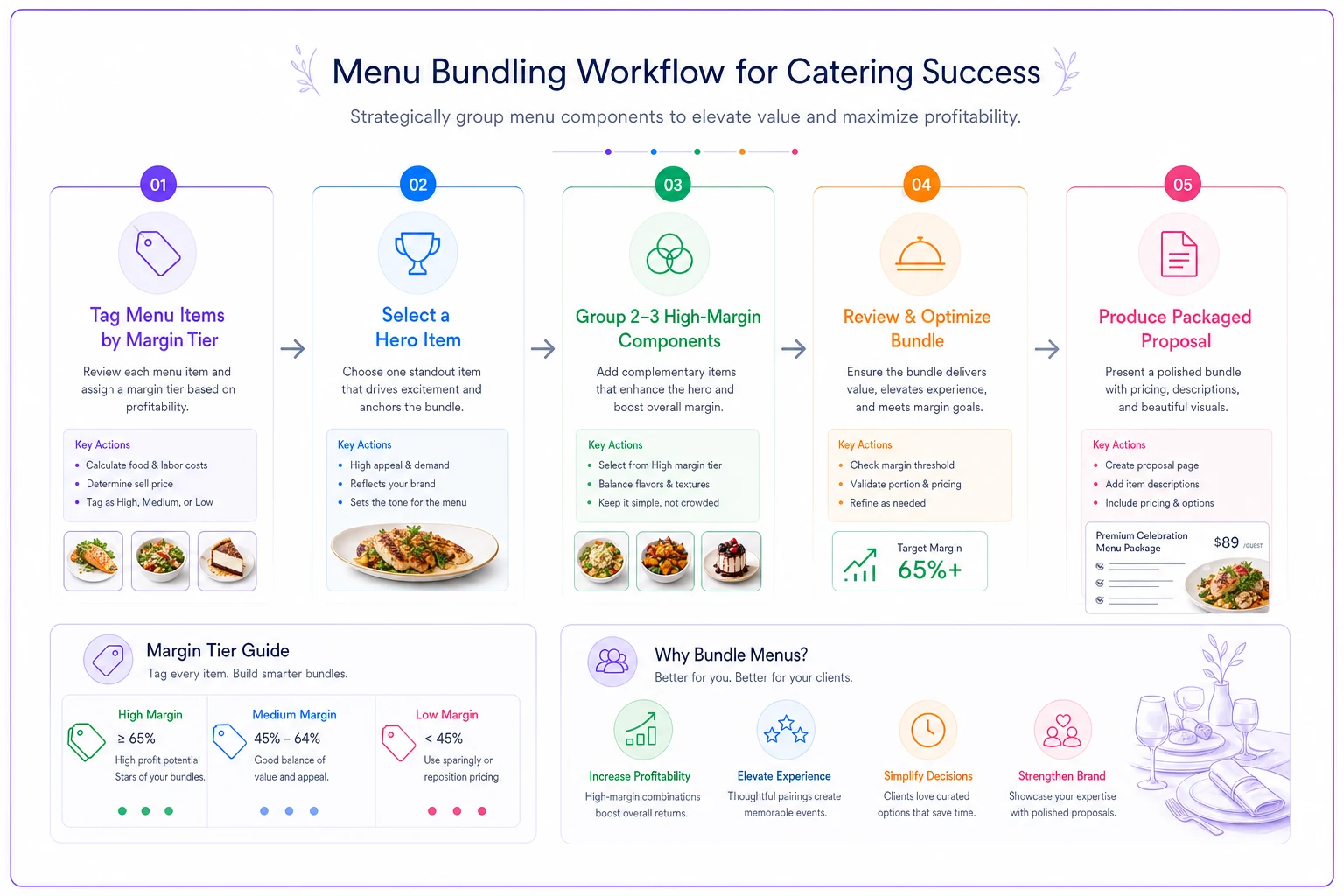
Here's a simple diagram of the repeatable bundling workflow.
Start with your top 20 menu items when tagging margins so the workflow stays manageable and repeatable.
That discipline is exactly what a KPI-linked pricing system with cost cards and price triggers is built for — the psychology sits on top of the math, not instead of it.
Sample proposal language you can lift
Here's a full sequenced package block using the tactics above. The order is intentional — anchor first, target second, floor last.
> Full Experience — $112 per guest (shown first as the anchor) > Five-course plated dinner, dedicated chef's station, curated wine pairings, and a custom dessert presentation.
> Premier — $84 per guest — our most-selected package > Three-course plated service with a live carving station, passed hors d'oeuvres, and a seasonal dessert display. Everything most hosts want, without the extras they don't.
> Signature — $68 per guest > Buffet or family-style service with two entrées, three sides, and a dessert table. A clean, generous spread for relaxed gatherings.
> Essential — $52 per guest > Single-entrée buffet with two sides and coffee service. Straightforward and reliable.
Then, below the tiers, the framed upgrades:
-
Upgrade to include a raw bar — $9 per guest
-
Add a late-night snack service — $6 per guest
-
Upgrade to include a champagne toast — $4 per guest
No line-item breakdown inside any tier. The client compares four whole packages, sees "most-selected" on Premier, sees the $112 anchor above it, and lands on Premier or Signature — both of which are above where the old flat Gold tier used to trap them.
The language above isn't filler. It's doing several things at once: anchoring, social proof, and value-before-price sequencing. Run it as-is before you customize it.
When this actually makes sense — and when it doesn't
These tactics work best on discretionary, emotional events: weddings, milestone birthdays, galas, celebration dinners. The buyer is spending on an experience and wants to feel like they chose the right option. Anchoring and framing lift value cleanly in that context.
They work poorly on pure-procurement corporate accounts where a facilities manager is comparing three vendors on a spreadsheet against a fixed per-head cap. Anchoring a rigid corporate buyer with a $112 showcase tier just gets you eliminated for looking expensive. For those clients, lead with the number they need and compete on reliability.
If your proposals already convert well and clients trade up on their own, don't touch it. And if your cost cards aren't accurate, restructuring tiers just spreads bad margins into prettier packages. Get the underlying numbers right first, then apply the framing.
The A/B test plan — proving the uplift without guessing
Most caterers skip this part. They restructure the proposal, feel good about it, and never actually know if it worked. Book volume is noisy, seasons shift, one big wedding skews the month. You need a clean test.
Run it like this:
-
Pick one event category to test — weddings, or corporate galas — not everything at once. Mixing categories muddies the signal.
-
Split incoming proposals evenly. Odd-numbered inquiries get the current proposal (control), even-numbered get the restructured one (variant). Assign at inquiry, before you know anything about the client, so you don't bias the split.
-
Hold everything else constant — same menu, same pricing math, same salesperson tone. The only thing changing is layout, ordering, and framing language.
-
Track two numbers per proposal did it close (yes/no), and average value per closed event.
-
Run until you have at least 40–50 proposals per side. Fewer than that and one large booking distorts the whole result. For most caterers that's one to two months.
-
Compare average event value on closed events, not just close rate. The goal is uplift per event — a slightly lower close rate at meaningfully higher value can still come out ahead.
A realistic outcome table after a two-month test might look like:
| Metric | Control (old proposal) | Variant (restructured) |
|---|---|---|
| Proposals sent | 46 | 44 |
| Close rate | 41% | 39% |
| Avg. value per closed event | $6,900 | $7,750 |
| Tier most selected | Middle (Gold) | Premier / Signature |
Close rate dipped two points — at this sample size, that's noise. But average value per event jumped roughly $850. Across a full season that's real money, from the same menu and the same costs.
One trap when reading results: don't celebrate a close-rate change at 44 proposals. That sample is too small to trust. Average value moves more reliably because it's measuring the tier clients actually picked, and framing directly influences that. If you want to go deeper on close-rate interpretation, wait until you're past 80 total proposals before drawing any conclusions about conversion trends.
A real scenario
A mid-sized caterer running mostly weddings — around 60–70 events a year — averaged somewhere near $6,800 per event. Their proposal was the classic three-tier flat structure, and nearly everyone picked the middle package. Average value had been stuck there for two full seasons.
They didn't raise a single price. They added a high anchor tier at the top, pulled the former top tier down slightly so it became the "most-selected" target, moved descriptions above prices, and switched every add-on to per-guest framing. Then they split-tested it over about eight weeks across incoming wedding inquiries.
The restructured proposals closed at roughly the same rate but landed clients on the higher tier far more often. Average event value moved from around $6,800 to just under $7,600. Over a full year of weddings, that's somewhere in the range of $45k–$55k in additional revenue — with no new menu items, no cost increase, and nothing a client could point to and call a price hike.
Several clients mentioned the proposal felt "clearer" and easier to decide from. That's the whole point of menu pricing psychology in catering — you're not extracting more, you're removing the friction that pushes people toward the cheapest option.
Where this fits in the bigger picture
Raising average event value at the proposal stage is one lever. The other half is what happens after the event — a client who trades up once and has a great experience is your easiest future booking.
The catering lifecycle blueprint for turning one-off clients into repeat revenue covers how post-event offers and re-booking sequences compound the value you captured with better pricing structure up front.
Get the proposal psychology right, prove the uplift with a clean test, and you've built a repeatable way to raise revenue that doesn't depend on charging more — just on presenting the same numbers in the order people actually make decisions.
Ready to elevate your catering business?
Join 500+ caterers trusting Caterngly to save time, reduce errors, and deliver flawless events.