

Most caterers price at the menu level. Chicken piccata dinner: $34 a head. Vegetarian option: $29. Kids meal: $16. That's how proposals get built, that's how contracts get signed, and that's exactly why margin leaks stay invisible — because nobody's watching the components underneath those prices.
Two identical-looking chicken plates can differ by $1.50–$2.00 in true component cost depending on which starch, which garnish, which sauce base, and which protein cut you used that week. Multiply that across 180 covers and you've quietly given away $270–$360 on a single event without a single line item changing on the invoice.
This is component-level margin engineering, and it's about as close to a free lunch as catering gets. You're not raising prices. You're not cutting portions in a way guests notice. You're re-engineering the inside of the plate so the same perceived value costs less to deliver.
Why the plate-level view hides your worst leaks
When you cost a menu item as one number, you lose the ability to see which of its five or six components is dragging margin. A plate is not one cost — it's a stack:
-
Protein (usually 45–60% of plate cost)
-
Starch (8–15%)
-
Vegetable/side (10–18%)
-
Sauce/finish (3–9%)
-
Garnish/plating element (1–4%)
-
Bread/roll or amuse (2–6%)
The leak almost always hides in the components you stopped thinking about. The protein gets scrutinized because it's expensive and volatile. But the sauce base made from demi-glace at $6.80 a quart versus a pan-reduction made in-house at $1.90 a quart? Nobody's watching that line. The garnish of microgreens at $22 a clamshell that yields 40 plates? Invisible. The "upgraded" dinner roll from the specialty bakery that added $0.65 a cover because a chef liked it two seasons ago and nobody ever reviewed it?
Consider a mid-size caterer running "herb-roasted chicken with seasonal vegetables" as a workhorse entree. Costed at the plate level, it shows about $10.60 in food cost against a $32 sell price. Fine. But break it apart and you find the "seasonal vegetables" were haricots verts trimmed by hand — $3.10 in raw cost plus roughly 4 minutes of labor per portion during prep. Swap to a roasted root medley with the same visual footprint and you're at $1.40 in raw cost and half the prep time. The guest experience reads as equivalent or better (roasted roots photograph beautifully), and you've recovered $1.70 plus labor on every plate.
That's a real number, on a real dish, that most operators are just leaving on the table.
Build the component margin matrix
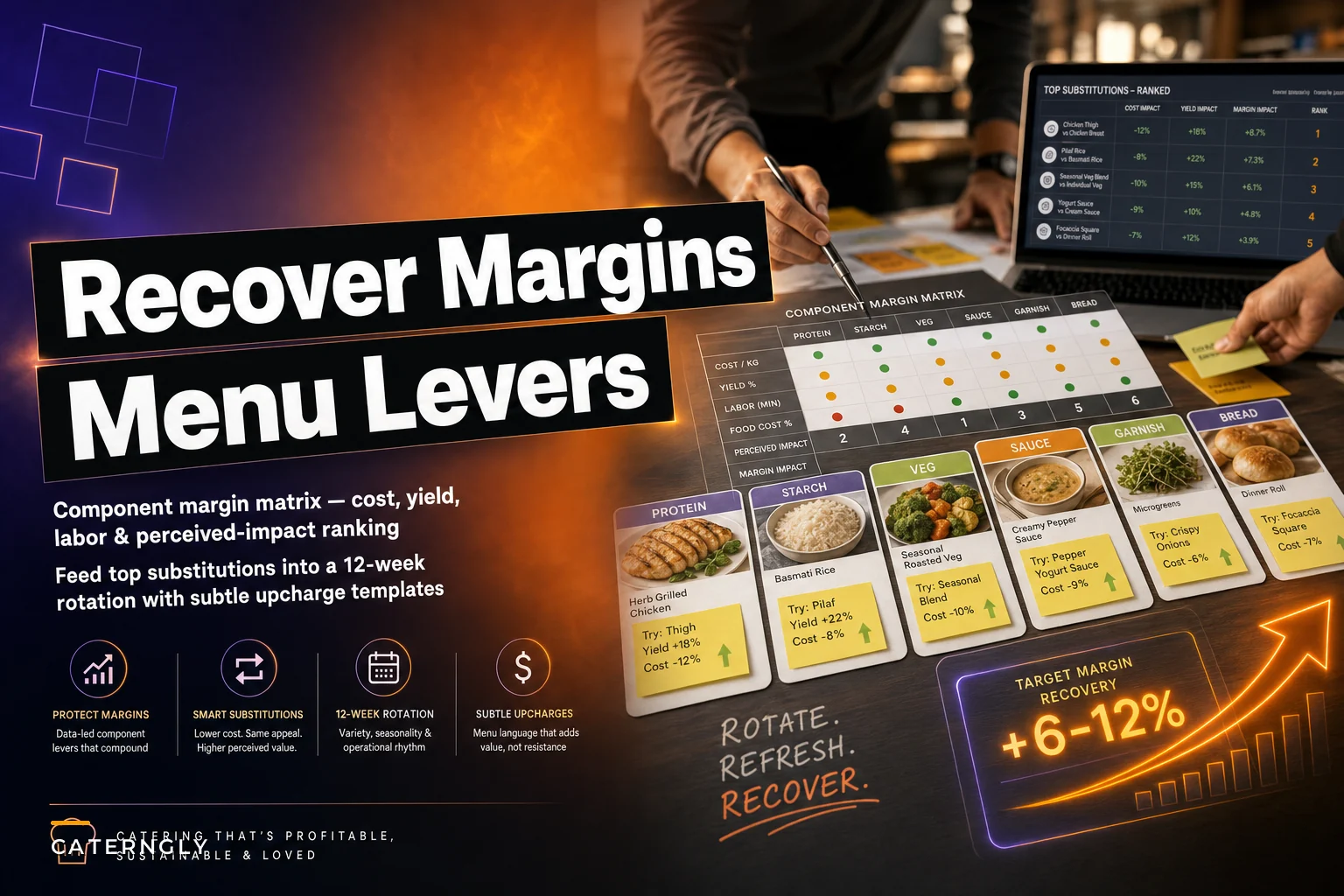
You can't engineer what you can't see, so the first move is a matrix that breaks every menu item into components with individual cost, yield, and margin contribution. Here's a simplified version for two versions of the same entree:
End chaos with centralized catering management.
Caterngly helps you plan, confirm, and manage every catering event seamlessly.
- Unified event and order management
- Real-time client updates
- Staff and resource scheduling
No credit card required
| Component | Version A (cost/portion) | Version B (cost/portion) | Perceived value impact |
|---|---|---|---|
| Protein — chicken breast (airline vs standard) | $5.20 (airline cut) | $4.10 (standard supreme) | Minimal at buffet; slight at plated |
| Starch — truffle mash vs herb roasted fingerling | $1.90 | $0.95 | Negligible |
| Vegetable — haricots verts vs root medley | $3.10 | $1.40 | Slight (visual difference only) |
| Sauce — bought demi vs pan reduction | $0.85 | $0.35 | None |
| Garnish — microgreens vs fresh herb sprig | $0.55 | $0.10 | Negligible |
| Total food cost | $11.60 | $6.90 | — |
Version B recovers $4.70 per plate. On a 150-cover event that's around $705. And the part most owners miss: you don't have to go all the way to Version B. Pull one or two levers — the sauce and the garnish alone recover $0.95 with essentially zero guest-perceivable change. That's the invisible tier.
The matrix does something a plate cost never can: it ranks your levers by dollars recovered per unit of perceived value lost. That ratio is the whole game. Chase the levers with the highest recovery and the lowest perception cost first.
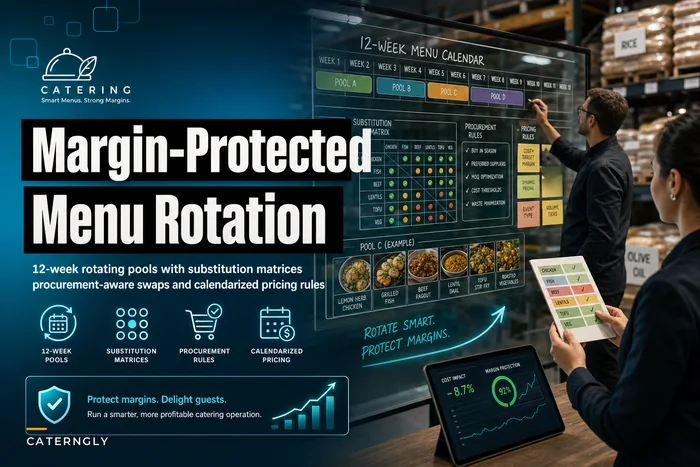
If you've already built out menu pools and substitution logic, this matrix plugs directly into that work — the margin‑protected menu rotation approach with 12‑week pools and substitution matrices gives you the rotation framework, and the component matrix tells you which components inside each pooled dish to flex.
Here's a simple workflow for how the component matrix feeds into substitution decisions and menu rotation.
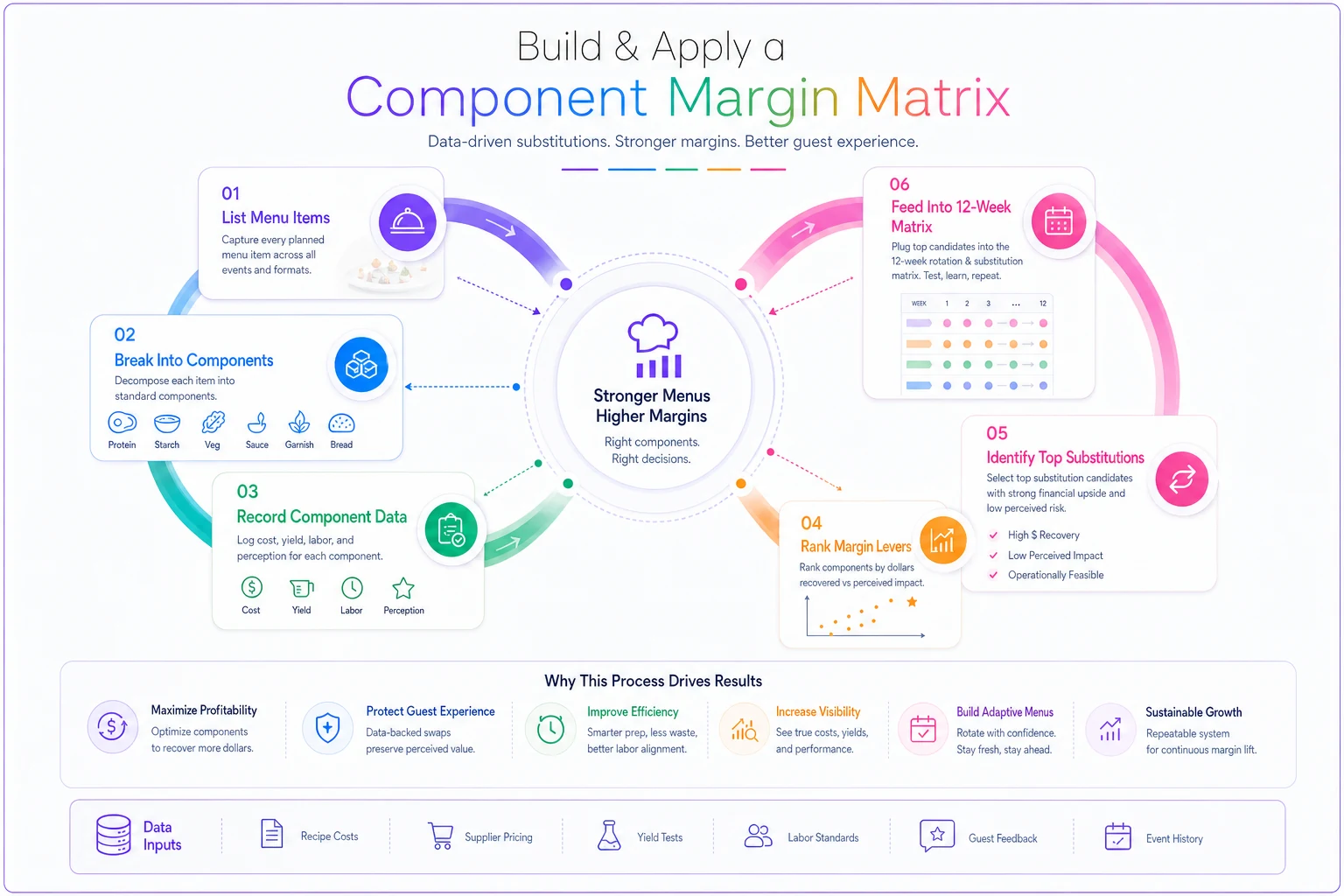
If you map this as a simple process, the operational steps become obvious: re-cost, rank, flag, and substitute where recovery is high and perception delta is low.
Substitution economics: the math behind swapping without downgrading
Substitution isn't just "use the cheaper thing." The economics only work when you account for four variables at once:
-
Raw cost delta — the obvious one
-
Yield delta — cheaper items sometimes yield worse (more trim, more shrink)
-
Labor delta — prep time per portion changes
-
Perception delta — how much, if any, the guest notices
A substitution that saves $0.90 in raw cost but adds 3 minutes of skilled labor per portion is often a losing trade once you load labor at $28–$34 fully burdened. Meanwhile a substitution that saves $0.40 in raw cost and cuts prep time is a double win that shows up nowhere on the plate.
Make the swap when: raw savings ≥ $0.50/portion AND perception delta is negligible AND labor is flat-or-lower.
Think hard when: raw savings are real but labor increases — run the fully-burdened math before committing.
Don't swap when: the component is a signature element the client specifically referenced, or when it's the plate's hero — the thing on the invitation, the thing in the tasting they fell in love with.
The safest substitutions are almost never the protein. They're the supporting cast — sauces, starches, garnishes, breads. Guests anchor their value judgment on the hero and the presentation. The margin is in everything they're not focused on.
Invisible upcharges: where the recovery compounds
Substitution recovers cost. Invisible upcharges recover revenue — and they're just as quiet.
-
Tiered protein positioning. Offer "chicken, salmon, or short rib" as choices where the salmon and short rib carry a $4–$7 upcharge that's mostly margin. Roughly a third of clients trade up, and that trade-up is nearly pure recovery.
-
Presentation upgrades. Family-style platters vs individually plated composed courses. The composed version reads as premium and justifies $3–$5 more per cover, while your actual component cost barely moves.
-
Station "enhancements." A carving station attendant or a live-finish element priced as an add-on. The perceived value is theatrical; the food cost delta is small.
-
Dietary-accommodation framing. Instead of eating the cost of allergy or vegan plates, position them as a per-plate accommodation line. Clients expect to pay for special handling — most caterers just forget to charge for it.
The mistake caterers make here is burying all of this in a single per-head number. When everything's bundled, every enhancement becomes a cost you absorb instead of a choice the client pays for. Unbundling — even while keeping a clean-looking proposal — is often worth 2–4 points of blended margin.
This connects directly to how you structure pricing overall. If your cost cards and price triggers are already dialed in through a KPI-linked pricing system, the upcharge tiers become a natural extension — you already know your true component costs, so you know exactly how much of each upgrade is margin.
Buyer communications: how you *say* it determines whether it works
Every component lever lives or dies on how it's communicated. The same substitution can feel like a downgrade or an upgrade depending entirely on the language in the proposal and the tasting conversation.
-
Lead with the seasonal story, not the substitution. "We're featuring roasted heirloom root vegetables this month" lands better than any explanation of what you swapped out. Nobody misses the haricots verts they were never told about.
-
Frame upcharges as personalization, not add-ons. "You can elevate any station with a live-carved element" invites a yes. "Carving station: +$X" invites a negotiation.
-
Never apologize for a component choice. The moment you explain why you changed something, you signal it was a compromise. Present it as the menu, confidently.
-
Use the tasting to lock the hero, flex the rest. Let the client fall in love with the protein and the presentation. Keep supporting components flexible in the contract language ("seasonal vegetable selection") so you retain the right to substitute without a change order.
That last point is quietly powerful. If your contract specifies "haricots verts," you've handcuffed yourself. If it specifies "chef's seasonal vegetable," every substitution lever stays open for the life of the contract — even if produce prices spike three weeks before the event.
A real scenario
A regional caterer running mostly corporate lunches and mid-size weddings — somewhere around 120–140 events a year — was pricing everything at clean per-head numbers with no component-level visibility. Blended food cost was sitting around 33–34%, which they thought was acceptable.
Breaking their eight most-used entrees into component matrices surfaced three things almost immediately: they were buying pre-made sauce bases they could produce in-house for a third of the cost, their "premium" dinner roll was adding about $0.60 a cover across nearly every event, and vegan and allergy plates were being absorbed for free at roughly $8–$11 a plate.
Nothing about the guest experience changed. Sauces went in-house, the specialty roll got swapped for a very good standard roll that almost nobody could distinguish, dietary plates became a $6 accommodation line, and two entrees got a salmon-upgrade tier at +$5.
Blended food cost dropped from around 33% to roughly 28–29% over a season. On revenue in the low seven figures, that recovered somewhere in the neighborhood of $40k–$55k annually — none of it from raising a single headline price. The clients who booked never knew a thing changed. That's the whole point.
When component engineering makes sense — and when it doesn't
This makes sense when:
-
You run repeatable menus with workhorse dishes that recur across many events
-
You have enough volume that small per-plate deltas compound meaningfully
-
Your food cost is drifting up and you can't (or won't) raise headline prices
This is a bad idea when:
-
You're doing bespoke high-end tasting-menu work where every component is the product
-
The component in question is genuinely the reason clients chose you
-
You'd be trading real, noticeable quality for pennies — guests aren't stupid, and one bad substitution can cost you a referral worth more than the recovery
Anyone treating substitution as an excuse to quietly cheapen the food is going to feel that in their reviews eventually. The whole model depends on the guest experience staying equal or improving. The second you're recovering margin by making the plate worse in ways people notice, you're not engineering margin — you're borrowing against your reputation.
Making it stick operationally
The reason most caterers never capture this is that the component matrix lives in one person's head and never gets maintained. Prices move, a sauce vendor raises rates, a seasonal vegetable comes off contract — and the matrix that recovered $50k last year is quietly wrong by spring.
-
Re-cost your top 8–10 recurring entrees at the component level every quarter
-
Flag any component that's moved more than 12–15% in cost since last review
-
Keep contract language generic on supporting components, specific only on heroes
-
Track which upcharge tiers actually convert, and prune the ones that don't
-
Tie substitution triggers to your procurement data so a price spike automatically flags a swap candidate
Tie substitution triggers directly to your reorder thresholds so swaps happen the moment a component crosses a cost trigger.
That last habit is where component thinking connects to inventory. When your reorder and pooled-ordering logic already tracks unit costs — the kind of setup covered in a solid multi-event inventory playbook — your component matrix can pull live cost data instead of stale spreadsheet numbers. A substitution flag fires the moment a component crosses its threshold rather than three months after the margin already leaked.
The caterers who win at this aren't running some elaborate system. They just refuse to price at the plate level. They see the stack, they know which levers are invisible, and they pull the quiet ones first — recovering four or five points of margin that competitors are giving away one dinner roll at a time.
The caterers who win at this aren't running some elaborate system. They just refuse to price at the plate level. They see the stack, they know which levers are invisible, and they pull the quiet ones first — recovering four or five points of margin that competitors are giving away one dinner roll at a time.
Ready to elevate your catering business?
Join 500+ caterers trusting Caterngly to save time, reduce errors, and deliver flawless events.