

The moment a catering operation stops being one owner-led team and becomes two or three crews running simultaneously, something shifts that almost nobody plans for: the owner stops being the person holding the whole event together. And most caterers don't notice the shift until service already slipped at one of the sites.
That's the core tension in catering organizational design multi-site — you're not just adding bodies, you're changing who makes decisions when the owner isn't standing there. The org chart isn't a formality. It's the thing that decides whether a 300-cover wedding two towns over runs smoothly or turns into three panicked phone calls to you while you're already elbow-deep in a different event.
This isn't about hiring more people. It's about designing the layers — site leads, span of control, pay bands that actually make sense, and a real path for someone to grow from server to running their own site. Get the structure right and you can run four events on a Saturday without personally touching any of them. Get it wrong and every event becomes a bottleneck that funnels straight back to you.
Why the org chart breaks first (and quietly)
There's a pattern that shows up constantly: a caterer scales revenue faster than they scale decision-making authority. Bookings double. Staff count doubles. But the number of people allowed to make a real call — swap a menu item on the fly, deal with an angry venue coordinator, decide whether the truck leaves without the extra chafers — stays at exactly one.
So the operation grows sideways, not up. You end up with fifteen people all reporting informally to the owner, which sounds flat and modern until you realize nobody in the middle is accountable for anything. When something goes wrong at Event B while you're at Event A, there's no one whose actual job is to own the outcome at B.
-
Two crews "borrow" the same rented linens because nobody owns cross-event allocation
-
A new server gets zero guidance on-site because the experienced person assumed someone else was handling it
-
A client complaint dies in a group text instead of reaching anyone who can actually fix it
-
Overtime creeps up because there's no one deciding, in the moment, when to send people home
None of these are people problems. They're structural gaps — roles that were never defined because the business grew before the chart did. If you've already worked through a staged roadmap to run simultaneous events without quality loss, the org design is the layer that makes that roadmap actually stick.
The three staged org shapes: 1 → 5 → 15
You don't design one org chart. You design three, and you know in advance when to transition between them. Trying to run a 15-person operation on a 5-person structure is where most of the pain lives.
End chaos with centralized catering management.
Caterngly helps you plan, confirm, and manage every catering event seamlessly.
- Unified event and order management
- Real-time client updates
- Staff and resource scheduling
No credit card required
Stage 1: The owner-operator crew (1–4 staff)
Everyone reports to you. You're on-site for every event. This works fine — as long as you never book two overlapping events. The whole model quietly assumes your physical presence.
The trap here is emotional, not operational: owners love this stage because they control everything. That comfort is exactly what makes the next transition painful.
Stage 2: The lead-and-crew structure (5–8 staff)
You promote your first site lead — someone who can run an event floor when you're not there. This is the single most important hire in the whole scaling journey, and most caterers wait too long to make it because they can't imagine anyone caring the way they do.
-
1 owner (now handling sales, ops planning, and float coverage)
-
1–2 site leads
-
1 kitchen lead
-
3–4 servers/setup staff
The key shift: the site lead owns the room. Not the recipes, not the client contract — the execution on the ground. Setup timing, service pace, teardown, the day-of vendor liaison. You're still close, but you're no longer the only one who can catch a problem.
Stage 3: The multi-site operation (12–15+ staff)
Now you're running concurrent events regularly. The structure gets a real middle layer:
-
Owner / operations director (no longer on any floor)
-
2–3 site leads (each owns one event at a time)
-
1 kitchen manager + line staff
-
1 logistics/inventory coordinator
-
Floating servers and setup crews assigned per event
Here's a comparison of what actually changes across the three stages:
| Dimension | Stage 1 (1–4) | Stage 2 (5–8) | Stage 3 (12–15) |
|---|---|---|---|
| Who owns event execution | Owner | Owner + 1 site lead | Site leads independently |
| Owner's real job | Everything | Sales + float coverage | Systems + growth |
| Max concurrent events | 1 | 1–2 | 3–4 |
| Decision authority | Owner only | Shared, informally | Defined by role |
| Biggest failure risk | Owner burnout | Lead not trusted enough | No middle accountability |
| Comp structure | Hourly, flat | Hourly + lead premium | Bands + salary for leads |
At 15 people the owner's job has completely changed. You're not catching problems anymore — you're building the systems that let other people catch them. If you're still personally fixing floor issues at this stage, the structure isn't done.
Span of control: the number nobody calculates
Span of control just means how many people one supervisor can actually manage well. In catering it's not a fixed number — it flexes with event complexity and staff experience.
-
On a live event floor one site lead can genuinely supervise 6–8 service staff. Past that, they stop managing and start firefighting. At a 400-cover plated event, you need two leads or a lead plus a strong senior server, full stop.
-
For buffet or drop-off service a lead can handle more, maybe 10–12, because the coordination load is lower.
-
For the owner/ops director the ceiling on direct reports is roughly 5–6 people you're actively developing. Beyond that, you need site leads absorbing the day-to-day so you're managing leads, not the whole roster.
The mistake caterers make is loading a green lead with a full crew on a complex event because "they're the lead now." Span of control isn't just headcount — it's headcount adjusted for how experienced the lead is and how demanding the event is. A first-month lead running eight people at a black-tie wedding is a setup for exactly the kind of service slip you're trying to prevent.
A useful gut-check: if your lead can't take a two-minute bathroom break during service without something going sideways, their span is too wide for their experience level.
Sample comp bands (and why flat pay stalls your best people)
Pay compression is a silent killer in catering. When your best server makes $2/hour more than your newest one, there's no reason to take on more responsibility. Why would someone become a site lead — with all the accountability that carries — for a rounding error?
You need visible gaps between bands. Not huge ones, but enough that moving up feels like moving up. These ranges vary by region, but the structure matters more than the exact figures:
| Role | Typical band | Structure |
|---|---|---|
| Setup / server (entry) | ~$16–19/hr | Hourly |
| Senior server | ~$19–23/hr | Hourly + event bonuses |
| Site lead | ~$24–30/hr | Hourly premium or per-event stipend |
| Kitchen lead | ~$26–32/hr | Hourly or partial salary |
| Ops director / GM | ~$55k–75k/yr | Salary + performance component |
The jump from senior server to site lead needs to be meaningful, because you're not paying for more hours — you're paying for someone to carry stress and make decisions when you're not there. If the raise is $1.50/hour, your best people will keep declining the role, and you'll stay the bottleneck.
Tie a slice of lead comp to event outcomes you actually track — on-time setup, no missed items, client satisfaction. If you've built any kind of KPI discipline around events, the lead's incentives should point at those same numbers. This is also where your labor forecasting has to sync with your pay structure; the connection between turning forecasts into hires with a three-horizon labor capacity system and your comp bands is what keeps you from overhiring leads you can't keep busy.
Promotion pathways: the ladder that keeps people
Turnover in catering is brutal, and a lot of it comes down to there being nowhere to go. Someone works two seasons, gets good, and then leaves for a restaurant that at least has a title structure. A clear ladder is retention infrastructure, not HR paperwork.
-
Setup/Server — learns the SOPs, the pack lists, the service basics
-
Senior Server — trusted on the floor, mentors new hires, handles a station solo
-
Site Lead (in training) — shadows a lead across 4–6 events, runs teardown independently
-
Site Lead — owns a full event floor, manages the crew, handles the day-of client and vendor contact
-
Multi-Site Lead / Ops — coordinates across concurrent events, develops other leads
Each rung needs a defined set of skills someone has to demonstrate before moving up — not "the owner likes them." This is where a real skill matrix earns its keep. The same discipline behind reliable service standards through onboarding playlists and skill matrices is what turns "we'll promote when someone's ready" into "here's exactly what ready looks like."
One pattern worth naming: the best server is not automatically the best lead. Great execution and great supervision are different muscles. Some of your strongest floor people will hate managing, and forcing them into a lead role burns out a great server and creates a bad manager at the same time. Give them a senior-specialist track with pay recognition instead of pushing everyone up the same ladder.
The 90-day site-lead transition checklist
Promoting a site lead and then throwing them onto a solo event with no ramp is the fastest way to lose both the event and the lead. This is a phased handoff, not a title change. Here's the 90-day structure that actually works:
Days 1–30 — Shadow and absorb
-
[ ] Lead-in-training works alongside an experienced lead on 3–4 events
-
[ ] Reviews every event's SOP, pack list, and day-of timeline in advance
-
[ ] Owns one contained zone (e.g., beverage station + teardown) start to finish
-
[ ] Sits in on at least one client/vendor day-of conversation as an observer
-
[ ] Learns the escalation path cold
what they can decide vs. what needs a call
Days 31–60 — Run with a net
-
[ ] Runs a smaller event (under ~100 covers) as lead, with the owner or senior lead on-site but hands-off
-
[ ] Manages the full pre-event brief with the crew themselves
-
[ ] Handles a real problem in the moment — a late vendor, a missing item — with coaching after, not during
-
[ ] Owns the post-event breakdown and reports what went wrong and why
-
[ ] Gets direct feedback after every event, in writing, tied to specific behaviors
A simple visual can make the phased handoff easier to follow for teams.
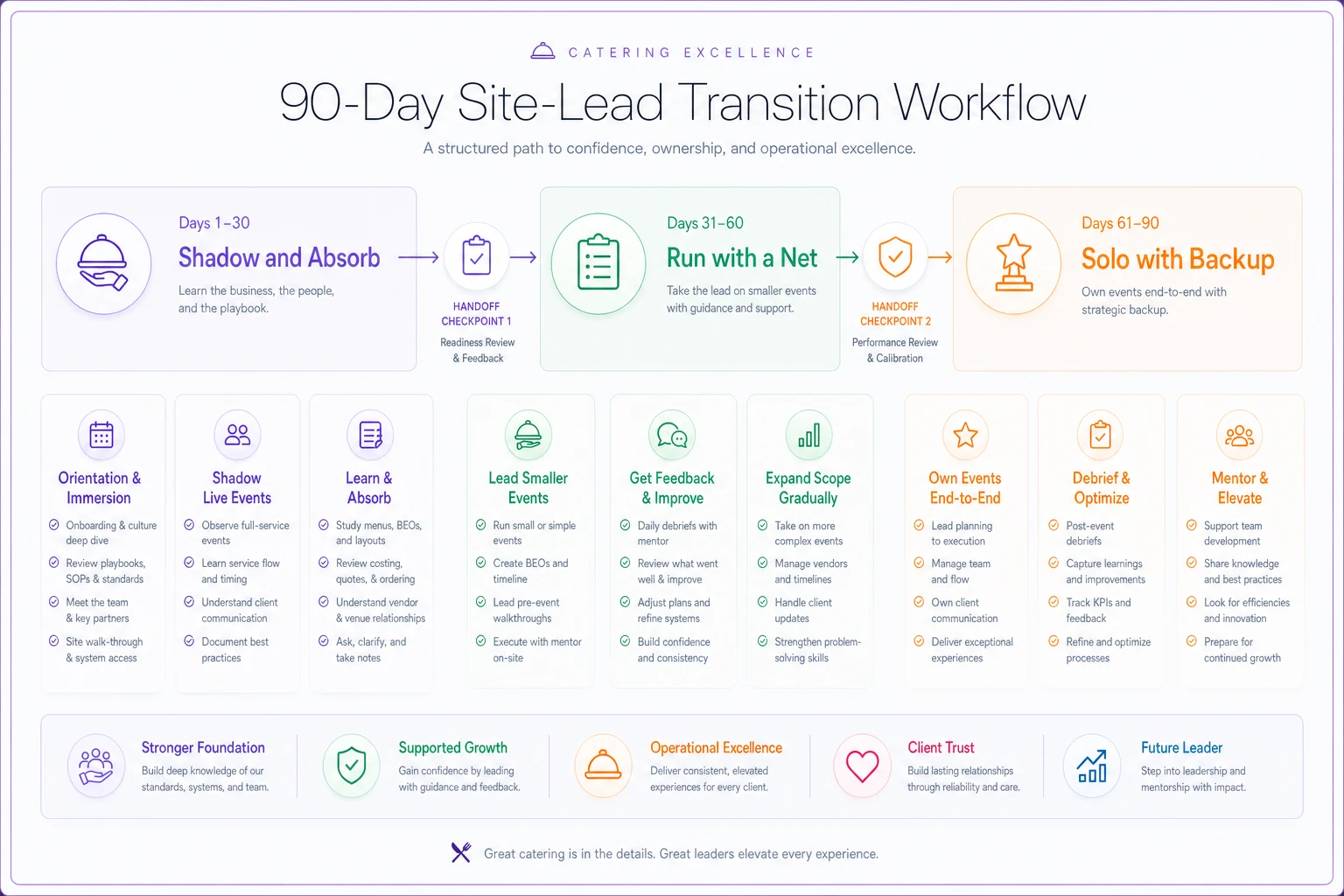
Days 61–90 — Solo with backup
-
[ ] Runs a mid-size event fully solo; owner is reachable but not present
-
[ ] Confirms crew assignments and span of control fit the event complexity
-
[ ] Handles the day-of client relationship independently
-
[ ] Leads the debrief and identifies their own improvement areas
-
[ ] Owner and lead agree on which event sizes and types they're now cleared to run alone
That last line matters. "Cleared to lead" isn't binary. A new lead might be solid on a 120-cover buffet but not ready for a 300-cover plated dinner with three vendors. Define the boundary explicitly so nobody guesses.
Where the structure quietly leaks — and where software actually helps
Once you have leads running independent sites, a new problem appears: you lose visibility. When you were on every floor, you knew everything by being there. Now you're relying on people to report accurately, and information gets lost between events.
This is the real reason multi-site coordination breaks — not bad people, but scattered information. Who's assigned where, which lead owns which event, what got escalated and whether it got resolved, whether the crew size actually matched the span-of-control rule. In a spreadsheet-and-group-text world, all of that lives in fragments.
This is where operational software genuinely earns its place — not as a magic fix, but as the shared source of truth your structure needs to run without you. A platform that centralizes event assignments, crew rosters, lead accountability, and escalation tracking means a site lead knows exactly who's on their crew and what they're cleared to decide, and you can see across all concurrent events without a single phone call. AI-assisted scheduling can flag when you've assigned a green lead too wide a crew, or when two events are competing for the same staff, before it becomes a Saturday-morning crisis. The point isn't to replace the site lead — it's to give the whole structure a nervous system so the layers you built actually function when you're not looking.
When this makes sense — and when it doesn't
Build this structure when:
-
You're regularly turning down or dreading overlapping events
-
You personally get pulled into floor problems more than a couple times per event
-
Your best people are leaving because there's no path up
-
You can't take a full day off during peak season without something breaking
Hold off when:
-
You're doing fewer than a couple events a month — you don't have enough volume to keep a lead sharp, and an out-of-practice lead is worse than no lead
-
Your margins can't yet support the pay bands the structure requires; premature layers add cost before they add capacity
Who should be careful: owners who scale headcount but refuse to hand over decision authority. If you build the chart but still make every call yourself, you've just added payroll without adding leverage. The structure only works if you actually let go of the room.
A real scenario
A regional caterer running roughly 90–110 events a year hit a wall at about 10 staff. Revenue was up, but the owner was on-site for nearly every event because no one else was trusted to run one. Overtime was creeping, two service slips in one quarter cost them a corporate repeat client, and the owner hadn't taken a weekend off during busy season in two years.
They spent one off-season doing three things: defining a proper site-lead role, promoting two senior servers through a structured 90-day ramp, and rebuilding pay bands so the lead premium was real — around a $5/hour jump, not $1.50. They also set hard span-of-control rules by event size.
By the following peak season, the owner was on-site for maybe a third of events instead of nearly all of them. They ran three concurrent Saturdays that spring for the first time without a service complaint. Overtime dropped noticeably because leads were sending crews home on schedule instead of waiting for the owner to decide. Both new leads stayed — one specifically because the path finally felt real. Nothing about the food changed. The structure changed, and that's what let the business hold quality while growing.
The takeaway
Scaling a catering operation isn't a hiring problem — it's an authority problem. You grow the moment you build layers of people who can own outcomes without you standing there, and you pay and promote them in a way that makes carrying that responsibility worth it. Span-of-control rules keep your leads from being overwhelmed. Comp bands keep your best people from walking. A real 90-day ramp keeps you from setting up leads to fail. Do that work, and the org chart stops being a diagram and becomes the thing that lets you run four events on a Saturday and not hear your phone ring once.
Ready to elevate your catering business?
Join 500+ caterers trusting Caterngly to save time, reduce errors, and deliver flawless events.