

The uncomfortable pattern in catering labor is that you almost never have the right number of people at the right time. Either you're scrambling to fill a Saturday three days out, calling every part-timer you've ever worked with, or you've got trained staff sitting idle in February wondering if they should pick up shifts somewhere else. Both problems trace back to the same root cause — reacting to the calendar instead of forecasting against it.
Most owners treat hiring as an emergency response. A big booking lands, panic sets in, you grab whoever's available. Then the season slows and you quietly hope people drift away on their own so you don't have to have the awkward conversation. That cycle costs you twice: once in the frantic overpaying to fill gaps, and again in the training you sank into people who left before they were worth it.
Real catering labor capacity planning isn't a spreadsheet you build once. It's a system that connects your booking pipeline to your hiring pipeline across three time horizons — 30 days, 90 days, and 12 months — each with different triggers and different actions. The 30-day view tells you who to schedule and where the gaps are. The 90-day view tells you who to recruit and cross-train. The 12-month view tells you whether your staffing model can survive next season. When those three horizons talk to each other, hiring stops being reactive.
The core problem: bookings and labor live in separate universes
In most catering operations, the sales side and the labor side never actually reconcile until the week of the event. Sales books whatever they can close. Ops finds out about the crunch when the event sheet lands on their desk. By then, the lead time to recruit and train anyone useful has already passed.
What you see across a lot of small catering teams is bookings tracked in one place — a CRM, a shared calendar, sometimes just the owner's memory — and labor availability living somewhere completely separate, usually a group text and a mental list of who's reliable. Nobody is doing the math that connects a signed contract to a required headcount to an actual hiring decision.
The math itself isn't complicated. A 200-cover plated dinner needs a predictable number of servers, captains, and back-of-house hands. If you've built a solid time-per-cover matrix for plated service, you already know your labor demand per event type. The failure isn't in estimating one event. The failure is in aggregating estimated demand across your whole pipeline and comparing it to the labor supply you actually have — trained, available, and reliable — over the next month, quarter, and year.
That aggregation gap is where the whole system breaks. You can staff a single event beautifully and still be structurally understaffed as a business.
The three horizons, and what each one is actually for
These aren't three copies of the same forecast at different zoom levels. They're three different questions.
End chaos with centralized catering management.
Caterngly helps you plan, confirm, and manage every catering event seamlessly.
- Unified event and order management
- Real-time client updates
- Staff and resource scheduling
No credit card required
Horizon 1 — 30 days (execution): Who works which event? Where are the confirmed gaps? Bookings here are mostly firm, so labor demand is nearly exact. Your only variables are no-shows, callouts, and events that upsize late.
Horizon 2 — 90 days (pipeline): Do you have enough trained people to cover what's coming? This is the recruiting and cross-training window. Ninety days is roughly the honest amount of time it takes to post a role, interview, hire, onboard, and get someone competent enough to run a station without a babysitter. Wait until Horizon 1 to notice a shortage and you've already lost the ability to fix it properly.
Horizon 3 — 12 months (structure): Can your staffing model handle next year's shape? This is where you look at seasonal peaks, your core-vs-flex ratio, wage inflation, and whether your lead trainers are heading toward burnout. Decisions here look like "we need a second captain on payroll year-round" or "September through December is going to require 40% more flex labor than we can currently source."
The mistake almost everyone makes is running only Horizon 1 — scheduling week to week and calling it planning. That's not planning, it's dispatching. Planning is the 90-day and 12-month work that makes the 30-day work boring and easy.
Mapping bookings to labor demand: the conversion layer
Before any of the horizons work, you need a clean way to translate a booking into a labor number. This is the layer most teams skip.
| Event type | Servers per 100 covers | BOH per 100 covers | Captain/leads | Staff-hours per cover (approx) |
|---|---|---|---|---|
| Buffet, casual | 3–4 | 2 | 1 per 150 | 0.6–0.8 |
| Plated, 3-course | 6–8 | 4 | 1 per 80 | 1.1–1.4 |
| Plated, high-touch/wedding | 9–12 | 5–6 | 1 per 60 | 1.6–2.0 |
| Cocktail/passed | 5–6 | 3 | 1 per 100 | 0.9–1.2 |
| Drop-off/delivery | 1–2 (load crew) | 1 | — | 0.2–0.3 |
Your real numbers will differ — venue distance, service style, and setup complexity all move these. The point isn't the exact coefficient, it's that every booking automatically produces a labor demand figure the moment it's confirmed. When sales closes a 180-cover plated wedding, the system should immediately register roughly 250–320 staff-hours of demand landing on a specific date.
Stack all confirmed and probable bookings on a calendar and you get a rolling demand curve. That curve, compared against your available trained labor, is the single most useful number in your business. It shows you where you're overbooked on labor before the event week arrives.
One thing people consistently miss: weight your probable pipeline, don't just count firm bookings. If you have four proposals out for the same Saturday in three months at a 40% close rate, that's real expected demand. Ignoring it means you'll under-recruit and then scramble when two of them close.
Hiring-pipeline KPIs that actually predict coverage
Once demand is quantified, the hiring pipeline needs its own metrics. Without them, you can't tell whether Horizon 2 is on track.
-
Time-to-fill days from posting a role to accepted offer. For flex catering staff, aim for under 21 days; if it's creeping toward 40, your 90-day horizon is already at risk.
-
Time-to-competent days from hire to running a station unsupervised. More important than time-to-fill and almost nobody tracks it. Realistic range is 3–6 shifts for experienced hires, longer for green ones.
-
Pipeline coverage ratio trained-and-available staff-hours ÷ forecasted demand staff-hours for the next 90 days. Below 1.0 means you're structurally short. You want a buffer around 1.15–1.25 to absorb callouts and late upsizes.
-
Reliable-fill rate of shifts offered, what percentage get accepted by your A-tier staff versus filled with unknowns. A dropping reliable-fill rate is an early warning that your core is thinning.
-
Cost-per-hire fully loaded — job ads, recruiter time, interview hours, onboarding labor, and the productivity drag of a new person's first few shifts.
That last one deserves its own honest number, because most caterers wildly underestimate it.
Cost-per-hire targets: the number owners guess wrong
When owners estimate cost-per-hire, they think about the job ad and maybe an hour of interviewing. The real cost is dominated by the invisible parts — the trainer's time, slower service during a new hire's first events, and the churn cost when they don't stick.
A realistic fully-loaded cost-per-hire for a flex catering server usually lands somewhere in the $600–$1,200 range once you count onboarding shifts at reduced productivity plus the trainer's diverted attention. For a captain or skilled BOH lead it's meaningfully higher — often $2,000–$3,500 — because the training curve is longer and the supervision cost is real.
Set targets in three tiers:
-
Flex server
target under ~$900 fully loaded, with sub-20% 90-day churn.
-
BOH/prep
target under ~$1,100, with strong retention because these roles anchor consistency.
-
Lead/captain
accept a higher cost, but demand longer tenure — you're investing in someone who reduces everyone else's cost-per-hire by training them.
Churn quietly multiplies cost-per-hire. If your first-90-day turnover is running around 30%, your effective cost-per-hire on the people who stay is roughly 1.4x your headline number, because you paid to train the ones who left too. This is why a clean onboarding process pays for itself faster than most owners expect. Standardizing how new staff learn — the way structured onboarding playlists and skill matrices make possible — is one of the highest-leverage cost-per-hire moves available, because it compresses time-to-competent and cuts early churn at the same time.
The cross-training matrix: your cheapest capacity
The fastest way to add labor capacity isn't hiring — it's making the people you already have able to work more positions. A cross-training matrix turns a headcount problem into a flexibility problem, which is much easier to solve.
Build a simple grid: staff down the left, competencies across the top (plated service, buffet, bar/passed, load-in/setup, captain duties, prep, driving/routing). Rate each person 0–3: 0 = untrained, 1 = can assist, 2 = solo competent, 3 = can train others.
What the matrix reveals almost immediately is your single points of failure. When only one person is a "3" on captaining, every large event is one callout away from chaos. When only two people can drive the box truck, your routing collapses if one is sick on a two-venue Saturday.
The rule worth pushing: no critical competency should sit with fewer than three people rated 2 or higher. Every quarter, the 90-day horizon should trigger deliberate cross-training to fill the thinnest columns before the season that needs them.
No critical competency should sit with fewer than three people rated 2 or higher.
Cross-training also does something the P&L loves — it reduces the overtime you rack up when the same few skilled people get scheduled into everything. That connects directly to the discipline of scheduling around overlapping events without runaway overtime; a deep matrix gives the scheduler more legal moves and fewer forced decisions.
Trigger thresholds: turning forecasts into action
Forecasts are useless if nobody acts on them. The bridge is a set of trigger thresholds — pre-agreed rules that say "when this number hits this value, this action fires." No debate, no waiting for a slow week to think about it.
-
Pipeline coverage ratio drops below 1.15 for any week inside 90 days → open recruiting for flex staff immediately. Don't wait for it to hit 1.0.
-
Any critical competency column falls to two people rated 2+ → schedule cross-training sessions within 30 days.
-
Reliable-fill rate drops below ~80% over a rolling four weeks → investigate retention now; you're losing your core before the numbers show a shortage.
-
Time-to-fill exceeds 30 days on an open role → widen sourcing channels or raise the offer; your 90-day coverage is about to slip.
-
Forecasted peak-season demand exceeds current trained supply by more than 25% (12-month horizon) → trigger a structural decision: add year-round headcount, build a partner staffing agreement, or cap bookings.
The discipline here is that the trigger fires on the forecast, not on the pain. By the time you feel the pain, the 90-day window to fix it is gone.
Below is a simplified view of how a booking flows through each horizon before it becomes a staffing decision:
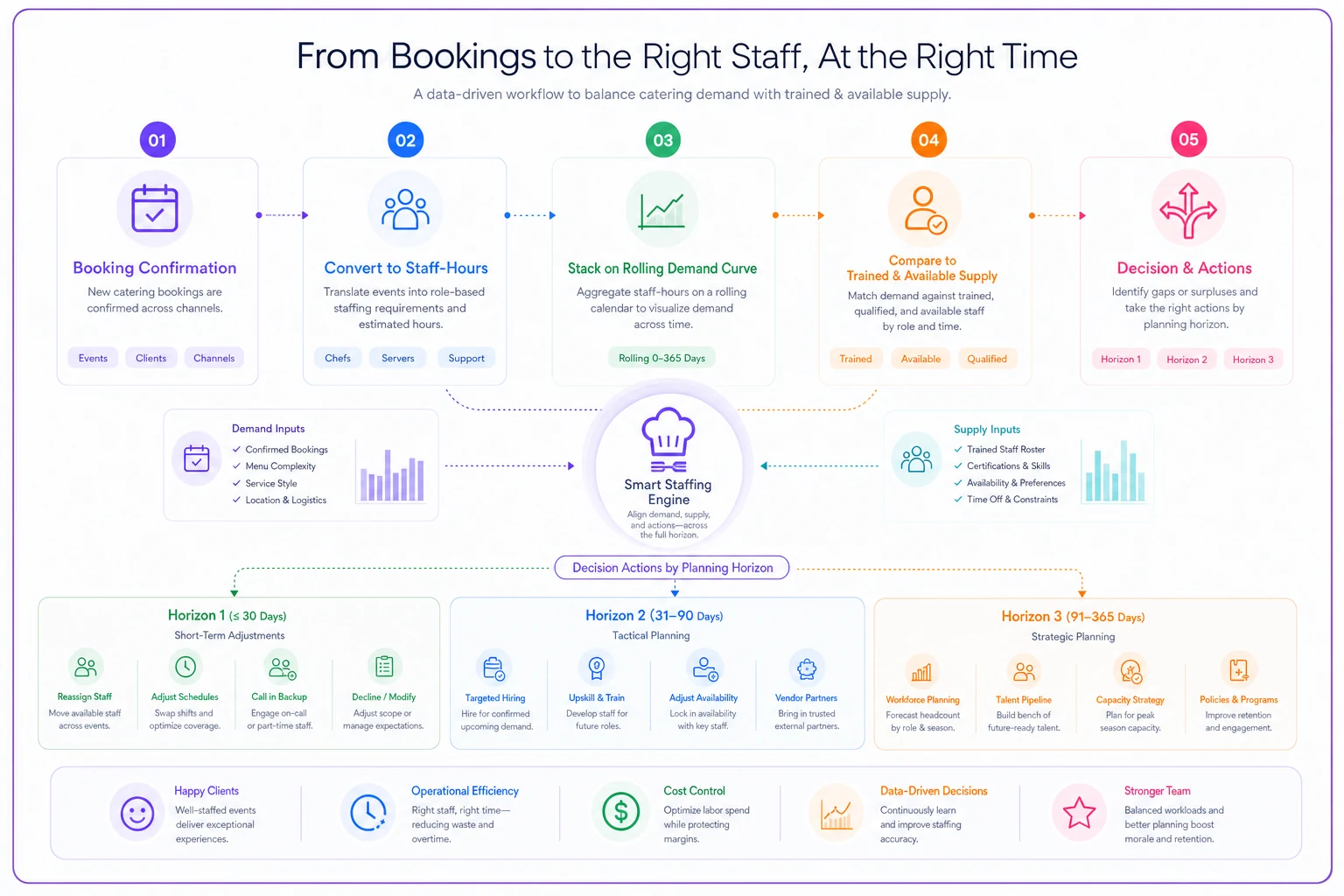
Booking confirmed/probable ↓ Convert to staff-hours (labor coefficient × covers) ↓ Stack on rolling demand curve ↓ Compare to trained-and-available supply ↓ Horizon 1 (≤30 days): schedule gap → assign or fill Horizon 2 (31–90 days): coverage ratio < 1.15 → recruit/cross-train Horizon 3 (91–365 days): structural gap > 25% → model change or cap
A real scenario: mid-size caterer, peak-season collapse avoided
A caterer doing roughly $1.4M a year, mostly weddings and corporate events, with about six core staff and a rotating flex pool of around 20 part-timers. Their pattern every year was the same: April through June they'd overpay for last-minute labor and burn out their two captains, and by July they'd quietly lost a couple of good people to exhaustion.
The fix wasn't dramatic. They started converting every confirmed and probable booking into staff-hours and stacking them on a 90-day rolling curve. In late February, the curve showed May demand running about 30% over their trained supply — a shortfall they wouldn't have felt until late April. The trigger fired: they opened recruiting in early March, hired three flex servers, and ran two cross-training sessions to get four more people captain-capable.
The season-over-season difference was noticeable rather than miraculous. Overtime dropped because the scheduler had more qualified bodies to spread across overlapping Saturdays. Last-minute premium-pay fill-ins — which had been running a few thousand dollars across the peak — shrank to almost nothing. Both captains made it through June without threatening to quit, which honestly was the outcome that mattered most. Effective cost-per-hire came down too, because the March hires had time to reach competence before the crush instead of being thrown in raw.
Nothing about this required new sales. It required connecting the pipeline they already had to the labor decisions they were making too late.
When this system makes sense — and when it doesn't
There's a real threshold where this kind of system earns its keep. If you're running more than a handful of events a month, have real seasonal swings, and rely on a mix of core and flex staff, the forecasting layer pays for itself fast. It's also close to mandatory once you're running simultaneous events at scale, where labor coordination is the thing most likely to break quality across venues.
If you're a solo operator or a very small shop doing a few predictable events a month with the same three people every time, three horizons is more machinery than you need. Track a simple availability calendar and skip the coefficients.
Anyone whose booking data is a mess should hold off entirely. If confirmed and probable bookings aren't captured consistently, the forecast will be garbage, and garbage forecasts fire false triggers that erode trust in the whole system. Clean up your booking capture first, then layer capacity planning on top. Building the demand curve on unreliable inputs is worse than not building it at all.
Where software quietly earns its place
You can run all of this in spreadsheets, and plenty of caterers do for a while. Where it starts to strain is the aggregation and the triggers. Manually recalculating a 90-day demand curve every time a booking lands, keeping the cross-training matrix current, checking every threshold — that's the part that decays. It works in March when you're motivated and quietly stops working in May when you're slammed, which is exactly when you need it most.
This is the natural place for AI-powered operational software to help — not by making decisions for you, but by keeping the demand curve live as bookings change, flagging when a coverage ratio or fill-rate trips a threshold, and surfacing the thin columns in your cross-training grid before they become a problem. The value isn't automation for its own sake; it's that the system keeps running during your busiest weeks, when a spreadsheet you have to remember to update is the first thing to fall off.
Bringing the horizons together
The reason so many caterers live in a permanent state of being over- or under-staffed is that they only run one horizon — the 30-day dispatch view — and mistake it for planning. Coverage, cost, and staff burnout are all downstream of forecasting decisions that should have been made 90 days or a year earlier.
Get the conversion layer right so every booking produces a labor number. Track the pipeline KPIs that predict coverage instead of confirming a shortage after the fact. Keep a cross-training matrix that kills single points of failure. Wire in trigger thresholds so the forecast turns into action on its own schedule, not your panic's schedule.
Do that consistently, and hiring stops being the fire drill that defines your peak season. It becomes a boring, well-timed process that quietly keeps quality high — while your competitors are still calling everyone they know three days before a 200-cover wedding.
Ready to elevate your catering business?
Join 500+ caterers trusting Caterngly to save time, reduce errors, and deliver flawless events.