



The gap between a 40-event year and a 400-event year isn't equipment or kitchen space. It's people — specifically, whether the person you scheduled for a job can actually do that job without someone hovering over them.
Most caterers hit a wall somewhere around the point where they can no longer personally vouch for everyone on every event. You know your core twelve. You trust them. But on a heavy Saturday with four events running simultaneously, you're pulling in temps from an agency, a couple of friends-of-staff, and that one guy who "has serving experience." That's where things quietly fall apart — not dramatically, but through the slow accumulation of small failures: chafers lit wrong, allergen questions answered badly, a buffet line that breaks down because nobody knew the reset sequence.
The usual response is to schedule by name and gut feel. "Put Marcus on the plated dinner, he's solid." That works until Marcus is double-booked and you're staring at a roster of names you can't rank. People operations at a real catering scale needs something more boring and more reliable than memory: a system where what someone is certified to do determines what they're allowed to be scheduled for. Certification gates scheduling. Scheduling gates risk.
Why "they've done it before" stops working
Experience-as-shorthand breaks for a predictable reason. With a small crew, knowledge about who can handle what lives in your head — and your head is a pretty good database at that size. You know Sarah can run a station solo, you know the new temp needs supervision, and you adjust on the fly.
But that knowledge doesn't scale and it doesn't transfer. The moment you add a second site lead making their own scheduling calls, the shared mental model fractures. Your site lead thinks "experienced server" means one thing; you mean another. A temp gets scheduled for a plated service they've never run because the agency listed them as "experienced" and nobody downstream had a definition to check against.
In real operations, this shows up as a cluster of day-of problems that all trace back to the same root: someone placed in a role they weren't actually qualified for, with no gate to catch it. The failure looks like a service problem. It's actually a people-ops problem — a missing definition of competence, enforced at the wrong moment or not at all.
What tends to happen across growing catering operations is that the business doesn't lack skilled people. It lacks a shared, written definition of what each skill level means and a mechanism to stop unqualified placements before they reach the event.
Micro-certification instead of job titles
The fix isn't a big HR binder. Job descriptions are too coarse — "Server" or "Captain" tells you nothing about whether this specific person can handle a buffet reset or an allergen table. What works better is breaking competence into small, provable units. Micro-certifications.
End chaos with centralized catering management.
Caterngly helps you plan, confirm, and manage every catering event seamlessly.
- Unified event and order management
- Real-time client updates
- Staff and resource scheduling
No credit card required
-
Can light and monitor a chafing setup unsupervised
-
Can execute a plated-service pass at 2+ covers per minute without errors
-
Can run allergen protocol
identify, communicate, escalate
-
Can lead buffet line reset during service
-
Can close out a station
breakdown, pack, manifest check
Each one is small enough to teach in under an hour and verify on a real event or a controlled drill. The person either holds it or they don't. No "sort of."
The power of breaking skills down this way is that scheduling stops being a judgment call and becomes a lookup. Need someone to run the allergen-sensitive table at a wedding? Pull from the pool of people who hold that specific cert. Doesn't matter if they're a temp or a five-year veteran — the cert is the qualifier, not the tenure.
This connects directly to the groundwork of onboarding and skill tracking. If you've already built out something like onboarding playlists and skill matrices with QA audits, micro-certs are the enforceable layer that sits on top: the matrix tells you who can do what, the certs make it official and schedulable.
Competency ladders: stacking certs into levels
Individual certs are useful, but people and schedulers still need a sense of overall level. That's where you stack certs into ladders. A ladder is just an ordered bundle of micro-certs that defines a role tier.
Here's a workable four-tier structure for service staff:
| Tier | Title | Required micro-certs | Can be scheduled for | Typical pay band |
|---|---|---|---|---|
| 1 | Support / Runner | Chafer setup, station close-out, basic food handling | Buffet support, bussing, backstage prep — always supervised | $16–18/hr |
| 2 | Service Staff | Tier 1 + plated pass certified, guest interaction, allergen-aware | Plated service, buffet line, guest-facing roles | $18–22/hr |
| 3 | Lead Server | Tier 2 + buffet reset lead, allergen protocol lead, section management | Can run a station/section unsupervised, trains Tier 1s | $22–27/hr |
| 4 | Captain / Site Lead | Tier 3 + event open/close, client liaison, incident escalation, team scheduling | Runs an entire event floor, owns day-of decisions | $28–38/hr or salaried |
The pay bands aren't arbitrary. They're tied to what the person is certified and permitted to do, which means your labor cost per role becomes predictable instead of negotiated case by case. A Tier 2 who wants Tier 3 money has a concrete, visible path: earn these specific certs. No more vague "we'll see how you do" conversations that create resentment and inconsistency.
One thing worth flagging: the jump from Tier 3 to Tier 4 is the one most caterers under-define. Running a station is a skill. Running an event — making the call to delay service, handling an angry client, deciding whether to escalate a food-safety issue — is a completely different competency set. If your ladder treats "senior server" and "captain" as the same thing with a pay bump, you'll keep putting great servers in captain roles and watching them freeze under pressure.
The delegation matrix: who can decide what
Certification tells you what someone can do. A delegation matrix tells you what someone can decide. These are different, and conflating them is a classic scaling mistake.
A delegation matrix maps decisions to the minimum tier allowed to make them. The point is to push authority down to the lowest competent level so your captains and owners aren't bottlenecks on every small call, while keeping the high-stakes decisions gated.
A simplified version:
-
Substitute a missing serving utensil from backup kit — Tier 2+
-
Adjust buffet line layout for guest flow — Tier 3+
-
Approve a minor off-menu guest request (dietary swap) — Tier 3+
-
Hold service start by up to 15 minutes — Tier 4 only
-
Escalate a food-safety concern / pull a dish — any tier can trigger, Tier 4 decides
-
Authorize overtime / call in additional staff — Tier 4 + owner notification
-
Handle a client complaint on-site — Tier 4, with escalation path to owner
Under-delegation hurts as much as over-delegation. When every decision routes up to the one captain or the owner, events stall. The captain is on the phone with a client while a buffet line backs up because nobody below them was authorized to fix the layout. A clear matrix means a Tier 3 just handles the buffet flow issue without waiting for permission — because the system already granted it.
This also protects you legally and operationally. Food-safety escalation being open to "any tier can trigger" matters: you want the newest runner to feel empowered to flag a problem, even if the final call belongs to the captain.
Scheduling-gate rules: where it all comes together
A scheduling gate is a rule that blocks an assignment when the person doesn't hold the certs the role requires. The event's staffing plan specifies required certs per slot; the gate checks each proposed assignment against the person's cert record; mismatches get flagged before the schedule is published.
How this works as a workflow:
-
Event build. When you build the staffing plan for an event, each role slot carries its required certs. A 120-guest plated wedding might need: 1 Tier 4 captain, 2 Tier 3 leads, 6 Tier 2 servers (all plated-pass certified), 1 allergen-protocol lead, 3 Tier 1 support.
-
Assignment. You or your site lead drop people into slots — from your core staff and your temp pool.
-
The gate check. Before the schedule locks, every assignment is validated against cert records. The temp you put in a plated slot who only holds Tier 1 certs gets flagged — blocked, or at minimum marked as "requires supervision."
-
Resolution. You either swap the person, pair them with a qualified lead, or — if it's appropriate — fast-track the cert with a pre-event verification.
-
Lock and publish. Only a schedule that passes the gates goes out.
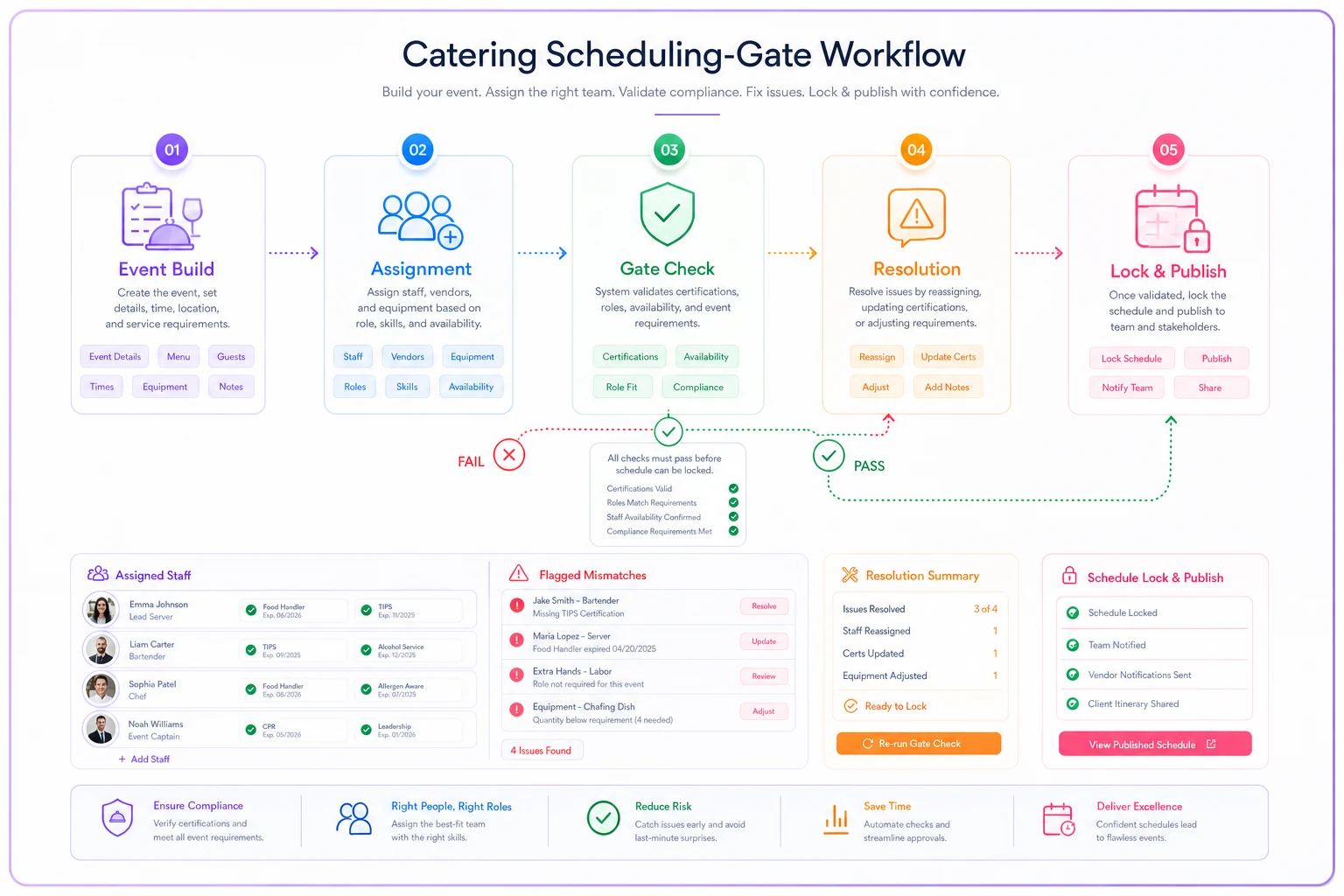
The reason this matters is that it moves the catch upstream. Most caterers catch the mismatch at the event — when the under-qualified person is already on-site, already in the role, already failing. The gate catches it days earlier, when you still have time to fix it without scrambling.
This pairs tightly with how you handle overlapping events. If you've worked through scheduling staff for overlapping catering events and controlling overtime, you already know the pain of juggling the same qualified people across four Saturdays. Cert-gated scheduling makes that juggling honest — you can see immediately that you only have three allergen-certified leads and four events that each need one, which is a planning problem you'd much rather find on Tuesday than Saturday morning.
Certification artifacts: what you actually keep
A cert system is only as good as its records. "Certified" has to mean something you can point to. The artifacts to maintain for each person:
-
Cert record — which micro-certs they hold, date earned, who verified it
-
Expiry / refresh dates — food-safety certs expire; skill certs that go stale with disuse should too
-
Verification evidence — the drill checklist signed off, or the event where they demonstrated the skill under observation
-
Tier status — current ladder position, derived from certs held
-
Delegation permissions — what decisions this person is authorized to make
Require captains to sign off provisional cert drills for agency temps so the record reflects a verified event-specific status.
The expiry piece gets ignored and it shouldn't. A server who hasn't run a plated pass in eight months isn't reliably plated-certified anymore. Building a refresh cadence — recertify after a certain period of inactivity — keeps your cert records honest instead of aspirational. The worst situation is a cert record that says someone's qualified when they've gone rusty, because now your gate is waving through a problem it was supposed to catch.
For temps specifically, the artifact that saves you is a provisional cert path: a short pre-shift drill — lighting a chafer, running a three-cover pass, reciting the allergen escalation steps — that a captain signs off before the event. Takes fifteen minutes and converts an unknown agency temp into a known quantity at a specific tier for that event. Agencies misrepresent experience constantly; a quick verified drill cuts through the noise.
A real scenario
A mid-size caterer running roughly 180–200 events a year — a mix of corporate lunches and weekend weddings — kept hitting the same failure. On busy weekends they'd pull 15–20 temps from two agencies, and somewhere around one event in six had a serious day-of service problem: broken buffet lines, slow plated service, a couple of allergen near-misses that genuinely scared them.
The owner's instinct was "better temps," and they burned money switching agencies twice. Didn't help, because the problem wasn't the temp pool — it was that temps were being dropped into roles with no definition of what the role required and no check before the event.
They built out about a dozen micro-certs, a four-tier ladder, and a pre-shift drill for agency temps. Scheduling became cert-gated: no one goes into a plated or allergen slot without the cert or a same-day verified drill. The build-out took a couple of months of working through definitions and getting site leads to actually run the drills consistently.
The change showed up within a season. Day-of service failures dropped from roughly one-in-six events to something closer to one-in-fifteen — not zero, but a clear improvement. Allergen near-misses essentially stopped, because those slots now only went to people who'd proven the protocol. There was also an unexpected upside: their better temps started requesting more shifts, because the tier system gave them a visible path to higher pay. Turnover in the reliable temp pool dropped noticeably.
The owner's own words were roughly that they'd spent years treating a systems problem like a hiring problem.
When this makes sense — and when it doesn't
This whole apparatus has a threshold below which it's overkill.
When it's worth building: You're running enough concurrent events that you can't personally staff each one from memory. You're relying on temps or agency staff regularly. You have more than one person making scheduling decisions. You've had day-of failures you couldn't trace to a specific person's known limitation. If two or more of these are true, cert-gated scheduling will pay for itself in avoided failures.
When it's premature: You're running a dozen events a year with the same six people. You know everyone's capabilities cold. Adding a cert ladder here is bureaucracy for its own sake — you'd spend more time maintaining records than you'd save. At that scale, your head is the system, and that's fine.
Who should be careful: Caterers in the awkward middle — growing fast but without a settled core crew — sometimes build an elaborate ladder before they know what their actual roles are. Let the roles stabilize a bit first. Define certs around work you actually do repeatedly, not around a hypothetical org chart. The ladder should describe your operation, not an aspirational version of it.
Making it hold up as you grow
The reason to connect certification to scheduling rather than keeping them separate is coordination. When your cert records, your competency ladder, and your scheduling all live in the same place, the gate can actually fire. When they live in a binder, a spreadsheet, and a scheduling app that don't talk to each other, the gate is just a policy nobody enforces — and policies nobody enforces are the same as no policy.
This is where operational software that connects staffing plans to cert records earns its place. Not as a magic fix, but as the thing that makes the gate automatic: when a site lead drops an under-certified temp into a plated slot, the system flags it right then, instead of relying on someone to remember to check. The checking is the part humans skip under pressure, and day-of pressure is exactly when the check matters most. Automating that one validation step is the difference between a system that works on calm weeks and one that holds on the chaotic ones.
The same logic extends backward into hiring. If you're forecasting staffing needs — and you should be, especially if you've built out a three-horizon labor capacity system — your cert data tells you not just how many people you'll need but which certs you're short on. Discovering in January that you'll be two allergen-certified leads short for spring wedding season is a solvable problem. Discovering it on a Saturday morning in May is not.
Bringing it together
The caterers who scale cleanly aren't the ones with the most talented staff. They're the ones who've written down what competence means, broken it into provable pieces, and wired those pieces into the moment where it counts — the schedule. Everything else follows from that. Pay bands stop being arguments. Delegation stops being bottlenecked. Temps stop being wildcards. And the day-of failures that used to feel random turn out to have been preventable all along, blocked at the point where an unqualified person first got placed in a role they couldn't hold.
Start small. Pick the three certs tied to your most common day-of failures. Define them precisely enough that two different site leads would verify them the same way. Gate those three slots. Then expand. The goal isn't a perfect system on day one — it's a system where the schedule itself refuses to set you up to fail.
Start small. Pick the three certs tied to your most common day-of failures. Define them precisely enough that two different site leads would verify them the same way. Gate those three slots. Then expand. The goal isn't a perfect system on day one — it's a system where the schedule itself refuses to set you up to fail.
Ready to elevate your catering business?
Join 500+ caterers trusting Caterngly to save time, reduce errors, and deliver flawless events.