


Most catering shops don't have a pricing problem. They have a catalog problem. Every quote gets rebuilt from scratch, every event manager has their own version of the "corporate lunch" package, and half the discounts that go out the door never get logged anywhere. By the time you reconcile three weeks later, the margin you thought you booked has quietly leaked out through concessions nobody tracked.
The fix isn't tighter pricing rules layered on top of a messy process. It's productizing the whole thing — turning your menu engineering and per-event P&L logic into a catalog of defined products, each with its own cost card, bundling rules, and a short list of pre-approved concessions. When that exists, quoting stops being an argument and becomes an assembly job.
Here's how this actually works, where it breaks as you grow, and what the catalog needs to contain to hold up under real event volume.
Why quoting falls apart without a catalog
The typical small-to-mid catering operation builds quotes off tribal knowledge. The owner knows the "right" price for a 120-person plated dinner. One event manager quotes it at $58 a head, another at $52 because they wanted to win it, and a third throws in free coffee service because the client pushed back.
-
Inconsistent pricing for functionally identical events, which clients eventually notice and use against you.
-
Unlogged concessions — the free upgrades, waived delivery fees, and "we'll throw that in" moments that never hit the P&L.
-
Rebuilt-from-scratch quoting, where every proposal takes 45 minutes to an hour because nobody trusts the last version.
This usually gets worse right when business is good. When you're slammed, event managers grab whatever quote template is closest, tweak it under time pressure, and ship it. The discipline that existed in the slow season evaporates in the busy one — which is exactly when margin matters most.
A product catalog attacks this at the root. Instead of pricing an event, you price products, and an event becomes a stack of products with known costs. The judgment shifts from "what should this cost?" to "which products go in this stack?" — a much smaller, safer decision to hand to a team.
What a product card actually contains
A product card is the atomic unit of the catalog. Think of it as the standardized definition of one sellable thing — "Plated Three-Course Dinner Service," "Coffee & Pastry Break," "Bar Service Package B," "Delivery Setup Tier 2." Each one carries everything needed to quote and cost it without a human recalculating from scratch.
End chaos with centralized catering management.
Caterngly helps you plan, confirm, and manage every catering event seamlessly.
- Unified event and order management
- Real-time client updates
- Staff and resource scheduling
No credit card required
-
A fixed product name and code so it maps cleanly across proposals, POS, and accounting
-
The standardized inclusions — what's actually in it, down to the component level
-
A cost card — the loaded cost per unit (food, labor, consumables, allocated overhead)
-
The list price and margin band — the target margin and the floor you won't sell below
-
Bundling behavior — what it can and can't be combined with
-
Approved concessions — the specific discounts or upgrades a manager can apply without escalation
The cost card underneath each product is where menu engineering meets financial reality. This is the same discipline covered in the per-event P&L allocation work — you're taking canonical allocation rules and baking them permanently into the product instead of re-deriving them on every quote. If your P&L says a plated dinner carries roughly $4.50 in consumables and a labor load of about 22 minutes per cover, that lives in the card. Nobody re-guesses it.
The insight most operators miss: the cost card should be versioned, not edited. When beef prices jump, you don't overwrite the old card — you create version 2 and date it. That way, when you reconcile an event quoted in March against costs that shifted in April, you can actually see which card was in force. Operators who edit cost cards in place lose the entire audit trail, and every margin investigation turns into guesswork.
Standardizing cost cards so they hold up
This is where a lot of catalogs get built and then quietly rot. Someone sets up solid cost cards in month one, and by month four they're stale because food prices moved, portion sizes drifted, and nobody updated the labor assumptions.
-
What's the true landed food cost per portion, including the yield loss and waste you actually experience — not the recipe-card fantasy?
-
What labor is loaded into it, expressed as time-per-unit so it scales with headcount?
-
What overhead allocation does it carry, using the same canonical rules across the whole catalog?
That third one is where inconsistency creeps in. If one product absorbs delivery and rental overhead and a comparable one doesn't, your margin comparisons are meaningless. The whole point of standardization is that a manager comparing two products is comparing apples to apples.
Version and date cost cards at the moment input prices change.
Substitution logic matters here too. When an ingredient spikes, you don't want each event manager improvising swaps on the fly. The catalog should carry pre-defined substitution rules tied to the cost card — the same thinking behind recovering margins through menu-component levers. If salmon jumps, the card already knows the approved alternate and its cost delta. The swap becomes a governed decision, not a kitchen improvisation that surfaces on the invoice later.
| Approach | Ad-hoc quoting | Productized catalog |
|---|---|---|
| Time to build a quote | 45–60 min | 10–15 min |
| Pricing consistency | Varies by person | Uniform |
| Concessions tracked | Rarely | Every time |
| Cost card accuracy | Drifts silently | Versioned & dated |
| Margin visibility | After reconciliation | At quote time |
| New-hire ramp | Weeks of shadowing | Days |
Taken together, these gaps compound. A team that's inconsistent on pricing and not tracking concessions and re-deriving costs every time is basically running blind. Any one of those is manageable; all three at once is how healthy-looking revenue quietly underperforms.
Bundling rules: where margin is made or lost
Bundling is the part everyone gets wrong. The instinct is to bundle to win deals — package everything together, discount the bundle, close the client. But undisciplined bundling is one of the quietest margin killers in catering, because the discount hides inside the package where nobody itemizes it.
Good bundling rules define three things: what can be combined, what the bundle does to margin, and what the bundle is allowed to discount.
A typical example: you offer a "Corporate Full-Day Package" that bundles breakfast break, plated lunch, and afternoon coffee service. Sold à la carte, those three products carry a blended margin around 34%. The bundle is allowed to discount to a floor of 28% — no lower. That floor is a rule, not a suggestion, and it's enforced by the catalog, not by the event manager's memory.
The pattern worth internalizing: bundles should trade margin for volume or commitment, never for pressure. A bundle discount tied to a full-day booking or a multi-event contract is a reasonable trade. A bundle discount handed out because the client frowned is just erosion with a nicer label. When you connect this to pricing psychology in your proposals, the bundle stops being a discount vehicle and becomes an anchoring tool — you show the à la carte total, then the bundle price, and the client feels the value without you giving away floor margin.
Approved concessions and governance
This is what separates a catalog that works from a spreadsheet that looks nice.
-
Waive delivery fee — allowed on orders above $X, no approval needed
-
Complimentary coffee service — allowed once per corporate account per quarter
-
5% loyalty discount — allowed for repeat clients with 3+ prior events
-
Anything beyond these — requires manager sign-off and gets logged with a reason code
That last line is the governance backbone. Every concession outside the approved list requires escalation, and every concession — approved or not — gets logged against the event. This is what closes the leak. When you reconcile later, you can see exactly what was given away, by whom, and why.
Most ad-hoc discounting isn't malicious, it's invisible. The event manager genuinely doesn't think of a waived setup fee as a discount — it's just being nice to the client. Until you make concessions a tracked, named category, they don't feel like money leaving the building. Once they're logged with reason codes, behavior changes pretty quickly, because now the giveaway shows up on a report someone actually reads.
A workflow for building the catalog
If you're starting from a pile of past quotes and a mental price list, here's a sane order of operations:
-
Pull your last 30–50 events and cluster them by type. You'll usually find that 80% of your business fits into 6–10 recurring event shapes.
-
Define a product for each recurring component across those clusters — the breaks, the service tiers, the bar packages, the delivery levels.
-
Build a cost card for each product using your existing per-event P&L allocation rules, so overhead loads consistently.
-
Set margin bands and floors per product — the target and the "never below this" number.
-
Write bundling rules for the combinations you actually sell, each with its own margin floor.
-
Draft the approved-concessions list per product, and define the reason codes for logged exceptions.
-
Version and date everything, then set a recalibration cadence — quarterly at minimum, faster during volatile food pricing.
The order matters. People want to jump straight to setting prices, but if you price before the cost cards are honest, you're just formalizing your existing guesses. Get the cost structure right first, then build the pricing on top of it.
Visual summary of the catalog build flow.
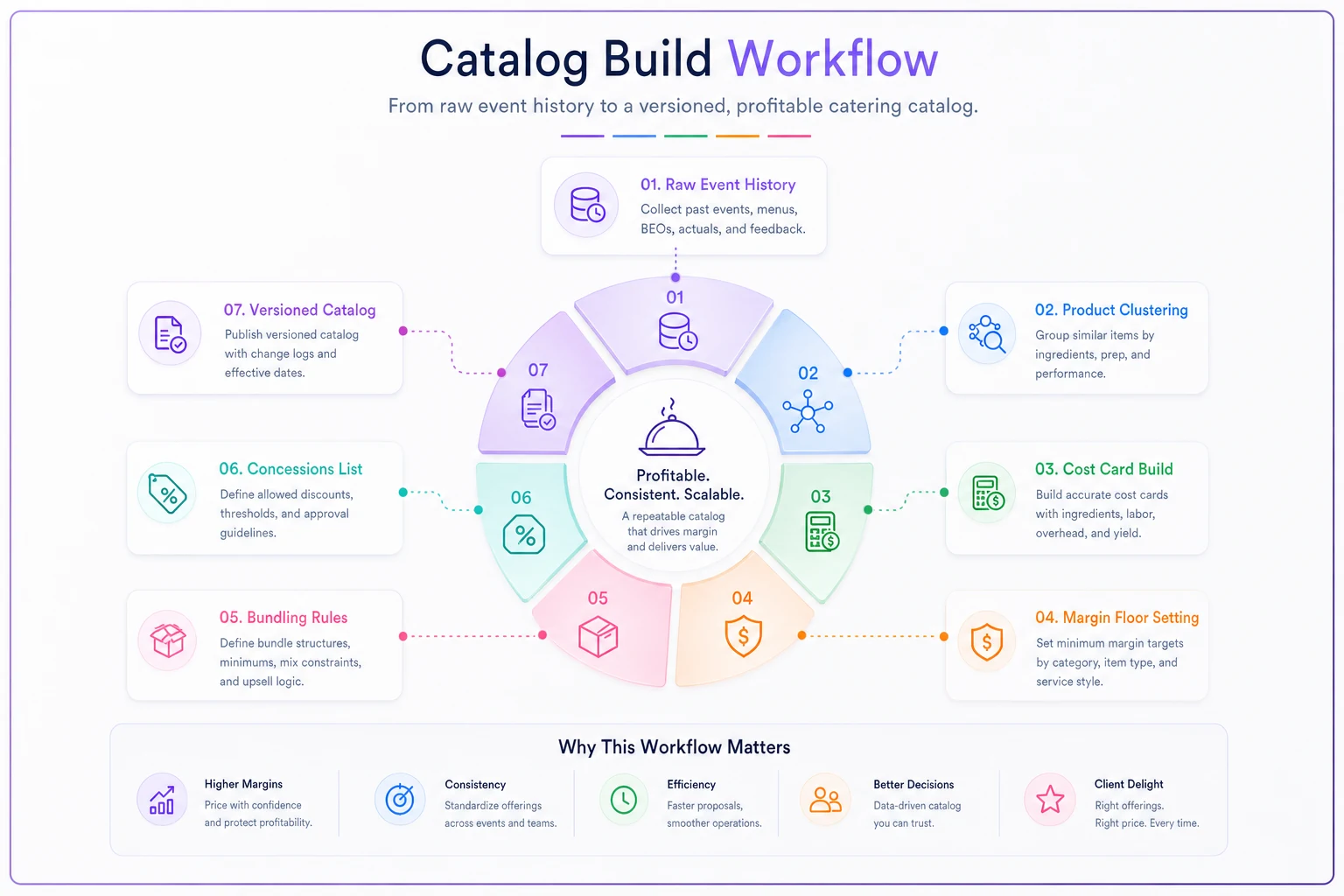
This maps the core steps to go from messy past quotes to a versioned product catalog you can operate from.
Where software quietly earns its keep
You can run a first version of this catalog in a well-built spreadsheet, and plenty of operators do. It starts to strain around the point where you're running enough simultaneous events that no one person sees all the quotes anymore.
That's when an operational platform starts paying for itself — not because it's sophisticated, but because it enforces the rules you already wrote. When product cards, cost cards, margin floors, and approved concessions live in a system, a quote can't go out below floor without triggering an escalation, concessions get logged automatically, and cost card versions stay attached to the events they priced. The governance stops depending on whether a busy event manager remembered the policy at 6pm on a Friday.
The less obvious win is at reconciliation. Because every quote was assembled from versioned products with tracked concessions, matching what you sold against what it cost stops being detective work. The margin story is already written by the time the event ends.
When this makes sense — and when it doesn't
This makes sense when you're running enough volume that quotes are being built by more than one person, or when your event types are recurring enough that you're clearly rebuilding the same thing repeatedly. If you can name your top eight event shapes off the top of your head, you're ready.
This is overkill when you're doing a handful of highly bespoke events a month where every client wants something genuinely custom. Productizing a truly one-off luxury catering business can make you rigid in a market that pays for flexibility. Even then, a partial catalog for your standard components still helps.
Who should not rush this: operators whose cost data is a mess. If you don't actually know your landed food cost and labor load per product, building a catalog on top of bad numbers just makes your errors official and repeatable. Fix the cost visibility first, then productize.
A real scenario
A mid-sized catering company running roughly 20–25 events a month had four people quoting, and no two quoted the same way. Their reconciliations kept showing events that were sold at healthy margins on paper coming in 6–9 points lower than expected. When they finally dug in, almost all the gap was concessions — waived fees, free upgrades, and bundle discounts nobody had logged.
They spent about three weeks building a product catalog: nine core products, versioned cost cards, margin floors, and a short approved-concessions list per product. Nothing exotic. Within two months, quote-building time dropped from close to an hour down to around fifteen minutes, and the margin gap between quoted and reconciled tightened to about 1–2 points — mostly because concessions were now visible and bounded. No revenue explosion, no dramatic turnaround. Just the money they were already earning finally staying on the books.
The bigger shift was behavioral. Once concessions showed up on a report, managers stopped treating them as favors and started treating them as decisions. That alone was worth the three weeks it took to build the thing.
The real point
Productizing your catering services isn't about being corporate or rigid. It's about deciding your pricing and cost logic once, deliberately, when you have time to think — instead of a hundred times a week under pressure by whoever's holding the quote.
A catalog turns quoting into assembly, turns concessions from invisible leaks into tracked decisions, and turns reconciliation from an investigation into a formality. The event managers still get to sell. They just sell from a deck where every card already knows its cost, its floor, and what it's allowed to give away.
Ready to elevate your catering business?
Join 500+ caterers trusting Caterngly to save time, reduce errors, and deliver flawless events.