

Most caterers approach sustainability backwards. A client asks for "eco-friendly" service, someone panics, and suddenly you're paying $0.34 per compostable clamshell instead of $0.11 for standard — eating the difference because nobody built it into the quote. Multiply that across a 300-guest corporate lunch and you've handed back a chunk of your margin for a decision made in the parking lot that morning.
The problem isn't sustainability itself. It's that these decisions get made emotionally, one event at a time, with no framework for when reusable beats compostable, when compostable beats disposable, and — critically — who pays for the difference. A real sustainability strategy caterers can actually live with treats every green choice as a costed operational decision, not a moral one. That's the whole game.
This article is about building the decision logic, procurement language, and pricing structure so that going greener either holds margin flat or improves it. Not the feel-good version. The version that survives a spreadsheet.
Why green decisions erode margin (and it's rarely the material cost)
The material premium on compostables is real but it's usually the smallest part of the leak. What kills margin is the coordination cost around a decision that was never systematized.
Here's what typically plays out:
-
The sales rep promises "sustainable service" without knowing the cost delta, so it becomes a silent line item nobody priced.
-
Procurement buys compostables in a panic at retail rather than contract pricing, paying 40–60% more than a planned order.
-
The kitchen doesn't know which events are "reusable service" so they default to disposables anyway — you paid for the reputation without delivering it.
-
Compostable waste goes into a regular dumpster because there's no diversion partner, meaning you paid the premium for zero actual environmental outcome and zero marketing credibility.
That last one is the quiet killer. Paying compostable prices while sending everything to landfill is the worst of every world: higher cost, no diversion, and exposure if a client ever checks. Sustainability that isn't operationalized is just more expensive disposables with a nicer story.
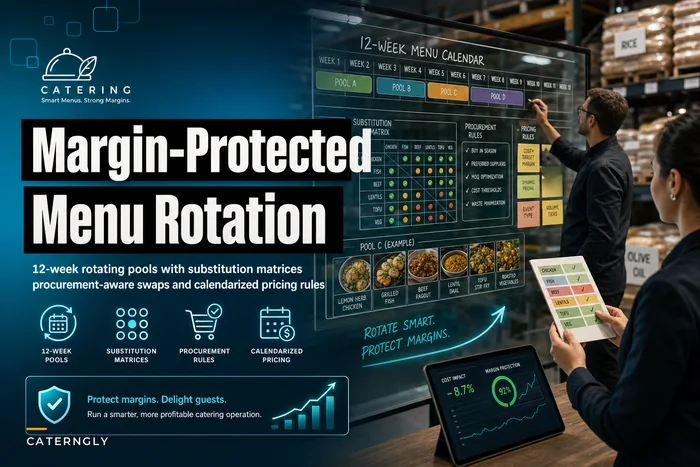
The pattern underneath all of this is the same one that shows up in menu and inventory decisions — cost leaks happen when a choice gets made downstream of the pricing conversation. If you've worked through margin-protected menu rotation, you already know this rhythm: the decision has to be structured before the event, priced into the quote, and executed by rule, not by mood.
The core decision: reusable vs compostable vs disposable
There's no universal winner. The right answer flips depending on event type, venue access, guest count, and whether you control the back-of-house. The mistake is picking one philosophy company-wide. You need a decision tree that runs per event.
End chaos with centralized catering management.
Caterngly helps you plan, confirm, and manage every catering event seamlessly.
- Unified event and order management
- Real-time client updates
- Staff and resource scheduling
No credit card required
Start with venue and logistics, not values.
-
Can you get the items back? Reusables only make economic sense when you control return logistics. On-site events at venues you service repeatedly, or events where your own staff bus and pack out — reusables are viable. Drop-off catering where nothing comes back? Reusables are a guaranteed loss.
-
What's the wash and transport cost? Reusables trade purchase cost for labor and logistics cost. If you're washing in-house, factor dish labor and breakage. If you're renting service ware, you've moved the cost to a rental line — which has its own reconciliation risk.
-
Is there a real diversion path for compostables? No commercial composting partner within reasonable range means compostables are just pricey landfill. Skip them and be honest about it.
-
What does the client actually value? Some clients want the visible signal — real plates, cloth napkins. Others want the certification — compostable, diverted. Those are different products at different price points.
A per-event decision matrix
| Event type | Guest count | Best default | Why | Who typically pays premium |
|---|---|---|---|---|
| Corporate drop-off lunch | 20–80 | Compostable (if diversion exists) | No return logistics; reusables can't come back | Client, bundled into per-head |
| Plated gala at fixed venue | 100–300 | Reusable / rental china | You control pack-out; premium look justifies rental | Client, expects it at this tier |
| Outdoor festival booth | 500+ | Compostable + clear waste stations | Volume makes reusables unmanageable; diversion is marketable | Split — often event organizer |
| Recurring office breakfast | 15–40 weekly | Reusable (client-owned kit) | Repeat cadence amortizes washing/logistics | Client via contract, amortized |
| Wedding, full-service | 80–200 | Reusable rental | Aesthetic non-negotiable; you're already staffing pack-out | Client, already in budget |
The insight most people miss: recurring events are where reusables actually pay off, because the return logistics only have to be solved once. A weekly office account justifies a client-owned reusable kit that a one-off never could. Chasing sustainability on one-off drop-offs is where caterers lose money; chasing it on recurring accounts is where they gain both margin and stickiness.
Procurement language that keeps the premium from becoming a surprise
Half the margin loss is a purchasing problem. When "we need compostables for Thursday" hits procurement 36 hours out, you're buying at retail. When it's a standing category with a contract, you buy at 40% less.
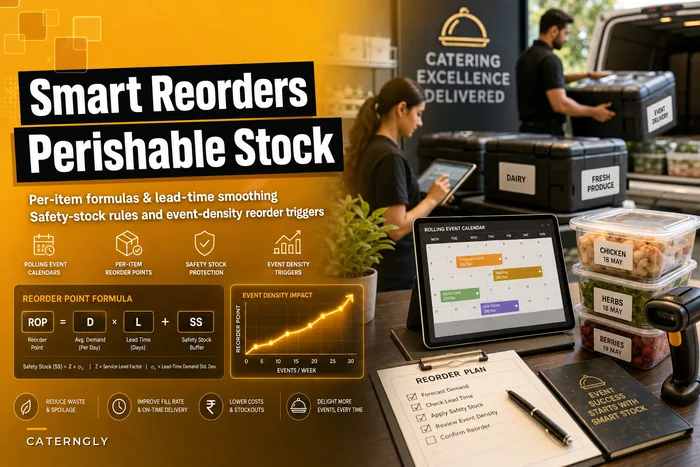
The fix is treating sustainable SKUs like any other planned category — fold them into your reorder and pooled-ordering logic instead of treating each green request as a fire drill. The same math behind perishable reorder points and safety stock applies cleanly here. Compostables don't spoil, but they have lead times, volume-break pricing, and demand that's forecastable from your booking calendar.
A few procurement moves that actually move the number:
-
Negotiate volume tiers on your top three green SKUs. You don't need fifty sustainable items. You need the clamshell, the cup, and the utensil kit priced at contract. Most caterers use a small handful of items across the majority of green events.
-
Write "or approved equivalent" into every eco spec. Locking yourself into one branded compostable line hands the supplier all the pricing power. Approved-equivalent language lets you substitute when prices move.
-
Put diversion in the supplier conversation. Some compostable suppliers will connect you to commercial composting partners or haul-back programs. Most caterers never think to ask.
-
Set a standing par for baseline green events. If a quarter of your book is compostable-service, carry par stock so you're never buying reactively.
The language matters in client contracts too. Vague promises like "eco-friendly service" create obligation with no cost recovery. Specific language — "compostable service ware with third-party diversion, billed at $X per guest" — turns sustainability into a priced, deliverable product line instead of a giveaway.
Lock "or approved equivalent" into vendor contracts to preserve pricing flexibility when a supplier raises rates.
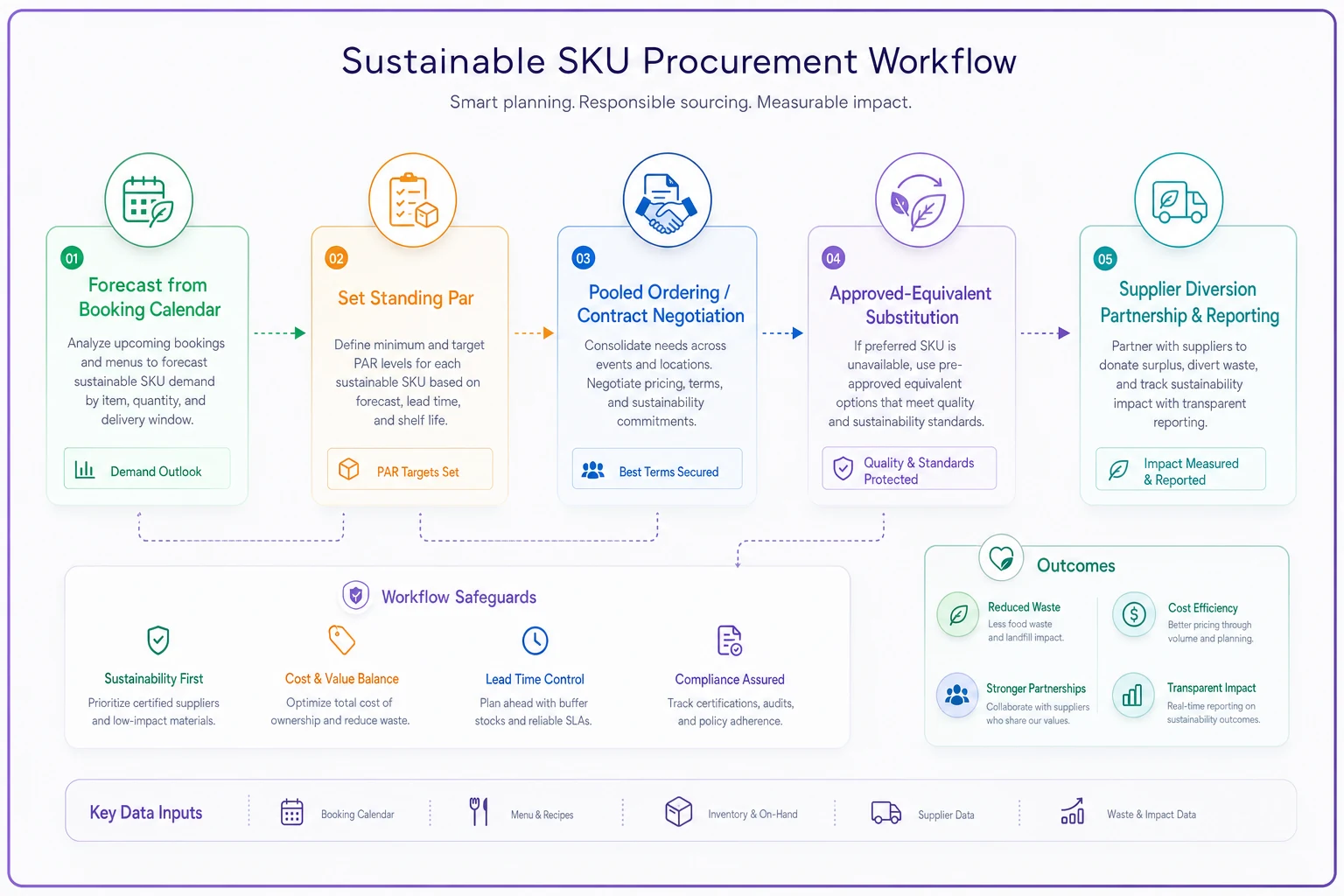
Treating green SKUs as a planned category eliminates the reactive retail buys that bleed margin and lets procurement manage price volatility.
Diversion partnerships: the part everyone skips
Diversion is where credibility lives. Anyone can buy compostables. The caterers who can actually say "we diverted 340 pounds of waste from landfill at your event" have something clients will pay for — and something they can't fake.
-
Map your commercial composting options by service radius. Many metros have haulers or municipal programs; many rural areas don't. Know your actual coverage before you promise anything.
-
Understand contamination rules. Commercial composters reject loads with the wrong plastics. Your compostables have to be genuinely certified and your waste stations clearly sorted — a labor and signage cost worth pricing in.
-
Get the reporting. The partner should give you weight or volume diverted. That number is your marketing asset and your proof for sustainability-minded corporate clients running their own ESG reporting.
-
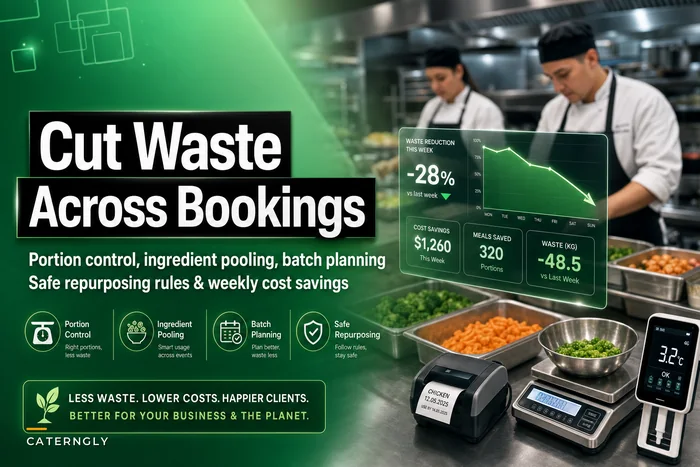
Bundle donation for edible surplus. Food diversion and packaging diversion are different streams. Partnering with a food-recovery org for surplus is a separate, often tax-advantaged move that pairs naturally with your waste-reduction story — and it connects directly to the repurposing discipline in cutting food waste across back-to-back bookings.
Diversion partnerships are a competitive moat precisely because they're annoying to set up. Once you have a reporting relationship with a composter and a food-recovery org, you can bid on sustainability-weighted RFPs that competitors physically can't answer. Corporate clients increasingly score this in procurement, and most caterers have nothing to put in the box.
Pricing the options so the client chooses their own margin impact
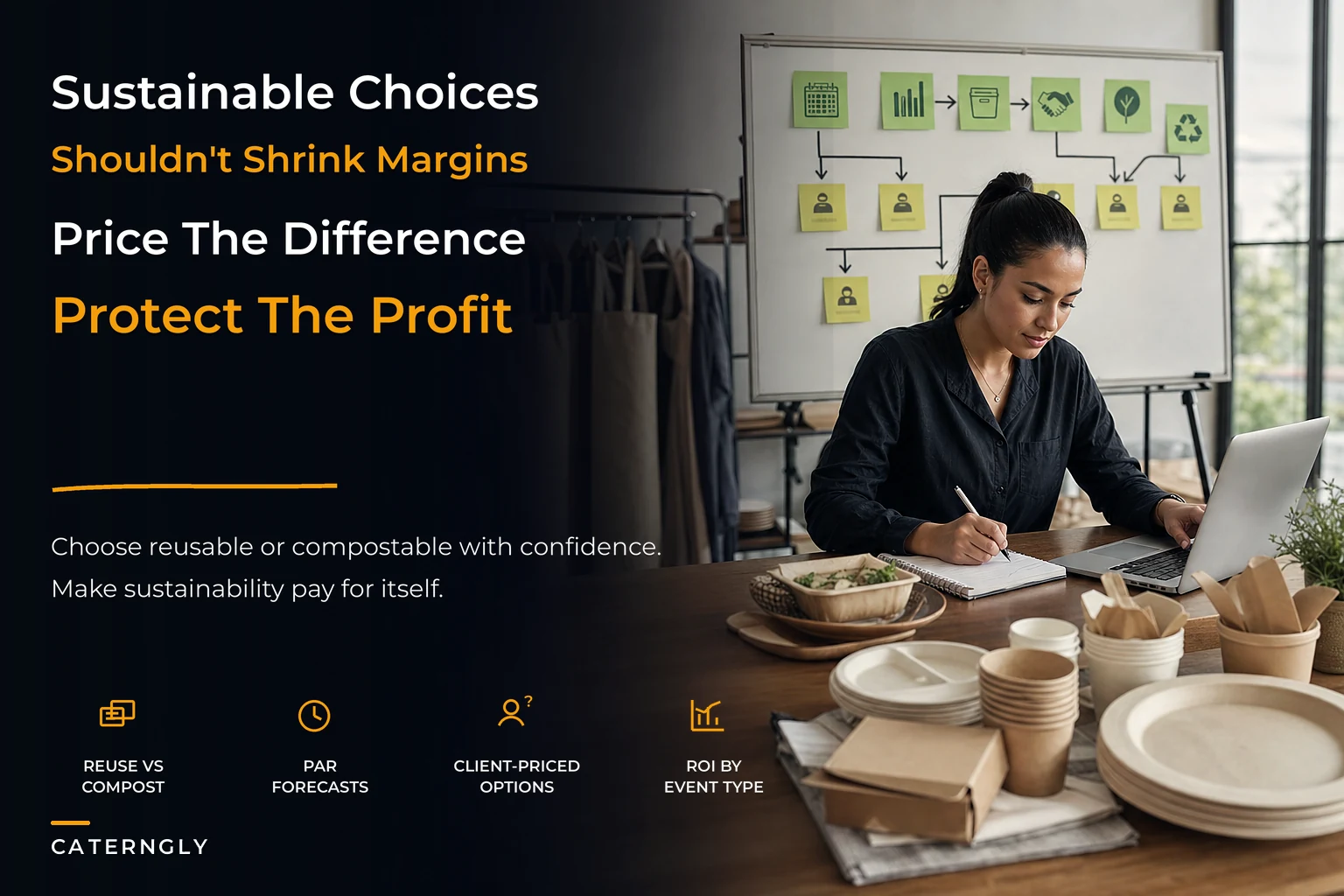
This is the move that flips sustainability from cost center to margin protector: don't absorb the green premium — present it as a client-selected tier.
Give every proposal three service-ware options, priced transparently:
-
Standard disposable, lowest cost, no diversion claim.
-
Compostable + diverted material premium plus diversion labor, plus a modest margin, with reporting included.
-
Reusable / rental highest touch, highest price, best aesthetic, best story.
When you present it as the client's choice, three things happen. First, you never eat the premium — whoever picks the green tier pays for it. Second, a meaningful share of clients trade up, and you capture margin on the upgrade rather than losing it. Third, the clients who pick standard have explicitly declined green service, which protects you from the "I thought you were eco-friendly" complaint after the fact.
Worked ROI by event type
Corporate drop-off lunch, 60 guests: Standard service ware runs about $0.55/head all-in ($33 total). Compostable-plus-diverted lands around $1.20/head once you include the diversion haul allocation ($72). Price the compostable tier at $2.10/head and you're at roughly $126 in revenue against $72 cost — about $54 of margin added versus the standard job, and the client got exactly what they asked for. Absorbing that same premium instead of pricing it would have cost you around $39.
Plated gala, 200 guests, fixed venue: Rental china, glassware, and linen might run $6–8/head including pack-out labor and a breakage buffer. At this tier clients already expect real service ware, so it's rarely a separate upcharge — but the strategic win is different: you avoid buying 200 compostable settings that would've cost $240+ and looked cheap at a premium event. The reusable choice here protects both margin and brand.
Recurring office breakfast, 30 guests weekly: A client-owned reusable kit costs maybe $400–600 upfront, amortized over a 12-month contract. Weekly compostables would run roughly $30–40/week — call it $1,500+ annually. The reusable kit, plus modest washing labor, comes in noticeably cheaper over the contract while giving the client a genuine zero-waste story. Recurring is where reusables quietly win the math.
The pattern across all three: the green premium should almost never sit on your side of the ledger. Either the client pays for it as a chosen upgrade, or the volume and recurrence makes reusables the cheaper option outright.
When each approach is a bad idea
When compostables are the wrong call: No diversion partner in range. You're paying the premium for a landfill outcome and a claim you can't back. Run standard and don't pretend otherwise.
When reusables are the wrong call: One-off drop-off events where nothing comes back, or venues where you don't control pack-out. You'll lose service ware, eat breakage, and blow labor chasing returns.
When the three-tier pricing thing backfires: Very low-budget events where adding options just creates decision friction and delays the booking. For a 25-person school function on a tight budget, one honest standard option is cleaner than three tiers nobody asked for.
Who should not build a full diversion program yet: Caterers doing low volumes of green-flagged events. If sustainability requests are occasional, negotiate compostable pricing and food donation, but don't sink time into formal composter contracts until the demand justifies the setup labor.
A short real scenario
A mid-sized catering operation running mostly corporate and wedding work was fielding more "sustainable option" requests but had no system for it. Sales was verbally promising eco service on roughly a fifth of bookings, procurement was buying compostables reactively at retail, and — this is the part that stung — most of it went into a regular dumpster because there was no diversion partner. They were paying the premium and getting none of the credibility.
They rebuilt it around three moves: a three-tier service-ware option on every proposal, contract pricing on their four most-used compostable SKUs, and a single composting partner covering their metro with monthly weight reporting.
Over the following couple of quarters, green-tier upgrades stopped being a cost and started carrying their own margin — because clients were now choosing and paying for them. Reactive retail purchasing basically disappeared for those top SKUs. And the diversion reporting turned into a genuine differentiator on a corporate RFP they'd previously had nothing to say on. Nothing dramatic on the top line, but the sustainability work moved from quietly bleeding margin to modestly adding it, which was the entire point.
Pulling it together
Sustainability erodes margin when it lives outside your systems — decided in the moment, bought in a panic, promised without pricing, and executed without a diversion path. It protects margin when you treat it like every other operational decision: costed per event, forecast into procurement, priced as a client-selected tier, and backed by a partner who can prove the outcome.
The caterers who get this right aren't spending more to be green. They're making the client choose and pay for the green option, buying at contract instead of retail, and turning diversion reporting into a bid advantage competitors can't match. Same booking calendar, better margin, and a story that's actually true. That's a sustainability strategy worth running — not because it feels good, but because it pencils out.
The caterers who get this right aren't spending more to be green. They're making the client choose and pay for the green option, buying at contract instead of retail, and turning diversion reporting into a bid advantage competitors can't match. Same booking calendar, better margin, and a story that's actually true. That's a sustainability strategy worth running — not because it feels good, but because it pencils out.
Ready to elevate your catering business?
Join 500+ caterers trusting Caterngly to save time, reduce errors, and deliver flawless events.