

Most caterers don't resist sustainable packaging because they don't care. They resist it because the first quote from a compostable supplier made their stomach drop. A clamshell that cost 14 cents suddenly costs 41 cents. A sugarcane plate runs double a standard poly-coated one. Multiply that across 180 covers and the "nice green upgrade" just ate the margin on a mid-size corporate lunch.
The problem isn't that sustainable packaging is unaffordable. It's that most operators make the swap emotionally or defensively — a client asked, procurement at some company put it in the RFP, someone on the team felt bad about the trash — and they never build the actual decision logic that tells them when a compostable item is worth it, when a reusable system wins, and when to just push the cost to the client cleanly.
This post is about that logic. Not sustainability philosophy. The numbers, the thresholds, and the client-facing options that let you say yes to greener packaging without pretending the extra cost disappeared.
Start with the only question that matters: does this item get bussed back or not?
Before you look at a single price list, split your packaging into two buckets based on one operational fact — whether you get the item back at the end of service.
Plated dinners, buffets with staff, venue events where your team breaks down the room: you get the dishware back. Drop-off catering, boxed lunches, grab-and-go corporate orders, festival stations: you don't.
This single distinction decides everything. Reusable packaging only makes financial sense when you physically recover the item and wash it enough times to beat the per-use cost of disposables. If the item walks out the door with a guest and never comes back, reusable is a guaranteed loss — you've bought a $4 container to replace a 30-cent one, and it's gone.
The mistake plays out like this: a caterer buys a run of nice reusable bento boxes to look premium on corporate drop-offs, assumes "clients will return them," and recovers maybe 40% over three months. The return logistics never existed. They ate the full unit cost on 60% of the fleet plus washing labor on the rest.
-
Recovered at breakdown → reusable is on the table
-
Leaves with the guest → disposable, and the only question is which disposable
Reusable only works where you control the back end — same discipline you'd apply to tracking rental returns, where photo check-in/out manifests and deposit rules exist precisely because "they'll bring it back" is not a plan.
The reusable vs single-use break-even math
Once you know an item gets recovered, you need the actual threshold — how many uses before reusable beats buying disposables each time.
End chaos with centralized catering management.
Caterngly helps you plan, confirm, and manage every catering event seamlessly.
- Unified event and order management
- Real-time client updates
- Staff and resource scheduling
No credit card required
The formula is simple but almost nobody runs it:
Break-even uses = Reusable unit cost ÷ (Single-use unit cost + per-use wash/handling cost)
Wait — that's not quite right, and the error matters. The real comparison is:
Break-even uses = Reusable unit cost ÷ (Single-use cost per event − reusable wash/handling cost per event)
Each time you reuse an item, you avoid buying a disposable but add a washing cost. The net savings per use is the disposable price minus your wash cost. Divide the upfront reusable cost by that net savings to get how many events you need before it pays off.
A worked example with a water goblet:
-
Reusable goblet cost
$3.80 per glass (owned, not rented)
-
Disposable equivalent you'd otherwise use
$0.22 per cup
-
Wash/handling cost per glass per event
$0.09 (labor, detergent, breakage allowance)
-
Net savings per use
$0.22 − $0.09 = $0.13
-
Break-even
$3.80 ÷ $0.13 ≈ 30 uses
Thirty events before that goblet is in the black. If you run 120+ plated events a year and the glass survives two seasons, it's a strong buy. If you do mostly drop-off and plated is occasional, you're tying up cash in inventory that breaks even in year three — if it doesn't break first.
The breakage line is where people lie to themselves. A $0.09 handling cost assumes low breakage. Push that number up and the math shifts fast:
| Item | Reusable cost | Disposable cost/use | Wash + breakage/use | Net savings/use | Break-even uses |
|---|---|---|---|---|---|
| Water goblet | $3.80 | $0.22 | $0.09 | $0.13 | ~30 |
| Dinner plate | $6.50 | $0.38 | $0.14 | $0.24 | ~27 |
| Flatware (per piece) | $1.40 | $0.11 | $0.05 | $0.06 | ~23 |
| Cloth napkin | $2.20 | $0.09 | $0.11 | −$0.02 | never |
| Reusable serving tray | $18.00 | $1.10 | $0.30 | $0.80 | ~23 |
Look at the cloth napkin row. Laundered napkins cost more per use than the compostable paper equivalent once you load in linen service fees. That's not an argument against cloth — clients will pay a premium for it as an experience upgrade — but it is not a cost-saving move. Know which category each swap lives in: cost-neutral, cost-saving, or premium-you-charge-for.
The cost-vs-sustainability decision table
Worth keeping somewhere accessible. This maps the decision across four variables: recovery, volume, cost delta, and whether the client is asking.
| Scenario | Recovery? | Annual volume of that item | Cost delta vs standard | Decision |
|---|---|---|---|---|
| Plated dinners, high volume | Yes | High (100+ events) | Reusable break-even < 40 uses | Buy reusable — strongest ROI |
| Plated, low volume / seasonal | Yes | Low | Break-even > 60 uses | Rent reusable or stay disposable |
| Drop-off / boxed lunch | No | Any | Compostable +15–25¢/unit | Compostable, charge through |
| Grab-and-go, price-sensitive client | No | High | Compostable adds real cost | Offer as tiered option, not default |
| RFP requires compostable | No | Contract volume | Fixed by spec | Price it in line-item, protect margin |
| Festival / high-breakage environment | Maybe | High | Breakage kills reusable math | Compostable — reusable loss too high |
The pattern most operators miss: reusable and compostable are answers to different questions. Reusable solves recovered-item economics. Compostable solves "this leaves the building and we want it to not be plastic." Trying to apply one logic to both situations is where margins leak.
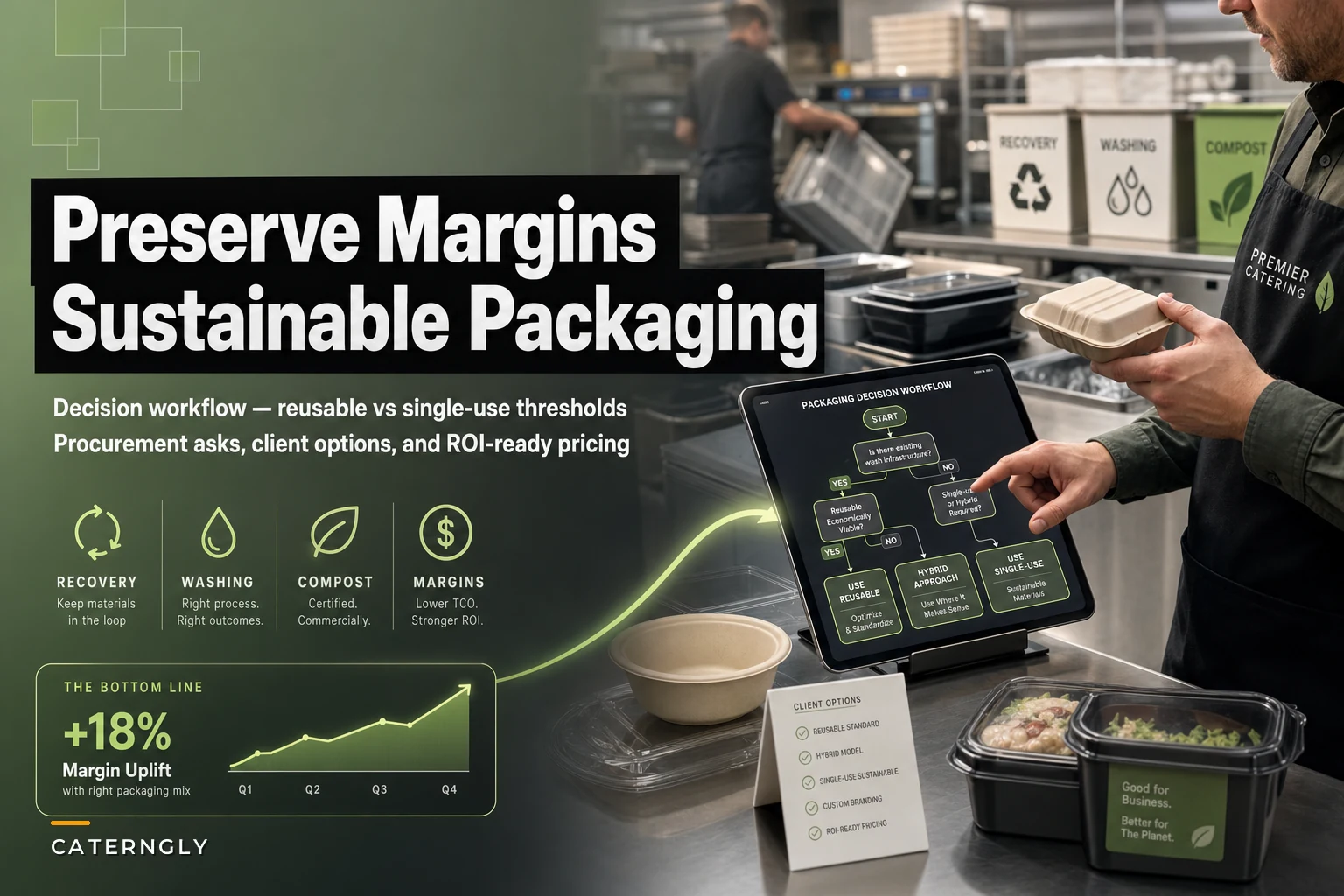
This flowchart visualizes the decision steps from recovery to final decision.
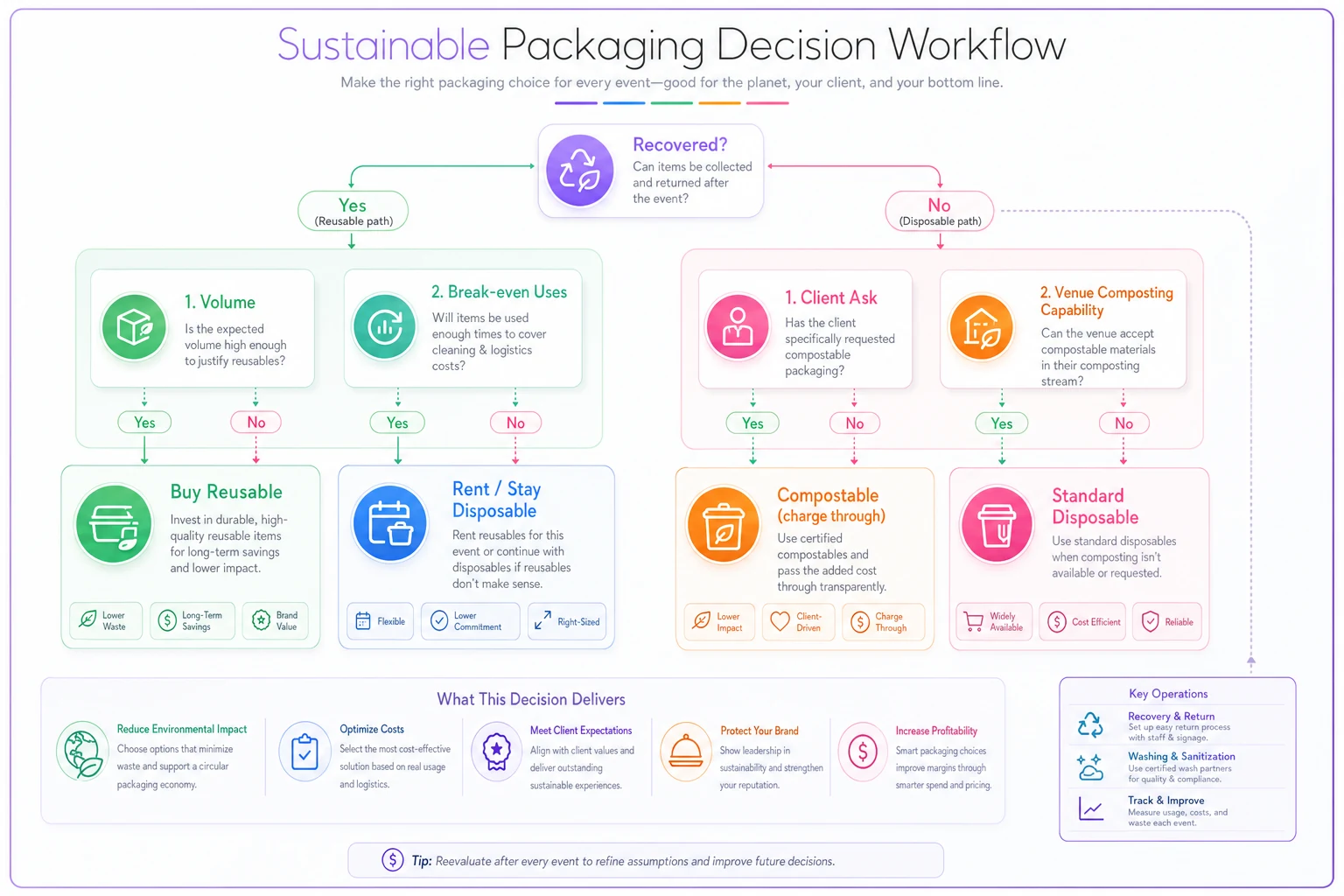
Use this map as a quick reference when evaluating packaging choices.
When procurement demands compostable: price it, don't absorb it
Corporate and institutional buyers increasingly write compostable or recyclable packaging into their RFPs. This is where caterers lose money silently — they see the requirement, want to win the bid, and bury the extra packaging cost into a blended per-person price they never adjusted upward.
The fix is treating packaging as its own line item during bid response, the same discipline you'd bring to any scored RFP where you quantify each requirement rather than eyeballing a lump sum.
-
Pull the exact unit-cost delta. Standard clamshell at $0.16 vs certified compostable at $0.39 = $0.23 delta per meal.
-
Multiply by contract volume. 2,400 boxed lunches over the contract = $552 in added packaging cost.
-
Add a handling/sourcing premium. Compostable supply is less reliable; add 10–15% for the risk of having to substitute at spot prices.
-
Make it a visible line. On your bid
"Certified compostable packaging: +$0.26/meal." Buyers who required it expect to pay for it. Hiding it only hurts you.
-
Confirm the disposal reality. If the venue has no compost stream, the compostable item goes to landfill anyway. Note this — some buyers will relax the spec when they learn their own facility can't process it, and you save the cost.
Make packaging its own visible line item on bids so buyers see and accept the unit delta rather than you silently absorbing it.
That last point is the quiet win. A surprising number of compostable requirements are performative — the buyer wants the line in the contract, but the actual venue tosses everything in one bin. Asking "does the site have commercial compost collection?" sometimes dissolves the whole premium.
Client-facing options that let the customer choose (and pay)
For non-contract clients, the strongest move is turning sustainability from a cost you eat into a choice they make. Give three packaging tiers on the proposal and let the client's values meet their budget.
A clean structure for a 150-person event:
| Tier | What it is | Added cost/guest | Total add (150) |
|---|---|---|---|
| Standard | Poly-coated disposables, standard serviceware | $0 (baseline) | — |
| Eco | Certified compostable plates, cups, cutlery | +$0.95 | ~$143 |
| Premium reusable | Real plateware + rented glassware, full breakdown | +$3.40 | ~$510 |
-
The baseline is honest. You're not pretending standard is bad; you're pricing the upgrades transparently.
-
Eco is a small, easy yes. Under a dollar a head reads as trivial on a $12k event, and most values-driven clients take it.
-
Premium reusable carries its own labor. That $3.40 includes the extra bussing, washing, or rental return handling — it's not just the item cost.
When clients choose the eco tier, they stop treating it as something you owe them. The $143 isn't a cost you're defending — it's a line they selected. That reframes the whole conversation and kills the "shouldn't sustainable just be included?" push.
Tie your packaging tiers to your menu planning rhythm too. If you run structured menu rotation pools with defined substitution rules, you already know which dishes travel well in compostable packaging versus which need rigid serviceware — hot saucy items destroy flimsy compostable trays, and that failure costs you in replacements and client complaints.
When sustainable packaging is a bad idea
Skip reusable when you can't control recovery. Any drop-off, any event where your staff isn't doing breakdown, any festival or open-public setting. The return rate won't support the economics.
Skip compostable when the waste stream can't process it. If the item ends up in landfill regardless, you've paid a premium for zero environmental benefit and zero marketing value. Compostable in a non-compost facility is just expensive trash.
Be cautious with high-breakage, high-heat, or high-grease applications. Compostable sugarcane and bagasse products soften under hot saucy food and leak. The replacement units plus the guest experience damage can exceed what you'd have spent on a sturdier standard product. Test every compostable item with your actual hottest, greasiest menu item before committing volume.
Reconsider reusable in low-volume operations. If an item breaks even at 30+ uses and you'll only run it a dozen times a year, your cash is better deployed elsewhere. Rent instead — let the rental company carry the inventory risk.
A short real scenario
A mid-size caterer doing mostly corporate drop-off and occasional plated events — roughly 300–340 events a year — kept getting dinged on compostable requirements in corporate RFPs and was absorbing the cost into blended pricing. Packaging was quietly running about 2 points higher than their cost cards assumed.
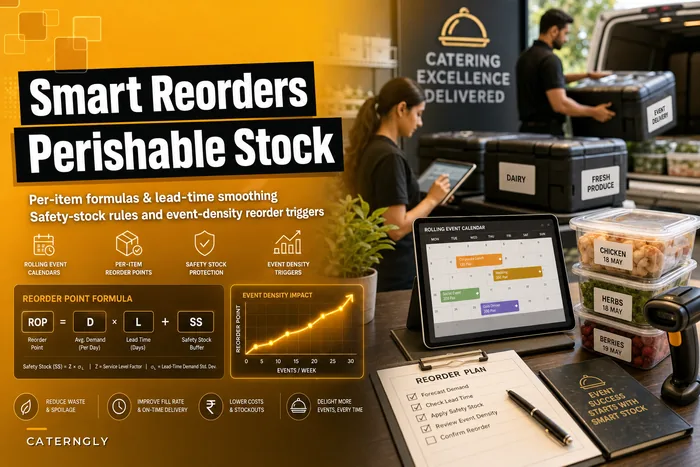
They changed two things. First, they broke packaging into its own line on every bid and priced compostable requirements through at cost-plus a small handling buffer. Second, for their recurring plated client base, they ran the break-even math and bought reusable glassware and plateware only for items clearing the ~30-use threshold, renting the rest. You can build this same logic into how you track perishable reorder points and safety stock — the underlying discipline is the same: know your thresholds before you commit capital.
Over the following two quarters, the absorbed packaging cost on corporate contracts went back to near zero — clients paid the stated line without pushback — and the reusable investment on plated work started paying off right around where the math predicted. Nothing dramatic. Just packaging decisions that stopped being emotional and started being line items.
The real takeaway
Sustainable packaging doesn't threaten your margins. Undecided sustainable packaging does — the swap you made without running the recovery check, the break-even math, or the client-facing options table.
Run the binary filter first: do you get it back? If yes, do the break-even math and buy only above threshold, rent below it. If no, go compostable only where the waste stream and the menu actually support it, and price it as a visible line the client either chooses or requires. The caterers who protect their numbers aren't the ones who said no to green packaging — they're the ones who built the logic that tells them exactly when to say yes.
Ready to elevate your catering business?
Join 500+ caterers trusting Caterngly to save time, reduce errors, and deliver flawless events.