


Most caterers don't fail at technology because they picked the wrong software. They fail because they tried to swap out four systems at once during their busiest quarter, told the team about it in a group text, and then had no real way to prove whether any of it actually moved the needle.
Adopting technology is an operations problem before it's a software problem. The tools are almost a footnote. What matters is the order you touch things, how you protect the workflows that already work, and whether you can point to a number three months later and say "this paid for itself."
This piece is about the sequencing, the reconciliation logic, and the change-management side that nobody thinks about until an event goes sideways because half the crew didn't know the new check-in process existed.
Why caterers get burned on adoption specifically
Catering is different from a restaurant or retail shop in one brutal way: your operation resets and re-forms every single event. There's no steady counter, no consistent floor plan, no repeatable Tuesday. Your "store" gets assembled in a hotel ballroom on Saturday and torn down by midnight.
That means any system change ripples across booking, kitchen prep, staffing, transport, on-site execution, and post-event reconciliation — all running on different timelines for different events simultaneously. When a retailer rolls out a new POS, they train the team over a slow week. When you do it, you might have three events that weekend, each with a different lead, half of them staffed by 1099 crew who won't see training until they show up.
The pain isn't the software learning curve. It's the coordination gap. The office adopts the new tool. The field never really does. Now you've got a system that's half-populated with real data and half-full of "we'll fix it later" — which is genuinely worse than the spreadsheet you replaced.
Start with the pain × difficulty matrix, not the shiny feature list
Vendors sell features. You should be buying relief from specific pain. Before you evaluate a single platform, map your actual operational pain against how hard each fix is to implement. This keeps you from doing the classic thing — automating something mildly annoying while ignoring whatever is quietly costing you thousands a month.
End chaos with centralized catering management.
Caterngly helps you plan, confirm, and manage every catering event seamlessly.
- Unified event and order management
- Real-time client updates
- Staff and resource scheduling
No credit card required
| Operational area | Pain (1–5) | Difficulty (1–5) | Priority verdict |
|---|---|---|---|
| Post-event reconciliation (booking → POS → payroll) | 5 | 3 | Do first — high pain, moderate lift |
| Proposal-to-booking handoff | 4 | 2 | Quick win — do early |
| Inventory / reorder tracking | 4 | 4 | Phase 2 — high value, heavy integration |
| Staff scheduling across overlapping events | 5 | 4 | Phase 2 — painful but complex |
| On-site execution checklists | 3 | 1 | Easy win — low disruption |
| Full accounting integration | 3 | 5 | Last — nice to have, high difficulty |
The pattern that jumps out: the high-pain / low-to-moderate difficulty box is where you start. Reconciliation between bookings, POS, and payroll almost always sits there for caterers, because the pain is real money and the fix mostly involves connecting systems you already have rather than replacing them wholesale.
The trap is the high-pain / high-difficulty box. Scheduling and inventory both live there. Worth doing eventually — but doing them first is how adoption projects die. You take on the hardest integration before you've built any trust or proven any ROI, and the moment it stutters, the whole team writes off "the new system."
The phased rollout: earn trust before you demand it
Phased adoption isn't about being cautious for its own sake. It's about stacking early wins so the team stops fighting you by the time you get to the hard stuff.
-
Phase 0 — Clean your master data first. You cannot integrate garbage. If your client names, menu items, and staff records are inconsistent across systems, every integration you build will inherit that mess. Get your naming and IDs consistent before anything talks to anything. This is unglamorous and it's the highest-leverage week you'll spend. If you haven't tackled this yet, the catering data governance and master-data model work has to happen before you connect a single tool.
-
Phase 1 — Ship one visible quick win. On-site checklists or the proposal-to-booking handoff. Something the field sees and feels, with low integration risk. The goal here is momentum, not ROI. You want the crew saying "okay, that actually helped."
-
Phase 2 — Connect the money loop. Booking → POS → payroll reconciliation. This is where ROI gets measurable and undeniable. The mechanics of mapping these systems are laid out in the integrations playbook for mapping bookings to POS, payroll and accounting — the point here is to sequence it after you've got a small win banked.
-
Phase 3 — Take on the hard integrations. Scheduling across overlapping events, inventory reorder logic. By now the team trusts the process and you've got clean data feeding real systems.
-
Phase 4 — Full accounting sync and reporting. The nice-but-not-urgent stuff, done last when everything upstream is stable.
Each phase needs a go / no-go gate. You don't start the next phase until the current one hits its milestone. That single rule prevents the most common failure: overlapping half-finished rollouts that nobody can tell apart.
Here's a visual of the phased rollout workflow.
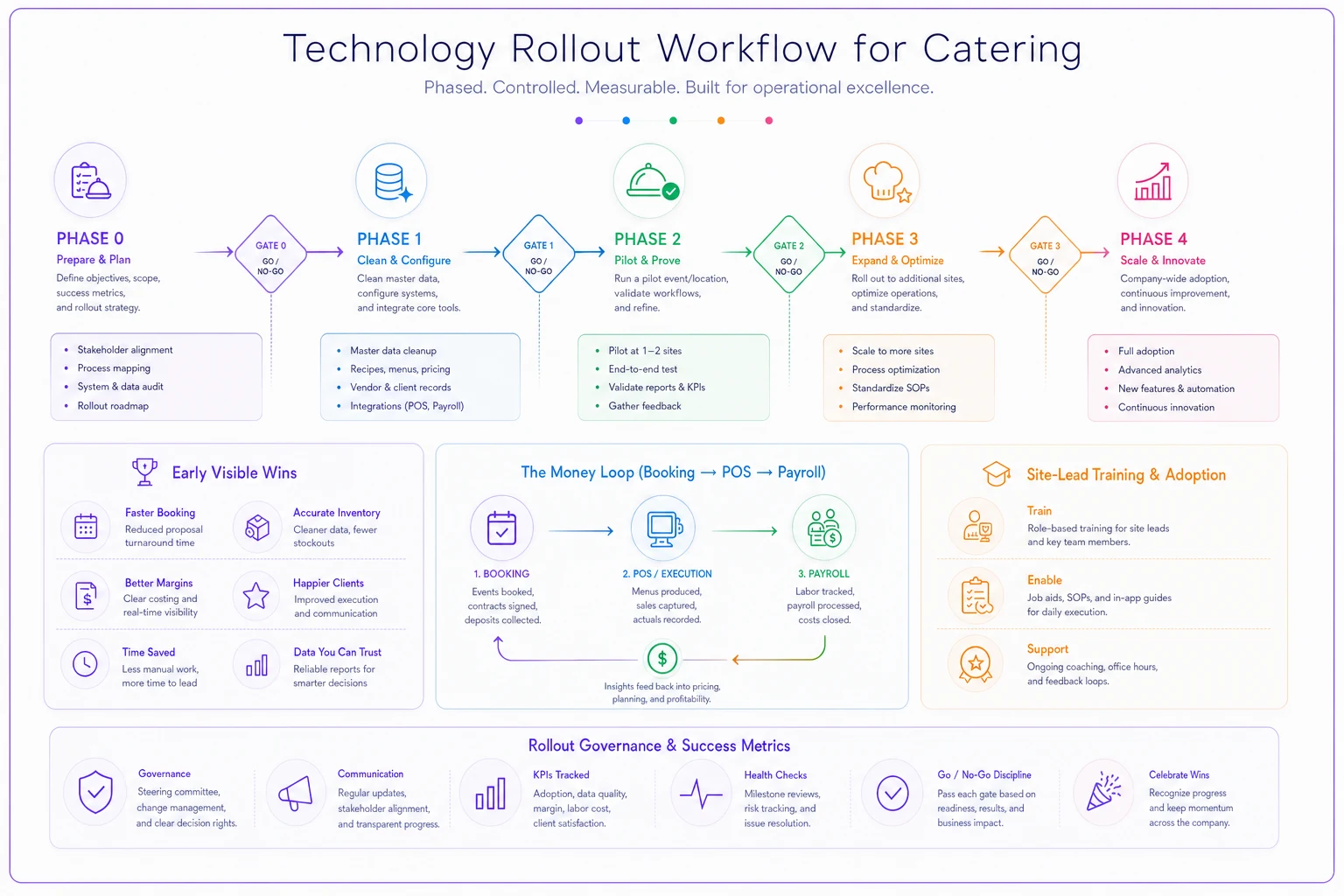
A sane sequence looks like this.
ROI milestones: define the win before you spend
The mistake almost everyone makes — they buy the software, then try to figure out afterward whether it worked. By then the baseline is gone and you're arguing feelings.
Set the milestone before you flip the switch. For each phase, write down:
-
The metric you're moving
-
The current baseline number
-
The target
-
The date you'll check
A realistic Phase 2 example: reconciliation currently eats one office person roughly 6–8 hours a week chasing mismatches between what got booked, what got rung up on-site, and what got paid to staff. That's somewhere around $9k–$12k a year in loaded labor, plus the errors that slip through. The milestone: cut reconciliation time by half within 60 days of go-live, and reduce payroll-vs-hours-worked discrepancies to near zero. If you can't measure it against that baseline, you can't claim the ROI.
Notice the milestones aren't about "adoption." Nobody cares that 90% of staff logged in. They care that the money loop closes faster and cleaner.
Reconciliation test-cases: prove the loop before you trust it
This is the part almost every adoption skips, and it's where real disasters hide. Before you rely on any integration between booking, POS, and payroll, you run deliberate test-cases that walk a fake event all the way through the pipe and check that the numbers survive the trip.
-
Clean event Booked at $8,400, POS rings the exact contracted amount, four staff clock the scheduled hours. Confirm all three systems agree at the end. If this basic case doesn't reconcile, stop — nothing else will.
-
Change-order event Booked at $6,000, client adds a bar package on-site pushing POS to $7,200. Does the change flow through, or does reconciliation flag a "mismatch" that's actually correct?
-
Under-delivery event Booked at $10,000, but a rained-out portion drops actual to $8,800. Does the system handle the shortfall cleanly, and does the deposit logic still hold?
-
Split-payroll event One staffer works two overlapping events in a day. Do the hours attribute to the right event ledgers, or does one event eat all the labor cost and wreck your per-event margin math?
That last one is the sneaky killer. When labor gets misattributed across overlapping events, your per-event P&L quietly lies to you and you make pricing decisions on bad numbers for months. Run the test-case, watch where the hours land, fix it before you trust the reports.
The whole point of test-cases is to break the system on purpose in a safe window instead of discovering the break during a real $40k wedding weekend.
The change-management side nobody budgets for
Software adoption fails at the human layer far more than the technical one. The office is bought in — they picked the tool. The field is skeptical, busy, and often not on payroll full-time. If your rollout plan is "we sent an email," you've already lost.
-
Name one owner per phase. Not a committee. One person accountable for that phase hitting its gate.
-
Train the site leads first, not everyone at once. Site leads become the local translators. If your leads own it, the crew follows. Works far better than mass training.
-
Write down the fallback. Every new process needs a "if the app is down, here's what we do" answer. Crews trust systems that have an escape hatch.
-
Kill the old system on a date. Running old and new in parallel "for safety" is how you end up with two half-populated systems forever. Set a hard cutover date per phase.
-
Collect friction weekly. Ask the field what broke this week. The complaints are your roadmap. Ignoring them is how adoption quietly dies.
-
Celebrate the first clean reconciliation out loud. People need to see the win to keep buying in.
Train site leads first — they become the local translators and accelerate crew adoption.
One thing worth internalizing: adoption speed is capped by your slowest-trained site lead, not your fastest office admin. Plan around that reality.
Adoption KPIs worth tracking (and ones that lie)
Track outcomes, not vanity. Login rates and "features used" tell you nothing about whether the operation actually got better.
-
Reconciliation cycle time — days from event end to fully closed books
-
Discrepancy rate — % of events where booking, POS, and payroll disagree by more than a set threshold
-
Data completeness at cutover — % of events where the field captured what they were supposed to, on the day
-
Rework hours — time spent fixing what the system should have caught
-
Per-phase gate hit rate — did each phase land on schedule, yes or no
Field data completeness is the leading indicator for everything else. When the field stops capturing data in real time, every downstream number rots. Watch it closely in the first 60 days.
A real scenario: mid-size caterer, overlapping-event chaos
A caterer running roughly 12–18 events a month, around $1.8M in annual revenue, was closing its books about three weeks after each event. Payroll disputes were routine because nobody could cleanly tie staff hours back to specific events, and the office was rebuilding reconciliation by hand in spreadsheets every Monday.
Rather than a full platform swap, they went phased. First they cleaned master data — consistent client and menu naming — which took about two weeks and surfaced a pile of duplicate records nobody knew about. Then a quick win on on-site checklists to get field buy-in. Then they connected the booking → POS → payroll loop and ran the four reconciliation test-cases before trusting a single report.
The split-payroll test-case immediately caught that overlapping-event labor was being dumped onto whichever event closed first — meaning per-event margins had been wrong for a year. Once fixed, reconciliation dropped from roughly three weeks to under a week, and the Monday spreadsheet rebuild — about 6 hours weekly — basically disappeared. Payroll disputes went from a regular headache to rare. No dramatic revenue jump. Just cleaner books, fewer arguments, and margin numbers they could finally trust for pricing.
The bigger win was cultural. Because they earned trust in Phase 1, the field didn't fight the harder scheduling integration later.
When this phased approach makes sense — and when it doesn't
When it makes sense: You're running enough events that manual reconciliation is genuinely eating labor, you've got overlapping-event complexity, and there's at least one person who can own the rollout without it being a side-of-desk afterthought.
When it's a bad idea: You're doing a handful of events a month and your spreadsheet honestly works fine. Adopting a stack of integrated tools to solve a problem you don't have yet is just expensive complexity. Grow into it.
Who should NOT do this right now: Anyone in peak season. Do not start a systems rollout during your busiest quarter. Start it in your slow window, get through Phase 2 before things heat up, and let the busy season be the stress test — not the launch.
Bringing it together
The caterers who get real ROI from technology aren't the ones with the fanciest platform. They're the ones who cleaned their data first, sequenced the rollout so the painful-but-simple wins came before the painful-and-complex ones, proved the money loop with deliberate test-cases, and treated field crew buy-in as the actual project — not an afterthought.
If you want the deeper technical foundation under all of this, the catering digital operations architecture guide on systems of record, sync rules and phased rollout covers how the pieces fit together at the architecture level. Pair that with disciplined phasing and honest ROI milestones, and adoption stops being a gamble and starts being something you can actually measure — one gate at a time.
Ready to elevate your catering business?
Join 500+ caterers trusting Caterngly to save time, reduce errors, and deliver flawless events.